New Jersey demands that its citizens be defenseless when they go about their day in public. Defenseless. Until forced to issue Permits to Carry a Handgun by the Bruen decision in 2022, New Jersey banned its citizens from carrying any weapon for self-defense. Still today, New Jerseyans cannot carry any ordinary object for protection against violent crime, not a baseball bat, not a stick, not a knife, not a pair of scissors, not anything. If a person keeps an ordinary baseball bat in her car or if she keeps a small baton (sometimes called a kuboton) on her keychain she can find herself arrested and thrown in prison under New Jersey law.
Daniel L. Schmutter HARTMAN & WINNICKI, P.C. September 21, 2026 ANJRP v. Davenport
Not only “can” but have been arrested and convicted. From the complaint:
In State v. Kelly, 118 N.J. 370 (1990), the New Jersey Supreme Court interpreted 2C:39-5(d) to exclude self-defense as a “lawful purpose.” The case involved, Kelly, a single mother of a young child who was taking the child to the park to play. Because she was worried that, on the way to the park, they might encounter her violent ex-boyfriend who had beaten her severely on multiple occasions (including once sending her to the hospital), the single mom brought with her a carpet cutter for protection. Id. at 373-74.
Kelly was correct in her prediction. On their way back from the park, they did encounter the violent ex-boyfriend, and he started punching Kelly repeatedly, including punching her in the head, dazing her, when she tried to run away. Kelly then produced the carpet cutter and cut him several times. He ceased his attack. Id. at 374-75.
The New Jersey Supreme Court unconscionably held that while Kelly could lawfully exercise self-defense by spontaneously encountering a weapon at the exact moment she needed it, she could not prepare for self-defense in advance by bringing a weapon with her on her travels, even though she correctly predicted that she would need it to defend her life:
When Kelly armed herself, the danger was in no way immediate. Had Kelly seized the weapon spontaneously and used it to defend herself against a life-threatening attack, then, she would not have possessed the weapon for a manifestly inappropriate purpose. As it stands, however, even Kelly acknowledged at trial that she knew she was not supposed to carry a razor but took it with her in anticipation of a confrontation with Boone. Thus, the record fully supports the jury’s finding that Kelly possessed the weapon under manifestly inappropriate circumstances. Her anticipatory self-defense does not excuse the possession.
Id. at 385-86. In what can only be described as the New Jersey Supreme Court’s Dred Scott moment, the Court concluded that the legally correct choice for Kelly was to die at the hands of her attacker.
As I have said before (and here, here, here, here, here, and here), “It’s this sort of thing that keeps me out of New Jersey until they are giving away free varmint hunting licenses for the criminal politicians and those that enforce these illegal laws.”
Not one Republican voted for HB 1163. Washington Democrats built a permit that costs $126, demands a class the state refuses to teach, and disqualifies much of the workforce capable of teaching it. When your own implementing agency has to publicly concede the mandatory step cannot be met, the failure belongs to the people who wrote the law, not the ones handed the clipboard.
I’m reminded of certain types of personality disorders (borderline personality disorder, and possibly others). They will create unwinnable situations for the people around them and when there is a conflict or something goes wrong, they will insist they are never at fault.
You can point out the laws of physics would have to be violated to accomplish what they demand of you and their response will not be to modify their demands. It will something on the order of, “You’ll just have to figure it out.”
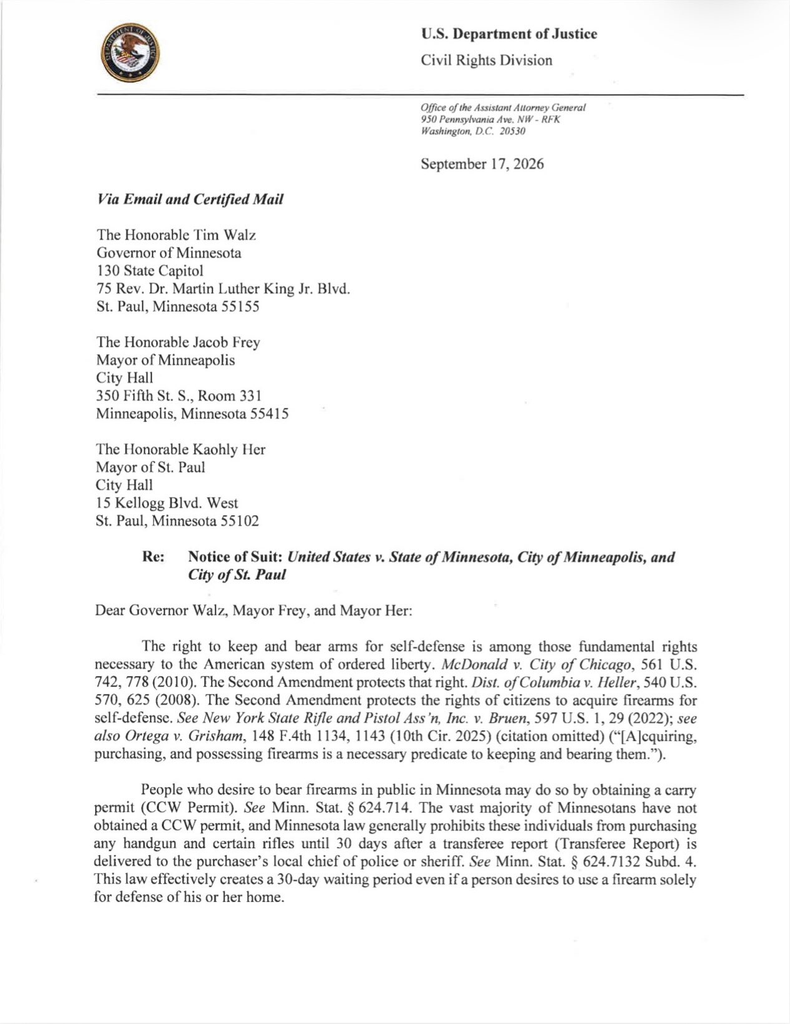
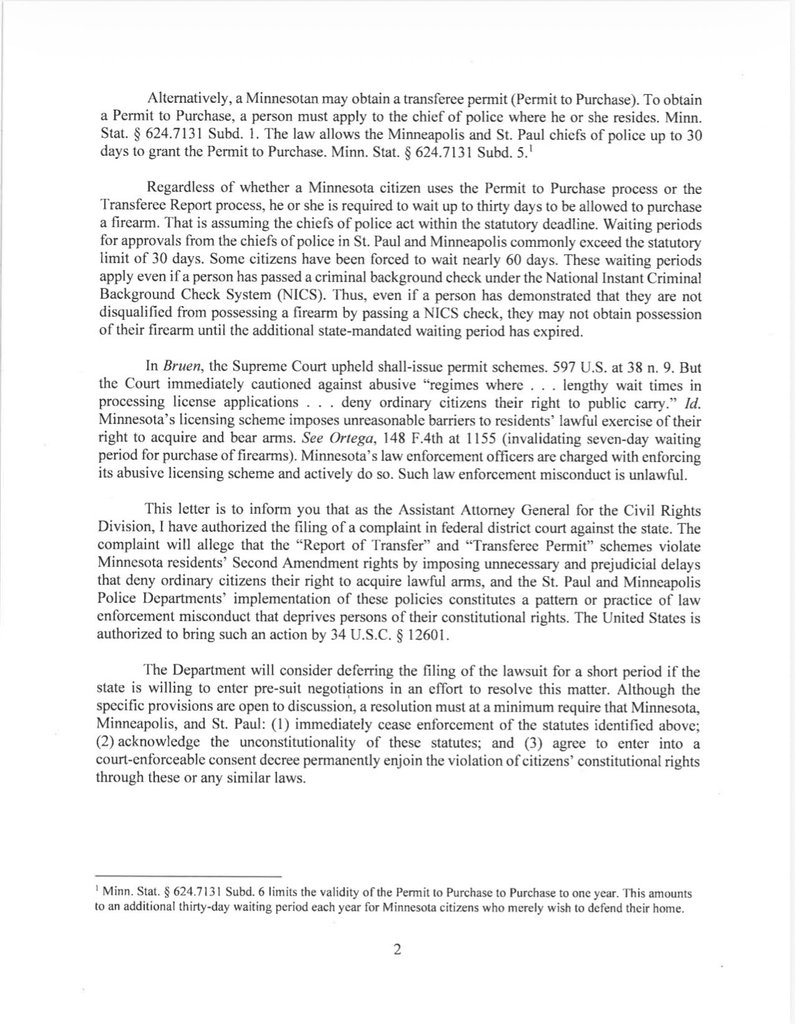
This letter is to inform you that as the Assistant Attorney General for the Civil Rights Division, I have authorized the filing of a complaint in federal district court against the state. The complaint will allege that the “Report of Transfer” and “Transferee Permit” schemes violate Minnesota residents’ Second Amendment rights by imposing unnecessary and prejudicial delays that deny ordinary citizens their right to acquire lawful arms, and the St. Paul and Minneapolis Police Departments’ implementation of these policies constitutes a pattern or practice of law enforcement misconduct that deprives persons of their constitutional rights. The United States is authorized to bring such an action by 34 U.S.C. § 12601.
The Department will consider deferring the filing of the lawsuit for a short period if the state is willing to enter pre-suit negotiations in an effort to resolve this matter. Although the specific provisions are open to discussion, a resolution must at a minimum require that Minnesota, Minneapolis, and St. Paul: (1) immediately cease enforcement of the statutes identified above; (2) acknowledge the unconstitutionality of these statutes; and (3) agree to enter into a court-enforceable consent decree permanently enjoin the violation of citizens’ constitutional rights through these or any similar laws.
I normally will not quote the same person twice in such a short time period. But Harmeet Dhillon and her team is making history here. This is such a target rich environment that pretty much any direction in firearm law they point their finger they find a soft target.
They are attacking state and local law to the exclusion of Federal law, but that is to be expected. The gun right organization can devote more resources to tearing down the Federal laws if the Feds are taking care of things in the state and local jurisdictions.
I will never get tired of winning*. Prove me wrong.
There’s no doubt that measuring mechanical functionality and discerning historical fidelity have become critical components of the conversation. Yet, if left abstract, they can obscure the real human people by whom and for whom these laws were enacted.
This abstraction turned to subterfuge in the challengers’ briefing before the Supreme Court last month. The most galling part of their argument is the recurrent invocation of—and self-righteous cloaking of their argument in—the language of democracy. “The decision whether a type of arm is too dangerous for ordinary Americans to possess,” they wrote, “is one that the people are entitled to make, not one that courts are empowered to make for them.” They say this, to be clear, in a brief asking the judges of the Supreme Court to make the decision about what weapons can be possessed over the decision of voters. Because the lower courts upheld these laws, the challengers want the justices to tell the citizens of Connecticut, Chicago, and other jurisdictions like California and New York that they cannot make fundamental judgments about public peace and safety.
Later in the brief, the challengers again assert that “whether the danger posed by a particular type of firearm outweighs its utility for lawful purposes is a decision for the American people to make, and judges are not authorized to second-guess that decision.” Yet their precise argument depends upon judges second-guessing—indeed, overruling—the decision that millions of those American people made about these weapons.
Charles in not just some random “journalist” for Slate. He specializes in 2nd Amendment law. Both Grok and Copilot says essentially the same thing:
In short: he is a mid-career legal academic with elite credentials (Duke Law honors, two federal clerkships, Big Law practice), a specialized scholarly profile in firearms and Second Amendment law, and a regular presence in both law reviews and opinion journalism. The Slate/MSN article sits in that public-commentary lane rather than being a news-desk report.
What I find most galling is that he does not address the many SCOTUS opinions which are completely contrary to his whining. He is advocating interest balancing, which is explicitly forbidding in SCOTU interpretation of the 2nd Amendment. Or as Copilot expresses it:
The article discusses the policy consequences of assault-weapon bans and the democratic legitimacy of those laws, but it gives relatively little attention to the Supreme Court’s repeated statements that judges are not supposed to resolve Second Amendment cases through interest balancing.
…
The article spends considerable space discussing why assault-weapon bans are good policy and why they enjoy democratic support. What it spends less time discussing is why those considerations remain legally relevant after Supreme Court precedent has repeatedly cautioned courts against deciding Second Amendment cases through judicial balancing of public-safety benefits against constitutional rights.
If he really believes legal decisions should ignore the U.S. Constitution when:
… their precise argument depends upon judges second-guessing—indeed, overruling—the decision that millions of those American people made about these weapons.
Then he should also support the formerly slave states which took issue with the 13th Amendment and passed numerous laws restricting the former slaves. The constitution, and the Bill of Rights in particular, took many legislative decisions off the table with majority support in certain states. You would think as an elite constitutional attorney he would know and respect that.
Perhaps I am too harsh in my speculation he is a hypocrite. For all I know he is a Democrat and does support those voting, social, educational, economic, and firearm restrictions for former slaves and their descendants passed by his Democrat cousins in earlier decades.
Eighteen-year-olds may vote, serve on juries, be drafted, and face adult criminal penalties, including capital punishment. The Constitution protects the people’s right to keep and bear arms. The Department of Justice may not constitutionally seek to impose criminal penalties on dealers who sell handguns to law-abiding adults who, in nearly every other relevant respect, are members of the political community.
FINALLY — COURT STRIKES DOWN FEDERAL INTERSTATE HANDGUN PURCHASE BAN. There is finally a national market for handguns. It shouldn’t have taken 18 years after Heller to get here. Let’s review.
I first challenged this dumb law in 2011. My client, a DC resident, couldn’t buy a handgun because the only DC FFL had lost his lease and couldn’t take the transfer from the Virginia store. Fourth Circuit held — NO STANDING, because the Virginia store’s decision to not violate the law was its own voluntary choice, therefore, not traceable to federal enforcement threat. Lane v. Holder. Obviously a crazy opinion, but, you know, guns.
And it created a direct conflict with the 5th Circuit, which had just upheld standing to challenge federal purchase restrictions. Fourth Circuit did not care. So… I brought a lawsuit in Texas. Judge O’Connor beat the government up badly on standing, got them to basically admit it, and struck down the law. Mance v. Holder.
Shortly before the appellate argument, the 5th Circuit advised us to discuss standing at argument. Gov’t gets up and concedes we have standing, no two ways about it. Judge Prado looks bummed out. Puts his head in his hands. Anyway, panel still reverses. Gun dealers may be able to follow out-of-state rifle laws, but not out-of-state handgun laws. Mind you, the purchasers were DC residents who needed permits from the police to acquire the handguns.
We lose the en banc 8-7. Dissents by Elrod, Willett, Ho. And of course cert denied in 2020, because SCOTUS just wasn’t hearing anything about 2A.
Over six years later, finally, some sanity. Watch for SCOTUS to affirm. But this should have happened 15 years ago. So many people had their rights violated for so long.
BREAKING: In a 2-1 vote, the Fifth Circuit ruled that the federal ban on direct interstate handgun sales violates the Second Amendment. pic.twitter.com/LT1WW93W7u
For those who need a reminder: Alan Gura did the heavy lifting part of the D.C. v. Heller win in 2008 which got the ball rolling on restoring our rights. He was essentially unknown and justifiably achieved rock-star status with his win at SCOTUS.
As predicted, structural collapse. Expect the collapse to accelerate through next June when the “assault weapon” bans are ruled unconstitutional by SCOTUS. With that win the political left will essentially give up on meaningful resistance. We will have a lot of cleanup to do, but the lower courts will mostly stop open defiance of SCOTUS.
I will never get tired of winning. Prove me wrong.
All law-abiding Americans have a constitutional right to bear arms for self-defense. This right is not a luxury reserved for a privileged few, but a fundamental element of our republic. You don’t need a law degree to recognize that charging a fee several times higher than the cost of the firearm itself is illogical, and an unconstitutional attempt to impede Americans’ Second Amendment rights.
* While this isn’t an actual win, it is more like more like Mike Tyson joining your side in a barroom brawl, it is something to celebrate and likely means the good guys will win.
North Carolina Democrat state legislative candidate Shelly Headen posted a Facebook story from a vacation showing her in front of ovens in a German concentration camp memorial, saying, “Visiting Dauchau [sic] Concentration Camp in Germany… This is where Trump supporters belong.”
I visited Auschwitz. I think people should visit and consider the implications for the right to keep and bear arms. But that isn’t what Ms. Headen had in mind.
It is genuinely upsetting how many people celebrated Charlie Kirk’s death with “Kirkiversary” posts. Some here, tons more on TikTok. The message is clear; if you disagree with progressive orthodoxy, they want you dead and will celebrate your murder too. That includes a young father like Charlie Kirk whose major “crime” was engaging in civil debate with them.
And these posts have thousands or hundreds of thousands of likes, these aren’t fringe edgelords, this is a major view at least among the progressive base. Violence and intimidation has become an accepted strategy for them.
I hate that I have to share a country with these broken people, they must be defeated and marginalized just as much as the brainrotted elements of the Candace Owens right.
I just can’t grasp their mindset. If some leftist commentator I despised was murdered for their views, I can confidently say I would not celebrate it, and you should really do some serious soul searching if that is who you have become. This shouldn’t even need to be debated.
Celebration of assassination and poltical violence is a very dark road to go down. But after Kirk, and their celebration of Mangione, and all the cheering for Trump assassins, it is safe to say it is what a significant portion of the progressive/DSA left now believes. This is who they are.
Oh, and they want to take your guns still. You know, for “safety.”
It is especially upsetting because this woman debated Charlie Kirk. He was nice to her. Didn't matter. Because he disagreed with her views, she apparently thinks his life was fair game. pic.twitter.com/iEvcwoIU2L
He says, “I just can’t grasp their mindset.” I think I can.
My hypothesis is there are two different ways to model their behavior. At a more basic level they are close to the same.
1) They are unable to think rationally. As I have explained before this is a process failure (Peterson Syndrome). It is psychologically uncomfortable for there to be many other people which believe differently from them. Being part of the “one true tribe” is important to them. Other tribes are a threat to them.
2) They are able to think rationally. They know they are unable to rationally refute the opposition. They cannot tolerate the public humiliation of being wrong. Silencing their opponent is more comfortable than admitting they were wrong.
In both cases they have an investment in their beliefs. It could be an emotional investment. Or it could be a political or power investment that is being threatened. Threats need to be neutralized.
It now makes sense when they say they feel unsafe because you express an opinion different from them.
It makes sense when people call themselves “gun safety advocates.” Taking your guns makes it safer to neutralize these sorts of threats to their investments.
The right to keep and bear arms is among the most cherished liberties secured by our Constitution and rooted in the timeless truth that our rights are endowed by Almighty God, not granted by government. This foundational freedom depends upon citizens who exercise it with discipline, integrity, and care, understanding that the blessings of liberty are preserved through personal responsibility and a steadfast commitment to the common good.
“You know, we can’t be so fixated on our desire to preserve the rights of ordinary Americans to legitimately own handguns and rifles—it’s something I strongly support—we can’t be so fixated on that that we are unable to think about the reality of life that millions of Americans face on streets that are unsafe, under conditions that no other nation—no other nations—has permitted to exist. BIll Clinton March 1, 1993 Debunked: “We can’t be so fixated on our desire to preserve the rights of ordinary .. | Metabunk
Major breaking news as the winds in favor of the Second Amendment continue in like a flood. This victory in federal court in Maryland. That’s right. A huge win for the Second Amendment in Montgomery County, Maryland in federal court down there, knocking out so-called sensitive places laws that prevented a Jewish congregation from bringing weapons to protect themselves at synagogue. A crazily great win for the Second Amendment. And by the way, for the first amendment, it all works together:
States District Court for the District of Delaware knocking out Delaware’s so-called ghost gun rules which are nothing more than preventing Americans seconds from being able to make their own firearms:
A huge federal court of appeals decision has just come out in favor of the Second Amendment saying that simply carrying a gun without more is not a basis for stopping someone on the suspicion that they are criminals or committed a crime:
I don’t think I will ever get tired of winning. Prove me wrong.
They heard an argument about extending the same passion and sympathy to more women who murdered their children—
and their conditioning told them this was justice.
That’s not compassion.
That’s what happens when your ideology eats your conscience and starts wearing its skin.
These people have been trained so thoroughly to locate inequality that they can find oppression inside a prison full of child murderers before they can find three murdered children.
Room full of women on the Oprah show starts cheering after a doctor says that black female child murderers need to be supported too, not just the white child murderers like Lindsay Clancy.
"I want us to have the same passion for [female child murderers] who don't look like… pic.twitter.com/VbaQfq9BYi
This is for people who think something like the 10s of millions of people killed by their own governments in Nazi Germany, the USSR, China, Cambodia, etc. can’t happen here.
Here we have an entire class of people seeing “justice” in not just a government murdering its own citizens, but a woman being able to murder her own children without serious punishment.
That they can justify that mindset to themselves and openly advocate for it; genocide is totally on the table. How do you talk someone like this out of this mindset? What do you do when they have made their mind up about murdering all the Jews, homosexuals, capitalists, Catholics, black people, or white people?
I only know of one thing that has any hope of mass changing of minds like that in time to save the lives of the innocents. High velocity lead.
…then apply it to incentives to commit crime. Disarming everyone will only make committing crime safer and will increase crime and anti-social behavior. Make everyone carry condition 1, and we’ll reduce ADs and NDs as well.
Mike H. September 6, 2026
Via email from Mike.
The following are the primary points of the Instagram post:
For as much as I’ve mellowed on the libertarian shit, I’m starting to regret as a younger man I didn’t just put all my money into gold and machine guns.
I usually avoid quoting long posts in their entirety. I’m making an exception for this because there is stuff here that I was unaware of. Independently any one of these would just be a speed bump for the next anti-gunowner administration. Together, combined with what is coming down the road in the next few years, this is closer to a brick wall.
The second Trump Administration has thus far exceeded all expectations when it comes to its nearly unprecedented defense of the Second Amendment. While Trump’s first term gave us hugely important wins on judicial appointments at SCOTUS and the lower courts, that was just about all we got. This term is much different. We are still getting good judicial picks, but are also making so much more progress beyond that baseline. This has been the first time any Department of Justice has meaningfully championed the Second Amendment since the days of the Freedmen’s Bureau during Reconstruction.
Given that, I thought it made sense to maintain a list summarizing the Trump Administration’s actions related to gun rights. I will do my best to keep this updated. If you can think of important things I missed, list them in the comments below.
LAST UPDATED: September 4, 2026.
General News
1. President Trump issues an executive order to defend the Second Amendment and directing further action.
5. US concedes inUS v. Petersonthat suppressors enjoy some degree of Second Amendment protection and may not be totally banned (an important concession to be used in states with total bans).
6. “Big Beautiful Bill” zeroes the tax on suppressors and SBRs, though registration requirement remains(Update: enjoined for now, at least as to members of the Plaintiffs orgs in two cases). ATF manages the application surge smoothly.
7. Department of Veterans Affairs ceases reporting Veterans to the Federal Bureau of Investigation’s National Instant Criminal Background Check System as “prohibited persons” only because they need help from a fiduciary in managing their VA benefits.
13. A number of judges have been confirmed to the lower courts, including Emil Bove and Jennifer Mascott in the Third Circuit, both of whom played a role in securing the first circuit court win on “assault weapon” and magazine bans.
14. After losing NFA consolidated cases ofSilencer Shop v. ATFandJensen v. ATF, DOJ decides against seeking to stay the District Court injunction, meaning the registration requirements are unenforceable against the Plaintiffs in the case. But questions remain as of August 13, 2026, including whether DOJ will appeal.
🚨 BREAKING: I’ve received confirmation from the Trump Administration that the DOJ will NOT appeal our historic court victory against the NFA.
THANK YOU, PRESIDENT TRUMP and Attorney General Blanche, for delivering the most significant Second Amendment win in OVER 90 YEARS!
15. In an Office of the Legal Counsel Opinion, DOJ concludes that Section 930(d)(3) of title 18, U.S. Code, permits the lawful carrying of constitutionally protected firearms in post offices that are generally open to the public. (This follows SAF’s win on the issue inFPC, et al. v. Bondi).
16. Tate Adamiak, George Peterson, and others convicted of constitutionally questionable gun-related crimes pardoned.
Tate Adamiak endured what amounts to political persecution. His convictions under the Biden administration were premised on major factual misrepresentations by the government and had significant constitutional infirmities, as we recently argued in an amicus brief in his favor.… pic.twitter.com/dtv3GBbDn2
— National Association for Gun Rights (@gunrights) September 4, 2026
Civil Rights Lawsuits
1. Sued Los Angeles Sheriff’s Department over its years-long wait times for carry permits. They cited SAF’s lawsuit in their initial pattern-or-practice investigation too.
In its amended complaint against Washington DC's "assault weapon" ban, the US DOJ has now added a claim that the District's total ban on suppressors is also unconstitutional. pic.twitter.com/diptits9Zv
1. Massive rights restoration process being implemented, with Final Rule published on August 17, 2026. While imperfect (SAF submitted a comment letter, and the final rule addressed some of our concerns), it’s probably the biggest step forward on this front we have yet to see.
2. ATF rule proposed to tighten up the definition of “unlawful user of a controlled substance.” This will help plenty of casual drug users, as well as people who the government can’t prove are anything but casual users.
2. They have also filed amicus briefs in the 3rd and 7th Circuit AWB/mag ban cases, calling such bans unconstitutional. Harmeet Dhillon participated in oral arguments in the 7th Circuit.
1. Their ongoing defense of the NFA.Update as of August 12, 2026: According to Rep. Clyde, DOJ will no longer defend the NFA’s registration requirements. Many questions to be answered, however, and it’s not clear currently if they will simply not seek a stay, or not appeal at all.
2. They also defend other laws too like the Gun free School Zones Act, even as applied to those walking around their own front yard or only just slightly off of it.
3. No pardon/commutation (at least not yet) for guys likeAdamiak andHoover. This one is disappointing because President Trump has not been shy about issuing other pardons and commutations. Preposterous someone like George Santos gets released while Adamiak sits in jail.
September 4, 2026 update: Adamiak and some others have been pardoned. Hoover has not been yet, though.
4. Scope of relief issue. Relief should not be limited to only those who are members of the association at the time a lawsuit was filed, as the government now argues. That would break the whole point of associational standing and force us to do costly class actions instead. Fortunately, it seems DOJ has backed off of this extreme position, albeit with some pressure from the courts.
5. RushingHemaniand its bad facts to the front of the line of marijuana cases (though this one ended up working out for us with a great ruling from SCOTUS inHemani).
7. Benson betrayal: DOJ (Jeannine Pirro) files brief urging DC Court of Appeals to grant rehearing en banc. This is another one that seems to have ended up OK, thanks to the Third Circuit giving us a circuit split anyway. But it was still a needless error.
California’s state legislature employs some of the busiest and most creative anti-gun staffers in the world, who operate in an atmosphere of nearly complete permissiveness.
Whatever lunacy these well-schooled goons propose has an extremely high likelihood of becoming state law, especially if it targets guns or shaves a chunk off of the Second Amendment protections enjoyed by free people living in free states.
Want to buy a Glock?
Sorry, it’s not one of the handguns California’s “experts” approved for personal purchase.
Need an AR?
Sorry, all you can have is a bastardized amalgamation of AR parts that won’t accept mags or function like normal ARs do for normal people in normal states.
These well-paid legislative dullards are the reason why California’s anti-gun laws migrate east and become laws in other deep blue states.
Some of those laws have already been blocked by the courts (such as the default “no guns unless posted” law). Many of more of those laws are headed for the trash bin of history next spring when SCOTUS declares AR-15 bans are unconstitutional. I expect the restrictions on suppressors and Glocks will also fall within a year or two.
California gun owners still have a long path ahead to just get parity with nearby freer states. But there are more and more court case guiding the way. The big question is, “Will the ‘well-schooled goons’ described above ever be prosecuted?” That is probably the only thing that will completely stop them.
Russell Phagan has never met a shooting sport rule he didn’t want to push. From building out the Brutality match series with InRangeTV, to founding FAST (Firearms Action Shooting Trials) as its own standalone series, to his day job as Director of KE Arms, he’s spent two decades finding the edge of what a “practical” gun match can look like — and now he’s found a new one. FAST’s newest division is Auto-Rifle: full-auto and forced-reset-trigger rifles, competing on the same stages as everyone else, for the first time in a mainstream two-gun series. The division debuts at FAST-ID in Parma, Idaho, this October, presented by X-Tech Tactical, with Red Right Hand sponsoring a dedicated Auto-Rifle stage where every competitor — regardless of division — gets to run a belt-fed gun. Russell returns to break down why FAST is willing to build rules around FRTs when most series won’t.
I had not thought of bending the criteria of my vision a little by calling a forced reset trigger a machine gun. It’s tempting but I think I will keep pushing for the real thing.
As it is within a one-day drive of my underground bunker I might attend some time to observe the format and think if something like that could be used or adapted in a high school competition.
When the ATF talks about a “new era of reform,” the language sounds modest: transparency, accountability, and partnership with the firearms industry. That framing comes straight from the agency, which says it is reducing unnecessary burdens on lawful businesses and gun owners while grounding its actions in clear statutory authority. According to ATF, the goal is a system that is more collaborative and less adversarial.
But the practical effect is much bigger than the branding suggests. In April 2026, DOJ and ATF announced 34 proposed and final rulemaking actions after a broad regulatory review ordered under President Donald Trump’s February 7, 2025 executive order on Second Amendment rights. California Attorney General Rob Bonta called that package the largest such rollout the agency had ever introduced at one time.
That matters because regulatory systems are rarely dismantled in one sweep. They are usually loosened piece by piece: an approval requirement here, a notice mandate there, a narrower definition in one section, a lighter paperwork standard in another. The cumulative result can be a very different enforcement landscape even when the underlying statutes remain on the books.
We spent fifty years fighting a gun registry. They built one anyway, and they didn’t need a single new law to do it.
There are now more than 120,000 automated license plate cameras across 5,000 American communities. They photograph every single vehicle that passes. Plate, time, location, and the stickers on your truck.
So nobody has to build a list of gun owners. They just search the gun store. The range. The gun show parking lot. The road home.
A registry only ever knew that you bought a gun. This knows how often you shoot, which range you shoot at, and whose truck was parked next to yours when you there.
They also violate my Jews in the Attic Test. And if you want to get some bipartisan support mention how they can be used to catch women who travel across state lines to get abortions.
I could see suppressed launchers for green-tip 5.56 becoming popular.
Our research shows firearm owners are more likely to adopt safe and secure storage practices when they can choose from a range of devices that meet their needs, such as biometric safes for quick access or cable locks for hunting rifles.
Remember, safe storage saves lives. Every gun, every time.
It used to be John Hopkins Center for Gun Violence Solutions was fighting for more gun bans, carry restrictions, and more oppressive red-flag laws. It makes me smile to see their front line has been pushed back to wistful thinking of mandatory safe storage.