Where does the bullet go?

I have worked with the mathematics of exterior ballistics for so long that I sometimes forget the general nature of the path of a rifle bullet to it’s target is not mind boggling obvious. I was reminded of this by an email I received today:


Need a answer: I was told that when shot a 30 cal. bullet goes up and makes an arc to the target, when held level. What happens, say at 100 yards.?


This email caused me to have a flashback to when I was in grade-school (yes Kris, firearms had been invented by the time I left grade-school).


When I was about the fourth grade a friend of mind, Verl (yeah, kids had strange names back in those days), insisted that the bullet would rise after it left the barrel of a rifle. I didn’t believe it and asked how long it took before it when into orbit (or some such thing that pointed out the absurdity of his claim). He didn’t know but asked his dad and came back to school and explained it went up for a while then came back down. My knowledge of and ability to articulate the physics of gravity and moving objects was limited and although I was profoundly unsatisfied with this explanation I couldn’t refute his assertion that it was true.


Later I made sense of it and eventually I wrote a computer programs that accurately predicts the path of a bullet as it leaves the muzzle. I am now much more capable of articulating the physics and will now attempt do so.


If you were to go to the range and instead of shooting the bullet you were to drop it from your fingers you would correctly expect the bullet to immediately accelerate toward the center of the earth and pick up speed at the rate of about 32 feet per second for each second it is in the air until it hit something. It doesn’t rise for a while then start falling. If you take a carpenter’s level to the range and line up the bore with the level such that the bore was horizontal and fire the gun the bullet will drop, relative to the horizontal, from the instant it leaves the barrel. It does not rise and then fall. It also does not fall at the same rate as a bullet you dropped from your fingers but that is another, much more complicated issue that is beyond the scope of this post.


Because the bullet immediately starts falling as it leaves the barrel in order for the sights to predict the impact point they are not aligned exactly parallel with the bore. They are aligned such that when you view the target they line up where the bullet will actually hit after bullet has dropped by whatever amount on it’s travel to the target. If the bore is horizontal the sights are pointed slight down. If the sights are horizontal then the bore will be pointed slightly up. In other words there is an angle between the line of sight and the bore of the gun. I call this angle the “Sight Angle”.


As far as I know I am the first to use the phrase “Sight Angle”. I use this to simplify the setting of the scope for long distance shooting. Most long range shooting instructors refer to your gun having a “Zero” that depends on the altitude, temperature, bullet velocity, and ballistic coefficient of the bullet. This is wrong. The gun is constant with respect to the environment. The drop of the bullet changes, not the scope setting.


Knowing the distance to the target and the drop the bullet makes when it goes this distance we can compute the proper angle the barrel should be with the horizontal to hit a target that is the same distance above the ground as the muzzle of the barrel. This angle is the proper angle required to have the gun exactly compensate for the drop of the bullet on it’s way to the target. This angle is not the sight angle because there is another complication–the height of the sight above (almost always but not necessarily) the bore. For a typical scoped rifle the line of sight through the scope is about 1.5 inches above the center of the bore. I call this the sight height. Using some trigonometry the sight height and proper angles can all be number crunched into a single number that you can dial into your scope such that for any give range and bullet drop you can dial your scope to the proper angle and you have precisely compensated for the drop of the bullet such that where you line the sights up that is where the bullet is going to go (minus bullet inaccuracy, wind drift, and shooter error). This “proper angle” is my Sight Angle. If you know what the environment is and you know the angle of the scope (and its height) relative to the bore you will know where the bullet will hit for any given range.


So, the email asked for what happens at 100 yards. Here are the graphs (generated with Modern Ballistics, which I wrote).


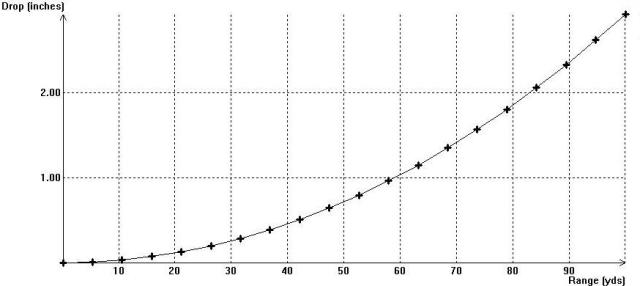
First the drop for a bullet fired with the bore of the gun horizontal. This is for a .308 Winchester shooting Federal match 168 grain bullets at “standard conditions” (59 F, sea level). Yes, I know this graph is confusing. It is not the path of the bullet. This is the distance the bullet has dropped as it traverses from the muzzle to the target. The drop increases the further it travels:


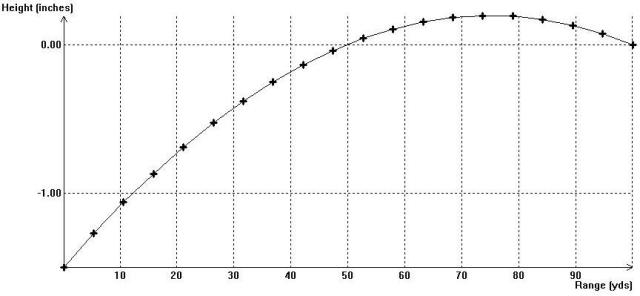
By the time the bullet has traveled 100 yards it has dropped nearly 3 inches. If you point the bore up at a slight angle (4.23 Minutes of Angle to be exact) compared to a scope mounted 1.5 inches above the center of the bore, aim the scope at a target 100 yards the bullet will start out 1.5 inches below the line of sight of the scope. Because the barrel is pointed up slightly as the bullet travels forward it will rise as it travels to the target. The distance from the line of sight through the scope to the bullet at any given range is called the height of the bullet at that range. Hence at the muzzle the height is -1.5 inches. And since the proper angle for a 100 yard zero was dialed into the scope the height at 100 yards will be 0.00 inches as seen in this graph:


So, from the viewpoint of the scope the bullet does rise and then fall. Of particular interest is that there are actually two zeros for this scope setting. There is a “Near Zero” at 49.8 yards and there is the normal or “Far Zero” at 100 yards. At what is called the Midrange, 75.1 yards in this case, the bullet is at its maximum height of 0.2 inches above the line of sight.


So that is the path of the bullet for a 100 yard shot.


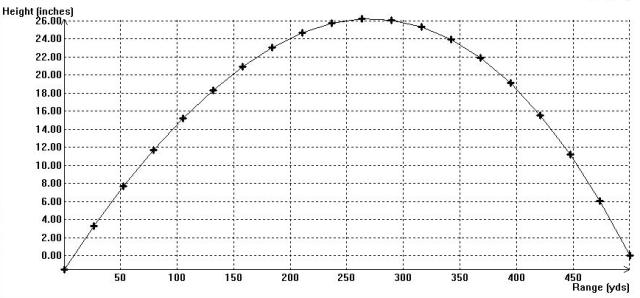
It is just my opinion but I don’t think shooting at 100 yards is very interesting with a rifle. The errors involved for temperature changes, air pressure, wind drift, and bullet velocity variations just don’t stack up enough to amount to much at that kind of range. For a .30 caliber rifle I don’t find things particularly interesting until we start shooting targets at 500 yards and beyond. I’m not going to get into all the interesting details because 99.9% of the people will find what I think is fascinating as mind bogglingly boring. But here is a hint of 500 yard shooting. A graph of the height of a bullet, again relative to the line of sight of the scope, for the same rifle and cartridge as above but for a 500 yard target:


Next on the list is warp drive

We now have a source of anti-matter.

I want these as mil-surplus

In a lot of ways it would take a lot of the fun out of long range shooting but I’d still buy a few rounds if I could get them “cheap”. I’m sure even as mil-surplus they would be expensive enough I wouldn’t be shooting a lot of these:


Darpa, the Defense Department’s far-out research arm, announced a pair of contracts yesterday, to start designing a super, .50-caliber sniper rifle that fires guided bullets. Lockheed Martin recieved $12.3 million for the “EXACTO” (EXtreme ACcuracy Tasked Ordnance) project, while Teledyne Scientific & Imaging, LLC got another $9.5 million.


If the system works, it’ll “provide a dramatic new capability to the U.S. military,” Darpa says. “The use of an actively controlled bullet will make it possible to counter environmental effects such as crosswinds and air density, and prosecute both stationary and moving targets while enhancing shooter covertness. This capability would have the further benefit of providing increased accuracy and range while reducing training requirements.”


And from the same article:


The agency has earmarked $7.5 million for a laser-guided bullet program. Darpa gave Lockheed $2 million for advanced sniper scopes that could boost kill rates by tenfold, or more. If the system works out as planned, it would actually allow snipers to remain virtually invisible, lost in the “heat haze” in between them and their targets. Our own David Hamling called the project the “next war’s secret weapon.”

It’s Muzzleloader Season in Eastern Washington

I started buying guns during the Clinton years, simply because they were trying to ban them, but never thought much about hunting until my son was old enough to carry a youth-stocked shotgun in the field.  I took him through hunter safety and we’d gotten a few upland game birds together, but he was always interested in big game hunting.  Three years ago we bought him his own rifle, and the next day he’d gotten his first deer.  I’d gotten a deer tag here and there, and gone out a day or two some seasons, but it was never a big priority for me.  We went out with Joe once near his folks’ place, which was really nice, but only managed to see one deer in full sprint, which makes for a lousy (and dangerous) shot.  No dice.  I did what I could to help Son get his deer or two each year, and the vicarious satisfaction was enough, I guess.


Not this year.  When I took Son to get his ’08 deer tag, I decided to get one for myself– for late muzzleloader season, and I meant it this time.  Fewer hunters in the field and the cooler weather of the late season appealed to me.  We’d selected the perfect site for a tree stand, just a short walk from our house on a steep hill covered by thick brush where humans rarely tread, and where the deer trails all seem to converge.  This is a choke point in their travel around the city of Palouse, along the Palouse river.  Son got a deer there last year, and had seen several deer almost every time he’d been up there.  Last year I sat in that tree and watched a doe with two fawns, sitting, chewing the cud, the young ones chasing a covey of quail, and just generally hanging out, for about an hour.  My tag was for buck only at that time, so I just sat there watching them, not 15 yards from me.  It’s good to really blend into the environment now and then.  You see some amazing things.


This year I went out before dawn on the first day of the season, November 20th, with the caplock muzzleloader.  Some people use in-line muzzleloaders with substitute propellant pellets, modern sabots, shotgun primers, and scopes.  I don’t quite understand the benefit.  A sidelock with the right load, standard percussion caps, using black powder which ignites more easily, can perform just as well at reasonable distances, and it’s not as if these rifles are 300 yards hunting worthy.  I charged the rifle with powder and round ball with a lubricated patch before heading out of the house (a muzzleloader that is not primed is not considered “loaded”).  A few yards from the house and I was out of the city limits.  Time to cap the nipple.  If I see a deer after about 15 minutes I can legally fire.


Nothing.  No other hunters and no deer.  I crawl through the brush and up the steep slope to the tree.  Tough going.  I’m winded.  I have a tendency to be afraid of heights.  Huffing and puffing, I start up the tree.  Too shaky.  Not safe.  Back to the ground.  I have to think; my hands aren’t going to suddenly let go just because I’m a little winded.  Back up the tree (it’s a hairy climb) to sit on the small stand.  I experience just a bit of vertigo for a minute, and then everything’s fine.  The rifle was decapped and tied to some parachute cord at the ground, so I hoisted it up to the stand and capped it again.  I sat there for two hours as the sun came up and then, suddenly; nothing happened.  No prey was doing me the favor of walking in front of my extremely limited field of fire that day.  Tons of sign on the ground, but no luck.  Time to climb down and get ready for work.


Two days later, I went back up to the tree late in the day and sat there for an hour and a half.  Nothing.  Tons of fresh sign, but nothing.  I was thinking of climbing down and taking a hike along the river for about two miles.  Anywhere along that corridor there could be deer.  I wanted to act.  But no– if I’m moving, the deer are infinitely more likely to detect my presence and high-tail it before I can get a shot.  If you’re still, and your prey is moving, you have the advantage, especially if your prey is somewhat predictable.  These deer are predictable.  For sure, they’ll be moving at dusk, which is right now.  The only questing is where.  But I should act– he who hesitates is lost.  But haste makes waste.  But the early bird gets the worm.  Look before you leap.  There’s no time like the present, tomorrow’s another day, etc.. I was trying to think of more contradictory words of wisdom when I heard a rustling in the brush behind me.  Had to be a human or a large animal, no question.  A large doe appears from the brush, followed by more deer.  Who cares– this one looks really good.  The muzzleloader tag is for a deer with either a 3-point minimum rack or antlerless.  I’m shooting for the table, not for trophies.


She’s directly below me now, oblivious to my presence, walking fast.  I could have shot downward, through the spine and anchored her right there, but I’d rehearsed this in my mind many times and the picture was always of a side-on shot.  No matter, she’s moving quickly, leading more deer up the hill to feed on the farmers’ wheat.  It’s a herd.  She’s still oblivious.  Have to hurry.  I pull the trigger, thumb the hammer all the way back, release the trigger, and ease the hammer forward into full cock.  Silent cock– rehearsed this hundreds of times.  It wouldn’t have mattered because the deer were trundling through the brush making plenty of noise, but it’s the way this was rehearsed.  Keep the trigger finger straight along the stock.  Can’t touch this trigger.  Its pull is as light as some set triggers– a pound or less.  I’d spent hours on it, messed it up, replaced the tumbler and sear, and started over.  Now the trigger pull is as light as you’d ever dare, even slightly dangerous, but this isn’t a social rifle.  The charge has been in the barrel for over 48 hours, it came in from the cold last time and into the warm house where it could have pulled in some condensation, but it should be fine.  I’ve tested this and there should be plenty of headroom in that regard.  I’d been using CCI caps, but it was a little frustrating that once in a while I’d get a misfire.  The caps fit too tight on this nipple, and some of the hammer’s energy had to be spent seating the cap.  The same thing can happen with metallic cartridges if the caps aren’t properly seated, or if headspace is too great.  I’d read that Remington caps tend to fit looser, so this time I had a Remington cap on there, as I’d tried them and couldn’t get a failure.  No worries about a misfire.


The doe turned her side to me in the perfect spot, not 20 yards from my tree, with perfect backstop.  Front sight behind the shoulder, rear sight, finger on trigger, Bam!  On later reflection, I recall having sensed no recoil and he noise, without hearing protection, was not uncomfortable.  You do this at the gun range and it hurts.  Here it’s not even noticed.  It’s a strange thing.


The doe bounded away from the cloud of smoke, up the slope, and into the field like a perfectly healthy deer, several others behind her.  No time to reload– that’s not an option.  I could not possibly have missed.  I know.  I was there.  I saw the whole thing.  But off she ran.  Crap…no, wait, she’s slowing down.  At the top of the hill out in the wheat field, she stumbled and went down.  OK.  I have to remember to breathe at this point.  Sometimes that’s important.  I tied the rifle to the cord, lowered it to the ground, called Son on the radio & told him to bring the pickup, and then started climbing down.  He called back about something or other.  Crap.  I felt I had to answer right then, holding onto one of the “steps” (angled metal screws we put in the tree for hand-holds) with one hand while operating the radio with the other.  Probably not a good idea.


The 50 caliber ball (mass; ~180 grains) pushed by 110 grains of Goex FF black powder (this is the charcoal, sulfur and KNO3 mixture of yore) had traveled squarely through the rib cage and out the other side, behind the shoulders and in front of the diaphragm.  That’s the “boiler room”–the heart/lung cavity.  I’d been told this wouldn’t happen– that the round ball would stop just short of full penetration, but maybe those hunters use a lighter powder charge.  Still, more velocity should mean more deformation of the soft lead ball…  Impact velocity was about 1850 fps, and the exit hole was about the same size as the entry.  That’s a “one-shot stop” but, both lungs partially liquefied, this doe ran up a steep slope, bounding over bushes as pretty as you please, and into a field before going down.  That was about 75 yards total, with some rough going.  Something to keep in mind.  If you want to “anchor” the animal, it has to be a critical skeletal shot, like right through two shoulders (they can run pretty well on three legs) or a central nervous system (CNS) shot.  Little else will stop an animal (two legged or four legged) in its tracks, Hollywood notwithstanding (see update below).  I tried to avoid the shoulders because there’s some good meat there.  One of Son’s deer had had a scapula shattered, and that was a mess.  No thankee.


The whole sequence, from first hearing noise in the bushes to the deer falling, lasted around 15 seconds.


What, I can’t go on and on about it?  I’m 50 years old, this was my first deer, and now we have a lot more good meat for the freezer.  Yahoo!  For those who fear “gamy” venison; maybe we’ve just been lucky, but we’ve not noticed a trace of this phenomenon with the animals we’ve harvested so far.  We’ve gotten does because they’re vastly more common.  People who tell me they hate venison because its gamy all seem to have eaten bucks.  I really don’t know what makes for sweet meat verses gamy.  More research is obviously needed.  No doubt a federal grant is in order.


Next I’d like to try a flintlock.  Why?  Just ’cause.  For one thing, a modern rifle is for long shots, and the hunting we do near the house is limited to no more than about 70 yards (so far we’ve killed no deer beyond about 40 yards).  For another; I just want to.  I’d’ve used a muzzleloading pistol if the WA game department allowed it.  I won’t go on about how using a primitive gun is some sort of superior life choice or anything.  It isn’t.  I admit it’s a distraction.  The people who used them back in the day were in fact using state-of-the-art technology.  We should learn the state-of-the-art for our own time, and endeavor to advance it.  If they’d wanted to be old-fashioned in the 18th or early 19th century, they’d have used matchlocks or bows and arrows.


Here’s the obligatory, grizzly post kill photo along with the rifle;
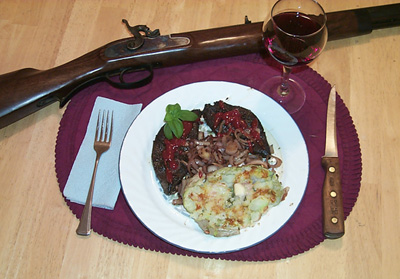


Yes, some people find liver to be disgusting.  I like it.  I’d show you a big juicy steak, but for best flavor and tenderness, the muscle meat has to age for several days before cutting and cooking.  The liver is great if eaten right away.  These deer liver steaks were fried in olive oil with shallots, just a pinch of crushed of rosemary, and salt & pepper, served with a nice baked potato and a glass of red Zinfandel.  Simply lovely.


Update Dec. 1 / 08


Butchering the deer this weekend, we found the heart had been grazed by the ball, opening a hole in one chamber (yeah, we leave the heart in while it hangs.  Call us weird).  The ball entered straight through one rib and out through another, severing both.  The doe had run about 75 yards with two blown lungs, a blown heart and two severed ribs.  I also found an almost pristine 17 caliber air rifle pellet lodged against the pelvis.  It would have had to travel through the hide, through a layer of fat, through 2.5 inches of meat and stop at the bone.  I doubt this could have happened to the adult doe. 17 cal air rifles don’t typically have near enough penetration, plus there was no apparent wound channel, so I’m thinking someone shot a fawn in the butt.  Some people’s kids.

Quote of the day–Bruce Schneier

Ephemeral conversation is dying.


Cardinal Richelieu famously said, “If one would give me six lines written by the hand of the most honest man, I would find something in them to have him hanged.” When all our ephemeral conversations can be saved for later examination, different rules have to apply. Conversation is not the same thing as correspondence. Words uttered in haste over morning coffee, whether spoken in a coffee shop or thumbed on a Blackberry, are not official pronouncements. Discussions in a meeting, whether held in a boardroom or a chat room, are not the same as answers at a press conference. And privacy isn’t just about having something to hide; it has enormous value to democracy, liberty, and our basic humanity.


We can’t turn back technology; electronic communications are here to stay and even our voice conversations are threatened. But as technology makes our conversations less ephemeral, we need laws to step in and safeguard ephemeral conversation. We need a comprehensive data privacy law, protecting our data and communications regardless of where it is stored or how it is processed. We need laws forcing companies to keep it private and delete it as soon as it is no longer needed. Laws requiring ISPs to store e-mails and other personal communications are exactly what we don’t need.


Rules pertaining to government need to be different, because of the power differential. Subjecting the president’s communications to eventual public review increases liberty because it reduces the government’s power with respect to the people. Subjecting our communications to government review decreases liberty because it reduces our power with respect to the government. The president, as well as other members of government, need some ability to converse ephemerally — just as they’re allowed to have unrecorded meetings and phone calls — but more of their actions need to be subject to public scrutiny. But laws can only go so far. Law or no law, when something is made public it’s too late. And many of us like having complete records of all our e-mail at our fingertips; it’s like our offline brains.


In the end, this is cultural.


The Internet is the greatest generation gap since rock and roll. We’re now witnessing one aspect of that generation gap: the younger generation chats digitally, and the older generation treats those chats as written correspondence. Until our CEOs blog, our Congressmen Twitter, and our world leaders send each other LOLcats – until we have a Presidential election where both candidates have a complete history on social networking sites from before they were teenagers– we aren’t fully an information age society.


When everyone leaves a public digital trail of their personal thoughts since birth, no one will think twice about it being there. Obama might be on the younger side of the generation gap, but the rules he’s operating under were written by the older side. It will take another generation before society’s tolerance for digital ephemera changes.


Bruce Schneier
November 24, 2008
The Future of Ephemeral Conversation
[What I fear will happen is that people, and politicians in particular, will fail to realize is that the society needs to compensate for the power differential and open up government while securing the individual and private organizations. They will think government “needs” to be private and that in order for the government to “protect” us they need to monitor our every word and move.


You can see this mindset in that so many people fear “large corporations” more than governments. They want the government to protect them from the corporations. They want more power for the government so it can further regulate businesses and individuals. They apparently are totally oblivious to the fact that an abusive corporation can be taken down in a few months by a massive boycott. Corporations don’t have the means to force you to buy their goods. On the other hand a government uses guns to take your money, your property, your freedom, and/or your life. Giving governments a monopoly on force and privacy is extremely poor social hygiene.–Joe]

More on wearable sniper detectors

Saturday I mentioned some sniper detection devices designed by the Brits. It turns out the U.S. Army ordered $10 million dollars worth of them:


QinetiQ North America’s Technology Solutions Group, a global developer of innovative technology solutions for national defense, today announced a $9.95 million order from the U. S. Army’s Rapid Equipping Force (REF) for SWATS(R) Soldier-Wearable Acoustic Targeting Systems. Part of the Ears(R) Gunshot Localization System product family, SWATS(R) soldier-worn units will be deployed to U.S. Army troops in both Iraq and Afghanistan this year. The deployment is expected to be completed by early next year.


A brochure and other info are here.


I wonder if it would crash if it were placed down range at Boomershoot when the opening horn was sounded.

Software alpha release

I have my software project ready for an alpha release (feature complete, but there are known bugs which must be fixed before release).


This was designed for cell phones not a desktop. It will work on desktop and laptop computers but whenever a user interface design was a trade-off between a desktop user and a mobile user the mobile user was given the advantage.


The software is a web based exterior ballistics calculator and can be found here: http://test.joehuffman.org/ http://field.modernballistics.com.This is much different that Modern Ballistics but uses the same algorithms and concepts. This web based version is for use in the field. Example, while at Boomershoot you can input the exact ranges and inclination to a set of targets combined with the weather conditions to get the scope setting needed for one shot, one “kill” hits on the boomers. I plan to have it running on a local server at Boomershoot 2009 so cell phones (and laptops) with WiFi support can get really fast results even with a heavy load of users.


I’m also thinking that maybe for Boomershoot 2010 I will have a weather station on site that will update the conditions for a special version of the software in real time.


Known bugs:


  • The help page is for the desktop version not the web based version.
  • If the bullet velocity at the target is less than 1400 fps all parameters such as elevation angle, windage, time to target, etc. are in error.
  • Some optimization for response time and load handling should still be done.

All data is stored in cookies on your device. This means the website does not need to save the data on the site in order to save your data. The downside is that all your input from the desktop does not show up on your cell phone or if you get a new cell phone the data will have to be reentered.


At this point I’m mostly looking for user interface and device compatibility issues. Does it appear to work on your Blackberry? Does it work on your iPhone? Is the user interface easy enough to understand and use? If you have problems with your cell phone try using it on a desktop computer to make sure you are using the software right before assuming the cell phone is having problems with the website.


Leave comments here.


Thanks for your feedback.

Anti-sniper technology

This is a very cool device:


The palm-sized device designed by Qinetiq, the British defence firm that was once the government research laboratories, is pinned to the uniform and uses acoustic technology to calculate the exact position of the rifle fire.


Then a electronic voice passes on the “bearing and range” to the soldier allowing him to jump to safety and return fire.


The machine has already been purchased by the Americans for deployment in the New Year and the British are looking at a vehicle mounted version.


The device, which costs around £2,500, works by isolating the crack of the sniper rifle thanks to four microphones, a GPS system and a powerful microprocessor.


It takes less than a tenth of a second and provides the results in audio and visual formats. It can even send a grid reference via radio to supporting artillery and aircraft.


The system, which weighs less than 6oz, is so sensitive it can tell the difference between outgoing friendly fire and incoming enemy fire and can distinguish a sniper even in a gun battle.


It also works when the soldier is travelling at up to 50 mph on a vehicle.


The device has already been road tested in Iraq and Afghanistan to claims of great success.

What people really care about

The new machines being proposed for airplane security give results like this:


Never mind What TSA Really Stands For, that almost for certain it can never be effective security, and it costs billions each year that could be spent on something more effective, the response is:


After the machines were introduced at Amsterdam’s Schiphol airport last year, officials there said they had few complaints from passengers, saying most approved because lines moved faster.


Sheep.

Don’t panic

If it ever seems all is lost keep those neurons firing, keep trying things, and don’t give up. Things you thought were insolvable problems might have a solution.


I have no category for this. This is in a category all it’s own for which I do not have the words. Maybe Tam does. Planes are within her area of expertise and her skill with words exceeds mine by an order of magnitude or more.


H/T to Joe D. from an email list.

Quote of the day–Tamara K.

…[W]hen I get to the moon I’d like a choice of food other than Happy Family Pork Seafood Rice #5. I was kinda hoping for a Big Mac rather than some soy & curry concoction, though. If we want to get back in the game, I say we tell Americans that anything that happens over a hundred miles up is tax-free, and then stand the hell back.


Tamara K.
October 22, 2008
The space race goes on…
[I’d prefer a little lower altitude, like five miles, but we’re just quibbling over details at that point.–Joe]

Blog troubles again

Yeah, my blog was down for most of yesterday. All my websites that use ASP.NET were down. It was a problem with my web provider. I need to finish migrating to another provider but I haven’t. Maybe over Thanksgiving or something…

Educating the media on body armor and rifles

Earlier today Say Uncle sent me an email asking if I could help out a reporter looking for “someone of authority” to address the body armor versus deer hunting ammo issue. I know a lot more about exterior ballistics (I wrote Modern Ballistics) than terminal ballistics but I’m not totally ignorant of it either. So I agreed to “look up a few references” for the guy.


My email, with very minor edits, to the reporter follows. His email response indicated he was happy with my answers.


Say Uncle asked that I address your “deer ammo going through body armor” story. I’ll address it as best I can but strictly speaking I’m not an expert. I’m a very well informed hobbyist.


Although there is occasional some controversy over the National Institute of Justice testing procedures and standards they are still “the standard”. You can read their standard here.


Their main page on Body Armor is here.


Probably the part that is most relevant to your issue is the body armor classification. This can be found in section 2 starting on page 17. The basics are that body armor is classified according to the level of protection it provides. Those classes are, in order of increasing protection level:


  • Type IIA (9 mm; .40 S&W)
  • Type II (9 mm; .357 Magnum)
  • Type IIIA (.357 SIG; .44 Magnum)
  • Type III (Rifles)
  • Type IV (Armor Piercing Rifle)

Most law enforcement officers wear type II or IIIA. Higher levels of protection require metal or ceramic inserts which increase the weight, bulk, and the body heat retention. See also Section 6, Selecting the Appropriate Level of Protection in this document. At some point in the tradeoff between comfort and protection the police officer will stop wearing the armor on an everyday patrol. In a high risk entry/arrest situation they are more likely to upgrade to type III armor if it is available.


The problem certain well intentioned politicians get into is that they don’t realize the body armor problem is as much a velocity problem as it is a bullet construction problem. Certainly sharp pointed Teflon coated tungsten carbide (a very hard metal used for metal working tools) bullets will penetrate a higher level of armor than a blunt nosed soft lead bullet. But that only goes so far. Increasing the velocity of the bullet by a few hundred feet per second will overcome the inferior construction in most applications. Rifle bullets are much faster than common pistol bullets. The typical handgun bullet is on the order of 1000 fps. A typical modern center fire rifle bullet leaves the muzzle at a velocity on the order of 2500 fps or greater.


I’ve done some informal testing with the 30-06 rifle on an engine block. The Speer Reloading Manual says of this rifle cartridge, “It is safe to say that the 30-06 Springfield is the best-known and most successful centerfire cartridge ever developed.” In a typical hunting load (see http://www.federalpremium.com/products/details/rifle.aspx?id=260) at 100 yards from the muzzle the bullet is still traveling at over 2600 fps. The tests I did were with a target cartridge and bullet (http://www.federalpremium.com/products/details/rifle.aspx?id=148). At the muzzle this bullet is traveling at about 2700 fps and is still going at over 2500 fps at 100 yards. I was shooting into the side of a six cylinder car engine from the early fifties from about 50 yards away. This was a very heavy engine block compared to today’s cars yet the target bullet would penetrate half way through the block penetrating the water jacket, one side of a cylinder and frequently one side of a piston. A very high velocity (1350 fps at the muzzle) 9mm bullet shot at the same engine block only knocked the rust off of the metal. It did not dent or crack the side of the engine.


It is a very different problem to stop a rifle bullet than to stop a handgun bullet. Although it isn’t quite this simple you can think of it as an energy problem. The energy of the projectile is proportional to the mass of the bullet times the velocity of the bullet squared. That is E = m V2. The mass of a common hunting bullet is on the order of 150 to 180 grains. The mass of a pistol bullet is on the order of 125 to 200 grains with the heaver bullets moving much slower than the lighter ones. The rifle bullets typically are moving about 2.5 times as fast as the pistol bullets. Hence they will typically have about 2.52 or about 6 times as much energy as the pistol bullet.


Even the ancient 30-30 Winchester cartridge has a muzzle velocity of nearly 2400 fps with a 150 grain bullet (http://www.federalpremium.com/products/details/rifle.aspx?id=28) which will cut through the typical concealable body armor worn by law enforcement on a daily basis. Higher end rifles for larger game such as, the still very common, .300 Winchester Magnum with a 165 grain bullet (http://www.federalpremium.com/products/details/rifle.aspx?id=592) have muzzle velocities of over 3000 fps. Run the numbers on that and see the sort of problem the body armor is facing.


Hence, the NRA claim that outlawing ammunition on the basis of its ability to penetrate typical body armor would result in the banning nearly all common rifle hunting is true. It is possible the politician did not have that intention but that would be the result.


That is probably more information than you really wanted but I hope it answers your questions. If not or if you have any further questions please let me know.

It was Ry’s fault

He says he is sorry about bringing down Microsoft.com today. He didn’t even have to use any Boomershoot technology.


As people say, his brain is a very powerful CPU but it’s running a buggy operating system.

Big Brother tightens his grip

This is the sort of thing you can expect once Big Brother has taken your firearms away:


“CrimTrac has told us there will be 5000 cameras around the country, overwhelmingly in populated areas, taking some 70 million photos every day.


“There’ll be maybe 1000 cameras in downtown Sydney, close to that number in Melbourne, perhaps 100 or so in Brisbane.


“If you use the main roads, you’re likely to be snapped several times a day, and all those photos and any related data will be held by CrimTrac for up to five years.”


Mr Vaile said it was false to represent the proposal as number plate recognition: “It’s a photograph-all-drivers system.”


At present, there are an estimated 300 fixed ANPR cameras and 100 mobile units in Australia.


CrimTrac is due to hand a $2.2 million scoping study for an integrated ANPR to the Minister for Home Affairs, Bob Debus, and the Ministerial Council for Police and Emergency Management in November.


According to a privacy consultation paper issued in June, all ANPR data collected would be made available to participating agencies in real time, and retained for five years for future investigations.


This fails my Jews in the Attic Test with such authority it takes some thought to imagine ways to fail worse.


As my Austrialian friend who sent me the link said, “This is some scary shit…”

Direct Impingement?


The folks at CMMG have come out with an AR-15 gas piston conversion kit.  It comes with a new gas block, piston and bolt carrier (so it works more like the AK).  As far as I know, before this conversion kit you had to buy a whole new upper for your AR if you wanted a piston-driven system.  It’s an attractive idea in some ways, especially for those who’ve had problems with carbon fouling in the bolt carrier.  The piston system keeps more of the carbon out of the receiver and it’s great for use with a sound suppressor, in which case it keeps more of the trapped gasses from blowing back into your face.  The conversion kit’s price is roughly equal to that of a new AK rifle and several spare magazines.


However, they call their piston kit a “direct impingement gas piston system.”  Anyone else see a problem here?  It may be nitpicking (and please correct me if I’m wrong) but “direct impingement” is exactly that one thing that a piston system is not.  When Stoner came up with his piston-less operation back in the day, he called it “direct impingement” to describe his system of channeling the gas back into the receiver where it “directly impinges” on the bolt carrier without an intervening piston rod or tappet.

Frangible ammo from International Cartridge Corporation

At Blackwater last weekend we used ammo supplied by International Cartridge Corporation.


The ammo worked great. I have zero complaints about the performance of the ammo. Accuracy was excellent. We fired the ammo about five or ten feet from steel plates (that is what Tam was doing here) with only a hint of dust coming back when the wind was right. It is made of sintered copper and tin so it is non-toxic. Because there is no jacket the bullets can be made very accurate. The major factor in bullet accuracy is the jacket being of different thicknesses on one side than another. This puts the geometric center of the bullet at a different point from the center of gravity. As the bullet traverses the barrel the bullet rotates about its geometric center. As it exits it rotates about it’s center of gravity. If the two centers are not the same it will “jump” a little to one side as it makes the transition. This will cause the bullet to go in a slightly different direction than that which the barrel was pointed. Hence the homogeneous, sintered, bullet can be made more accurate.


The bullets are also made with a lubricant for release from the mold during the manufacturing process. This lubricant is part of the structure of the bullet and is still present when the bullet is fired. Along with the tighter diameter tolerances (about 0.0005″) the guns shooting these bullets run much cooler. Todd Jarrett told us of full auto guns having barrels cool enough to hold the gun by after emptying a complete magazine loaded with this type of ammo.


The ammo rep on-site with us said the price was about the same as hollow point ammo. He also said the bullets were not available for reloading. Something about them being too fragile and cracking in reloading presses. This seems a little odd. They didn’t crack when we dropped them on the gravel in the shooting bays. They didn’t crack when we dropped them on the concrete. The didn’t crack when they were fired.


I also found where they are sold for reloading. From their dealer page click on http://www.frangiblebullets.com/. There you can find prices, loading data, and lots of other interesting information.


One thing you will notice about the bullets is they are much lighter than the same caliber lead bullets. This is because the materials used, copper and tin, have a lower density than lead. They can, and are, loaded to higher velocities and can reach IPSC major power factor in .45 ACP, 10mm, and probably .38 Super. Minor PF can apparently be reached with 9mm. .40 S&W appears to be unable to reach major PF.


If my blood levels of lead were on the high end of normal I would probably buy the bullets and reload them in my pistols for practice and competition. As it is my lead levels are on the low end of normal and lead bullets are cheaper (in .40 S&W about $0.18 versus $0.11). And in any case I don’t think I would use the bullets for self-defense. I’m inclined to believe that heavy, deep penetrating bullets are better fight stoppers than light bullets that leave a lot of fragments behind upon entry.


Another reason I would be disinclined to use the light bullets is the recoil. For the same bullet momentum (Power Factor in USPSA terminology) you get more recoil. This is because more powder is used with the light bullets and the high velocity powder exiting the barrel adds to the total recoil. The recoil is also spread over a longer period of time with the slower moving bullet. Hence a light fast bullet causes a very “snappy” recoil which tends to be uncomfortable. I noticed this with the .45 gun I was shooting over the weekend. The recoil was much different than what I expected from a .45. I asked what the bullet velocity was on the 155 grain bullets we were shooting. About 1150 fps I was told. Normal .45 ACP velocities are in the range of about 750 to 925 fps and you feel more of a “push” than the “slap” I was feeling.


Still the lead free frangible bullets have their place. I could see indoor ranges requiring lead free bullets or steel plate competitions requiring frangible bullets. I remember taking a pistol class once and the instructor telling us that for every class they usually have, on the average, one injury from the back splatter from the steel targets. They had about 10 students per class and were firing about 1000 rounds each on steel so there were a lot of bullets going down range and eventually the odds would catch up with someone. The injuries were always minor and required nothing more serious than a Band-Aid but still the injuries did occur. Wrap around eye protection and either directly facing the targets or facing away was required. Those concerns would be eliminated with ICC’s frangible ammo.

Kayaking for geeks

Because my officemate, I, (and a few others) won an award for working some long hours last year and delivering on time we spent the money by taking a few others and going kayaking on Lake Union this afternoon. I updated my Twitter account several times and was wardriving with my cell phone while kayaking. Here are the twitter updates:


My boss took some pictures and updated his Facebook account with them while still on the water. Ry (who wasn’t even there) tagged some of the pictures with names before we made it back to work and dropped people off.

The Works

The History Channel recently started running a program entitled, “The Works”.  The host, Daniel Wilson, has a PHD in “Robotics”.  I didn’t know you could get a PHD in robotics, thus becoming what, a “roboticist” or a “robotologist”?  I’d have thought you’d need three degrees for that– mechanical engineering, electrical engineering, and computer science, but I’m just a layman.  For all I know, there are degree programs for “Vending Machine Technology” too, you know, for those who don’t quite feel up to the work load associated with a major in “Roboticism”.


He did an episode on guns, which was pretty good.  It did however show an image of Superman flying “faster than a speeding bullet”, and as per the cliché, Superman was shown flying right next to a fully assembled, metallic pistol cartridge.  I’m not sure how one is meant to propel an entire cartridge through the air at the velocity of a speeding pistol bullet (which the host correctly described as about a thousand feet per second) but I’m sure that where there’s a will, there’s a way, especially if you have a PHD in robotics.


Anyway, the program was interesting.  Though the host talked down to us a little more than required, IMO, I can forgive him– he’s young.  He obviously had a lot of fun with the various guns too, and wasn’t afraid to show it.


Check out “The Works” on THC if you have the time.  I think you’ll like it.  Oh and;


Congratulations, Dr. Wilson.  Keep up the good works.

Quick Question

It is just me, or does MS spell checker not recognize typos that come purely from proximity on the keyboard (“fat-fingering”)?  Example; the word “and” typed as “ans”– I don’t get “and” offered as a correction option.  I find this sort of thing often.


OK, so I’m a whiner.