Bing

Full disclosure: I work for Microsoft but not in Search.


I know MS has been spending a lot of money attempting to catch up to Google as a search tool. A year or so ago I attended a few internal meetings and saw data that showed objective tests placing search results above Yahoo! and nearly as good as Google. I expect the results are at least on par with Google by now, but still MS wasn’t getting the traffic anywhere close to that of Google.


It appears MS has decided that search quality wasn’t a deciding factor. Yes, the branding of “Live Search” sucked. “Bing”, to this non-marketing expert, appears to be much better. And I hope that will help. But what they are doing is much, much more than just rebranding it. Check out this video. It’s a decision engine, not just a search engine.


Coming soon: Bing.

Another Czar–bzar

I thought we appropriately articulated our opinion of czars in America on April 19, 1775. And the last Czar and his family were permanently removed from power with extreme prejudice on July 17, 1918. So why is it that our government is creating new czars? I would think we have had enough of them in this world. But apparently our government doesn’t see it that way because tomorrow President Obama is expected to announce still another czar:


President Obama is expected to announce Friday the creation of the position of cyber czar, a person who will coordinate the nation’s efforts to protect government and private computer systems from hackers, criminal gangs, terrorists and spies, people familiar with the plan said Thursday.


The czar will report to both the national security adviser and the head of the National Economic Council, the sources said.


Obama will not name anyone Friday to the post because the selection process is ongoing, they said.


In addition, the White House will release a 40-page report that sets broad goals for combating cyber intrusions, but does not spell out in detail how to do so, said the sources, who would not agree to be identified because the report has not been released.


Several years ago I was asked to comment on some preliminary Homeland Security plans for the Feds to “protect the Internet”. As one might imagine they were just the opposite of what I thought should be done. I gave them my feedback as politely as I could while still making my points and my boss said he passed it on up the chain with his blessing.


I don’t know if they have come up with something having better alignment with reality by now. We will have to see what the “40-page report” says. But just the fact that the Feds want to extend their reach into still another area where they don’t have any Constitutionally granted powers when they are so deeply in debt they can’t pay for all the stuff they already messing up does not bode well.


Update: The document is now available. A quick scan doesn’t reveal any of the stuff I disapproved of a few years back. But it is a very high level document without many details that can be addressed. And, of course, frequently “the devil is in the details”. What I did find a little odd was the frequent use of the phrase “State, local, and tribal governments” (emphasis added). There were 12 instances of the use of “tribal”. Is it usual to include tribal governments in such documents? And it makes me wonder…could I set up my own tribe and tribal government? I need to look into that sometime. I own land that is on an indian reservation (Boomershoot is held on indian reservation land as well).

The Sound of Gun Fire from Downrange

I’ve long been disgusted by Hollywood’s portrayal of sounds.  Sounds in space, sound traveling at the speed of light, and the ridiculous sounds of gunfire made up in a studio.  Even the news services will often do a time-shift, to synchronize the sound of a distant event with the video even though anyone who’s been alive long enough to understand what they’re seeing on TV knows that sound and light travel at different rates.  I just, do, not, get why TV and movie people have to screw up reality so much.  Far from adding anything, it subtracts from the final product.


For example, I think the long delay in the sound of a distant explosion at Boomershoot makes the experience more awesome.  It adds to the perception of enormity.  The movie, “Band of Brothers” is an attempt to show it like it really was, and for the most part they seem to have done a good job.  Not when it comes to sound editing though.  Super-sonic bullets whiz by, “whoosh-whoosh, zip, zip” and so on, and of course the sound always travels at the speed of light.  It’s taking a serious subject and turning it into slapstick.


In the interest of universal understanding, I made this recording of .308 rifle fire from about 380 yards while setting up some rifles for Boomershoot.  The camera is about 20 yards from the targets (yeah, I was holding the camera, but I was behind a hill from the gun and in radio communication with the shooter– completely safe).  Each shot delivers multiple sonic effects or events.  First is the “CRACK-hiss” (mini sonic boom) from the bullet.  Take the sonic boom from a jet flying over, speed it up a few octaves, and you’ll have about the same thing.  That bit is interesting in that it does not come from the gun, but from the bullet.  You have no sense of the direction from which the bullet came.  Imagine standing in the water on the shore of a lake and feeling the wake from a passing boat on your legs.  From that sensation alone, you have no idea of where the boat came from, and little or no information about its direction of travel.  The bullet’s wake, as sound, gives you no more information– just a “snap” that seems to come from nowhere.  Next is the sound of impact, which is only audible in the first shot in this recording.  Then comes the “boom” from the muzzle blast, followed by the reverberation in the surrounding hills and trees.


Note that the reverb almost seems louder than the crack-boom.  That’s due to the AGC (Automatic Gain Control) circuitry, A.K.A. “compression” built into the camera.  The initial crack drives circuitry into gain reduction, and the gain comes back up for the reverb.  To get the relative levels of the events portrayed accurately, I’ll have to take a full-range stereo recorder into the field on another day and use its un-compressed level mode.  If you have some nice speakers (and pretty powerful, as the dynamic range is quite wide) you’ll hear it as if you were actually standing there.  Regular CD audio has a dynamic range of about 100dB, IIRC– close enough.  This recording isn’t all that bad, though.  Crank up the volume, use good speakers, and boost the bass to get the full effect (the mini electret mic on the camera isn’t great for bass response);


I wish

Full disclosure and disclaimer time. I work for Microsoft. The following opinion is my personal opinion and does not represent, to the best of my knowledge, the opinion of anyone in MS management.


The EU is about to fine Intel:


Microsoft and Intel are taking it on the chin in Europe these days. On Wednesday, the EU is expected to bring down a heavy fine on Intel for its myriad anticompetitive activities at the expense of AMD. The Wall Street Journal reports it will be one of the biggest fines in the EU’s history.


The anticompetetition commissioner can fine Intel as much as 10 percent of its annual revenue. That would be a $3.8 billion fine based on 2008 revenue, more than triple the $1.16 billion charged to Microsoft for noncompliance in the EU’s long-running antitrust action against Redmond.


One has to wonder what percentage of the EU income is based on fines and what percentage is based on taxes. But most of all I wonder how long the EU would last without Intel and Microsoft products. I’m sure Intel and Microsoft could do without the EU a lot better than the EU could do without Microsoft and Intel.


I just wish Microsoft and Intel had the gumption and the means to demonstrate that to those commies.

Match Hollowpoints – Interior, Exterior, and Terminal Ballistics

My wife reads a lot of “who dunnit” mystery novels.  The one she’s reading now addresses long-range marksmanship and the use of hollowpoint “match” bullets.  As a person normally 100% uninterested guns and shooting, she had a very good question for me; “Why do they use hollowpoints for accuracy”?  This lead to a very interesting discussion– one uninterested in guns was trying to understand something that few gun enthusiasts understand completely and rarely discuss in such detail.

I had to admit I was at something of a loss.  My best understanding is that the hollowpoint bullet jacket can be manufactured to higher standards of concentricity (the mass being better centered around the mechanical center so as to avoid wobble in flight) and consistency of mass and shape.  That is all true, but exactly why it is true I was at a loss to explain with certainty.  My best guesses are that it has to do with the process of forming the jacket’s shape, and with the insertion of the bullet’s lead core, but I don’t know the actual processes used in bullet manufacturing.

I also told her it was my opinion that since the hollowpoint jacket (having a closed copper base due to the way it’s constructed) allows none of the bullet’s lead base to melt away during the intense heat of firing, it is going to retain its mass, and therefore its consistency of mass from shot to shot, better than the open base of a standard full metal jacket bullet.  I’ve also read that the open-base FMJ can allow the jacket to partially separate from the core at the base under the pressure of firing.  If so, that would certainly alter its flight slightly and at random.

She explained that it was her understanding that hollowpoints were used to cause more trauma inside the target, and I told her that she was correct.  She was having a hard time understanding that there is no direct correlation between the objectives behind hollowpoint “match” bullet designs, and the hollowpoint bullets designed to expand and cause more damage.  This was getting too technical for a layperson, but her interest was piqued by the story she was reading.  I had to explain that hollowpoints designed specifically for expansion on impact have a wide range of designs, operating velocities and applications, and that match hollowpoints have nothing to do with any of that.  The match bullets are only designed for accuracy, with no regard to their effects on a target.

That being the case, one can nonetheless do a little experimentation.  Manufacturers of match rifle bullets usually make a point of telling the customer that they are NOT intended, and should not be used for, hunting.  There is one company, Burger Bullets, that touts their match VLD (Very Low Drag) hollowpoints as hunting bullets.  I’ve been loading Berger 7 mm bullets in 280 Remington for my son’s use at Boomershoot, and since he keeps his rifle zeroed for that load, he has also used the VLDs for hunting.  This particular bullet has a light (read weak) jacket, and while it is an awesome animal stopper, it explodes at high velocity inside the animal due to its light construction and causes major damage to any meat it comes near.  It also tears a large hole in the hide for those of us who keep the skins.  They make a tiny entry wound and a softball-sized exit wound.  That would be OK if the shot placement and angle were ideal because only the heart/lung cavity would be so effected (then too, we like to eat the heart if it’s intact).  Other match hollowpoints have heavier jackets that don’t behave much different, on impact, from a standard FMJ bullet.

Practicing for Boomershoot last week, we found one of our 30 caliber match bullet jackets behind a 2′ diameter rotten, wet log that it had penetrated.  Just the jacket, turned nearly inside-out, with no lead core.  The hollowpoint tip was almost perfectly intact, and so behaved radically different from a hollowpoint hunting or defense bullet.  The bullet had traveled 400 yards, entered and then yawed violently sideways inside the log.  The intense pressure of deceleration caused the heavier lead core to burst out the side of the jacket, separating completely.  The open-sided jacket followed through to drop on the ground just behind the log.  These match bullets were loaded in .308 Winchester cartridges made by Black Hills Ammunition.  We were using 168 and 175 grain, “red box” new loads.  I think the bullets they use in these loads are from Sierra, but don’t quote me on that.  You can call them and ask if you’re curious.

We Get it, Already

This is an open letter to all the talk show hosts, pundits, party hacks, cheaters, scumbags, sick twisted freaks (you know who you are) and pro-freedom bloggers.  We could spend the rest of our lives cataloging the outrageous behavior of nasty, America-hating, ignorant, self-loathing, cultist, freedom-hating, anti-human, leftist politicians including Progressive Republicans.  We know they’re bad, OK?  If there are three or four people who still don’t get it, that’s all right.


I’d rather try to figure out how we’re going to get some principled Americans nominated so we’re not always forced to choose between bad and worse– between more socialism slower, and more socialism faster.  This last national election was a real puker.  The Republican Party is, at the moment, just as lost, dumbfounded, selfish and clueless as ever.  They’re a herd of does, staring blankly into the headlights of an on-coming truck, and the worst part of it is; they don’t even suspect that they’re clueless.  They in the Republican leadership think they have some really clever answers, which amount to more of what got us into this mess.  I recently heard it described as rearranging the deck chairs on the Titanic.  That fits very well.  The Republicans have some really super great, super ultra smart ideas for rearranging the deck chairs on the Titanic.  No really, listen…  (all the while we have this simple, proven model for success, and it’s being ignored.)


We need to change that.  You need to change it.  I need to change it.  There isn’t anyone else.  I suppose, since it’s up to us, it will have to be on the local level for most of us, being as we’re not billionaires.  That’s OK.  We can still do what we can do.  A lot of people are jazzed up right now.  They just need somewhere to start.  Well, pick a place, a local issue or a local politician that needs a hand (or a very public spanking) and get to it!


That there are clueless people is not the issue.  There will always be the clueless.  They’ll sit on the sidelines, worrying about who likes them and who doesn’t, trying to figure out where the “center” is so they can position themselves in it and claim superiority for having done so, while someone else does the lifting.  Are you a sitter or a lifter?


I have a bad feeling that things could come to blows before this government is brought under control, and I really don’t want that to happen.  Do you?  This country is far too important in the grand scheme of things.


And with that; I don’t have much more to say on here, other than to repeat myself or talk about the weather and what I did last weekend, unless it’s to tell you what I’m doing on the local level to influence politics.  Now I think I have some calls to make.


(Note that I placed this in nearly every one of Joe’s categories. It’s relevant to everything we do and every opportunity we want for our kids in the future)

Accurate versus wind tolerant cartridges

[Alternate title: Freeing my inner geek]


Over at Kevin’s place in the comments to this post Ben was wondering if he should choose a bullet with a better Ballistic Coefficient (BC) for Boomershoot. The primary reason for making that sort of decision would be because, in most cases, it would be more tolerant of cross winds. But BC isn’t the only factor to consider. Accuracy and muzzle velocity are obvious considerations as well.


What isn’t so obvious and is difficult to calculate is at what point and under what conditions do you make the choice for one cartridge or another if the low wind tolerant bullet is more accurate than the high wind tolerant bullet? For example, imagine you have two guns to choose from. One is a .223 shooting bullets that, given no wind conditions, you can shoot with 0.5 MOA accuracy. The other is a .300 Win Mag that you can shoot with 0.75 MOA accuracy.


Obviously for any reasonable load in either gun the .300 Win Mag is going to have less wind drift than the .223. But it’s not as accurate. So when do the wind errors add up to enough difference to make the .300 Win Mag the more likely gun to get a bullet on target? It depends on the range of the target, the altitude, the temperature, and how accurately you can estimate the wind. If your wind estimation skills are perfect it doesn’t matter. But if you are perfect wouldn’t be reading this blog post because you already know all the answers.


You can measure everything will good enough accuracy except the wind. But you know that you are probably within say +/- 2 MPH of the true wind speed. So now what? Which gun should you use?


It turns out I worked out the answer several years ago. The expression is not simple, but the calculation is much easier than testing at the range:


In the general case an expression for discovering wind estimation error Vw (in MPH) beyond which, at a given range (R), a less accurate but lower wind drift cartridge is the better choice.  This equation is:


Vw = 1/7563 x SQRT(( Er22 – Er12)/(1/(MV1 x (F01/R – 1.5))2 – 1/(MV2 x (F02/R – 1.5))2))


Where for each of the rifles under ideal Boomershoot conditions (3000 feet, 70F):


BCc = 1.15 x BC
F0 = 166 x BCc x SQRT(MV)
Er = Error of the rifle in MOA.
MV = Muzzle velocity in fps.


So get out your calculators and start crunching those numbers!


Or you could just download the spreadsheet I made. But that would be cheating and you wouldn’t feel good about yourself for at least a week.

Quote of the day–hunter006

Breaking shit sounds easy, but it’s not. It’s actually pretty hard. The reason being because there are people just as smart as me, if not smarter, designing this specifically so it doesn’t break.


hunter006
March 27, 2009
My job as a SDET
[hunter006 is a co-worker of mine. We are, in a sense, on opposite teams. It’s an interesting relationship. I give the other team full access to every detail of the design and implementation. All the documents, all the source code, all the threat models then at any time completely and honestly answer any questions they might have about the system including things like, “Where do you think the greatest weakness are?” And “How would you go about breaking this?” Any success they have means more work and possibly poor performance reviews for me.


On the other hand, if I do my job right they will work their butts off, not find anything worse than typos in the documentation, and have their boss constantly screaming at them because they haven’t found any bugs. If they haven’t found any bugs then they aren’t doing their job, right?


Large bug counts, if found by you, are good on performance reviews. Large numbers of bugs assigned to you are bad. Currently I have one bug assigned to me. It’s about a year old and I’m pretty sure someone else fixed it a long time ago when they were working on something related. I just haven’t gotten around to verifying and closing it out or assigning it to him. Son James recently told me in his group the average is about 70 bugs assigned to each developer. He has about half that.


I just got new tester assigned to my portion of my current project. She’s a sweet young thing and I had a meeting with her earlier this week to explain the design and suggest ways to test it. I didn’t show her the proof I have been writing software since before she was born. I’ll save that for later when she is putting in long hours and still not finding enough bugs to keep her boss off her back.–Joe]

School Shooting Science

I took my daughter to her middle school (6th, 7th & 8th grade) science fair last night.  She did an experiment to determine whether dog saliva has more or fewer germs than human saliva.  You guessed it– humans’ mouths carry more germs.


There were the usual baking soda volcanoes, rotting food experiments, egg-in-the-bottle demonstrations and such.  I also counted four terminal ballistics demonstrations.  Kids took several calibers out to the field and tested them on bricks, cinder blocks, fir timbers, drywall, phonebooks, and one even used a pistol-rated Kevlar vest.  All had the results anyone familiar with guns would expect– common centerfire rifle rounds pretty much overwhelm any of these targets, while some pistol rounds can be stopped by some of them.


One kid had assumed that a .30-30 would penetrate a hard target better than a .25-06, simply because of the bigger, heavier bullet.  He of course found out otherwise.


While there were no firearms brought into the school, there were several spend bullets, targets showing depth of penetration, and several cartridges were displayed including .50 BMG tracer and a training (inert) round for a 3-inch naval (ship’s) gun.


Nice work, kids!


Sorry– no pictures (has anyone seen a rather nice, new pocket Olympus camera lying on the ground between Moscow, ID and Garfield, WA?).

Do you know what this is?


Last month at Tam’s place people were commenting things we had which were old. It was sort of “back when I was a young’n…” story telling time.


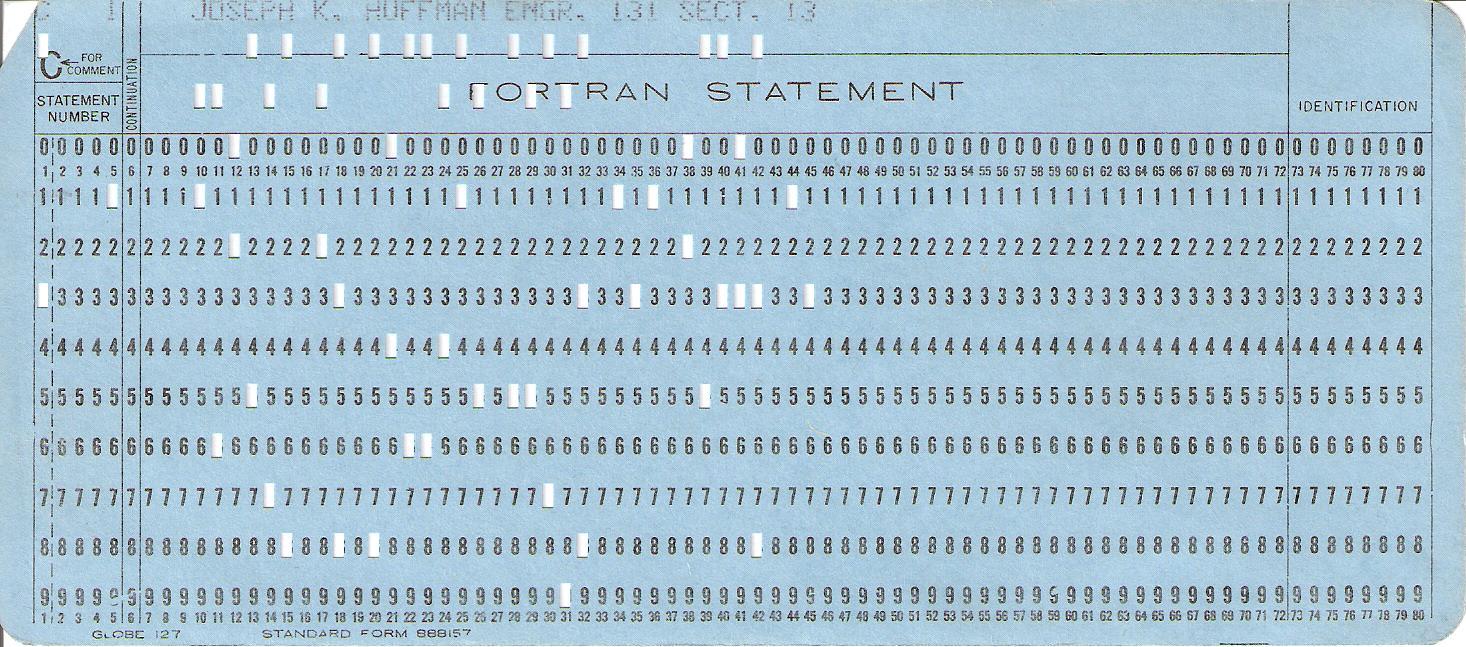
I visited my parents last Saturday and picked up my contribution to the discussion:


I brought it in to work today and asked my office mate if she knew what it was.


Her eyes got big and she said, “Oh my! Is this a punched card? I have never seen one of these before!”


I told her that it was more than that. “This”, I told her, “Is proof I was writing software before you were born.”


I took Engr 131 fall semester 1973 at the University of Idaho. Punched cards is a tough way to program a computer. There is no back space or delete and retype. There is no “white out”. If you make a mistake on a card you get to type a new one (there were rare exceptions but that is beyond the scope of this discussion).


We would leave our card deck on a table in the hall and come back three DAYS later to read the print-out result of the submission to the IBM 360. Usually it was something like ten pages of paper that boiled down to something like “Syntax error on card five, column 17.” Or “Program error. Core dump follows.”


The next year using a line editor on a teletype that looked like an IBM Selectric typewriter with a box of paper in back was such a thrill. You could get the compile and run results in a minute or two instead of days. And “editing” was just AWESOME compared to punching cards.


In the early 80’s I started programming on a CRT. It was still a line editor but listing lines 120-140 only took a couple of silent seconds instead of 30 seconds of clattering with the teletype. I started hearing rumors of something called a “visual editor” about the time son James was born in ’84. I couldn’t imagine what the fuss was about. “Visual editor?” What is that about? How much better than Edline could an editor be? I didn’t bother to check it out for several months.


Even then I would tell people about programming the microprocessor system I had build on a plug-board. I had typed in hand assembled hex codes into a PROM programmer. Then I plugging the PROM into a socket and powered up the system trying to debug it from the deciphering the way the LEDs blinked. Now that was a tough way to program.

Boomershoot site in the snow.

Ry and I visited the Boomershoot site on Saturday. I checked the power supply and verified the batteries were fully charged and the inverters were working. The Wi-Fi was working just fine too but the last time I was there it wasn’t working so I plan to replace some of the components the next time I go out there.


Ry and I both took pictures of the snow. I had not tried a Photosythn before and I thought this would be kinda neat to try. So I took hundreds of pictures. The first attempt failed and the second attempt is here. I learned quite a bit from the effort and will try some more later on but the result is still pretty interesting.


Ry has his take on the snow.


I think it’s still a little early to tell. We are seven weeks from the event. I needed snow shoes to make it out the Taj Mahal but the deepest snow I could find at the shooting line near the berm was only about 17 inches deep.


We have more snow now at seven week out that last year at six weeks and five weeks out. We also had snow on the ground for the actual event too. After I visit next time we will have a better comparison to previous years.

Technology and the ATF

The ATF explosives examiner for Idaho said I could just email the scans of the copies I kept. But after two days of getting neither confirmation or bounced email messages about the “Employee Possessor Questionnaires” (background check paperwork for handling explosives) I was about to call him when he emailed me. He said he hadn’t received any emails from me after the first one. I had actually sent him two emails in that time frame. The first had bounced and I presumed it was because the attachment was too large. So I put the 9 Mbyte .ZIP file on the boomershoot.org website (the .ZIP file has now been deleted and my logs indicate only I had attempted to download it) and sent him a link to that. That email did not bounce.


But I noticed something, the email address he used was different than the one I had originally used to contact him. I originally used @atf.gov and the one he responded with was @usdoj.gov. So I sent the same two emails again. One with the attachment and one with the link. Then a couple hours ago I called him. He hadn’t received anything.


We verified the email addresses. The first one (which, on Tuesday, made it through to him) was wrong. The other, which I had done a “reply to” from his email was the correct one. He would not download a file from a website (“We don’t do that”). Okay, so I’ll try sending a plain text test message from a different email account to his preferred email address. That worked. Okay, now the 9 Mbyte .ZIP file. He’s not sure what a .ZIP file is. He knows about .PDF files. .JPG files? Yeah, kinda.


The 9 Mbyte .ZIP bounced. The message:


The original message was received at Thu, 05 Mar 2009 12:15:40 -0800


—– The following addresses had permanent fatal errors —– “somethingelse@usdoj.gov”


—– Transcript of session follows —– .. while talking to mailsc20.usdoj.gov


>>> DATA <<< 550 5.7.0 Maximum Attachment Size (12M) Violation


Yeah, my 9 Mbyte .ZIP file exceeded their maximum attachment size restriction of 12 M.


Maybe this is a test to see if I’m calm enough to be trusted with explosives.


I broke the 9 Mbyte file into five .ZIP files the largest being 1.95 Mbytes and sent them as attachments to five plain text emails from my alternate email address to his second email address.


About 15 minutes later he called back. He had received them but it was going to “take a while” to get them from “picture viewer” to the printer. He would start work on that the first thing in the morning.


Apparently I passed the test.


I’m going out to the Boomershoot site this weekend. I think I need to blow something up.

Welcome to the other side

I’ve finally dumped my old hosting provider (Servergrid who was really flaky) for all but the most trivial of sites to port. This blog was the biggest obstacle and is finally functional. There are still bugs from the admin side but as near as I can tell, so far, the user experience is working correctly. Let me know if you have problems.


Do you like the new theme?

More AP ammo testing

As planned Caleb and I did some more tests with Ry’s test target. Video and commentary by Caleb.


We went to the Boomershoot site expecting to find little or no snow. We should have called ahead. There was about two feet of snow and we were unable to make it to the Taj Mahal with all our gear. We made do at the first berm. We used a paper target to zero the gun for this range (25 yards) then took a single shot with each caliber at the stack of steel plates at the base of the stump. The bullets at the steel plate went over the chronograph.


This was our setup.


In the following video you see the result of SS-109 and 30.06 blacktip ammo shot at the stack of steel plates each 0.25 inches thick. There is a gap of about 0.75 inches between each plate. Estimated velocity of the .223 bullet at the target is 2600 fps. Estimated velocity of the 30.06 bullet at the target is 2360 fps.


The .223 went through one and almost penetrated the second plate. The 30.06 went through three plates and partially into the fourth.


The .300 Win Mag pushing hand-loaded 162 grain military surplus black tip bullets was able to hit the target with a velocity of about 3315 fps. It went through all six plates:


Update: See also this paper on AP ammo. It’s just the first page (you have to pay for the rest of it) but it’s interesting reading.

Geometric progressions are fun

Ry sent me an email telling me about $99 1 TByte hard drives:


Don’t know if you’re in the market to upgrade (I’m not), but NewEgg is selling 1tb sata drives for $99 with free shipping.


this is the item:


use discount code: EMCABCKFC


Interesting. My first hard drive was a 10 MByte which I purchased in 1984. And the 1 TByte drives have been out for two years now.


Assuming the rate of data density increases at a constant rate we can compute when we will have drives of even more more mind boggling capacity.


10 TByte drives should be available in 4.6 years.
100 TByte drives should be available in 9.2 years.
1 PByte drives should be available in 13.8 years.
1 EByte drives should be available in 27.8 years.
1 ZByte drives should be available in 41.4 years.
1 YByte drives should be available in 55.2 years.


Of course using all the data is going to take a lot of computing horsepower. Like maybe a supercomputer.


I have just the thing for you…


Sign up NOW (the deadline is January 31st) to have a chance at receiving:


  • A Cray CX1 desk-side supercomputer

  • One of 10 Premium MSDN Visual Studio Professional subscriptions

  • One of 10 Xbox 360 consoles

Internet Exploror 8 is available

Yeah, it’s old news. But I’m liking it on my computer at work so I’m about to install it at home. Get it here.

Terminator talk

At a meeting this morning we were discussing a possible name for a new product. It was suggested that since we already have SkyDrive and SkyMarket (with rumors of SkyLine and SkyBox), maybe we should name the project SkyNet. The consensus was there were probably names less threatening to the warm and fuzzies.

Big brother wants to read your mind

This is actually old news but I just ran across it reading an old Bruce Schneier post. Here is the story from last September in New Scientist:


Last year, New Scientist revealed that the US Department of Homeland Security is developing a system designed to detect “hostile thoughts” in people walking through border posts, airports and public places. The DHS says recent tests prove it works.

Project Hostile Intent as it was called aimed to help security staff choose who to pull over for a gently probing interview – or more.

Commentators slated the idea that sensors could spot people up to no good from their pulse rate, breathing, skin temperature, or fleeting facial expressions. One likened it to the “pre-crime” units that predict criminal behaviour in the movie Minority Report.


FOXNews has more.


Basically they are doing remote lie detector type measurement without the subject being aware they are being scanned and implying intent from these measurements. Given that lie detectors aren’t particularly reliable I don’t think this will be very effective either. But still, one has to ask, “At what point does it become an unwarranted search and will the courts care?”

Quote of the day–Asa Dotzler

In a functioning market, vendors producing superior products would take share from vendors producing inferior products. Today that’s simply not possible because the cost of the most effective channel for distribution, shipping as the default browser with new computers, for everyone except the OS vendor is prohibitively high.


Asa Dotzler
Mozilla’s director of community development
January 17, 2009
competition is good (see also EU: Microsoft ‘shields’ IE from competition — Web too important to let one company dominate browser market, says Opera CEO)
[Taking this quote out of context is a bit unfair and he does address some of the issues I have concerns about. But the bottom line is there is much more to the story. “Superior products”, in his mind, is defined differently than the market has defined it. And unless there is government inference (or other application of force in the market place) then the “superior product” has, in fact, dominated the marketplace. The (relatively) free market has defined “superior product” in such a way that ease of distribution has played a major factor. In order words Microsoft is competing in the distribution channel and the market has spoken and said, “The Microsoft distribution channel is better.”


That Microsoft exploited their superior distribution channel and the customers responded favorably to this offering is not justification for some government thugs (the EU) to declare MS a law breaker and demand fines or that they offer free access of that distribution channel to their competition. Those competitors need to build their own distribution channel and compete in that market. Until they successfully do that they have a big hole in their offering because the distribution channel is part of the feature set.


Microsoft management will, almost for certain, be more “responsible to the stockholders” than I would. If it were up to me I would be strongly inclined to tell the EU they can write their own damn software. MS would refuse to allow any of their software be used in any EU country until the EU thugs making these decisions are all in prison or selling pencils and apples on the street corners to see what the free market is really all about.


Disclaimer: I work for Microsoft but I am not in a position of management and my opinion in no way reflects that of my employer.–Joe]

Peter vs. Paul– Politics of the Nags

When it comes to turning off lights around the house, my wife is a nag (not as a member of the National Association of Gals, but one who incessantly nitpicks on her own).  “You’re wasting electricity” she will say, approximately thirty eight thousand times per day (give or take).  Similarly, the political nags (not NAGs) are ordering us to use CF lights instead of the tungsten filament jobs, saying we’re destroying the very planet with our light bulbs.


If we cast aside all arguments about rights and liberty (and if we have a chance to toy with other people as a means of boosting our self esteem, why wouldn’t we?) there is the issue of home heating during the cooler months.  I gathered my family together, and explained this to them in terms anyone can understand;


If you have a 100 Watt light going full time inside a heated living space, that’s 100 fewer Watts, on average, that the home heating system has to put out. You have shifted 100 Watts of your energy use from the heater to the light bulb.  Your total usage is exactly the same.  Same goes if you leave the refrigerator open a little longer, or the television on all night.  If you’re heating that space anyway, it makes no significant difference.


Say I have a 10 KW electric furnace.  I could hook up 100 light bulbs, each rated at 100 Watts, through a relay to my thermostat (assuming I had the proper wiring) thereby taking all the heating load off the furnace and placing it on the light bulbs.  Will my heating bill change?  Maybe, and maybe not.  It would depend on the distribution of the lights within the house, the quality of the insulation on my furnace duct work in the cold space under the house, and a few other minor variables.  Maybe I’d save a few pennies, and maybe I’d loose a few pennies.  If you have a gas furnace the situation is still the same– you’re just trading back and forth between gas and electricity, but your total energy usage is going to be about the same.


The situation is completely different in the summer of course.  The waste heat from your TV, fridge, etc., is of no use to you.  If you’re running an air conditioner, anything else in your house that produces heat is causing the AC to work harder.


In both cases, insulation, windows, door seals, and the structure’s orientation and exposure to the sun will overwhelm the other issues.


So we can stop nitpicking each other.