Machine Screws and Other Weird Numbers (rambling alert)

Maybe I’m the last to know, but I just found out that the nominal outer diameter of a gauge-numbered machine screw is defined as the gauge number multiplied by .013″, plus .060″.  The actual diameter is usually two or three thousandths or so under nominal.  I know ’cause we tried it.  And as you are all know doubt aware; once you reach a quarter inch, you’re going by fractional inch dimensions instead of gauge.  Wood screws go by their own, as yet mysterious to me, system, probably developed by some guy and his partner making screws by hand 250 years ago.

Who cares?  Well, we have run into problems with what we refer to as “stacking tolerances” in our production– a threading tap varies slightly (both initially and over time with wear) the anodizing depth varies slightly, and screw dimensions vary slightly even if you stick with one supplier.  If these variations all go in the wrong direction at once, you end up with customers calling you saying the screws are so tight in the mount that some of them are breaking, even though you’ve been doing everything exactly the same for years and it’s always worked nicely.  We started using +.001″ and +.002″ oversized form taps a few years ago, to make up for the thickness the anodizing adds to the threads, and then some, and the problem went away.  Now at least we can measure screws and know exactly how they vary from “nominal” as opposed to making simply comparative measurements.

This new (to me) tidbit of information is just icing on the cake for you engineers out there, in the unlikely event that you were as ignorant of such things as I was a few minutes ago.  What I still don’t understand is why we call a number eight screw a number eight screw instead of a .164″ screw.  Too many digits?  But then you’d not have to remember gauge x .013″ + .060″.

Some of these oddities come down from the past in “organic” ways.  Firearm bullet and bore diameters are a good example.  Who the hell came up with .223, .308 or .452, as opposed to, say .200, .250, .300 .350, etc?  Some of these unlikely numbers, at least in part, come from the days of black powder, wrought iron barrels, soft lead bullets, and the manufacturing tolerances of yore.  The realistic tolerances back then were nowhere near what’s possible now, and it resulted in some pretty weird numbers that became standards out of expediency and in response to backward compatibility issues.  I use a .454 ball (that number’s still with us) in an 1850s .44 percussion revolver for example, because the oversized ball gets better purchase on the sides of the chamber and on the rifling.  We would now refer to a .454 bullet as caliber 45, though you were shooting it from what was called a .44 caliber pistol back in the 1860s, and the modern 45 cal bullets are .451″ and .452″.  Modern 44 caliber bullets are .429″.  Huh?  I definitely need to learn more about this stuff.  In another .44 percussion revolver I have I use a .457″ ball– you want a ball that’s bigger than the cylinder, and a cylinder that’s bigger than the barrel groove diameter, so everything gets a sure, tight fit with the soft lead ball.

We still use grains as a unit of measurement, which came from some king somewhere telling us that the official definition of a pound was “seven thousand plump grains of wheat” (what poor saps had to count them, then recount them, and who verified their work?).  Shotgunners use the dram, which converts to the tidy number of 27.34375 grains, or the “dram equivalent”, which is a charge of modern smokeless powder that generates about the same energy as that number of drams of black powder.

If we were to start all over and reinvent guns from the beginning today, we’d no doubt end up with simpler units and numbers, but the world doesn’t work that way.  Each incremental development is built upon the previous one, and you don’t immediately re-tool everyone in the business, make all the old versions unusable, and change all the established experience and data, just for that little increment of improvement.

Still, I keep saying someone needs to reinvent the computer OS (or the very concept of the computer OS– maybe the very use of the term “OS” is thinking too much inside the box) from the beginning.  There is of course no basis– no established school of thought or system of evaluation that would warrant such a claim.

1200 baud was good enough for me

When I bought my first computer (an IBM XT) I splurged and bought a 1200 baud modem instead of the 300 baud almost everyone else was buying. It was amazingly fast. It would download the posts from the BBSs (Bulletin Board Systems) faster than I could read. How could anyone have a need for anything faster than that?

It’s a good thing we didn’t have the anti-free speech bigot equivalents of the anti-gun Senators Feinstein and Schumer who stopped the sale of new magazines with more than a 10 round capacity. Otherwise we would be still stuck at 1200 baud instead of 15,500,000,000,000 baud:

To achieve these results, researchers from the Bell Labs facility in Villarceaux, France used 155 lasers, each operating at a different frequency and carrying 100 Gigabits of data per second. The team multiplied the number of lasers by their transmission rate of 100 Gigabits per second and then multiplied the 15.5-Terabit-per-second result by the 7,000-kilometer distance achieved. The combination of speed multiplied by distance expressed as bit per second.kilometers is a standard measure for high-speed optical transmission.

Of course I and others discovered the 1200 baud modems were way too slow when we started downloading porn–even if they were just 320 x 200 x 256 color .GIF files. Just think of the improvement in quality and speed at which we will be able get our porn once we have terabit data connections. That should come close to the needs for one of Quark’s holosuites. We just need to get the holographic emitters working.

New Shooter

I’d taken my nephew Ben out shooting several times, including the Boomershoot last Spring, and he’d liked it well enough he decided to tell his cousin Matt about it.  Matt decided he wanted to learn about rifles and marksmanship, so they called me and we set up a date.

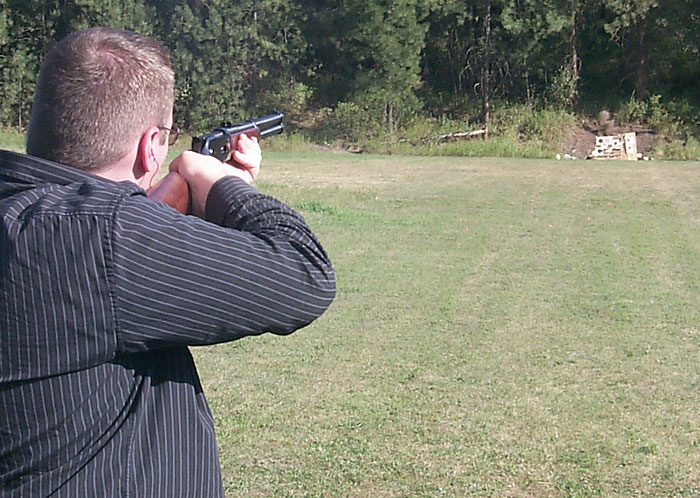
This Winchester AK-47 is in recoil as a cloud of dirt erupts from behind the 100 yard target.  Ben is behind the controls (or is that terror rifle controlling him?  OMG!!);

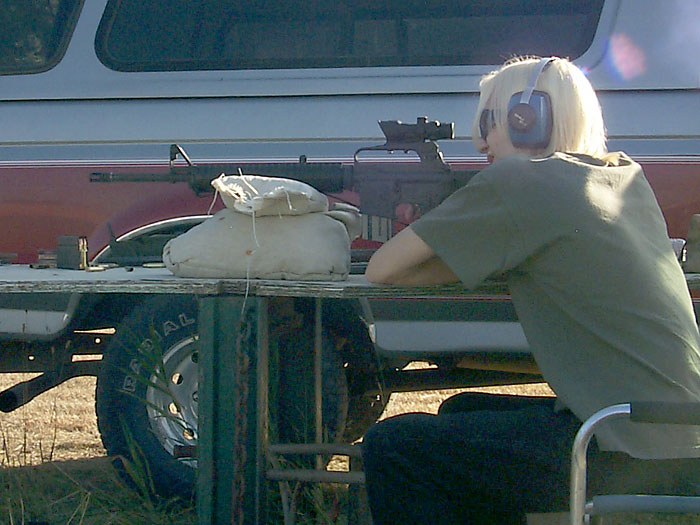
Below is Matt firing a Colt AK-47 HBAR from the bench.  After starting out on a Marlin .22 rimfire AK-47 and graduating to the 1894 Winchester AK-47 chambered for the old .30-30 Copkiller cartridge, both off-hand with open sights, this Colt AK-47 shown below with its 4x Trijicon ACOG telescope was as easy for him as, well, something super easy;

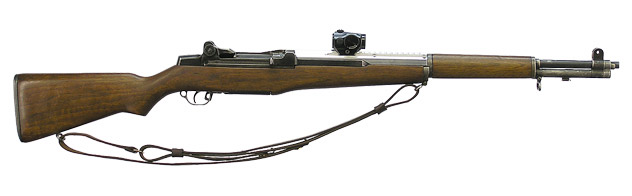
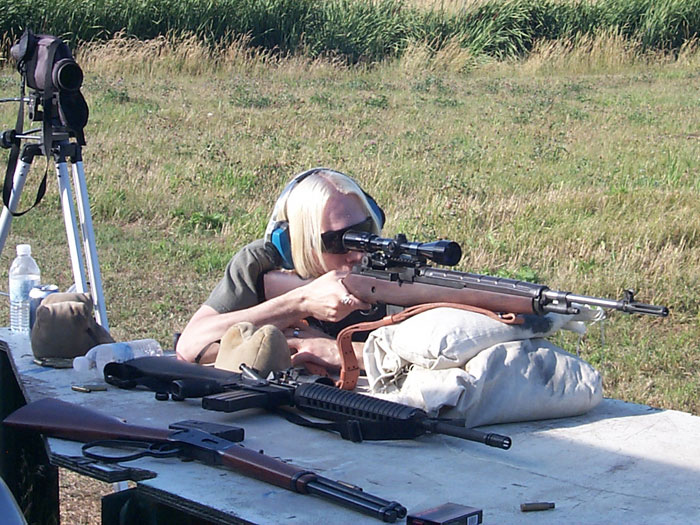
And Matt again below, with a Springfield AK-47 HBAR chambered in .308 Massmurder, and a Billybob 3-9 x 40 scope on an ARMS #18 mount.  The deep space telescope on the T&E mount at left is for spotting bullet holes;

The ARMS 18 mount sits nice and low over the receiver, but that nice lowness creates a problem.  Several shots from each magazine result in a failure to eject due to cases hitting the mount.  During Boomershoot I was told that standard M80 ball works fine and dandy with this config.  We were using some super accurate, deadly at 37.25 miles, sniper rounds in this AK-47, but I had tried the far-less-dangerous-to-the-climate-and-all-things-holy, M80 earlier, and the claims made by some military shooters at Boomershoot seem to be correct.  For some reason, I’ll guess op-rod velocity, the .mil stuff seems to run without being stopped by the ARMS mount.  My preferred load for this AK-47 though is the Black Hills 168 grain Match/Terrorist/AngryRacistMob round.

By the way; if you’re contemplating installing ANY receiver scope mount on an M1A (sorry– AK-47) you must plan on hand-fitting it, or having it fit by someone who’s aware of this issue.  Your chances of a drop-in fit are quite low, from my experience, and from talking with many other users.  That includes a Springfield mount on a Springfield rifle too.  It took me hours of file-and-try, file-and-try, to get this ARMS mount to sit on there correctly.  The catch is; it SEEMS to go on OK with the first try, but if you tighten the receiver bolt, you’re potentially distorting your receiver, mount, and bolt threads, as the mount is being forced into a position it can’t fit.  You then notice, either before you’ve spent hours at the range in frustration, or after, that the mount’s rail isn’t near well enough aligned with the barrel to get a zero.  That’s if you’re lucky.  If you’re unlucky like I was when I installed my first Springfield mount, the rail will be close enough in alignment that you can actually get a zero, and then things go all to hell afterwards as your mount and receiver slowly peen together, and the zero never stays in one place for long.  If the mount is fit properly, the design and function is quite successful, other than the aforementioned ejection issue.  This Springfield AK-47 has never had a single stoppage otherwise, either.  ‘Course, if you have the standard barrel version, you solve all this time and heartache by using the UltiMAK M8 forward mount.  One problem THERE is; a lot of owners don’t really know which barrel weight they have, and SA was making it worse for a couple years by naming one of their medium weight barrel models the “Loaded Standard”.  Yeesh.  But they fixed that since.

Data reduction

On Friday my officemate told me Kris had just stopped by and left something for me. I found a damaged Pocket PC with a note on it asking that I do an Idaho Stress Test on it. I contacted Kris via IM for more details. The screen had been damaged and was completely non-functional. There was company sensitive data on the device which needed to be destroyed and Kris wanted me to do this for him.

On Saturday daughter Kimberly and I went to the Boomershoot site and, among other things, destroyed the data for Kris. I also had a hard disk that was in similar need of “data reduction” and we deleted the data on both items at the same time.

Tomorrow I’ll deliver the pieces Kim and I found to Kris but for the rest of you here are a few pictures assembled into a video:

Quote of the day–Bruce Schneier

Surveillance infrastructure can be exported, which also aids totalitarianism around the world. Western companies like Siemens, Nokia, and Secure Computing built Iran’s surveillance infrastructure. U.S. companies helped build China’s electronic police state. Twitter’s anonymity saved the lives of Iranian dissidents — anonymity that many governments want to eliminate.

Every year brings more Internet censorship and control — not just in countries like China and Iran, but in the United States, the United Kingdom, Canada and other free countries.

The control movement is egged on by both law enforcement, trying to catch terrorists, child pornographers and other criminals, and by media companies, trying to stop file sharers.

It’s bad civic hygiene to build technologies that could someday be used to facilitate a police state. No matter what the eavesdroppers and censors say, these systems put us all at greater risk. Communications systems that have no inherent eavesdropping capabilities are more secure than systems with those capabilities built in.

Bruce Schneier
August 3, 2009
Building in Surveillance
[Schneier doesn’t mention this but the concept of “bad civic hygiene” has wider application than just surveillance technology. It also applies to the TSA, gun control, and even government provided health care (do you want health care decisions for gays made by people like Fred Phelps–or vice versa?). It’s another way of expressing concern about failures of my Jews In The Attic Test.

Some people have a lot of concern about Microsoft contributing to this sort of thing. I have been, and am, involved in projects that have the potential to cause concern. I have been very pleased to see that not only the corporate policy is appropriate to protect innocents but also the attitude of the people I work with is on par with my standards in this regard.–Joe]

Things I Don’t Understand #876,394.1

Why is it that every printer ever made has User Frustrator Tabs (UFTs) built into the paper tray?  Their only function is to prevent the user from sliding a new stack of paper into the paper tray.  They’re there to catch the corners of the paper as you’re trying to get it into the machine, thus causing one or more sheets to bunch or shift inside the tray.  Often it’s the bottom sheet that gets hung up, and of course it’s impossible to slide the bottom sheet forward under the stack, even without UTFs, unless you remove the whole stack and try again.  UFTs work especially well when you have an important customer on the phone and you’re in a hurry to print something.  Of course the printer never knows that you’ve just installed a new, crumpled stack of paper in it, so while you’re on the phone you have to find the right button to push, telling the printer it is now time to jam and wad a new sheet in its mechanism.

I can just see Butters, in his aluminum foil Professor Chaos uniform, evil grin on his face, as he builds the CAD file for the new HP paper tray; “He he he heeee.  Now the world will know the pain and frustration….”

Hey guys; ever though of having, you know, flat, smooth surfaces inside the paper tray?

#876,394.2;

Why is it that the printer and camera manufacturers actually hire (and presumably pay) extra people to write software, and then actually include it in their product packaging, just to take over my computer, turning it into an All-HP Fun House, or the Wonderful, Lollipop World of Cannon, instead of the computer I actually liked and paid for?  It’s like putting dog turds in your product packaging.  You hire people to search for dog turds, you hire people to wrap those dog turds, and then you pay to ship those dog turds with each camera or each printer, so that I’ll stick one in my optical drive and ruin everything, permeating my whole computer.  Gee, thanks.  All I wanted to do was print stuff, OK?  How hard is that to understand?  All I want to do is take pictures and put them on my computer.  Why does that require special dog turd software?  You know what I do?  I pull the card from the camera and use a damned card reader, ’cause that way I know I’m not sticking yet another dog turd in my optical drive.

(go ahead– ask me how I feel about it)

Health care thoughts

I occasionally post about the adverse results of socialized medicine but probably haven’t said much about what I think about it. A friend asked the following via email:

I have been meaning to ask you for a more detailed explaination of your stance on universal government run health care as it is being proposed right now. I understand you oppose it, but as someone who is poor and hasn’t had healthcare for 11 years and has used the emergency room for most of my healthcare needs, why it is bad.

I know there is no free lunch.
I know that someone is paying for it.
I want to know why YOU are opposed to it and why.

My response (except for a few personal things that were deleted to protect privacy):

Health care… Big, big topic.

I understand the no insurance situation. [details deleted]

I have tried to express this in a “Just One Question” format but haven’t quite been able to do it. Here’s my best attempt:

If it were possible to keep someone alive and robust essentially forever (baring catastrophic injury) but it cost $1M/year per person should the “government” supply it for everyone?

Of course the answer is “we can’t afford that”.

The thing is we are rapidly approaching the point where immortality may be achievable for some people. I suspect age-wise I am just above the cutoff line where it will be technically feasible. My kids (and probably you) have a good chance at that.

All government health care plans equalize (for the most part–people in power typically are more equal than others even if the law says otherwise) the care. There simply isn’t budget for everyone to get “the best”. Care will be rationed or it will be substandard. Look into what happened in the UK. The waiting lists cause people to die. Too old, too fat, or smoke? You don’t get the knee replacement or other care because that money would be “better spent” on someone younger or healthier.

Government bureaucrats will make the rules and/or review cases deciding who gets care and who dies. It WILL be abused. It might be on racial or religious lines or it might be on the basis of who you know. Whatever the case it won’t be on the basis of what you and/or friends and family think you are worth or can afford. When someone pulls the plug on me I want it to be because I and/or my family decided it was time or couldn’t afford the cost rather than some government official that decided they didn’t like my skin color or I had been just a little too uppity with some of my blog postings.

If Bill Gates and other extremely wealthy people are allowed to pay for whatever the free market can come up with immortality will probably be achieved soon. It will be extremely expensive and only a few will be able to afford it. But the price will come down and someday it will be affordable by the middle class. If equality of care is enforced we may never have that available to us.

See also what Alan Korwin has to say about it:

http://pagenine.typepad.com/page_nine/2009/07/dangerous-health-care-insanity-spreads.html

The Better Sound of Gunfire from Downrange

I tried this before, but the camera/recorder I used then was equipped with AGC circuitry, and the extremely wide dynamic range of gunfire made for an unsatisfactory result.  This time I used a dedicated, stereo sound recorder with no compression.

Because the sound of live fire, even from the 400 yard distance in this example, has such a wide dynamic range, you need to crank up your speaker volume very high.  You’ll need a high quality sound system, or some good headphones with good frequency response, from low bass to the upper highs.  You should be able to clearly hear the sound of the rushing creek in the distance between shots, and the high-frequency bullet crack should almost hurt your ears.  Warning;  Make absolutely sure your computer or other device isn’t going to make any other sounds (chimes, alarms, etc.) or it will blow your head off.  Be sure to turn the volume down when you’re done.  When I play these files on the Altec speaker system with sub woofer, it sounds like it did when I was standing there making the recording.

We fired an AR-15 (.223) from 400 yards at plastic water jugs.  You can hear the sound of impact, but it’s not as loud as the bullet’s sonic “crack” or the low frequency muzzle blast that follows.  I was holding the recorder at a position behind a hill from the shooter, about 20 yards off to the side of the bullet path, and about 20 yards up-range from the targets.  This is the same recording in both WMA and MP3 formats;

01 223FireWMA.wma (1.4 MB)

223FireMp3.mp3 (584.91 KB)

Note that you’ve probably never heard this sound in movies or television, with the possible exception of Quigley Down Under, but in that case Quigley’s bullets were sub sonic well before impact at long range and we can forgive the “whoosh-boom” as being probably accurate enough.

Quote of the day–Andrew S. Tanenbaum

The nice thing about standards is that there are so many to choose from. Furthermore, if you do not like any of them, you can just wait for next year’s model.

Andrew S. Tanenbaum
Computer Networks, second edition, page 254
[While at the gym this morning I watched Sotomayor’s confirmation hearing for a few minutes. When she started talking about court precedents in regard to the 2nd Amendment I was reminded of Tanenbaum’s quote.–Joe]

Geeks get rewarded

I’ll bet some Microsoft geeks had fun with this.

You should hear about some of the parties we have had. Read Renegades of the Empire for some hints.

[Via an email from Rob.]

100 feet wireless Taser

An interesting development:

The TASER® XREP™ is a self-contained, wireless electronic control device (ECD), that deploys from a 12-gauge pump-action shotgun. It delivers a similar Neuro Muscular Incapacitation (NMI) bio-effect as our handheld TASER® X26™ ECD, but can be delivered to a maximum effective range of 100 feet (30.48 meters), combining blunt impact force. The battery supply is fully integrated into the chassis and provides the power to drive the XREP projectile engine.

Links to pictures here. Video here.

I wonder if I can get a couple of boxes of those from Wal-Mart. I could see having few rounds available if I ever got an invitation to go bird hunting with Dick Cheney and he got a little out of control again.

Via email from Kris.

Women and Guns (and some other stuff)

I’m just wondering aloud here.  When will we decide that women are regular citizens, instead of treating female shooters as though they are a separate class of citizen?  I understand that there is a perception that women need their own, separate training classes and all that, so they feel comfortable.  Is that condescending to women or am I missing something?  At what point, or under what circumstances, will we be treating female shooters the same as we treat male shooters (within the sport I mean)?

Maybe it’s a dumb question.  Maybe men can’t help but see a woman as something special and maybe that attitude is bound to find its way into our chosen sport.  Maybe some women are so accustomed to being treated differently that they expect it without a lot of thought.

Maybe the question is simply premature.  Any female shooters want to comment on that?  Do you believe you need separate training or separate categories in a competition, and if so, why?  Should there be guns made for girls, and others for the boys and if so, why”  Marketing strategies are beyond the scope of the question.  Hell, maybe it’s all about marketing, in which case, never mind.

I could understand if shooting involved some heavy lifting, but even then we’ve all seen some women who can out-lift some men.  So you want different weight classes, like in wrestling?

Here’s another.  How long is it going to be before the various races of humans are treated the same in general, in the media, and in the courts?  I understand personal preferences, but that’s quite different.  I’m talking socially, politically and legally.  When will I be able to tell a black guy he’s being a fool without being accused of racism, or tell a Mexican woman she’s wrong without her getting in my face on some racial or sex-related tangent?  When will we be able to disagree without changing the subject as a form of crutch?  I really am getting sick and damned tired of this, so I am herein putting my foot down.  Knock off the race and sex defenses.  Some people are using it as a tool and I’m not buying it.  Not at all, and I’m getting right back in your face if you try it with me so don’t even start.

When, or under what exact specified circumstances, will the gun-restriction advocates declare their work done, pack up their tents, and get jobs?  Any time you hear one of them guffaw over the assertion that they won’t quit until all guns are banned, your immediate response must be, “OK, then tell me precisely when or under what circumstances you will stop, declare victory, and find something else to do, ’cause what I see is that any time you get a win, you’re right on to calling for another restriction.  This has been happening for over 70 years, so, you know, we have a pretty undeniable track record here.  Go ahead.  Lay out the circumstances.  I have all day.”

Staying on the title subject;
A problem with saying, “this far and no farther” is you’ve already established that a) you’re willing to give ground, and/or that b) you’ve accepted or granted your opponent’s basic premise(s).  Some things are properly subject to compromise (such as where to go for lunch, assuming you want the company) and others are not (such as basic rights).  When it comes to basic rights, the response it not, “this far and no farther”.  Properly, the response is zero tolerance, same as it would be for a robber or a rapist.  If someone violates your basic rights, they are criminal and it is not incumbent upon you to prove your magnanimity by compromising with them.  You fight to win, then you fight for compensation and restitution, then you fight for justice, assuming your opponent is still breathing.  Few if any in Congress, for example, seem to have a clue how that might happen with regard to their violations of our basic rights.

Vicious Circle

I listened to all (I only had time for half of #7 which I had previously heard) the Vicious Circle podcasts on my way to/from Idaho this weekend. The most common topic is guns with some porn and technology discussions thrown in. My kind of stuff!


With very little structure, mediocre production quality, and a fair amount of rambling it’s never going to win any awards. But I enjoyed it. It certainly was much better than merely listening to road noise.


In some episodes (especially #8, We be hating) it sort of reminded me of gossipy Jr. High girls whispering to each other about someone else behind their back. And then there was another than made perhaps a few too many “short jokes” for me to be entirely comfortable with it (and I’m not short). But there wasn’t really anything I hadn’t said in private conversations before. But I wouldn’t make those sort of conversations public.


I’ll be adding more to my Zune as they come out for further entertainment while on the road.


Full disclosure:


#7, Boomershoot 2009, was very favorable about Boomershoot. Late in #5 a favorable mention of somethings I have said appears to be at least partial inspiration for episode #6. I think there was another favorable mention or two of me in some of the episodes as well.


I don’t believe these significantly affected my opinion of the podcasts but I thought you should know they might have.

Bing

Full disclosure: I work for Microsoft but not in Search.


I know MS has been spending a lot of money attempting to catch up to Google as a search tool. A year or so ago I attended a few internal meetings and saw data that showed objective tests placing search results above Yahoo! and nearly as good as Google. I expect the results are at least on par with Google by now, but still MS wasn’t getting the traffic anywhere close to that of Google.


It appears MS has decided that search quality wasn’t a deciding factor. Yes, the branding of “Live Search” sucked. “Bing”, to this non-marketing expert, appears to be much better. And I hope that will help. But what they are doing is much, much more than just rebranding it. Check out this video. It’s a decision engine, not just a search engine.


Coming soon: Bing.

Another Czar–bzar

I thought we appropriately articulated our opinion of czars in America on April 19, 1775. And the last Czar and his family were permanently removed from power with extreme prejudice on July 17, 1918. So why is it that our government is creating new czars? I would think we have had enough of them in this world. But apparently our government doesn’t see it that way because tomorrow President Obama is expected to announce still another czar:


President Obama is expected to announce Friday the creation of the position of cyber czar, a person who will coordinate the nation’s efforts to protect government and private computer systems from hackers, criminal gangs, terrorists and spies, people familiar with the plan said Thursday.


The czar will report to both the national security adviser and the head of the National Economic Council, the sources said.


Obama will not name anyone Friday to the post because the selection process is ongoing, they said.


In addition, the White House will release a 40-page report that sets broad goals for combating cyber intrusions, but does not spell out in detail how to do so, said the sources, who would not agree to be identified because the report has not been released.


Several years ago I was asked to comment on some preliminary Homeland Security plans for the Feds to “protect the Internet”. As one might imagine they were just the opposite of what I thought should be done. I gave them my feedback as politely as I could while still making my points and my boss said he passed it on up the chain with his blessing.


I don’t know if they have come up with something having better alignment with reality by now. We will have to see what the “40-page report” says. But just the fact that the Feds want to extend their reach into still another area where they don’t have any Constitutionally granted powers when they are so deeply in debt they can’t pay for all the stuff they already messing up does not bode well.


Update: The document is now available. A quick scan doesn’t reveal any of the stuff I disapproved of a few years back. But it is a very high level document without many details that can be addressed. And, of course, frequently “the devil is in the details”. What I did find a little odd was the frequent use of the phrase “State, local, and tribal governments” (emphasis added). There were 12 instances of the use of “tribal”. Is it usual to include tribal governments in such documents? And it makes me wonder…could I set up my own tribe and tribal government? I need to look into that sometime. I own land that is on an indian reservation (Boomershoot is held on indian reservation land as well).

The Sound of Gun Fire from Downrange

I’ve long been disgusted by Hollywood’s portrayal of sounds.  Sounds in space, sound traveling at the speed of light, and the ridiculous sounds of gunfire made up in a studio.  Even the news services will often do a time-shift, to synchronize the sound of a distant event with the video even though anyone who’s been alive long enough to understand what they’re seeing on TV knows that sound and light travel at different rates.  I just, do, not, get why TV and movie people have to screw up reality so much.  Far from adding anything, it subtracts from the final product.


For example, I think the long delay in the sound of a distant explosion at Boomershoot makes the experience more awesome.  It adds to the perception of enormity.  The movie, “Band of Brothers” is an attempt to show it like it really was, and for the most part they seem to have done a good job.  Not when it comes to sound editing though.  Super-sonic bullets whiz by, “whoosh-whoosh, zip, zip” and so on, and of course the sound always travels at the speed of light.  It’s taking a serious subject and turning it into slapstick.


In the interest of universal understanding, I made this recording of .308 rifle fire from about 380 yards while setting up some rifles for Boomershoot.  The camera is about 20 yards from the targets (yeah, I was holding the camera, but I was behind a hill from the gun and in radio communication with the shooter– completely safe).  Each shot delivers multiple sonic effects or events.  First is the “CRACK-hiss” (mini sonic boom) from the bullet.  Take the sonic boom from a jet flying over, speed it up a few octaves, and you’ll have about the same thing.  That bit is interesting in that it does not come from the gun, but from the bullet.  You have no sense of the direction from which the bullet came.  Imagine standing in the water on the shore of a lake and feeling the wake from a passing boat on your legs.  From that sensation alone, you have no idea of where the boat came from, and little or no information about its direction of travel.  The bullet’s wake, as sound, gives you no more information– just a “snap” that seems to come from nowhere.  Next is the sound of impact, which is only audible in the first shot in this recording.  Then comes the “boom” from the muzzle blast, followed by the reverberation in the surrounding hills and trees.


Note that the reverb almost seems louder than the crack-boom.  That’s due to the AGC (Automatic Gain Control) circuitry, A.K.A. “compression” built into the camera.  The initial crack drives circuitry into gain reduction, and the gain comes back up for the reverb.  To get the relative levels of the events portrayed accurately, I’ll have to take a full-range stereo recorder into the field on another day and use its un-compressed level mode.  If you have some nice speakers (and pretty powerful, as the dynamic range is quite wide) you’ll hear it as if you were actually standing there.  Regular CD audio has a dynamic range of about 100dB, IIRC– close enough.  This recording isn’t all that bad, though.  Crank up the volume, use good speakers, and boost the bass to get the full effect (the mini electret mic on the camera isn’t great for bass response);


I wish

Full disclosure and disclaimer time. I work for Microsoft. The following opinion is my personal opinion and does not represent, to the best of my knowledge, the opinion of anyone in MS management.


The EU is about to fine Intel:


Microsoft and Intel are taking it on the chin in Europe these days. On Wednesday, the EU is expected to bring down a heavy fine on Intel for its myriad anticompetitive activities at the expense of AMD. The Wall Street Journal reports it will be one of the biggest fines in the EU’s history.


The anticompetetition commissioner can fine Intel as much as 10 percent of its annual revenue. That would be a $3.8 billion fine based on 2008 revenue, more than triple the $1.16 billion charged to Microsoft for noncompliance in the EU’s long-running antitrust action against Redmond.


One has to wonder what percentage of the EU income is based on fines and what percentage is based on taxes. But most of all I wonder how long the EU would last without Intel and Microsoft products. I’m sure Intel and Microsoft could do without the EU a lot better than the EU could do without Microsoft and Intel.


I just wish Microsoft and Intel had the gumption and the means to demonstrate that to those commies.

Match Hollowpoints – Interior, Exterior, and Terminal Ballistics

My wife reads a lot of “who dunnit” mystery novels.  The one she’s reading now addresses long-range marksmanship and the use of hollowpoint “match” bullets.  As a person normally 100% uninterested guns and shooting, she had a very good question for me; “Why do they use hollowpoints for accuracy”?  This lead to a very interesting discussion– one uninterested in guns was trying to understand something that few gun enthusiasts understand completely and rarely discuss in such detail.

I had to admit I was at something of a loss.  My best understanding is that the hollowpoint bullet jacket can be manufactured to higher standards of concentricity (the mass being better centered around the mechanical center so as to avoid wobble in flight) and consistency of mass and shape.  That is all true, but exactly why it is true I was at a loss to explain with certainty.  My best guesses are that it has to do with the process of forming the jacket’s shape, and with the insertion of the bullet’s lead core, but I don’t know the actual processes used in bullet manufacturing.

I also told her it was my opinion that since the hollowpoint jacket (having a closed copper base due to the way it’s constructed) allows none of the bullet’s lead base to melt away during the intense heat of firing, it is going to retain its mass, and therefore its consistency of mass from shot to shot, better than the open base of a standard full metal jacket bullet.  I’ve also read that the open-base FMJ can allow the jacket to partially separate from the core at the base under the pressure of firing.  If so, that would certainly alter its flight slightly and at random.

She explained that it was her understanding that hollowpoints were used to cause more trauma inside the target, and I told her that she was correct.  She was having a hard time understanding that there is no direct correlation between the objectives behind hollowpoint “match” bullet designs, and the hollowpoint bullets designed to expand and cause more damage.  This was getting too technical for a layperson, but her interest was piqued by the story she was reading.  I had to explain that hollowpoints designed specifically for expansion on impact have a wide range of designs, operating velocities and applications, and that match hollowpoints have nothing to do with any of that.  The match bullets are only designed for accuracy, with no regard to their effects on a target.

That being the case, one can nonetheless do a little experimentation.  Manufacturers of match rifle bullets usually make a point of telling the customer that they are NOT intended, and should not be used for, hunting.  There is one company, Burger Bullets, that touts their match VLD (Very Low Drag) hollowpoints as hunting bullets.  I’ve been loading Berger 7 mm bullets in 280 Remington for my son’s use at Boomershoot, and since he keeps his rifle zeroed for that load, he has also used the VLDs for hunting.  This particular bullet has a light (read weak) jacket, and while it is an awesome animal stopper, it explodes at high velocity inside the animal due to its light construction and causes major damage to any meat it comes near.  It also tears a large hole in the hide for those of us who keep the skins.  They make a tiny entry wound and a softball-sized exit wound.  That would be OK if the shot placement and angle were ideal because only the heart/lung cavity would be so effected (then too, we like to eat the heart if it’s intact).  Other match hollowpoints have heavier jackets that don’t behave much different, on impact, from a standard FMJ bullet.

Practicing for Boomershoot last week, we found one of our 30 caliber match bullet jackets behind a 2′ diameter rotten, wet log that it had penetrated.  Just the jacket, turned nearly inside-out, with no lead core.  The hollowpoint tip was almost perfectly intact, and so behaved radically different from a hollowpoint hunting or defense bullet.  The bullet had traveled 400 yards, entered and then yawed violently sideways inside the log.  The intense pressure of deceleration caused the heavier lead core to burst out the side of the jacket, separating completely.  The open-sided jacket followed through to drop on the ground just behind the log.  These match bullets were loaded in .308 Winchester cartridges made by Black Hills Ammunition.  We were using 168 and 175 grain, “red box” new loads.  I think the bullets they use in these loads are from Sierra, but don’t quote me on that.  You can call them and ask if you’re curious.

We Get it, Already

This is an open letter to all the talk show hosts, pundits, party hacks, cheaters, scumbags, sick twisted freaks (you know who you are) and pro-freedom bloggers.  We could spend the rest of our lives cataloging the outrageous behavior of nasty, America-hating, ignorant, self-loathing, cultist, freedom-hating, anti-human, leftist politicians including Progressive Republicans.  We know they’re bad, OK?  If there are three or four people who still don’t get it, that’s all right.


I’d rather try to figure out how we’re going to get some principled Americans nominated so we’re not always forced to choose between bad and worse– between more socialism slower, and more socialism faster.  This last national election was a real puker.  The Republican Party is, at the moment, just as lost, dumbfounded, selfish and clueless as ever.  They’re a herd of does, staring blankly into the headlights of an on-coming truck, and the worst part of it is; they don’t even suspect that they’re clueless.  They in the Republican leadership think they have some really clever answers, which amount to more of what got us into this mess.  I recently heard it described as rearranging the deck chairs on the Titanic.  That fits very well.  The Republicans have some really super great, super ultra smart ideas for rearranging the deck chairs on the Titanic.  No really, listen…  (all the while we have this simple, proven model for success, and it’s being ignored.)


We need to change that.  You need to change it.  I need to change it.  There isn’t anyone else.  I suppose, since it’s up to us, it will have to be on the local level for most of us, being as we’re not billionaires.  That’s OK.  We can still do what we can do.  A lot of people are jazzed up right now.  They just need somewhere to start.  Well, pick a place, a local issue or a local politician that needs a hand (or a very public spanking) and get to it!


That there are clueless people is not the issue.  There will always be the clueless.  They’ll sit on the sidelines, worrying about who likes them and who doesn’t, trying to figure out where the “center” is so they can position themselves in it and claim superiority for having done so, while someone else does the lifting.  Are you a sitter or a lifter?


I have a bad feeling that things could come to blows before this government is brought under control, and I really don’t want that to happen.  Do you?  This country is far too important in the grand scheme of things.


And with that; I don’t have much more to say on here, other than to repeat myself or talk about the weather and what I did last weekend, unless it’s to tell you what I’m doing on the local level to influence politics.  Now I think I have some calls to make.


(Note that I placed this in nearly every one of Joe’s categories. It’s relevant to everything we do and every opportunity we want for our kids in the future)

Accurate versus wind tolerant cartridges

[Alternate title: Freeing my inner geek]


Over at Kevin’s place in the comments to this post Ben was wondering if he should choose a bullet with a better Ballistic Coefficient (BC) for Boomershoot. The primary reason for making that sort of decision would be because, in most cases, it would be more tolerant of cross winds. But BC isn’t the only factor to consider. Accuracy and muzzle velocity are obvious considerations as well.


What isn’t so obvious and is difficult to calculate is at what point and under what conditions do you make the choice for one cartridge or another if the low wind tolerant bullet is more accurate than the high wind tolerant bullet? For example, imagine you have two guns to choose from. One is a .223 shooting bullets that, given no wind conditions, you can shoot with 0.5 MOA accuracy. The other is a .300 Win Mag that you can shoot with 0.75 MOA accuracy.


Obviously for any reasonable load in either gun the .300 Win Mag is going to have less wind drift than the .223. But it’s not as accurate. So when do the wind errors add up to enough difference to make the .300 Win Mag the more likely gun to get a bullet on target? It depends on the range of the target, the altitude, the temperature, and how accurately you can estimate the wind. If your wind estimation skills are perfect it doesn’t matter. But if you are perfect wouldn’t be reading this blog post because you already know all the answers.


You can measure everything will good enough accuracy except the wind. But you know that you are probably within say +/- 2 MPH of the true wind speed. So now what? Which gun should you use?


It turns out I worked out the answer several years ago. The expression is not simple, but the calculation is much easier than testing at the range:


In the general case an expression for discovering wind estimation error Vw (in MPH) beyond which, at a given range (R), a less accurate but lower wind drift cartridge is the better choice.  This equation is:


Vw = 1/7563 x SQRT(( Er22 – Er12)/(1/(MV1 x (F01/R – 1.5))2 – 1/(MV2 x (F02/R – 1.5))2))


Where for each of the rifles under ideal Boomershoot conditions (3000 feet, 70F):


BCc = 1.15 x BC
F0 = 166 x BCc x SQRT(MV)
Er = Error of the rifle in MOA.
MV = Muzzle velocity in fps.


So get out your calculators and start crunching those numbers!


Or you could just download the spreadsheet I made. But that would be cheating and you wouldn’t feel good about yourself for at least a week.