Modern Ballistics for the field

I’ve fixed all the fixable bugs in my cell phone/PDA web based exterior ballistics program I announced last November and put it at it’s permanent home at http://field.modernballistics.com/.


Enjoy and let me know if you run across any bugs not mentioned on the Known Bugs page. Suggestions for improvements are also welcome. Send them to “JoeH AT modernballistics.com”.

Where does the bullet go?

I have worked with the mathematics of exterior ballistics for so long that I sometimes forget the general nature of the path of a rifle bullet to it’s target is not mind boggling obvious. I was reminded of this by an email I received today:


Need a answer: I was told that when shot a 30 cal. bullet goes up and makes an arc to the target, when held level. What happens, say at 100 yards.?


This email caused me to have a flashback to when I was in grade-school (yes Kris, firearms had been invented by the time I left grade-school).


When I was about the fourth grade a friend of mind, Verl (yeah, kids had strange names back in those days), insisted that the bullet would rise after it left the barrel of a rifle. I didn’t believe it and asked how long it took before it when into orbit (or some such thing that pointed out the absurdity of his claim). He didn’t know but asked his dad and came back to school and explained it went up for a while then came back down. My knowledge of and ability to articulate the physics of gravity and moving objects was limited and although I was profoundly unsatisfied with this explanation I couldn’t refute his assertion that it was true.


Later I made sense of it and eventually I wrote a computer programs that accurately predicts the path of a bullet as it leaves the muzzle. I am now much more capable of articulating the physics and will now attempt do so.


If you were to go to the range and instead of shooting the bullet you were to drop it from your fingers you would correctly expect the bullet to immediately accelerate toward the center of the earth and pick up speed at the rate of about 32 feet per second for each second it is in the air until it hit something. It doesn’t rise for a while then start falling. If you take a carpenter’s level to the range and line up the bore with the level such that the bore was horizontal and fire the gun the bullet will drop, relative to the horizontal, from the instant it leaves the barrel. It does not rise and then fall. It also does not fall at the same rate as a bullet you dropped from your fingers but that is another, much more complicated issue that is beyond the scope of this post.


Because the bullet immediately starts falling as it leaves the barrel in order for the sights to predict the impact point they are not aligned exactly parallel with the bore. They are aligned such that when you view the target they line up where the bullet will actually hit after bullet has dropped by whatever amount on it’s travel to the target. If the bore is horizontal the sights are pointed slight down. If the sights are horizontal then the bore will be pointed slightly up. In other words there is an angle between the line of sight and the bore of the gun. I call this angle the “Sight Angle”.


As far as I know I am the first to use the phrase “Sight Angle”. I use this to simplify the setting of the scope for long distance shooting. Most long range shooting instructors refer to your gun having a “Zero” that depends on the altitude, temperature, bullet velocity, and ballistic coefficient of the bullet. This is wrong. The gun is constant with respect to the environment. The drop of the bullet changes, not the scope setting.


Knowing the distance to the target and the drop the bullet makes when it goes this distance we can compute the proper angle the barrel should be with the horizontal to hit a target that is the same distance above the ground as the muzzle of the barrel. This angle is the proper angle required to have the gun exactly compensate for the drop of the bullet on it’s way to the target. This angle is not the sight angle because there is another complication–the height of the sight above (almost always but not necessarily) the bore. For a typical scoped rifle the line of sight through the scope is about 1.5 inches above the center of the bore. I call this the sight height. Using some trigonometry the sight height and proper angles can all be number crunched into a single number that you can dial into your scope such that for any give range and bullet drop you can dial your scope to the proper angle and you have precisely compensated for the drop of the bullet such that where you line the sights up that is where the bullet is going to go (minus bullet inaccuracy, wind drift, and shooter error). This “proper angle” is my Sight Angle. If you know what the environment is and you know the angle of the scope (and its height) relative to the bore you will know where the bullet will hit for any given range.


So, the email asked for what happens at 100 yards. Here are the graphs (generated with Modern Ballistics, which I wrote).


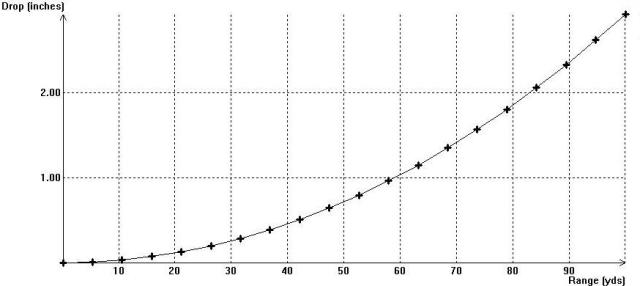
First the drop for a bullet fired with the bore of the gun horizontal. This is for a .308 Winchester shooting Federal match 168 grain bullets at “standard conditions” (59 F, sea level). Yes, I know this graph is confusing. It is not the path of the bullet. This is the distance the bullet has dropped as it traverses from the muzzle to the target. The drop increases the further it travels:


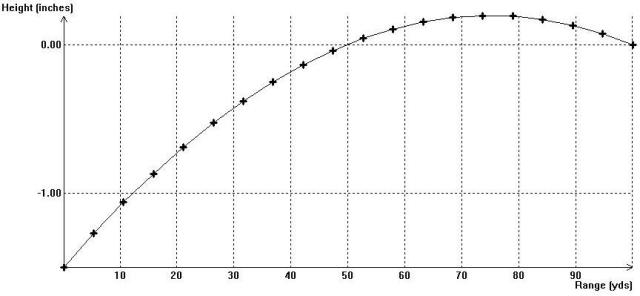
By the time the bullet has traveled 100 yards it has dropped nearly 3 inches. If you point the bore up at a slight angle (4.23 Minutes of Angle to be exact) compared to a scope mounted 1.5 inches above the center of the bore, aim the scope at a target 100 yards the bullet will start out 1.5 inches below the line of sight of the scope. Because the barrel is pointed up slightly as the bullet travels forward it will rise as it travels to the target. The distance from the line of sight through the scope to the bullet at any given range is called the height of the bullet at that range. Hence at the muzzle the height is -1.5 inches. And since the proper angle for a 100 yard zero was dialed into the scope the height at 100 yards will be 0.00 inches as seen in this graph:


So, from the viewpoint of the scope the bullet does rise and then fall. Of particular interest is that there are actually two zeros for this scope setting. There is a “Near Zero” at 49.8 yards and there is the normal or “Far Zero” at 100 yards. At what is called the Midrange, 75.1 yards in this case, the bullet is at its maximum height of 0.2 inches above the line of sight.


So that is the path of the bullet for a 100 yard shot.


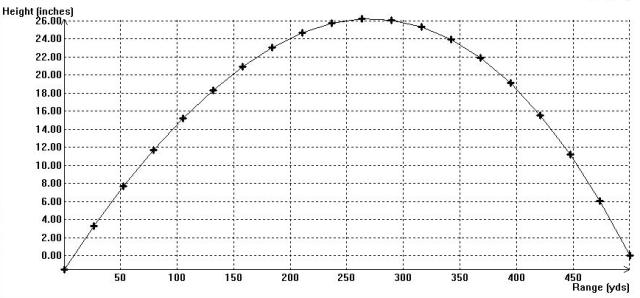
It is just my opinion but I don’t think shooting at 100 yards is very interesting with a rifle. The errors involved for temperature changes, air pressure, wind drift, and bullet velocity variations just don’t stack up enough to amount to much at that kind of range. For a .30 caliber rifle I don’t find things particularly interesting until we start shooting targets at 500 yards and beyond. I’m not going to get into all the interesting details because 99.9% of the people will find what I think is fascinating as mind bogglingly boring. But here is a hint of 500 yard shooting. A graph of the height of a bullet, again relative to the line of sight of the scope, for the same rifle and cartridge as above but for a 500 yard target:


The answer is yes

Someone wants to know if a .50 caliber round can penetrate a Mercedes Guard Pullman:


Domain Name   swbell.net ? (Network)
IP Address   69.155.141.# (SBC Internet Services)
ISP   SBC Internet Services
Location  


Continent  :  North America
Country  :  United States  (Facts)
State  :  Texas
City  :  Houston
Lat/Long  :  29.7755, -95.4152 (Map)
Distance  :  1,644 miles
Language   English (U.S.)
en-us
Operating System   Microsoft WinNT
Browser   Firefox
Mozilla/5.0 (Windows; U; Windows NT 6.0; en-US; rv:1.9.0.5) Gecko/2008120122 Firefox/3.0.5
Javascript   version 1.5
Monitor  


Resolution  :  1024 x 768
Color Depth  :  32 bits
Time of Visit   Dec 30 2008 4:24:59 pm
Last Page View   Dec 30 2008 4:24:59 pm
Visit Length   0 seconds
Page Views   1
Referring URL http://www.google.co… pullman&btnG=Search
Search Engine google.com
Search Words can a 50 caliber round pierce a mercedes guard pullman
Visit Entry Page   https://blog.joehuffman.org/2005/03/
Visit Exit Page   https://blog.joehuffman.org/2005/03/
Out Click    
Time Zone   UTC-6:00
Visitor’s Time   Dec 30 2008 6:24:59 pm
Visit Number   409,000


The answer is yes.


The Mercedes Guard Pullman is built to level B6/B7:


High-Protection vehicles, engineered to the European B4 resistance level, resist large-calibre revolver ammunition and offer particularly good protection against the increasing threat of drug-related and violent street crime.

Highest-Protection vehicles, engineered to resistance level B6/B7, provide effective protection against the threat posed by terrorist attacks. Their armour is designed to resist rifle-launched projectiles from military weapons which have a velocity almost twice that of bullets fired from a revolver. They also offer resistance to shrapnel from hand grenades and explosive charges.


According to this page the resistance levels are as follows:


  • B1 rifle .22 lr RN/Lead 10m

  • B2 hand gun 9mm Para FJ2)/RN/SC 5m

  • B3 hand gun .357 Magnum FJ3)/CB/SC 5m

  • B4 hand gun .44 Magnum FJ4)/FN/SCP 5m

  • B5 rifle 5.56mm x 45 FJ4)/PB/SC 10m

  • B6 rifle 7.62mm x 51 FJ2)/PB/SC 10m

  • B7 rifle 7.62mm x 51 FJ4)/PB/BC 10m*

The 7.62mm x 51 is .308 Winchester equivalent. Which means that even a .300 Win Mag (a common hunting rifle for those people in the Brady Campaign reading this) is not something they designed for. A .50 BMG should be able to punch through as well.


*If someone knows what the FJ4)/PB/SC etc. designations are I would appreciate being clued in. I presume it is the bullet type, like Full Metal Jacket, etc. PB might be lead (Pb is the chemical symbol), SC might be Steel Core. But that is all speculation on my part.


Thanks.

Xenia uses my Gun Blog 45

She is so creative.


She forgot to turn the laser off before she put it back in the case however. I lost a few hours of battery life but it wasn’t that big of a deal.

Quote of the day–Col. William C. Hunter

If there is anything in the theory of survival of the fittest, a lot of the people we know must have been overlooked.


Col. William C. Hunter
[I’m a little bit annoyed they canceled the steel match scheduled for today. People should be practicing under adverse conditions as well as when the environment is accommodating. Otherwise they are just enabling themselves to be culled when failure to perform under some hardship means non-survival.


I’d call them a bunch of wimps (actually I already did, but I didn’t mean it) except there wouldn’t be any place to park vehicles. With all the snow on the ground people couldn’t have driven up the road to the parking area.–Joe]

March pinup is non-functional

Did anyone else with the ParaUSA 2009 calendar notice that the March pinup is non-functional?


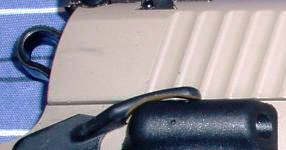
Here is the picture:


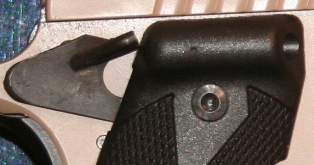
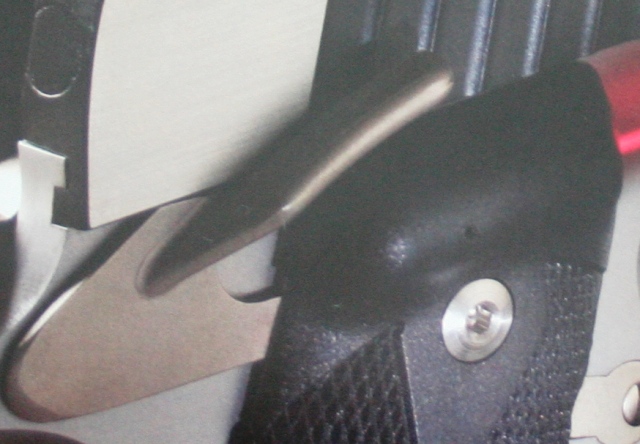
If you don’t see the problem click on the picture for a close up. People not familiar with 1911’s will be at a slight disadvantage in discovering the blocking issue.


Update: In response to comments and Tam’s post I present the following pictures from my Para Gun Blog 45 and what I think is Caleb’s Gun Blog 9 (I stole the picture from the header on his blog):


Para Gun Blog 45 safety.


Para Gun Blog 9 safety.


I admit I could still be wrong on this point. I do not think the safety on March pinup has been modified as seen in either of the two pictures immediately above. Therefore in order for the Para SX745S pictured on the March calendar to be function one or more of three things would have to be true:


  1. The safety is mounted in a slightly different place


  2. The safety requires less travel


  3. The grips mount in a slightly different location

I think each of the above are very unlikely to be true. Therefore I stand by my claim the safety in this picture is unusable and the gun was for display purposes only.


Anyone want to make bets on the topic?


Update2: Kerby Smith from Para Public Relations says:


From the camera angle you can not see that the safety is relieved on the bottom side. The SX745S which is the March 2009 Special Edition pistol can be ordered with or without the Crimson Trace Laser grips. The ones that are ordered with the Crimson Trace Laser grips will have the right bottom side of the safety modified. And that is why the Crimson Trace Laser grips are coming factory installed as an option so we can make sure the safety works with them.

Merry Christmas to someone

Position 65 for Boomershoot 2009 just opened up. It’s on the shooting berm near the west end. On the berm means shooting benches are discouraged.


Sign up here.


Do it fast. I expect it will be gone within a few minutes.


Update: Gone in four minutes, 45 seconds.

What to do after a rainy, slushy, windy Sunday

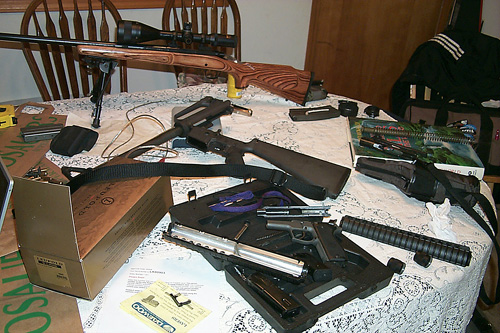
Well, duh!  You dry out your guns, of course.  If they stay wet, all kinds of corrosion can happen, which is bad.  The Remington 700 at the top has already been disassembled, dried and reassembled.  The Daewoo pistol and the Colt rife are still airing out.


I took my nephew, Ben, into the Idaho mountains to try some “long range” shooting on Sunday.  After 4-wheeling it through several miles of snow, we found a nice place to shoot.  Ben had never fired at anying more than 100 yards distant, and had only fired pistols and carbines. Shooting a sub two-inch group on the first try at 200 meters was something he was pretty sure he couldn’t manage.  He did that much easily, shivering in the rain, firing over the hood of my pickup using the Remington with its “deep space telescope” and heavy barrel.  Ben did some 25 yard work with the pistol and I worked out a preliminary zero on the Colt AR-15 HBAR’s new tritium sights at 25, 200 and 300 meters.  Ben made some comment about being “all wet and cold, and stuff” but I’m not sure what point he was trying to make.  It is December and we’re in the mountains, so?  By then it was getting too dark to shoot so we had to pack up.  There never seems to be enough time in the day.

Remington gets my approval

David reports on what Remington says about HS Precision. Good on Remington. I hope things continue to go along the current path.


My only Remington gun is fitted to a HS Precision stock. Except for HS Precision thinking a government thug is a good endorsement I’m very pleased with the combination.

The mocking of H-S Precision contest winner

Sebastian had a contest (which I intended to link to but never got around to in time) and the results are in. It is a very deserving entry. Congratulations Tim.

I’m on a blogger super hero team

Cool! I am especially thrilled with all the tall good-looking women (RobertaX, Tamara, and Brigid) I get to hang out with and help save the world.

Bowling pin match results

I said I was going to a bowling pin match yesterday.


Only three people showed up in the cold and the rain. I was the only one who had ever actually shot at a bowling pin match before and that was probably 10 years ago. We didn’t exactly remember the rules and some of the things we did we knew were “not according to spec”. For example we always drew from a holster with a starting position of wrist above our shoulders.


Also, the plan was to have a little bit of money riding on the results. We didn’t do that.


After doing the five pins in any order pretty much as the game is usually played we messed around with other things.


The results were:


5 pin first stage
Joe 7.55 7.40 8.91 Total: 14.95
Mike 17.09 8.74 6.11 Total: 14.85
Roger(winner) 7.41 16.40 7.08 Total: 14.49


5 pin second stage
Joe 8.87 8.95 9.00 Total: 17.82
Mike(winner) 5.75 7.22 8.73 Total: 12.97
Roger 8.77 6.54 12.65 Total: 15.31


10 pin (arranged like in a bowling alley)
Joe(winner) 9.25 8.21 19.78 Total: 17.46
Mike 11.08 8.31 11.34 Total: 19.39
Roger 13.94 15.18 14.59 Total: 28.53


Inside Out 7 pin (7 pins in a line, but you had to shoot the standing pin in the middle then work your way out)
Joe 12.17 +1 = 13.17 (I got a 1 second penalty for shooting one pin out of order)
Mike(winner) 10.32
Roger 14.65


Inside Out 5 pin (5 pins in a line, but you had to shoot the standing pin in the middle then work your way out)
Joe 12.11
Mike(winner) 6.46
Roger 9.08


Outside In 7 pin (7 pins in a line, but you had to shoot the standing pins in the ends first then work your way in)
Joe 9.65
Mike(winner) 7.83
Roger 10.92


Shoot one, skip one 7 pin (7 pins in a line, but you had to shoot every other standing pin from one end first then reverse it, repeating until all the pins were down or off the table)
Joe 11.92
Mike(winner) 11.33
Roger 21.33

Thanksgiving day pictures

Xenia has them.


Also from Xenia is a set from Thanksgiving 1991 with the Huffman family. I especially like this one:


That is her first gun. It was given to her by her Grandpa Huffman who made it himself.

I want these as mil-surplus

In a lot of ways it would take a lot of the fun out of long range shooting but I’d still buy a few rounds if I could get them “cheap”. I’m sure even as mil-surplus they would be expensive enough I wouldn’t be shooting a lot of these:


Darpa, the Defense Department’s far-out research arm, announced a pair of contracts yesterday, to start designing a super, .50-caliber sniper rifle that fires guided bullets. Lockheed Martin recieved $12.3 million for the “EXACTO” (EXtreme ACcuracy Tasked Ordnance) project, while Teledyne Scientific & Imaging, LLC got another $9.5 million.


If the system works, it’ll “provide a dramatic new capability to the U.S. military,” Darpa says. “The use of an actively controlled bullet will make it possible to counter environmental effects such as crosswinds and air density, and prosecute both stationary and moving targets while enhancing shooter covertness. This capability would have the further benefit of providing increased accuracy and range while reducing training requirements.”


And from the same article:


The agency has earmarked $7.5 million for a laser-guided bullet program. Darpa gave Lockheed $2 million for advanced sniper scopes that could boost kill rates by tenfold, or more. If the system works out as planned, it would actually allow snipers to remain virtually invisible, lost in the “heat haze” in between them and their targets. Our own David Hamling called the project the “next war’s secret weapon.”

Bowling pin match tomorrow

I plan to attend a pistol match at the Lewiston Pistol Club outdoor range tomorrow (Friday). From organizer Mike Brown:


We’re going to have a “Black Friday” bowling pin shoot for those of you who would rather shoot than shop. $1 a table, fastest time in each run gets the pot.


Just pistol. 1100 start.


Everyone who can play safe is welcome.

It’s Muzzleloader Season in Eastern Washington

I started buying guns during the Clinton years, simply because they were trying to ban them, but never thought much about hunting until my son was old enough to carry a youth-stocked shotgun in the field.  I took him through hunter safety and we’d gotten a few upland game birds together, but he was always interested in big game hunting.  Three years ago we bought him his own rifle, and the next day he’d gotten his first deer.  I’d gotten a deer tag here and there, and gone out a day or two some seasons, but it was never a big priority for me.  We went out with Joe once near his folks’ place, which was really nice, but only managed to see one deer in full sprint, which makes for a lousy (and dangerous) shot.  No dice.  I did what I could to help Son get his deer or two each year, and the vicarious satisfaction was enough, I guess.


Not this year.  When I took Son to get his ’08 deer tag, I decided to get one for myself– for late muzzleloader season, and I meant it this time.  Fewer hunters in the field and the cooler weather of the late season appealed to me.  We’d selected the perfect site for a tree stand, just a short walk from our house on a steep hill covered by thick brush where humans rarely tread, and where the deer trails all seem to converge.  This is a choke point in their travel around the city of Palouse, along the Palouse river.  Son got a deer there last year, and had seen several deer almost every time he’d been up there.  Last year I sat in that tree and watched a doe with two fawns, sitting, chewing the cud, the young ones chasing a covey of quail, and just generally hanging out, for about an hour.  My tag was for buck only at that time, so I just sat there watching them, not 15 yards from me.  It’s good to really blend into the environment now and then.  You see some amazing things.


This year I went out before dawn on the first day of the season, November 20th, with the caplock muzzleloader.  Some people use in-line muzzleloaders with substitute propellant pellets, modern sabots, shotgun primers, and scopes.  I don’t quite understand the benefit.  A sidelock with the right load, standard percussion caps, using black powder which ignites more easily, can perform just as well at reasonable distances, and it’s not as if these rifles are 300 yards hunting worthy.  I charged the rifle with powder and round ball with a lubricated patch before heading out of the house (a muzzleloader that is not primed is not considered “loaded”).  A few yards from the house and I was out of the city limits.  Time to cap the nipple.  If I see a deer after about 15 minutes I can legally fire.


Nothing.  No other hunters and no deer.  I crawl through the brush and up the steep slope to the tree.  Tough going.  I’m winded.  I have a tendency to be afraid of heights.  Huffing and puffing, I start up the tree.  Too shaky.  Not safe.  Back to the ground.  I have to think; my hands aren’t going to suddenly let go just because I’m a little winded.  Back up the tree (it’s a hairy climb) to sit on the small stand.  I experience just a bit of vertigo for a minute, and then everything’s fine.  The rifle was decapped and tied to some parachute cord at the ground, so I hoisted it up to the stand and capped it again.  I sat there for two hours as the sun came up and then, suddenly; nothing happened.  No prey was doing me the favor of walking in front of my extremely limited field of fire that day.  Tons of sign on the ground, but no luck.  Time to climb down and get ready for work.


Two days later, I went back up to the tree late in the day and sat there for an hour and a half.  Nothing.  Tons of fresh sign, but nothing.  I was thinking of climbing down and taking a hike along the river for about two miles.  Anywhere along that corridor there could be deer.  I wanted to act.  But no– if I’m moving, the deer are infinitely more likely to detect my presence and high-tail it before I can get a shot.  If you’re still, and your prey is moving, you have the advantage, especially if your prey is somewhat predictable.  These deer are predictable.  For sure, they’ll be moving at dusk, which is right now.  The only questing is where.  But I should act– he who hesitates is lost.  But haste makes waste.  But the early bird gets the worm.  Look before you leap.  There’s no time like the present, tomorrow’s another day, etc.. I was trying to think of more contradictory words of wisdom when I heard a rustling in the brush behind me.  Had to be a human or a large animal, no question.  A large doe appears from the brush, followed by more deer.  Who cares– this one looks really good.  The muzzleloader tag is for a deer with either a 3-point minimum rack or antlerless.  I’m shooting for the table, not for trophies.


She’s directly below me now, oblivious to my presence, walking fast.  I could have shot downward, through the spine and anchored her right there, but I’d rehearsed this in my mind many times and the picture was always of a side-on shot.  No matter, she’s moving quickly, leading more deer up the hill to feed on the farmers’ wheat.  It’s a herd.  She’s still oblivious.  Have to hurry.  I pull the trigger, thumb the hammer all the way back, release the trigger, and ease the hammer forward into full cock.  Silent cock– rehearsed this hundreds of times.  It wouldn’t have mattered because the deer were trundling through the brush making plenty of noise, but it’s the way this was rehearsed.  Keep the trigger finger straight along the stock.  Can’t touch this trigger.  Its pull is as light as some set triggers– a pound or less.  I’d spent hours on it, messed it up, replaced the tumbler and sear, and started over.  Now the trigger pull is as light as you’d ever dare, even slightly dangerous, but this isn’t a social rifle.  The charge has been in the barrel for over 48 hours, it came in from the cold last time and into the warm house where it could have pulled in some condensation, but it should be fine.  I’ve tested this and there should be plenty of headroom in that regard.  I’d been using CCI caps, but it was a little frustrating that once in a while I’d get a misfire.  The caps fit too tight on this nipple, and some of the hammer’s energy had to be spent seating the cap.  The same thing can happen with metallic cartridges if the caps aren’t properly seated, or if headspace is too great.  I’d read that Remington caps tend to fit looser, so this time I had a Remington cap on there, as I’d tried them and couldn’t get a failure.  No worries about a misfire.


The doe turned her side to me in the perfect spot, not 20 yards from my tree, with perfect backstop.  Front sight behind the shoulder, rear sight, finger on trigger, Bam!  On later reflection, I recall having sensed no recoil and he noise, without hearing protection, was not uncomfortable.  You do this at the gun range and it hurts.  Here it’s not even noticed.  It’s a strange thing.


The doe bounded away from the cloud of smoke, up the slope, and into the field like a perfectly healthy deer, several others behind her.  No time to reload– that’s not an option.  I could not possibly have missed.  I know.  I was there.  I saw the whole thing.  But off she ran.  Crap…no, wait, she’s slowing down.  At the top of the hill out in the wheat field, she stumbled and went down.  OK.  I have to remember to breathe at this point.  Sometimes that’s important.  I tied the rifle to the cord, lowered it to the ground, called Son on the radio & told him to bring the pickup, and then started climbing down.  He called back about something or other.  Crap.  I felt I had to answer right then, holding onto one of the “steps” (angled metal screws we put in the tree for hand-holds) with one hand while operating the radio with the other.  Probably not a good idea.


The 50 caliber ball (mass; ~180 grains) pushed by 110 grains of Goex FF black powder (this is the charcoal, sulfur and KNO3 mixture of yore) had traveled squarely through the rib cage and out the other side, behind the shoulders and in front of the diaphragm.  That’s the “boiler room”–the heart/lung cavity.  I’d been told this wouldn’t happen– that the round ball would stop just short of full penetration, but maybe those hunters use a lighter powder charge.  Still, more velocity should mean more deformation of the soft lead ball…  Impact velocity was about 1850 fps, and the exit hole was about the same size as the entry.  That’s a “one-shot stop” but, both lungs partially liquefied, this doe ran up a steep slope, bounding over bushes as pretty as you please, and into a field before going down.  That was about 75 yards total, with some rough going.  Something to keep in mind.  If you want to “anchor” the animal, it has to be a critical skeletal shot, like right through two shoulders (they can run pretty well on three legs) or a central nervous system (CNS) shot.  Little else will stop an animal (two legged or four legged) in its tracks, Hollywood notwithstanding (see update below).  I tried to avoid the shoulders because there’s some good meat there.  One of Son’s deer had had a scapula shattered, and that was a mess.  No thankee.


The whole sequence, from first hearing noise in the bushes to the deer falling, lasted around 15 seconds.


What, I can’t go on and on about it?  I’m 50 years old, this was my first deer, and now we have a lot more good meat for the freezer.  Yahoo!  For those who fear “gamy” venison; maybe we’ve just been lucky, but we’ve not noticed a trace of this phenomenon with the animals we’ve harvested so far.  We’ve gotten does because they’re vastly more common.  People who tell me they hate venison because its gamy all seem to have eaten bucks.  I really don’t know what makes for sweet meat verses gamy.  More research is obviously needed.  No doubt a federal grant is in order.


Next I’d like to try a flintlock.  Why?  Just ’cause.  For one thing, a modern rifle is for long shots, and the hunting we do near the house is limited to no more than about 70 yards (so far we’ve killed no deer beyond about 40 yards).  For another; I just want to.  I’d’ve used a muzzleloading pistol if the WA game department allowed it.  I won’t go on about how using a primitive gun is some sort of superior life choice or anything.  It isn’t.  I admit it’s a distraction.  The people who used them back in the day were in fact using state-of-the-art technology.  We should learn the state-of-the-art for our own time, and endeavor to advance it.  If they’d wanted to be old-fashioned in the 18th or early 19th century, they’d have used matchlocks or bows and arrows.


Here’s the obligatory, grizzly post kill photo along with the rifle;


Yes, some people find liver to be disgusting.  I like it.  I’d show you a big juicy steak, but for best flavor and tenderness, the muscle meat has to age for several days before cutting and cooking.  The liver is great if eaten right away.  These deer liver steaks were fried in olive oil with shallots, just a pinch of crushed of rosemary, and salt & pepper, served with a nice baked potato and a glass of red Zinfandel.  Simply lovely.


Update Dec. 1 / 08


Butchering the deer this weekend, we found the heart had been grazed by the ball, opening a hole in one chamber (yeah, we leave the heart in while it hangs.  Call us weird).  The ball entered straight through one rib and out through another, severing both.  The doe had run about 75 yards with two blown lungs, a blown heart and two severed ribs.  I also found an almost pristine 17 caliber air rifle pellet lodged against the pelvis.  It would have had to travel through the hide, through a layer of fat, through 2.5 inches of meat and stop at the bone.  I doubt this could have happened to the adult doe. 17 cal air rifles don’t typically have near enough penetration, plus there was no apparent wound channel, so I’m thinking someone shot a fawn in the butt.  Some people’s kids.

Gun Blogger Summer Camp shoothouse video

From Gun Blogger 2008 Summer Camp. See also the slide show I made.


My pathetic run:


Others have put theirs up too:


More on wearable sniper detectors

Saturday I mentioned some sniper detection devices designed by the Brits. It turns out the U.S. Army ordered $10 million dollars worth of them:


QinetiQ North America’s Technology Solutions Group, a global developer of innovative technology solutions for national defense, today announced a $9.95 million order from the U. S. Army’s Rapid Equipping Force (REF) for SWATS(R) Soldier-Wearable Acoustic Targeting Systems. Part of the Ears(R) Gunshot Localization System product family, SWATS(R) soldier-worn units will be deployed to U.S. Army troops in both Iraq and Afghanistan this year. The deployment is expected to be completed by early next year.


A brochure and other info are here.


I wonder if it would crash if it were placed down range at Boomershoot when the opening horn was sounded.

Software alpha release

I have my software project ready for an alpha release (feature complete, but there are known bugs which must be fixed before release).


This was designed for cell phones not a desktop. It will work on desktop and laptop computers but whenever a user interface design was a trade-off between a desktop user and a mobile user the mobile user was given the advantage.


The software is a web based exterior ballistics calculator and can be found here: http://test.joehuffman.org/ http://field.modernballistics.com.This is much different that Modern Ballistics but uses the same algorithms and concepts. This web based version is for use in the field. Example, while at Boomershoot you can input the exact ranges and inclination to a set of targets combined with the weather conditions to get the scope setting needed for one shot, one “kill” hits on the boomers. I plan to have it running on a local server at Boomershoot 2009 so cell phones (and laptops) with WiFi support can get really fast results even with a heavy load of users.


I’m also thinking that maybe for Boomershoot 2010 I will have a weather station on site that will update the conditions for a special version of the software in real time.


Known bugs:


  • The help page is for the desktop version not the web based version.
  • If the bullet velocity at the target is less than 1400 fps all parameters such as elevation angle, windage, time to target, etc. are in error.
  • Some optimization for response time and load handling should still be done.

All data is stored in cookies on your device. This means the website does not need to save the data on the site in order to save your data. The downside is that all your input from the desktop does not show up on your cell phone or if you get a new cell phone the data will have to be reentered.


At this point I’m mostly looking for user interface and device compatibility issues. Does it appear to work on your Blackberry? Does it work on your iPhone? Is the user interface easy enough to understand and use? If you have problems with your cell phone try using it on a desktop computer to make sure you are using the software right before assuming the cell phone is having problems with the website.


Leave comments here.


Thanks for your feedback.

Quote of the day–Greg Hamilton

Recently I was told “well you guys are all Glock guys” “you all just like glocks” we are surely NOT “glock guys” I don’t shoot glocks because I like them. I like them because they do for me what I want. They have the combination of reliability and longevity I want; in a reasonable package size, for a reasonable price. Funny things is a lot of people pick Glocks because of how much ammo they carry, that wasn’t really in my criteria at all. The only way that would fit into my decision making is if two guns were equal in ALL other areas and one carried more ammo, then sure I’ll always take more for no trade off.

Greg Hamilton
Founder and Chief Instructor Insights Training
Insights Email List: October 25, 2008 12:21 PM Subject: Random Thoughts
[I frequently get asked “What gun should I buy?” My response is typically a heavy sigh. It depends on what you are going to use it for, how often you are going to shoot, and probably a dozen other things. The Insights instructors mostly shoot Glocks but their criteria is a little different than mine. And my criteria is a little different than the last five people that have asked me what gun to buy.

I advise new shooters to buy something fairly cheap and shoot it until they are fairly certain they are shooting better than the gun or they understand their needs well enough to buy something more appropriate. My first rifle was a SKS I paid $125 for. I put over 1000 rounds through it before I had a need for a better rifle. But I knew the rifle was holding me back and a better rifle would get better results. My first handgun was a Ruger P89. I put about 30,000 rounds through it. I even won a few steel and USPSA matches with it. By that time I knew the P89 was holding me back and I knew why. I then bought my STI Eagle because it would overcome the weaknesses for my uses I had exposed in the P89.–Joe]