Quote of the day—Dave Workman

Fascitelli would have the world – or at least the Pacific Northwest corner – believe that just one more gun law, and a lot fewer guns in the hands of law-abiding citizens, would be a panacea to the kinds of irrational violence witnessed recently at the Kent car show and a casino near Auburn.

He would gladly sacrifice our civil right to advance his political agenda. That may be okay in New York, but he’s on the wrong side of the Mississippi River to be pushing involuntary public disarmament.

Dave Workman
August 5, 2011
Question to CeaseFire president: Who is the real extremist?
[The Washington CeaseFire board president claimed the Second Amendment Foundation was an extremist organization. This is particularly amusing, as Workman points out, because SAF was on the winning side of  the Heller and McDonald decisions while the position advocated by Fascitelli was struck down. When the Supreme court disagrees with you might want to revaluate who you are calling an extremist.

Does anyone else keep seeing “Fascist” when they glance at the name “Fascitelli”? As a name for anti-gun advocate that has to rank right up there with Professor Bogus.—Joe]

Privacy issues

Numerous times I’ve posted half-baked concerns about our increasing loss of privacy and the dangers and even extreme dangers.

Some people have brought up good points and/or asked good questions and I will respond to those people then share further thoughts I’ve had on the topic.

Acksiom asks (after I said having a twin could be useful to raise reasonable doubt about who did what):

Joe, what kind of situations do you have in mind where that would be appropriate?  I can’t imagine any where I would want to raise reasonable doubt by blaming another innocent person, so I’m curious.

What if your employer is extremely conservative/liberal and a picture shows up of you at a gay-bar or sex shop/gun range or Tea Party rally? There are lots and lots of things of this nature. In the mild case they are things like pictures of a drunk, topless, woman at spring break 10 years ago who now wants to run for public office or be a Sunday School teacher. In the worst case we are talking matters of life and death, Jews in the Attic, type of things.

Alan states:

Privacy is a recent illusion caused by growing population and increased mobility.  Technology is allowing the return to the historical lack of privacy that has been the normal human condition for thousands of years.

You can’t fight it any more than the RIAA or MPAA can fight file sharing.  Better to start thinking how we’re going to adapt to everyone knowing everything.

In regards to his first point, it’s more like millions of years but that doesn’t distract from the validity of his observation. What is different now is that we don’t have a small homogenous tribe. We have an exceedingly diverse population with a powerful government.

In regards to his second point I’m not entirely convinced it is possible create an environment where “everyone knows everything”. And as long as an imbalance of knowledge exists there are “issues”. I am convinced that he is right about the analogy with the RIAA and MPAA. The “privacy gene” is not only “out of the bottle” the bottle has evaporated.

Sebastian posted (three+ years ago):

But in an information based society government will be able to know a lot about its citizens.  Our government probably knows more about its citizens than any other government in history.  There won’t be much means to avoid that.  Conversely though, information technology also makes it possible to know more about our government than any other people in history.  I would encourage and recommend anyone who’s interested in this topic to read David Brin’s The Transparent Society.

Tam stated (several months ago):

I think David Brin had it mostly right in The Transparent Society: This genie is well and truly out of the bottle, and the only non-Orwellian outcome will be if everybody has access to it.

Sebastian echoes (last night),

One of the sources I look to in this issue is David Brin’s “The Transparent Society”. I don’t think Brin is right about everything, but the fundamental idea that the loss of privacy isn’t such a big deal provided it’s applied equally in society, I think is a reasonable concept.

I responded (three+ years ago) by saying the politicians and government employees should go first and we will see how well that works out. The only thing I think I need to add to that post is that they should add real time location information to the collection of public servant information available to the general public.

We are entering uncharted territory. Never before has their been societies this diverse able to know this much about everyone else. Sure, if you go back far enough (it would not be necessary but just to make the point stick go back to where the family tree branching off of the apes) people didn’t have privacy when they had sex or were defecating let alone where they were or what sort of god(s) they did or did not worship. But in those days, with a much more homogenous society, it may not of mattered.

I say “may” because I wonder if such an open society was almost forced to be homogenous at a communistic lowest common denominator level. Perhaps a capitalistic/competitive society requires certain levels of privacy to function. My hypothesis is that trade secrets, secret contracts, and secret finances are necessary for a competitive society. Stated in the strongest (but perhaps indefensible) terms, if you don’t have privacy you cannot “get ahead”. A corollary that follows (perhaps also indefensible) is that if there is no privacy then society is economically doomed to some sort of tribal communistic system. Did the rise of commerce, technology and industry only come about because various tribes had privacy from one another?

Now there may be at least partial solutions to the economic hazards of a completely open society. Patents, for example, are intended to protect information that cannot be protected by trade secrets. Written agreements can be kept private unless a court order demands otherwise. But there are still many vulnerabilities when facial images or location data of people entering corporate headquarters reveals a connection between two or more companies that didn’t used to be there. Or your employer tracking after hours employee location data discovers a handful of engineers getting together at a bank and checking out empty office buildings together.

Imagine what can happen in political campaigns. Knowing who is talking to who gives someone tremendous information about what sort of issue are going to be important and how much money is going to be involved. Sure that information all comes out eventually but when you have the info weeks in advance it will make a huge difference.

Imagine the implications for stalkers. Anytime they wish to go on the hunt they leave their cell phones 50 miles away and know exactly where their prey settled down for the night.

Imagine the implications for an abused spouse trying to hide from their ex.

On a governmental scale the events are less likely but the consequences are catastrophic. Here is a scenario I heard outlined this morning. Monitoring of your water, electricity, and data (Internet) consumption shows a step increase. Examination of your communication traffic might well show that one or more people had a decrease in traffic therefore they are likely
the new residents in your home. Examination of transportation expenditures could confirm it. This fails my Jews in the Attic Test.

Imagine a scenario where a government is deadly hostile to gays (gun owners, Jews, blacks, Tea Party “terrorists”, Christian Fundamentalists, whoever). Public records (while I support gay marriage I sometimes wonder if it is a greater risk than people realize), blogs, and social networks, are scoured to identify the individuals. The communication traffic is examined and the leaders are easily identified even without knowing the content of the communication. Location information is then used in synchronized snatches at 3:00 AM. The plans for the snatch in any realistic “transparent society” would still be opaque because it would be protected out of concern for “nation security”.

Do you think it couldn’t happen in this country?

If so you have forgotten about the black lists in the 1950s. And the Japanese, German, and Italian internments which held over 100,000, of which about 60% were US citizens, during WWII. And you aren’t familiar with the Palmer Raids. Okay, the Palmer Raids were at 9:00 PM, not 3:00 AM. You have me there.

Those events are just the tip of the iceberg and  without computers. Imagine what a government could do with computers and far, far, more detailed information about our location, habits, and social networks.

Someone in law enforcement once told me that the government has a list of everyone in this country who has training as a sniper and “keeps close track of them” in what sounded like nearly daily updates on their locations and somewhat less frequent updates on their attitudes toward high level government officials. How many high-power rifle shooters also have their names on some list?

In a “transparent society” what does it matter if there are lists like that, right? You can have your lists too! But some lists are scarier than others and will always be secret for “reasons of national security”.

Although some have advocated deliberately adding noise to your digital footprint unless this is automatically done by your own computer at near zero cost per transaction you are soon going to get tired of the game. And if FinCEN can’t pierce the noise they will just make it illegal. And, as a person with a Masters degree in communication theory where we learned to pull signals out of noise, I don’t think it would be that hard to detect the noise, pull out the true signal, and then give greater attention to those people.

A few years ago I mentioned to someone in the banking industry that I did almost all my financial transaction in cash. Checks, credit and debit cards where used far less than most people. I was told that, for certain, put me on a list.

Perhaps my view is biased by reading too many books like Hitler’s Willing Executioners, Plotting Hitler’s Death, and Bloodlands—Europe Between Hitler and Stalin, but I contend a “Transparent Society” is very risky. I still don’t have any good answers short of “dropping off the grid” which just doesn’t scale. I have some possible answers which I would be glad to discuss in private but I just don’t have the time to implement them let alone deploy them on a scale where it could make a material difference even if they were effective and could avoid being declared illegal when detected.

The one method of last resort, a doomsday plan, which appears to be the least distasteful if things get really bad are the Second Amendment remedies. But even without formal gun and/or gun owner registration our society is already transparent enough that a “first strike” on the top 10,000 or so gun owners/activists with follow ups on a few hundred thousand more (remember the numbers from the WWII internment camps?) might be sufficiently effective to neutralize even it.

I’m told I’ll never have to worry about that. I suspect most of the people that tell me that are absolutely correct but for the wrong reason. I’ll be in the “first pass”.

Let them start with John Kerry

While I can understand the impulse if this were to be implemented I think it should be first applied to the likes of John Kerry who says stupid things like:

The media in America has a bigger responsibility than it’s exercising today. The media has got to begin to not give equal time or equal balance to an absolutely absurd notion just because somebody asserts it or simply because somebody says something which everybody knows is not factual.

This was in regard to the Tea Party who he claims “held the country hostage” during the debt ceiling debates.

“Everybody knows”? I would like to suggest Senator Kerry reexamine the last election results in terms of how many people believe what the Tea Party candidates have to say.

It’s going to get worse before it gets better

S&P downgraded the U.S. debt rating. And it’s not looking good for the future either:

The outlook on the long-term rating is negative. As our downside alternate fiscal scenario illustrates, a higher public debt trajectory than we currently assume could lead us to lower the long-term rating again. On the other hand, as our upside scenario highlights, if the recommendations of the Congressional Joint Select Committee on Deficit Reduction–independently or coupled with other initiatives, such as the lapsing of the 2001 and 2003 tax cuts for high earners–lead to fiscal consolidation measures beyond the minimum mandated, and we believe they are likely to slow the deterioration of the government’s debt dynamics, the long-term rating could stabilize at ‘AA+’.

And with each downgrade the interest rates increase which makes the debt burden more difficult to bear which makes it more likely another downgrade is coming.

Hope and change just keeps coming.

Mass printing of money is almost for certain in our future. I figure than in another couple years I can probably pay off our mortgage with that half ounce of gold in one of my safes or a few hundred pounds of lentils…

Quote of the day—Democratic aide

I just remember the question. I sort of think it sort of speaks to a larger issue of guns in society. I guess the question is, if legislation affects people who don’t follow the law. I think, ultimately, more guns on the street isn’t the answer.

I guess the simple answer is, there is no place for them in society. What purpose do they serve?

Democratic aide
March 22, 2011
In response to the question, “How would more legal restrictions on legal gun-owners affect criminals and their illegal possession of firearms.”
Everything you need to know about the most recent gun-control debate (but didn’t have anyone to ask), Part II
[The word “simple” applies—as in “simpleton”.

Their entire world view was balanced on a house of cards and a gentle puff caused their universe to collapse into a black hole. And their response was, “We want to ban them all.”

That is behavior consistent with bullies everywhere. If you show them to be fools they will beat you up and take your property.—Joe]

Random thought of the day

There exist heat pumps that can heat our homes with greater than 100% efficiency compared to converting the electrical/mechanical energy directly into heat.

Could there exist a means to make a “light pump” and convert large quantities of infrared light (thermal energy) into smaller quantities of visible light as a means of artificial lighting at something greater than the abysmal  efficiencies of our existing light sources?

Quote of the day—Donna Davis

There are too many guns around already; we don’t need more, and in a public place like that, I’d like to feel safe if I’m going to the park. If there’s a gun there, I don’t want to be there.

Donna Davis
August 4, 2011
Local Governments Have Until Oct. to Remove Gun Control Laws
[And just how many is too many? I suspect all she knows is that there is more than zero and that is too many for her. If that is the case then Ms. Davis needs to move to a different country because in this country what she wants is clearly unconstitutional.

It’s no different than her saying, “There are too many mixed race couples and blacks around already; we don’t need more, and in a public place like that, I’d like to feel safe if I’m going to the park. If there’s a black person there, I don’t want to be there.”

Ms. Davis, since you don’t even know how many guns are “around” yet you spout off like that anyway you must have crap for brains. And since you want to infringe upon a specific enumerated right you should move to some country which doesn’t recognize the natural right to keep and bear arms. You don’t belong here so rather than whine about it just move. We all will be happier for it.—Joe]

Gold and silver

The price of gold is now $1670.00 an oz. Silver is $41.80.

I think it’s the hope and change taking effect.

Quote of the day—Violence Policy Center

In the 1980s, a very significant shift in gun design and marketing occurred: high-capacity semiautomatic (firing one round per trigger pull) pistols became the dominant product line. Looking at the United States, the most lucrative civilian handgun market in the world, prior to the 1980s the most popular handgun design was the revolver, most often containing six shots. In 1980, semiautomatic pistols accounted for only 32 percent of the 2.3 million handguns produced in America. The majority were revolvers. By 1991 this number had reversed itself with semiautomatic pistols accounting for 74 percent of the 1.8 million handguns produced that year.

Violence Policy Center
July 25, 2011
The Glock Pistol: A Favorite of Mass Shooters
[I love it when our opponents make our points for us. What this means is that Glock pistols are protected by the Second Amendment because they are “in common use” (see D.C. v. Heller).

If the VPC and the Brady Campaign people want to ban guns and actually have some chance of success what they should to is go after the guns that might not be protected by the Second Amendment. The guns that might not be protected are the flintlocks, matchlocks, and cap and ball firearms of a century or more ago. That would actually make a certain amount of sense because both the organizations and those type of firearms are only of interest from a historical perspective.—Joe]

Illegal guns explained by Tom Diaz

VPC’s Senior Policy Analyst Tom Diaz explains “illegal guns”. He gets off to a great start with:

The phrase illegal guns really has no value in the way we approach looking at the problem of death and injury in the United States which is from the public health perspective. It’s really sort of a political term that is often used to avoid confronting the bigger problems…

He goes on to explain various ways firearm end up in the hands of those prohibited from owning firearm. He does a pretty good job of it. I really couldn’t find much fault with what he said until the very end when he said the states with lax gun laws needed to have strict gun laws.

What he willfully ignores and fails to mention is that those states with strict gun laws have a strong tendency to have higher rates of violent crime. By myopically only looking at “how did the criminal get a gun” rather than “what firearms policies result in increased public safety” he completely fails at the presumed goal of his organization, The Violence Policy Center. It should be abundantly clear that Tom Diaz is not interested in policies that reduce criminal violence. He is interested in restricting access to firearms. His organization wants to ban firearms and infringe upon the specific enumerated rights of innocent people. It’s shameful the interviewer, “Eight Forty-Eight” only presented the position of an organization which advocates for illegal government acts.

No good answers

Privacy is more and more a thing of the past:

In one experiment, Acquisti’s team identified individuals on a popular online dating site where members protect their privacy through pseudonyms. In a second experiment, they identified students walking on campus — based on their profile photos on Facebook. In a third experiment, the research team predicted personal interests and, in some cases, even the Social Security numbers of the students, beginning with only a photo of their faces.

Carnegie Mellon researchers also built a smartphone application to demonstrate the ability of making the same sensitive inferences in real-time. In an example of “augmented reality,” the application uses offline and online data to overlay personal and private information over the target’s face on the device’s screen.

“The seamless merging of online and offline data that face recognition and social media make possible raises the issue of what privacy will mean in an augmented reality world,” Acquisti said.

Cloud computing will continue to improve performance times at cheaper prices, and online people-tagging and face recognition software will continue to provide more means of identification.

“Ultimately, all this access is going to force us to reconsider our notions of privacy,” Acquisti said. “It may also affect how we interact with each other. Through natural evolution, human beings have evolved mechanisms to assign and manage trust in face-to-face interactions. Will we rely on our instincts or on our devices, when mobile phones can predict personal and sensitive information about a person?”

This technology has profound implications for both good and evil. Surveillance cameras can scan our sidewalks for wanted criminals as well as political dissidents. And the app for your cell phone can do a background check on your daughter’s date or identify a TSA agent in line at the grocery store.

I worry about this but don’t have any good answers. It seems that about the best you can hope for is that you have a twin* such that you can raise reasonable doubt in those situations where it really matters.


* My twin was discovered by AntiTango.

Quote of the day—Tea Party

US Treasurys Now a Toxic Asset.

TeaParty@TeaParty.org
August 2, 2011
Subject line to this email.
[If only there were somebody we could unload the toxic asshats in Washington on. Someone with an abundance of tar, feather, and rails would please me.—Joe]

Quote of the day—Carolyn McCarthy

I don’t understand why people can’t have common sense. Large magazines do not need to be part of it. The large manufacturers, they should even take a moral point of view in not selling them to ordinary citizens through the gun stores. The police and military can still use them. But I just morally think they should not look to sell them to the average citizen.

Carolyn McCarthy
July 28, 2011
Norway shooter: Ammo clips were from U.S.
[Yes, it’s “the shoulder thing that goes up” Carolyn McCarthy demonstrating her ignorance and bigotry again.

“Common sense” is a big issue with these folks isn’t it? It must be because arithmetic is beyond them and/or they know the numbers don’t support their conclusions.

And how does one “morally think”? I’m pretty sure that is one of the same argument used by those opposed to mixed race and homosexual marriages. That’s sure some good company you keep there McCarthy. I’ll bet you and Fred Phelps would get along just fine as long as you both consistently and appropriately swapped the words “gays” and “guns” during the conversation.

The entire article could be a case study in “layers of editorial oversight”. There are things like, “The Norwegian press has written extensively about how Breivik legally acquired his weapons and ammunition, but the mail-order purchase of his ammo from the United States has received little attention in the English-language press.” Apparently the author, Reid J. Epstein, doesn’t know the difference between ammo and “clips”. Although I was surprised that there were two instance where he appropriately used “magazine”.

And McCarthy must be reading the gun blogs because she wasn’t quoted as saying “clips” even once and she is quoted as saying “magazine” twice. Perhaps she is capable of learning. I wonder if someone were to introduce her to the “in common use” part of the Heller decision if she could grok that as well. But probably not. I pretty sure Dorothy Parker had people like her in mind when she explained about horticulture.—Joe]

Debt reduction via a police state

As the Federal debt started exploding a few years ago I tried to look ahead and figure out what would happen. Lots of bad things of course, but one potential outcome, as I mentioned in a blog post a few days ago, was that a new wave of politicians would get elected and scrap most or all of the nanny state agencies to cut expenses. Sort of “every cloud has a silver lining” kind of thing.

I should know better than to think any government operation could have a “silver lining”.

What I had never considered, not even in my most pessimistic moments was that the Feds would find a way to turn the crisis into a way to further expand their control. Instead of control weakening as funding became harder to get there is a path whereby funding is obtained by increasing control. Sure, I know about the war on drugs and confiscating property “involved” in a drug crime being used to fund law enforcement. But this is much, much worse.

I recently had a reliable source tell me the EPA, OSHA, and other regulatory agencies have been told to explore how they can supply their own revenue such that they become self supporting. “Run like a business” and even potentially make a profit. My source explicitly called out the EPA and OSHA but one can easily imagine how this mandate will be extended to the ATF and hundreds of other government organizations.

If the color didn’t just drain out of your face and you nearly fainted you either don’t have a very good imagination or you have a government job.

The only way these regulators can “make” money is through fines and confiscation of property. One of the examples given to me was of dust production in a particular type of facility of which there are thousands all across the country. I’ll not name them to avoid giving the Feds easy targets but these facilities have existed for many decades and are an essential part of our infrastructure. The regulations say that if more than 0.125” of dust builds up on the interior surfaces of the buildings they must be cleaned or else they can be fined. The problem is that no one knows of a fix for the problem. It would take 7 to 8 hours to clean a facility. It’s a problem similar to the classic “If one man can dig a post hole in two minutes how many minutes would it take two men to dig a post hole?” It just can’t be done in less than 7 to 8 hours. Once the facility goes back into production the dust will exceed spec in about 30 minutes. Obviously a facility that is in maintenance mode 15 times as much as it is in production mode is not viable. So maybe they could just pay the fine and figure that is “just the cost of doing business”. That doesn’t work either.

If the Feds come back a week later and they are out of spec the fine can be doubled. And doubled again the next week (or day) if they are still in production. Basically it amounts to after the first fine the operator will have to shutdown the facility or find a permanent fix to the dust problem—and no such solution exists. Dust, in many situations, cannot be significantly reduced.

Numerous other examples were given to me of extremely low-hanging fruit that the Feds can “harvest” at will if they only know where to look. This type of problem exists essentially everywhere. It’s Huffman’s rule of firearms law on a massive scale applied to nearly every industry and every person (remember Three Felonies a Day?). That is how they can generate revenue, “become profitable”, and our country becomes a police state.

Boomershoot 2012 prep

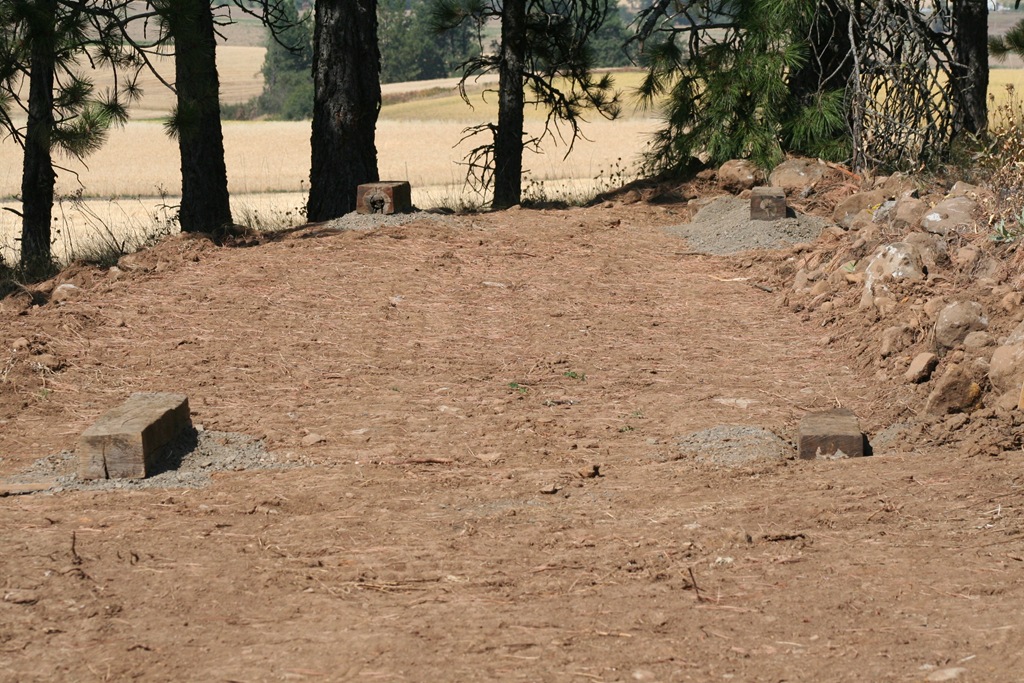
Son-in-law Caleb and I went out to the Boomershoot site yesterday. Caleb staked out the four corners of where we will place the shipping container for the new reactive target production facility:

IMG_6284Web_2011

The corners stake out an area 8’ x 40’. We brought a laser level and Caleb was able to determine that I had got it level within three inches using my eyeball and the old dozer. After the crop has been taken off the surrounding field this fall we will go back in with a pickup load of gravel and put a little gravel on each of the four corner locations making the rear end about 3” higher to keep water from draining to the rear, settle the railroad ties from Matthew into the gravel, and then bring in the shipping container.

While Caleb worked on staking and leveling task I worked on getting the Wi-Fi connection set up and then did some further tests on Internet provider options. One of the options included putting an antenna on a distance hill that is visible both from Mecca (this Boomershoot production facility), my brother Doug’s home, and Teakean Butte where First Step Research has high-speed wireless link available. Doug would pay the recurring Internet bill and I would pay for the equipment and do the installation.

Currently we are getting service from a neighbor who has a satellite connection but does not have visibility of Teakean Butte. The connection is slower and cheaper than the connection from First Step, a latency you could measure with a sundial, and “Fair Access” limits of only a few gigabytes per month. Doug does not have visibility of Teakean Butte either but if I were to put up a solar powered FSR connection on the hill at the power pole in the distance (about 0.75 miles away from the Wi-Fi access point in the foreground below) I could service both all of the Boomershoot site and my brother Doug.

IMG_6275Web_2011

The picture above was taken with a 300 mm lens which gives about a 6 X boost from a normal view.

The question was could I make the 0.75 mile connection with the current technology I have or would I need better antennas and/or higher powered transmitters. I pointed my antenna at the distance hill, connected to the neighbors satellite powered access point via the rear lobe of the directional antenna which was about 0.7 miles away through a few trees. I then went to the distance hill to measure the signal strength—with my cell phone. I could not connect from the distant hill but I could measure the signal strength. It will work. The signal strength would probably be strong enough I could even connect with some laptop computers. Propagation was very good and the noise floor was very low. That appears to be a viable option.

Dolly Sewell (“War Horse”)

While visiting with my parents yesterday my dad told a story. I had heard it many times while growing up but had forgotten about it until he told it again. There were some additional details I noticed this time which I hadn’t put in proper perspective before.

The story, from about 75 years ago is about two students in Dad’s class at the Teakean grade school. It happened about 1936 when Dad was in the 6th or 7th grade. I decided to post it here so it would have a better chance of being remembered and some other people might appreciate it.

There were only about 10 kids in all eight grades so there was no hiding in the crowd or any hope of not being identified if you pulled off a prank in public.

A girl in the grade ahead of Dad was named Dolly Sewell. At age 13 or 14 she had hit her growth spurt and was taller than any kid in the entire school. She could also run far faster than anyone else. In any foot races she out distanced by a large margin the next fastest runner. Another student was Leon Coe. He was a little bit of troublemaker and, as boys of that age are prone to, liked to tease the girls. Because of Dolly’s height and running abilities Leon started calling Dolly “War Horse”. This was not a reflection on her general appearances as she was really a very nice-looking girl. But Leon should have thought things through a little better before he decided to push things a little too far with someone he knew was his physical superior.

One day at recess Dolly and some of the other girls were playing jump rope. I was just an old length of rope they found. Nothing special but it worked. Leon started daring Dad and some of the other boys to grab the rope and take it away from the girls. No one would take him up on his dare and finally he said, “If none of you guys are brave enough, I’ll show you how it’s done.” He then ran over, grabbed the rope and took off back to his buddies who were watching. Dolly took off after him and he tossed the rope on top of the roof as he went by. There was a ladder leaning up against the building and Dolly used the ladder to recover the rope.

As Dolly came down off the ladder, she spotted Leon and Dad told Leon that he better get out of there. Leon took off running as fast as he could and Dolly, rope in hand, took off after him. Even though they were not supposed to leave the property of the school Leon took off through the gate. Dolly followed him and easily caught up. She didn’t try to knock him down but instead trotted along behind and used the rope as bull whip and repeatedly smacked him on the rear side as Leon tried in vain to escape. They were just disappearing over the top of the second hill when the bell ran and the rest of the kids went back to class.

A few minutes later Dolly came back and sat down in her seat looking cool, calm, and collected. Leon came back several minutes after Dolly all sweaty, very bedraggled, and presumably wiser.

Dad saw Dolly a few years ago at the Old Timers Picnic at the Teakean Grange Hall. She had apparently done quite well. She and her husband lived someplace in California and had flown their own airplane up from California to attend the picnic. Dad asked what sort of business they were in and got a somewhat minimalist response of “the hamburger business”.

Dolly died last year and is buried near her parents in the Teakean cemetery.

What I hadn’t noticed before was that Dolly’s last name was Sewell. Barbara and I had a classmate when we went to High School in Orofino by the name of Nancy Sewell. Nancy’s parents were very good friends with Barb’s parents so when I got home I asked Barbara what Nancy’s father name was. It was Jim. So I then called up Dad and asked him what the names of Dolly’s brothers were. Dad said her siblings were named and were born in this approximate order: Ida, Lora (both missionaries) , Wally, Dolly, Elmer (who later drove the truck which pulled my Great Uncle Walt’s mobile home from Lewiston where he bought it to the farm where he lived for several years), Walter, and Johnny (who was a car salesman in Orofino for several years). Her parents were Charlie and Alice Sewell. They only lived there for a couple years but had a home on the east side of Meridian Road just north of the turn in for the shooting line at Boomershoot.

They may not be related at all but at best it appears that the father of our classmate Nancy was a cousin of Sewell family Dad knew. If someone stumbles across this and knows the answer I would appreciate hearing about it.

Unintended consequences

When possession of firearms is discouraged it is inevitable that familiarity with them decreases. And even firearm safety training is discouraged. Just look at the resistance to the Eddy Eagle program where no guns are even present!

The unintended consequence of this is accidents such as this:

A Banning woman accidentally shot her 12-year-old daughter after pulling the trigger of a miniature revolver she had mistaken for a novelty cigarette lighter, authorities said Thursday.

As soon as children go through puberty they will start experimenting with sex even if their parents keep them isolated and ignorant. There will always be recreational drugs around even if they are banned and there are police knocking down peoples doors in the middle of the night. And there will always be guns around. It is time to admit this and teach them gun safety as a standard part of growing up.

Via email from Donald W.

Origins of progressives

According to one source the origin of the term “progressive” came about in the late1800s:

The first citation of the term “progressivism” in the Oxford English Dictionary is dated to 1892, in England. At that time the St. James Gazette used it as a term of derision, equating it with “radicalism”. However, the St. James usage doesn’t suggest that a neologism was being coined for the occasion (nor does the OED say as much).

As it turned out, the identification of biological evolution with social advancement was based on confused and ultimately false ideas; but Spencer’s elaboration of an essentially inevitable and indefinite social progress proved extraordinarily popular — even among those who would today be described as conservatives. (Spencer and Sumner were both arch conservatives.) Among those most taken by Spencer’s ideas was the young Englishman Winwood Reade, who popularized them in The Martyrdom of Man. Reade’s book, originally published in 1872, was read so widely that it reached an eighth edition just twelve years later — shortly before the St. James Gazette would use the term “progressivism” in its pages.

In the U.S. the Progressive Party was formed in 1912 and supported many of the positions associated with progressives today. As a third party in the U.S. it did quite well but still withered and died as the other two major parties adopted the more popular ideas from them.

The progressives of Europe in the early 20th Century were a somewhat different origin. They were the students of Marx and Engels who believed a proper study of history would allow the prediction of the future. The end of capitalism and the rise of socialism and communism was inevitable. Those advancing communism were progressives and those opposed to communism were anti-progress. This “progress” could only come through revolution.

According to Timothy Snyder in Bloodlands—Europe Between Hitler and Stalin, Stalin used this label in his exterminations of millions of people. He was advocating the inevitable progress of society and he and his supporters were progressives. Who could be against progress? Whoever such people were they were deserving of death. The utopia of a perfect communist society was just ahead and these people, these millions of murdered people, were a small price to pay to these progressives. They were starved in great famines caused by the seizing the food in the Ukraine, which was the food basket of Europe. Think about that. Millions of people starved to death in the major food production area of the continent due to progressives.

Millions more were arrested then sent to the Gulag after show trials or simply shot in the basements of the police buildings by the progressives of the Soviet Union.

In the U.S. progressives advocated for a vast increase in government power. In the USSR and elsewhere progressives used expanded power of government to murder tens of millions of people.

I see the social inequities which progressives use as their talking points. I understand the appeal of the “progressive” approach to social inequities. But progressives appear to not understand the terrible risks that have been demonstrated by their political ancestors.

I believe a much better term to describe their political persuasion is that advocated by Ayn Rand—looters.

Quote of the day—Thomas Sowell

Egalitarians create the most dangerous inequality of all — inequality of power. Allowing politicians to determine what all other human beings will be allowed to earn is one of the most reckless gambles imaginable. Like the income tax, it may start off being applied only to the rich but it will inevitably reach us all.

Thomas Sowell
[I really like this. It translates into a “sound bite” rebuttal. Those that advocate for the equalization of outcomes cannot implement such a system without creating an inequality of power.-Joe]

Quote of the day—Winston Churchill

Socialism is a philosophy of failure, the creed of ignorance, and the gospel of envy, its inherent virtue is the equal sharing of misery.
 
Winston Churchill
[Socialists and communists claim a more equal and just society. Before you buy into that ask someone who grew up in such a society. Even in very small groups (how many communions have been created and failed in this country?) it has a strong tendency to fail. In groups larger than a few hundred I am of the opinion it is not possible for it succeed in a form its advocates claim. In very small tight knit groups, such as a family, where shame and social rejection are powerful tools I think it can work. But it just doesn’t scale. Those that claim otherwise are ignorant, stupid, or power hungry.—Joe]