No good answers

Privacy is more and more a thing of the past:

In one experiment, Acquisti’s team identified individuals on a popular online dating site where members protect their privacy through pseudonyms. In a second experiment, they identified students walking on campus — based on their profile photos on Facebook. In a third experiment, the research team predicted personal interests and, in some cases, even the Social Security numbers of the students, beginning with only a photo of their faces.

Carnegie Mellon researchers also built a smartphone application to demonstrate the ability of making the same sensitive inferences in real-time. In an example of “augmented reality,” the application uses offline and online data to overlay personal and private information over the target’s face on the device’s screen.

“The seamless merging of online and offline data that face recognition and social media make possible raises the issue of what privacy will mean in an augmented reality world,” Acquisti said.

Cloud computing will continue to improve performance times at cheaper prices, and online people-tagging and face recognition software will continue to provide more means of identification.

“Ultimately, all this access is going to force us to reconsider our notions of privacy,” Acquisti said. “It may also affect how we interact with each other. Through natural evolution, human beings have evolved mechanisms to assign and manage trust in face-to-face interactions. Will we rely on our instincts or on our devices, when mobile phones can predict personal and sensitive information about a person?”

This technology has profound implications for both good and evil. Surveillance cameras can scan our sidewalks for wanted criminals as well as political dissidents. And the app for your cell phone can do a background check on your daughter’s date or identify a TSA agent in line at the grocery store.

I worry about this but don’t have any good answers. It seems that about the best you can hope for is that you have a twin* such that you can raise reasonable doubt in those situations where it really matters.


* My twin was discovered by AntiTango.

Boomershoot 2012 prep

Son-in-law Caleb and I went out to the Boomershoot site yesterday. Caleb staked out the four corners of where we will place the shipping container for the new reactive target production facility:

IMG_6284Web_2011

The corners stake out an area 8’ x 40’. We brought a laser level and Caleb was able to determine that I had got it level within three inches using my eyeball and the old dozer. After the crop has been taken off the surrounding field this fall we will go back in with a pickup load of gravel and put a little gravel on each of the four corner locations making the rear end about 3” higher to keep water from draining to the rear, settle the railroad ties from Matthew into the gravel, and then bring in the shipping container.

While Caleb worked on staking and leveling task I worked on getting the Wi-Fi connection set up and then did some further tests on Internet provider options. One of the options included putting an antenna on a distance hill that is visible both from Mecca (this Boomershoot production facility), my brother Doug’s home, and Teakean Butte where First Step Research has high-speed wireless link available. Doug would pay the recurring Internet bill and I would pay for the equipment and do the installation.

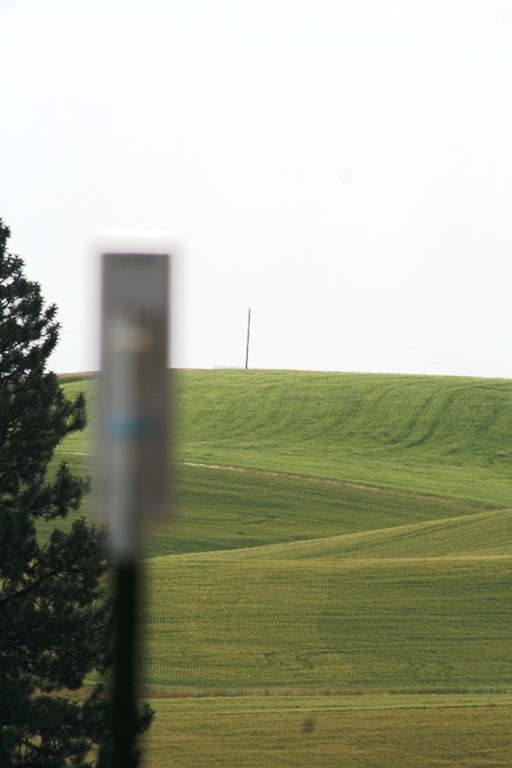
Currently we are getting service from a neighbor who has a satellite connection but does not have visibility of Teakean Butte. The connection is slower and cheaper than the connection from First Step, a latency you could measure with a sundial, and “Fair Access” limits of only a few gigabytes per month. Doug does not have visibility of Teakean Butte either but if I were to put up a solar powered FSR connection on the hill at the power pole in the distance (about 0.75 miles away from the Wi-Fi access point in the foreground below) I could service both all of the Boomershoot site and my brother Doug.

IMG_6275Web_2011

The picture above was taken with a 300 mm lens which gives about a 6 X boost from a normal view.

The question was could I make the 0.75 mile connection with the current technology I have or would I need better antennas and/or higher powered transmitters. I pointed my antenna at the distance hill, connected to the neighbors satellite powered access point via the rear lobe of the directional antenna which was about 0.7 miles away through a few trees. I then went to the distance hill to measure the signal strength—with my cell phone. I could not connect from the distant hill but I could measure the signal strength. It will work. The signal strength would probably be strong enough I could even connect with some laptop computers. Propagation was very good and the noise floor was very low. That appears to be a viable option.

Steve Lacy is dead

Via Peter N. Biddle I discovered a former co-worker of mine, Steve Lacy, was killed in a car accident on Sunday:

A volatile mix of speed, alcohol and road rage claimed the life of an innocent victim Sunday who happened to be driving in the wrong place at the wrong time.

The Washington State Patrol says the incident began at about 2 p.m. when a man driving a black Hyundai SUV was involved in a road rage incident on Interstate 405.

Witnesses told troopers the Hyundai driver began following a driver who he believed had cut him off as he headed south down the freeway.

As the Hyundai driver took the Northeast 85th Street off-ramp, he was speeding and lost control, flying across the eastbound lanes of Northeast 85th into the westbound traffic.

At that point, the Hyundai slammed into a gray BMW that was heading west on 85th Street and had not been involved in the earlier road rage incident.

The impact killed the driver of the BMW. He was identified as Steve Lacey, a software engineer at Google and father of two young children.

I have driven on both that freeway and that street countless time. I’ve even walked up and down that street more times than I can count. Sometimes there just isn’t anything you can do about it when death comes calling.

It was this Steve that I blogged about a few years ago.

Steve came to the U.S. from the U.K. when Microsoft purchased the company he worked for. This company had a 3-D graphics rendering package. Steve wrote a lot of the code that is now known as Direct-X 3D. Every time you play a video game on a Windows machine that does 3-D rendering you are executing code that Steve wrote. The world is a poorer place now not only because of the contributions he would have continued to make but because he was also a really nice guy.

Quote of the day—Dave Barry

But the greatest Electrical Pioneer of them all was Thomas Edison, who was a brilliant inventor despite the fact that he had little formal education and lived in New Jersey.  Edison’s first major invention in 1877, was the phonograph, which could soon be found in thousands of American homes, where it basically sat until 1923, when the record was invented.  But Edison’s greatest achievement came in 1879, when he invented the electric company.  Edison’s design was a brilliant adaptation of the simple electrical circuit: The electric company sends electricity through a wire to a customer, then immediately gets the electricity back through another wire, then (this is the brilliant part) sends it right back to the customer again.

This means that an electric company can sell a customer the same batch of electricity thousands of times a day and never get caught, since very few customers take the time to examine their electricity closely. In fact the last year any new electricity was generated in the United States was 1937; the electric companies have been merely re-selling it ever since, which is why they have so much free time to apply for rate increases.

Dave Barry
The History of Electricity
[I’m reminded of this by Barron’s Power Series. Normally I get really annoyed when someone gets some technological detail all wrong and I praise those that get everything correct. But In this case I’m going to reverse myself and give Barry the edge over Barron for pleasurable reading.—Joe]

Mecca

Today I did some more prep for the new explosives manufacturing site. This new place needed a name so a few weeks ago I asked daughter Kim and son-in-law Caleb to try and come up with some names. Caleb almost immediately suggested “New Mecca”. I thought about it some and suggested dropping the “New”. When I told others of the suggestion it received a warm welcome (especially from Barron and Janelle) so “Mecca” it is.

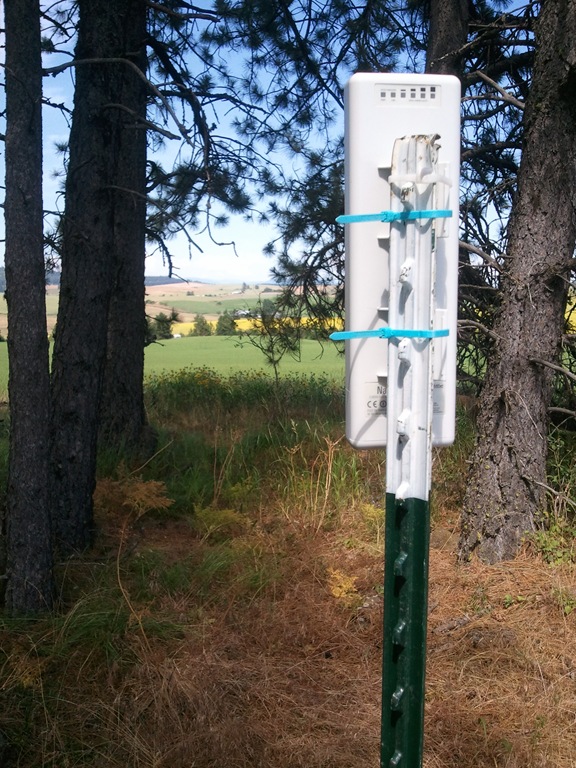
What I did today was put up the Wi-Fi access point. I wasn’t able to test it because the Wi-Fi access point at the provider wasn’t working and no one was home for me to get access and fix it. I think I’m probably going to get my own connection to First Step Research which will be a lot faster and more reliable than the second hand satellite connect I am currently using.

Anyway, here is a picture of the new access point:

WP_000109

The fence post was rather difficult to get into the “ground”. The place it really needed to be was mostly big rocks covered with a few pine needles. I got it into the ground and I hope to be able to test the connection the next time I go back. It’s over a half-mile to the source with partial blocking by the trees and that is a little bit of a concern to me.

Here are the railroad ties donated by Matt and delivered by Barron and unloaded with the help of Kim and Caleb we will use for the new production facility Ry is supervising:

WP_000113

Thanks again guys. We are going to have a great new place to make targets next spring.

Ok, That Is Pretty Cool

I’ve come to shrug my shoulders at the various “flying car” ideas out there.  Most of them have never flown, and probably never will, despite having the flight specs listed on the their web sites.  There are of course helicopters and auto gyros, but I don’t know of any highway rated ones.


This one is already in the air and the road, and seemingly ready to go.


I want the option of putting floats on mine, and skis, plus four wheel drive, and it needs to able to carry four people, the dog, and a week’s worth of camping supplies for the family, my tools, several rifles and a couple thousand rounds of ammo.  I’ll have to wait for the “F150 4 x 4” version, and then get it used, ’cause I can’t afford a quarter mil.  You early adopters will no doubt be a great help.

Trunk Monkey!

I’m not sure how well it’d work, but the idea is interesting.


HT to Castboolits.

Breadboard Computers

In the early days of radio, you’d have what we now refer to as a “breadboard radio”.  You’d buy, say, the power supply, or the power supply and the detector, mounted on a wooden board that resembled a breadboard.  You’d then add an RF amp, a VFO once those came available, an AF amp and so on, until you’d built up your desired system.  You’d then assemble the A and B batteries and set about to hooking it all up and aligning it so it would work.  In other words, you had to be something of a technician if you were going to have a radio, or you’d have to know a technician willing to help you with the hours upon hours of component selection and set-up.


I’ve said for years that we’re still in the breadboard phase of computer technology.  It is changing, but we’re still there.  Similarly, in the early days of the automobile it was not uncommon to purchase your chassis from one manufacturer, and take it to the coach builder of your choice for the body work and interior.


Son got a computer yesterday, along with a multi-track recording interface.  We selected the computer for high processor speed, a large amount of RAM, and at least a TB of HD.  We had to add a firewire card, making sure the available slots on the motherboard would accommodate the particular firewire card with the particular chip we wanted.


The damned thing still won’t work.  Something about a 32 bit verses 64 bit Win 7 OS, and something about a sound card, or sound card driver (we still don’t know which) that doesn’t allow for something referred to as “direct audio input”.  Never heard of it.  Don’t understand why the sound card is even a factor, since it was my understanding that the recording interface, and it’s related software, took care of all those functions.


A thousand bucks into it (and that’s a screamin’ good deal) and we’ve only begun to spend.  The technicians at the computer stores are of zero help, so now it’s to the digital recording specialists we know (I grew up in the analog, magnetic tape days, so I’m of little use), and to the manufacturer of the interface.


All this of course represents a business opportunity.


ETA; actually, you’d get either the A and B batteries or you’d get the AC power supply for your “radio set” once the AC supplies came available.  It took several decades for the complete system being sold as a unit to become the rule.  I have a 1931 Atwater Kent system that came in basic form as the old breadboard unit, though it was a complete, functioning breadboard set.  It also has the optional wooden cabinet, into which the breadboard slides, with the control knobs and frequency display mating up into cut-outs in the cabinet front.  The “dynamic loudspeaker” is another option in this set.  This one is the alternate to the free-standing loudspeaker, or to a mere headset.  It hangs on two hooks inside the optional cabinet.  Then it also has the optional coil loop antenna.  All components were sold by the same company and complimented one another nicely.  That’s about where we are with tower PCs these days, except that the components don’t always match up or work at all together.  Hence, putting together a computer system for some specific purposes is a hobbyist’s or technician’s activity, rather than a simple consumer purchase.

1.5 Watts! Wow! No wait…

I was over at friend, Cliff’s house last night.  He showed me his new LED light bulbs.  They’re awesome.  Nice spectrum, smaller than a regular bulb, plenty of light, no observable strobe effect from the power supply, and IIRC they used only 1.5 Watts.  Cool to the touch after being on for hours.


But wait.  This is the North.  With the low temps this Spring, we’re still heating our homes.  Therefore any reduction in the heat output of your lighting and other appliances has to be made up, one for one, by the home heating system.  Zero energy savings until we get warmer weather (outdoor lighting is of course exempt from this issue – any reduction in consumption means direct energy savings).


That means there will be maybe 120 days this year in which your ultra efficient indoor lighting pays off anything in this region.  Remember that when making your pay-off calculations.


Cliff is in the stage production supply business.  He showed me some of the new LED Par cans (stage lighting, in this case also computer [MIDI] controlled).  Stage lighting can be brutal on the performers, since even with the biggest, most powerful sound systems, it is the lighting that traditionally used the majority of the electrical power.  That’s why you’ve so often seen performers soaked in sweat.  We’ve been running the old, hot cans, and then running clusters of fans to try keeping the performers halfway comfortable.  With these new LED cans, it’s going to be much, much nicer to be on stage, and we won’t need to have the sometimes difficult to accommodate power requirements in our performance contracts.  This particular model also changes color by switching the LEDs, something like the way a color video display uses the different color pixels, which means no more screwing around with color gels.


Technology is wonderful, just so long as we keep the retarded politicians (but I repeat myself) out of our business.  Let them shovel shit instead.  With some training in shit shoveling, maybe they could be of some small service to humanity.  I’ve done it.  It can be quite important at times.

A bug or a feature?

I need to report this to some co-workers and at least warn them.

After leaving Microsoft last night I deleted my MS email account on my phone. The phone immediately said I needed to change my password on the phone. There were three edit boxes. One for my old password, one for the new password and one to confirm the new password. I put in the requested information and it claimed my old password was invalid. I tried again. Same problem. I then noticed it said my old password was four digits long. That wasn’t right. It had been six digits. As I tried to “get in” it started making me wait before I could retry. First it was one minute, then two, then four. When it got to 16 minutes I gave up trying plausible passwords they remotely set the device to. I got online and used the remote wipe feature to completely erase the phone.

Grrrr…. that was unpleasant. I can understand why a company would want to delete company private information off of former employee phones when they leave the company. But I did that with the deleting of the email account. The rest of the information that ended up being deleted was my personal information. They should have at least warned me so I could make sure I had all my personal information copied to a safe place.

As it turns out I think the only thing I lost was some notes about the length of some Boomershoot berms, all my SMS messages with my kids and wife from the past few months and a few things like that. Nothing that is more than annoying rather than something really important like a video of your child’s first steps or something.

The irony is that while at dinner with Ry last night he suggested I delete my email account rather than just let it expire and have Microsoft remotely wipe my phone like what happened to him when he left.

There is no privacy

I had lunch with someone today that told me they attended a “Privacy Conference” recently. One of the interesting things that came out of it was that the technologist all thought the lawyers would be the ones that would save privacy and the lawyers all thought the technologists would save it.

Other observations included:

  • Kinect has a camera, microphone, a connection to the Internet and a view of the interior of your home.
  • Many people carry a device with GPS, camera, microphone, and a connection to the Internet with them wherever they go.
  • Surveillance cameras are almost free.
  • Someone has demonstrated a system that you can take a picture of a random person on the street and ~40% of the time deliver the person’s SSN within a minute.
  • An 8-core computer processor in quantity 1 can be now be purchased for about $8.00. This has implications.
  • The UK may have millions of cameras and no improvement in their crime rate to show for it but they were trying to watch the cameras with human eyes. My fear is that we may get 100s of millions of cameras with computer eyes (Kinect technology?) and a police state to show for it.

I think I’m depressed again.

Quote of the day—Senator Al Franken

Steve Jobs said to the press that ‘we build a database of cell tower hotspots that could be 100 miles away from where you are, those are not telling you anything about your location.’ Yet in a written statement, Apple explained that the very same data would help your iPhone calculate its location. How can those two statements be true at the same time? Does this data indicate anything about your location or doesn’t it?

Senator Al Franken
May 10, 2011
Senators press Apple, Google for answers about location tracking
[I know! I know!

While Apple is a direct competitor to my employer (Microsoft) with this product and it’s not in my best interest to defend them I feel compelled to say that in this particular instance Apple is getting a bum rap. I worked on this same feature in Windows Phone 7 and understand the problem very, very well.

The answer given wasn’t the best and that probably made it difficult for Franken to grasp the concepts. So I’ll try again. Almost for certain this is how it works. The phone obtains a collection of cell tower  locations and unique cell tower IDs in a particular geographical area. This area could be a rectangle that is 100 miles by 100 miles on a side. When the user requests their location the phone obtains the unique ID of the cell tower the phone is connected to. The ID is looked up in the collection of cell towers, just as someone’s name might be looked up in an address book. The location/address of the cell tower is then returned to the user as the best estimate of the user’s location.

As long as the cell tower IDs used for location lookup are not stored then the best that can be done by examination of the files on the phone is to see the different cell towers (and Wi-Fi) collections that were stored. As long as those collections were large (100 miles by 100 miles per collection) then the best that can be deduced is the user was someplace within that collection area. If the collection area is much smaller, say 100 feet by 100 feet (this could happen because Wi-Fi access points have much greater density that cell towers) then it becomes very important to make sure those collections are secure from snooping. If those collections are sometimes for a small geographical area and the files are not made secure then shame on Apple. They were being careless with the users privacy and should be chastised for that carelessness. But at this time I cannot conclude Apple screwed up.

So to answer Franken’s questions, those two statement can be true at the same time. The data does indicate your position within the geographical area of the hotspot locations. But that does not necessarily mean the location is know with the type of accuracy that a stalker would find particular useful–unless just knowing the city or zip code is sufficiently damaging.—Joe]

Are there any homosexuals in your home?

Telephone surveys are a valuable method of obtaining data. Sometimes they are the only means by which data on a particular topic can be gathered. But there are times when they can give you very bad data.

Suppose you did a phone survey asking if there were any fugitives from justice living at your house. My guess is the data obtained would differ considerably from the actual value.

Suppose you did a phone survey asking if you had expensive jewelry. Probably to a lesser extent but still my guess is the answers given will not be accurate.

Furthermore my hypothesis is the differences from reality to the two questions above would be be fairly constant over time. If you asked about fugitives living at your home my guess is that you might get 1 out of 100 to admit a fugitive was living there when there was one and that would not change much from 25 years ago to today.

Now suppose you did a survey on how many homosexuals live in your home. If you did the survey in the 1950s my guess is the report of a “none” when in fact there was one or more would be very high. But if the survey were done today the false reporting would be much lower.

Surveys on gun ownership suffer from similar problems. There is a threat of oppressive regulation and confiscation in some jurisdictions and there is the threat of theft by non government actors as well. Gun owners have a vested interest in not giving accurate data to some random person calling up on the phone.

Hence, I am skeptical of the latest survey on gun ownership. The huge increase in gun sales during late 2008 and 2009 was do to fear of heavy restriction. This climate of fear would have been motivation to falsely report to survey takers.

Note that this is not a VPC survey but just a VPC interpretation of a survey. Had it been a VPC survey additional motivation for error introduction could have been present as well. The VPC conclusions are almost for certainly flawed. If they were correct then Brady Campaign and VPC “membership” would be up and the NRA membership would be down. But this is not the case. I don’t think we can determine what the true gun ownership numbers are but I’m nearly certain it is much higher than that reported in the survey.

As Sebastian said to the Brady Campaign, “Keep telling yourselves that.

Boomershoot prep

Yesterday Ry, his daughter Arden, my son-in-law Caleb, and I went out to the Boomershoot site. We did tests of a new target type invented and built by Ry. It was a little disappointing. I’ll put video up someday. I’m just too tired right now.

Most importantly though is that Caleb put in nearly 500 stakes at the tree line for targets. I put in the fence posts to create “clothes lines” to support more targets in the air above (sort of, they are offset some) the ground targets. This will give us space for about 1000 targets at the tree line. The tree line is about 375 yards from the shooting line and these targets always go fast and are completely consumed. By utilizing the vertical dimension we can put more targets in front of the same linear foot of berm (backstop) space.

I also worked on getting the extra Wi-Fi access point on the shooting line working. I was not successful and in fact just before I left I managed to get the configuration set such that I couldn’t access the network via Wi-Fi.

Today I went back out and finally got the Wi-Fi working. With the three access points I can now get on the net with my cell phone (my laptop had pretty good access already) from the tree line to the shooting line to the Taj. There are very few points on the normally traveled areas of that 40 acres that I can’t get access.

I also put up some fences posts for aerial targets on the hillside. I put them at the bottom of the hill probably closer than we have ever had hillside targets before. By suspending them we get the bullets hitting more into the hillside behind the target rather than bouncing off the ground with a shallow angle of attack on that range.

Location info—why you should care

The iPhone (and cousins) storing of location information and similar activity by Android is turning out to be a pretty big scandal. Some people are saying, “I’ve got nothing to hide.” but most people I associate with don’t think that way. And since that guy writes for the NYT he doesn’t really count with most of the country anyway.

Brian X. Chen and Mike Isaac explain the issue better than I could:

Having a data file with over a year’s worth of your location information stored on your iPhone is a security risk.

So if a thief got his hands on your iPhone, he can figure out where you live and loot you there, too. Same goes for a hacker who gains remote access to the consolidated.db file. But if a thief or hacker dug into an Android device, there isn’t going to be much geodata saved on the smartphone to digitally stalk you. (There’s plenty of other data on smartphones such as text messages, address books and so forth, but at least we have control over what data we store in this regard.)

Bottom line, this data shouldn’t stick around on your iOS device, because it does nothing but put you at risk. And you should care about that, because this problem can be and should be fixed by Apple, and you should demand that.

I’m not at liberty to say much but I will say that I spent some time explaining the security of Windows Phone 7 location services to our Program Manager and Dev Manager this afternoon. Both seems satisfied with the status. It’s not as good as I would like it to be when I put on my utopian privacy hat but I think the tradeoffs made were within acceptable bounds. I’m also pleased that at every stage through the location service development process privacy was taken seriously by everyone I worked with. I had expected I would have to fight hard at times to protect location information but that was not the case. I only got pushback on some relatively minor issues, for legitimate needs, and the compromises made were acceptable to me.

WP7 location service does a much better job of protecting your privacy and giving you control over your data than the iPhone currently does and probably better than Android. And as long as I am working on location services I will do my best to make sure it stays that way.

Windows Phone 7 update is available

The Windows Phone 7 update for the Samsung Focus (and I think all AT&T Windows Phone 7 phones) is now available.

Copy and Paste is just one of the many new features and bug fixes that come with the update.

Connect your phone to your computer to install the update.

Just say no

This would not be acceptable to me:

The Michigan State Police have a high-tech mobile forensics device that can be used to extract information from cell phones belonging to motorists stopped for minor traffic violations.

If a cop were to ask me to allow him to connect his device to my cell phone the answer would be, “No”. If that wouldn’t be allowed I would attempt to do a hard reset of the phone (know how to do this so you can do it quickly) or attempt to call someone who could remotely wipe it for me.

Via email from retired co-worker Chet.

Quote of the day—TJ

Google isn’t so much a company as it is a programmers cult.


TJ
A programmer at Google
April 6, 2011
[I talked with him for over an hour. He had me convinced the above assessment is correct. Their culture is very different.—Joe]

Don’t mess with the geek

If you send a particularly offensive email to someone and don’t want it forwarded to your boss don’t depend on Outlook forwarding restrictions to protect you.

I found a way to defeat it other than the obvious taking a picture of the computer monitor with the email visible.

Blacklist plugin for Windows Live Writer

Several months ago I started using Windows Liver Writer for creating and editing blog posts. It is much better than the native editors for any of the blogging software that I have ever tried. Yes, I am Microsoft employee and this is a Microsoft product but I’m not exaggerating. It makes blogging much more pleasant.


Barron has improved the experience still more by creating a plugin for Live Writer such that it checks all of your links in your post against the Right Haven blacklist I created. Hence, if you have a link to one of the bad guy media outlets the plugin will catch it at publish time.


I did have some problems installing it. When I tried to save or run the .msi file it always turned into an .htm file for some reason. I ended up saving it as a .htm then renaming it to .msi and then running it to install the plugin. Another item of confusion was that there are two ways you can set options in Live Writer. One is from the “Blog Account” tab and the other is dropdown menu that has the exit menu entry. The first option setting method doesn’t give you all the configuration control over the plugin. Be sure to use the second method.