Quote of the day—Clark

Due to forces of technology (CNC controlled machine tools, cheap computation, open source ethics, and social sharing of designs) gun control is utterly dead. It’s a corpse, staggering along, not yet aware that it’s been gut shot, it’s blood pressure has dropped to zero, and its brain (such as it is) is about to die the True Death.

Try to outlaw gun powder and we’ll move to railguns and big capacitors. Try to outlaw primers and we’ll see plans for electronic ignitions up on wikileaks by the end of the day.

Go back a step and outlaw the sparkplugs and the capacitors and …yeah, it’ll work as well as the restrictions on cold syrup have ENTIRELY shut down meth production.

Gun control will stagger on for a bit, but there’s no putting some genies back in their bottles, and home printed firearms are one of those genies.

One hundred years from now everyone from Chinese peasants to American bankers (or do I have that backwards?) will have all the firearms and ammo they want, in the same way that 15 year old have all the hot monkey sex pr0n they want today.

It’s called technology, and it’s the universal solvent.

Clark
October 6, 2011
The Third Wave, CNC, Stereolithography, and the end of gun control
[I have nothing to say except H/T to Mad Rocket Scientist.—Joe]

Interesting times ahead for Microsoft

I’ve seen reports that there are now more smart phones sold than P.C.s. This is part of the reason Microsoft has been putting so much effort into Windows Phone Seven (and beyond). Now people are saying:

Realistically, Microsoft’s last chance to make a dent in Apple and Google’s mobile aspirations is with Windows Phone 7.5. While the operating system is generally well regarded, many still believe it lacks the killer feature that will help it overtake the considerable leads held by its rivals.

The Nokia deal is about to reach first fruition with the shipment of the first Nokia phones with Windows Phone 7.5. If that doesn’t flop I expect Microsoft will still push on to Windows Phone Eight. I know a little about this and because this information is proprietary can’t say what the main push will be with it. I will say that I wasn’t entirely convinced it was the proper strategy. Maybe it is. But they had some very tough decisions to make and none of the options available were anything close to a sure thing and doing everything in the timeframe required simply isn’t possible.

Without a strong position in the phone and tablet markets which are cutting into the desktop and laptop sales Microsoft is facing completely new territory. As much as I liked working for Microsoft I’m glad I’m not working there right now.

Windows Phone 7.5

I just updated my phone to Windows Phone 7.5. I love the new I.E. I can finally read my blog on it without enlarging the page and then scrolling from side to side. http://field.modernballistics.com/ is now much more usable too.

Maps now, finally, has “Favorites” and voice directions (I used to hear the void directions being tested for hours from my office when I worked at Microsoft).

The upgraded took longer than I liked but it went smoothly enough. Time to upgrade Barb’s phone now.

Style Thwarting Function

It used to be that your car’s horn control was a 360 degree, or near 360 degree chrome-plated metal ring.  It didn’t take much time or effort to find it when you needed it.  My Ford pickup has two horn buttons– tiny rectangular surfaces in the wheel spokes that are stylistically flush-mounted, much like the controls on an iPod.  Just as the iPod looks cool but can’t be very well controlled by touch due to the carefully flush-mounted buttons, so too the horn buttons for my pickup are designed as if to challenge the driver’s muscle memory and pin-point precision in a desperate situation.

Driving home in the dark last night I noticed a car in front of me swerve into the on-coming lane.  “Idiot” I thought, “probably texting or something…WHOA!”  After driving this pickup for many years, I am now able to stab the horn button in about a tenth of a second.  I am proud of that fact.  It has taken all those years practicing with the same rig to learn to do it.  Of course I wore out one engine at around a quarter million miles, and am well into wearing out the second.  I figure that by the time most people learn to find the horn button in the dark in a panic, they’ve already trashed the vehicle and are on to the next one, having then to start all over with the process of learning to find the horn button in the dark in a panic.

There was a deer, hell bent on crossing the highway ten feet in front of me while I was doing 60 MPH.  Stupid animals.  I’ve found that the white-tailed deer responds very well to short horn blasts, at around 3 to 4 per second.  It mimics the universal alarm sound in the animal world.  A full sized pickup whooshing along at 60 MPH doesn’t give them pause, but that horn will send them into hysterics and they’ll stop whatever they’re doing.  You should have seen the look on that deer’s face.  It looked as though it had been lassoed and yanked backwards, eyeballs bugging out, which is much preferable to having it crawl through my radiator and into the front of my engine at 60 MPH.  Sometimes if the car in front of you swerves, there is a good reason.

My next thought was to look in the rear view mirror.  No traffic.  If I’d hit the deer, at least I could have had time to heave it into the pickup bed without encountering any traffic in my lane.  If you’re going to have your radiator destroyed, at least there could be some compensation in your freezer the following week.  And yes; I can drive without a radiator (or a water pump, or an accessory belt).  Can’t you?  You go until the engine temp red-lines, then you stop and wait for it to cool down.  Restart, repeat as necessary.  I’ve had to do that on two or three occasions, for different reasons.  Drag racers don’t have trivialities like a cooling system and they do just fine.

But enough with the flush-mounted controls, OK?  Engineers; can we agree it’s a dumb idea?

Safe storage laws

There are now controls for Internet control of your heating and the government wants to control your air conditioning, refrigerators, lights, and computers so this is really just a logical extension.

It’s for the children.

Via Gus from work.

Odd stuff

I was going through my projects folder on my computer and saw a number of projects I didn’t recognize.  Looking at the code they were clearly my coding and comment style but I still didn’t remember many of them. Most were junk projects that appeared to be something that solved, or would have solved had they been finished, some simple problem.

There were projects like “NetConnect” which apparently was intended to pop up a dialog box of the machines visible on the network and handle assigning a drive letter to their public shares. Another project was “Wait” which wouldn’t compile because the requested version of Windows was so old. “SurveyProcess” appears to be for processing the Boomershoot participant survey results from 2006.

But the oddest project I found was “UniDecrypt”. I appears to be something to test the feasibility of a “universal decryption algorithm”. It is junk code. Something very “quick and dirty” that I apparently started working on at about midnight in late November of 2006. The time stamps of the various files continue through a little after 8:00 AM and then the last timestamp being about 1:30 AM the following day. This project probably was something that woke me up in the middle of the night and I couldn’t go back to sleep after thinking about it. That happens every once in a while. I once woke up in the wee hours of the morning and had to go find my “Modern Physics” text book (is it still considered “Modern Physics” if I took the class in 1976?) to look up why it was I had not thought up a way to travel faster than light.

Yeah, my brain is a little warped at times.

Awesome idea!

This is awesome!

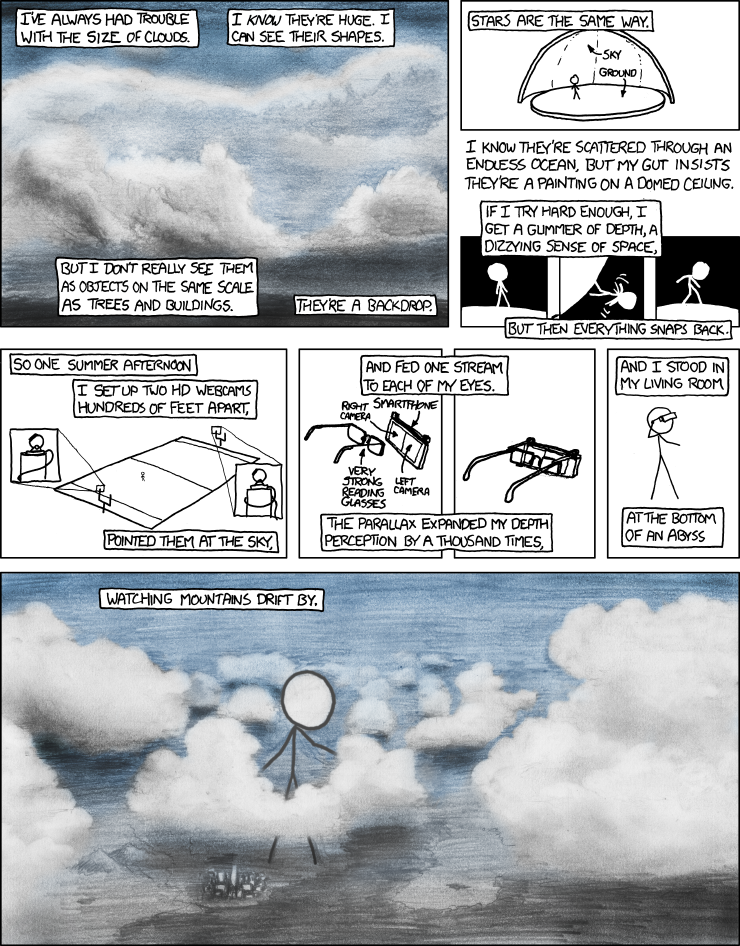
I've looked at clouds from both sides now.

I think he has the left and right cameras reversed (I suppose it depends your view of the cameras) but other than that I’m thrilled with the idea. I want my ideal house equipped with movable cameras like that. And why not do the same sort of things with microphones?

Then expand the electromagnetic spectrum down to about 500 kHz (I would need to pick up all the AM band of course) and up through cosmic rays. One could either compress it all into the visible or else tune into just a couple octaves. Do the same sort of thing for the audible spectrum and it would be a toy I could play with for weeks. It would be like having the sight and hearing of a god.

What could go wrong?

The most obvious problem with this it is that it’s part of the continuing degradation of our privacy:

The National Highway Traffic Safety Administration is beginning real-world trials of cars equipped with prototype vehicle-to-vehicle technology, deploying a communication network where cars can talk with one another to increase overall road safety.

Starting in August, 2012, the agency will begin gathering data from 3,000 cars equipped with wireless communication technology. Known as The Safety Pilot, the trials will run for one year in Ann Arbor, Mich., to provide data for setting V2V standards and determining what data streams are most helpful.

Here’s how it works: Using existing, universally accessible technology such as GPS and on-board diagnostic data, cars broadcast what’s called a “Here I Am” message at 5.9 GHz. All V2V equipped vehicles will be able to communicate on this band, sharing data such as speed and location. On-board computers sense the presence of other nearby vehicles, calculate the risks they may pose and even taking action — such as hitting the brakes or warning the driver of an impending collision.

From a privacy point of view as long as the vehicles do not broadcast a unique ID I don’t have a problem with it. But if they broadcast an ID that can be traced to the individual car this fails my Jews in the Attic Test.

But what really looks bad to me is the potential to cause accidents with this. Imagine some jokester/terrorist/whatever turning on one of these ‘”Safety Pilots”, broadcasting a signal indicating a stopped (or going the wrong way) vehicle in the middle of a busy freeway with vehicles traveling 70 MPH. People could use them to block emergency vehicles. It could make escapes easier and delay firefighters and/or police to terrorist events.

It’s possible, I suppose, the creators thought of these sort of problems and successfully addressed them. But my guess is they did not.

People need to think of the not only the benefits but the problems created with new technology. Especially those associated with government mandates.

What caliber for riots?

Like a lot of other people I’ve been thinking about what would be the best defense against the riots like are being experience in the U.K. and the flash mobs in some U.S. cities.

Recently someplace, which I can’t find right now, I proposed a couple of fully loaded USPSA Grandmasters could rapidly educate a crowd on the downside of violence against innocent people.

Yesterday Phil advocated 9mm because of the greater capacity.

While I think those ideas have potential the rioters in the U.K. have been dispersing at the first sign of law enforcement then regrouping at another location (apparently many of these “poor” people have cellphones). Plus no matter how many rounds in whatever caliber you have when you are facing off against hundreds of people the odds of getting hurt yourself is significantly greater than zero. This calls for a different weapons platform.

I think the right caliber for the task is a couple of AC-130s.

Too bad

Information Week says Windows Phone is likely headed for extinction:

Microsoft’s share of the smartphone market is plummeting at an alarming rate–so much so that the company’s last ditch effort to make an impact in mobility, Windows Phone 7, may be irrelevant by the time it manages to ship the much-anticipated Mango update and realize its partnership with Nokia later this year.

Mango’s debut should also coincide with the arrival of the first Nokia phones running Windows Phone 7, though Microsoft has yet to provide precise arrival dates for Mango or Nokia phones. Under a partnership announced last year, the Finnish phone maker is transitioning its entire smartphone line to Microsoft’s mobile OS.

Whether Windows Phone 7 is a legitimate player in the market by the time that happens remains to be seen. The current numbers suggest otherwise.

I was very proud of both my contribution and of the final product. I can’t speak for the iPhone but I have played with the Android enough to be convinced the Windows Phone has a better user interface. Barb has always said she didn’t want a fancy phone. She just wanted something really simple. I knew she wasn’t going to be very pleased when I got her one for Christmas. I was pretty sure she would eventually be happy with it but I had to get her something else to go with it or else I would be in trouble so I got her a Jeep. Now she loves the phone and she came up to speed on it really fast.

I now sometimes get a dozen or more text messages a day from her. With her previous phones the kids and I could sometimes get her to read text messages but sending them was exceedingly rare and usually accompanied with a bad mood. Now she even Tweets from her Windows Phone 7.

As I was leaving Microsoft in the middle of May I had some people inside and outside of Windows Phone who were in much better “positions to know” than I was tell me, “You are doing the right thing.” A lot of this was based upon the market acceptance of Windows Phone 7 as well as the crappy manager I had.

Microsoft might still pull it out but there are a lot of outside influences that Microsoft just doesn’t have that much control over like the number of external developers who support Windows Phone. And the carriers who might wonder why they are putting effort into supporting a smart phone with such a small percentage of the market.

It’s too bad. I think it’s a great phone and I’m look forward to the Mango update.

Privacy issues

Numerous times I’ve posted half-baked concerns about our increasing loss of privacy and the dangers and even extreme dangers.

Some people have brought up good points and/or asked good questions and I will respond to those people then share further thoughts I’ve had on the topic.

Acksiom asks (after I said having a twin could be useful to raise reasonable doubt about who did what):

Joe, what kind of situations do you have in mind where that would be appropriate?  I can’t imagine any where I would want to raise reasonable doubt by blaming another innocent person, so I’m curious.

What if your employer is extremely conservative/liberal and a picture shows up of you at a gay-bar or sex shop/gun range or Tea Party rally? There are lots and lots of things of this nature. In the mild case they are things like pictures of a drunk, topless, woman at spring break 10 years ago who now wants to run for public office or be a Sunday School teacher. In the worst case we are talking matters of life and death, Jews in the Attic, type of things.

Alan states:

Privacy is a recent illusion caused by growing population and increased mobility.  Technology is allowing the return to the historical lack of privacy that has been the normal human condition for thousands of years.

You can’t fight it any more than the RIAA or MPAA can fight file sharing.  Better to start thinking how we’re going to adapt to everyone knowing everything.

In regards to his first point, it’s more like millions of years but that doesn’t distract from the validity of his observation. What is different now is that we don’t have a small homogenous tribe. We have an exceedingly diverse population with a powerful government.

In regards to his second point I’m not entirely convinced it is possible create an environment where “everyone knows everything”. And as long as an imbalance of knowledge exists there are “issues”. I am convinced that he is right about the analogy with the RIAA and MPAA. The “privacy gene” is not only “out of the bottle” the bottle has evaporated.

Sebastian posted (three+ years ago):

But in an information based society government will be able to know a lot about its citizens.  Our government probably knows more about its citizens than any other government in history.  There won’t be much means to avoid that.  Conversely though, information technology also makes it possible to know more about our government than any other people in history.  I would encourage and recommend anyone who’s interested in this topic to read David Brin’s The Transparent Society.

Tam stated (several months ago):

I think David Brin had it mostly right in The Transparent Society: This genie is well and truly out of the bottle, and the only non-Orwellian outcome will be if everybody has access to it.

Sebastian echoes (last night),

One of the sources I look to in this issue is David Brin’s “The Transparent Society”. I don’t think Brin is right about everything, but the fundamental idea that the loss of privacy isn’t such a big deal provided it’s applied equally in society, I think is a reasonable concept.

I responded (three+ years ago) by saying the politicians and government employees should go first and we will see how well that works out. The only thing I think I need to add to that post is that they should add real time location information to the collection of public servant information available to the general public.

We are entering uncharted territory. Never before has their been societies this diverse able to know this much about everyone else. Sure, if you go back far enough (it would not be necessary but just to make the point stick go back to where the family tree branching off of the apes) people didn’t have privacy when they had sex or were defecating let alone where they were or what sort of god(s) they did or did not worship. But in those days, with a much more homogenous society, it may not of mattered.

I say “may” because I wonder if such an open society was almost forced to be homogenous at a communistic lowest common denominator level. Perhaps a capitalistic/competitive society requires certain levels of privacy to function. My hypothesis is that trade secrets, secret contracts, and secret finances are necessary for a competitive society. Stated in the strongest (but perhaps indefensible) terms, if you don’t have privacy you cannot “get ahead”. A corollary that follows (perhaps also indefensible) is that if there is no privacy then society is economically doomed to some sort of tribal communistic system. Did the rise of commerce, technology and industry only come about because various tribes had privacy from one another?

Now there may be at least partial solutions to the economic hazards of a completely open society. Patents, for example, are intended to protect information that cannot be protected by trade secrets. Written agreements can be kept private unless a court order demands otherwise. But there are still many vulnerabilities when facial images or location data of people entering corporate headquarters reveals a connection between two or more companies that didn’t used to be there. Or your employer tracking after hours employee location data discovers a handful of engineers getting together at a bank and checking out empty office buildings together.

Imagine what can happen in political campaigns. Knowing who is talking to who gives someone tremendous information about what sort of issue are going to be important and how much money is going to be involved. Sure that information all comes out eventually but when you have the info weeks in advance it will make a huge difference.

Imagine the implications for stalkers. Anytime they wish to go on the hunt they leave their cell phones 50 miles away and know exactly where their prey settled down for the night.

Imagine the implications for an abused spouse trying to hide from their ex.

On a governmental scale the events are less likely but the consequences are catastrophic. Here is a scenario I heard outlined this morning. Monitoring of your water, electricity, and data (Internet) consumption shows a step increase. Examination of your communication traffic might well show that one or more people had a decrease in traffic therefore they are likely
the new residents in your home. Examination of transportation expenditures could confirm it. This fails my Jews in the Attic Test.

Imagine a scenario where a government is deadly hostile to gays (gun owners, Jews, blacks, Tea Party “terrorists”, Christian Fundamentalists, whoever). Public records (while I support gay marriage I sometimes wonder if it is a greater risk than people realize), blogs, and social networks, are scoured to identify the individuals. The communication traffic is examined and the leaders are easily identified even without knowing the content of the communication. Location information is then used in synchronized snatches at 3:00 AM. The plans for the snatch in any realistic “transparent society” would still be opaque because it would be protected out of concern for “nation security”.

Do you think it couldn’t happen in this country?

If so you have forgotten about the black lists in the 1950s. And the Japanese, German, and Italian internments which held over 100,000, of which about 60% were US citizens, during WWII. And you aren’t familiar with the Palmer Raids. Okay, the Palmer Raids were at 9:00 PM, not 3:00 AM. You have me there.

Those events are just the tip of the iceberg and  without computers. Imagine what a government could do with computers and far, far, more detailed information about our location, habits, and social networks.

Someone in law enforcement once told me that the government has a list of everyone in this country who has training as a sniper and “keeps close track of them” in what sounded like nearly daily updates on their locations and somewhat less frequent updates on their attitudes toward high level government officials. How many high-power rifle shooters also have their names on some list?

In a “transparent society” what does it matter if there are lists like that, right? You can have your lists too! But some lists are scarier than others and will always be secret for “reasons of national security”.

Although some have advocated deliberately adding noise to your digital footprint unless this is automatically done by your own computer at near zero cost per transaction you are soon going to get tired of the game. And if FinCEN can’t pierce the noise they will just make it illegal. And, as a person with a Masters degree in communication theory where we learned to pull signals out of noise, I don’t think it would be that hard to detect the noise, pull out the true signal, and then give greater attention to those people.

A few years ago I mentioned to someone in the banking industry that I did almost all my financial transaction in cash. Checks, credit and debit cards where used far less than most people. I was told that, for certain, put me on a list.

Perhaps my view is biased by reading too many books like Hitler’s Willing Executioners, Plotting Hitler’s Death, and Bloodlands—Europe Between Hitler and Stalin, but I contend a “Transparent Society” is very risky. I still don’t have any good answers short of “dropping off the grid” which just doesn’t scale. I have some possible answers which I would be glad to discuss in private but I just don’t have the time to implement them let alone deploy them on a scale where it could make a material difference even if they were effective and could avoid being declared illegal when detected.

The one method of last resort, a doomsday plan, which appears to be the least distasteful if things get really bad are the Second Amendment remedies. But even without formal gun and/or gun owner registration our society is already transparent enough that a “first strike” on the top 10,000 or so gun owners/activists with follow ups on a few hundred thousand more (remember the numbers from the WWII internment camps?) might be sufficiently effective to neutralize even it.

I’m told I’ll never have to worry about that. I suspect most of the people that tell me that are absolutely correct but for the wrong reason. I’ll be in the “first pass”.

Random thought of the day

There exist heat pumps that can heat our homes with greater than 100% efficiency compared to converting the electrical/mechanical energy directly into heat.

Could there exist a means to make a “light pump” and convert large quantities of infrared light (thermal energy) into smaller quantities of visible light as a means of artificial lighting at something greater than the abysmal  efficiencies of our existing light sources?

No good answers

Privacy is more and more a thing of the past:

In one experiment, Acquisti’s team identified individuals on a popular online dating site where members protect their privacy through pseudonyms. In a second experiment, they identified students walking on campus — based on their profile photos on Facebook. In a third experiment, the research team predicted personal interests and, in some cases, even the Social Security numbers of the students, beginning with only a photo of their faces.

Carnegie Mellon researchers also built a smartphone application to demonstrate the ability of making the same sensitive inferences in real-time. In an example of “augmented reality,” the application uses offline and online data to overlay personal and private information over the target’s face on the device’s screen.

“The seamless merging of online and offline data that face recognition and social media make possible raises the issue of what privacy will mean in an augmented reality world,” Acquisti said.

Cloud computing will continue to improve performance times at cheaper prices, and online people-tagging and face recognition software will continue to provide more means of identification.

“Ultimately, all this access is going to force us to reconsider our notions of privacy,” Acquisti said. “It may also affect how we interact with each other. Through natural evolution, human beings have evolved mechanisms to assign and manage trust in face-to-face interactions. Will we rely on our instincts or on our devices, when mobile phones can predict personal and sensitive information about a person?”

This technology has profound implications for both good and evil. Surveillance cameras can scan our sidewalks for wanted criminals as well as political dissidents. And the app for your cell phone can do a background check on your daughter’s date or identify a TSA agent in line at the grocery store.

I worry about this but don’t have any good answers. It seems that about the best you can hope for is that you have a twin* such that you can raise reasonable doubt in those situations where it really matters.


* My twin was discovered by AntiTango.

Boomershoot 2012 prep

Son-in-law Caleb and I went out to the Boomershoot site yesterday. Caleb staked out the four corners of where we will place the shipping container for the new reactive target production facility:

IMG_6284Web_2011

The corners stake out an area 8’ x 40’. We brought a laser level and Caleb was able to determine that I had got it level within three inches using my eyeball and the old dozer. After the crop has been taken off the surrounding field this fall we will go back in with a pickup load of gravel and put a little gravel on each of the four corner locations making the rear end about 3” higher to keep water from draining to the rear, settle the railroad ties from Matthew into the gravel, and then bring in the shipping container.

While Caleb worked on staking and leveling task I worked on getting the Wi-Fi connection set up and then did some further tests on Internet provider options. One of the options included putting an antenna on a distance hill that is visible both from Mecca (this Boomershoot production facility), my brother Doug’s home, and Teakean Butte where First Step Research has high-speed wireless link available. Doug would pay the recurring Internet bill and I would pay for the equipment and do the installation.

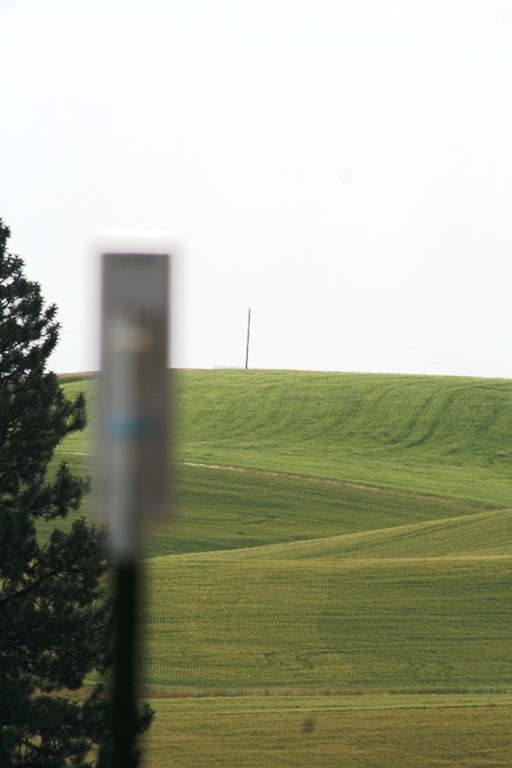
Currently we are getting service from a neighbor who has a satellite connection but does not have visibility of Teakean Butte. The connection is slower and cheaper than the connection from First Step, a latency you could measure with a sundial, and “Fair Access” limits of only a few gigabytes per month. Doug does not have visibility of Teakean Butte either but if I were to put up a solar powered FSR connection on the hill at the power pole in the distance (about 0.75 miles away from the Wi-Fi access point in the foreground below) I could service both all of the Boomershoot site and my brother Doug.

IMG_6275Web_2011

The picture above was taken with a 300 mm lens which gives about a 6 X boost from a normal view.

The question was could I make the 0.75 mile connection with the current technology I have or would I need better antennas and/or higher powered transmitters. I pointed my antenna at the distance hill, connected to the neighbors satellite powered access point via the rear lobe of the directional antenna which was about 0.7 miles away through a few trees. I then went to the distance hill to measure the signal strength—with my cell phone. I could not connect from the distant hill but I could measure the signal strength. It will work. The signal strength would probably be strong enough I could even connect with some laptop computers. Propagation was very good and the noise floor was very low. That appears to be a viable option.

Steve Lacy is dead

Via Peter N. Biddle I discovered a former co-worker of mine, Steve Lacy, was killed in a car accident on Sunday:

A volatile mix of speed, alcohol and road rage claimed the life of an innocent victim Sunday who happened to be driving in the wrong place at the wrong time.

The Washington State Patrol says the incident began at about 2 p.m. when a man driving a black Hyundai SUV was involved in a road rage incident on Interstate 405.

Witnesses told troopers the Hyundai driver began following a driver who he believed had cut him off as he headed south down the freeway.

As the Hyundai driver took the Northeast 85th Street off-ramp, he was speeding and lost control, flying across the eastbound lanes of Northeast 85th into the westbound traffic.

At that point, the Hyundai slammed into a gray BMW that was heading west on 85th Street and had not been involved in the earlier road rage incident.

The impact killed the driver of the BMW. He was identified as Steve Lacey, a software engineer at Google and father of two young children.

I have driven on both that freeway and that street countless time. I’ve even walked up and down that street more times than I can count. Sometimes there just isn’t anything you can do about it when death comes calling.

It was this Steve that I blogged about a few years ago.

Steve came to the U.S. from the U.K. when Microsoft purchased the company he worked for. This company had a 3-D graphics rendering package. Steve wrote a lot of the code that is now known as Direct-X 3D. Every time you play a video game on a Windows machine that does 3-D rendering you are executing code that Steve wrote. The world is a poorer place now not only because of the contributions he would have continued to make but because he was also a really nice guy.

Quote of the day—Dave Barry

But the greatest Electrical Pioneer of them all was Thomas Edison, who was a brilliant inventor despite the fact that he had little formal education and lived in New Jersey.  Edison’s first major invention in 1877, was the phonograph, which could soon be found in thousands of American homes, where it basically sat until 1923, when the record was invented.  But Edison’s greatest achievement came in 1879, when he invented the electric company.  Edison’s design was a brilliant adaptation of the simple electrical circuit: The electric company sends electricity through a wire to a customer, then immediately gets the electricity back through another wire, then (this is the brilliant part) sends it right back to the customer again.

This means that an electric company can sell a customer the same batch of electricity thousands of times a day and never get caught, since very few customers take the time to examine their electricity closely. In fact the last year any new electricity was generated in the United States was 1937; the electric companies have been merely re-selling it ever since, which is why they have so much free time to apply for rate increases.

Dave Barry
The History of Electricity
[I’m reminded of this by Barron’s Power Series. Normally I get really annoyed when someone gets some technological detail all wrong and I praise those that get everything correct. But In this case I’m going to reverse myself and give Barry the edge over Barron for pleasurable reading.—Joe]

Mecca

Today I did some more prep for the new explosives manufacturing site. This new place needed a name so a few weeks ago I asked daughter Kim and son-in-law Caleb to try and come up with some names. Caleb almost immediately suggested “New Mecca”. I thought about it some and suggested dropping the “New”. When I told others of the suggestion it received a warm welcome (especially from Barron and Janelle) so “Mecca” it is.

What I did today was put up the Wi-Fi access point. I wasn’t able to test it because the Wi-Fi access point at the provider wasn’t working and no one was home for me to get access and fix it. I think I’m probably going to get my own connection to First Step Research which will be a lot faster and more reliable than the second hand satellite connect I am currently using.

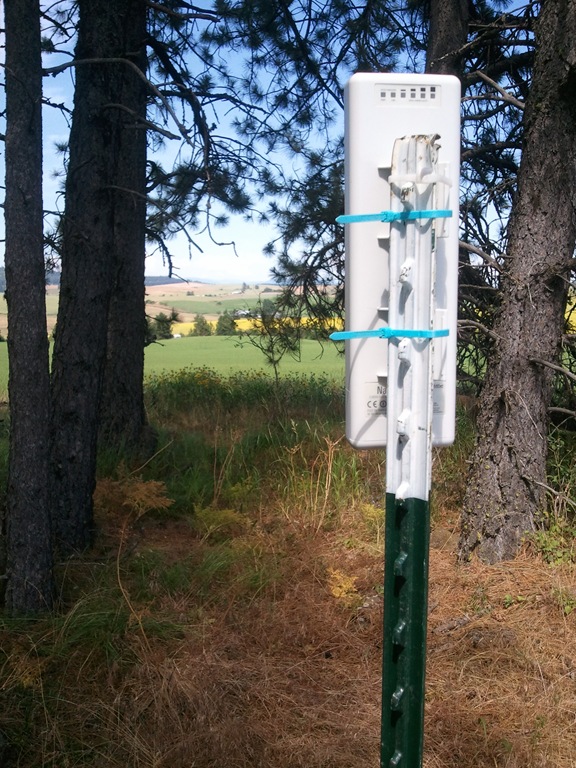
Anyway, here is a picture of the new access point:

WP_000109

The fence post was rather difficult to get into the “ground”. The place it really needed to be was mostly big rocks covered with a few pine needles. I got it into the ground and I hope to be able to test the connection the next time I go back. It’s over a half-mile to the source with partial blocking by the trees and that is a little bit of a concern to me.

Here are the railroad ties donated by Matt and delivered by Barron and unloaded with the help of Kim and Caleb we will use for the new production facility Ry is supervising:

WP_000113

Thanks again guys. We are going to have a great new place to make targets next spring.

Ok, That Is Pretty Cool

I’ve come to shrug my shoulders at the various “flying car” ideas out there.  Most of them have never flown, and probably never will, despite having the flight specs listed on the their web sites.  There are of course helicopters and auto gyros, but I don’t know of any highway rated ones.


This one is already in the air and the road, and seemingly ready to go.


I want the option of putting floats on mine, and skis, plus four wheel drive, and it needs to able to carry four people, the dog, and a week’s worth of camping supplies for the family, my tools, several rifles and a couple thousand rounds of ammo.  I’ll have to wait for the “F150 4 x 4” version, and then get it used, ’cause I can’t afford a quarter mil.  You early adopters will no doubt be a great help.

Trunk Monkey!

I’m not sure how well it’d work, but the idea is interesting.


HT to Castboolits.

Breadboard Computers

In the early days of radio, you’d have what we now refer to as a “breadboard radio”.  You’d buy, say, the power supply, or the power supply and the detector, mounted on a wooden board that resembled a breadboard.  You’d then add an RF amp, a VFO once those came available, an AF amp and so on, until you’d built up your desired system.  You’d then assemble the A and B batteries and set about to hooking it all up and aligning it so it would work.  In other words, you had to be something of a technician if you were going to have a radio, or you’d have to know a technician willing to help you with the hours upon hours of component selection and set-up.


I’ve said for years that we’re still in the breadboard phase of computer technology.  It is changing, but we’re still there.  Similarly, in the early days of the automobile it was not uncommon to purchase your chassis from one manufacturer, and take it to the coach builder of your choice for the body work and interior.


Son got a computer yesterday, along with a multi-track recording interface.  We selected the computer for high processor speed, a large amount of RAM, and at least a TB of HD.  We had to add a firewire card, making sure the available slots on the motherboard would accommodate the particular firewire card with the particular chip we wanted.


The damned thing still won’t work.  Something about a 32 bit verses 64 bit Win 7 OS, and something about a sound card, or sound card driver (we still don’t know which) that doesn’t allow for something referred to as “direct audio input”.  Never heard of it.  Don’t understand why the sound card is even a factor, since it was my understanding that the recording interface, and it’s related software, took care of all those functions.


A thousand bucks into it (and that’s a screamin’ good deal) and we’ve only begun to spend.  The technicians at the computer stores are of zero help, so now it’s to the digital recording specialists we know (I grew up in the analog, magnetic tape days, so I’m of little use), and to the manufacturer of the interface.


All this of course represents a business opportunity.


ETA; actually, you’d get either the A and B batteries or you’d get the AC power supply for your “radio set” once the AC supplies came available.  It took several decades for the complete system being sold as a unit to become the rule.  I have a 1931 Atwater Kent system that came in basic form as the old breadboard unit, though it was a complete, functioning breadboard set.  It also has the optional wooden cabinet, into which the breadboard slides, with the control knobs and frequency display mating up into cut-outs in the cabinet front.  The “dynamic loudspeaker” is another option in this set.  This one is the alternate to the free-standing loudspeaker, or to a mere headset.  It hangs on two hooks inside the optional cabinet.  Then it also has the optional coil loop antenna.  All components were sold by the same company and complimented one another nicely.  That’s about where we are with tower PCs these days, except that the components don’t always match up or work at all together.  Hence, putting together a computer system for some specific purposes is a hobbyist’s or technician’s activity, rather than a simple consumer purchase.