Daughter Xenia sent me these links:
I like the last two best:



As I reported earlier I had a dead battery in the Crimson Trace Lasergrips. As Rob pointed out the case is tight enough that if the master switch was left on the grip switch would be activated when the gun was cased.
I installed the new battery and the laser came to life but wasn’t right. It was just like it was when I tried to use it at Summer Camp. It appeared to be hitting the pin for the slide lock and what light hit the target was a blob instead of a laser beam. Further testing indicated the laser lens was either dirty or possibly defective. I tried using an ordinary cotton swab with alcohol but I couldn’t detect any improvement after repeated cleanings.
Say Uncle sent me an email saying he had similar problems with his laser and when he used the swab supplied with the grips rather than ordinary cotton swab it cleaned up and worked correctly. The cotton swab is just too large to deep down to the laser lens. I was able to confirm his results. My laser now works as expected.
I practiced drawing and dry firing with the laser probably a 100 times. I discovered that frequently I don’t have a solid grip on the gun with the middle finger on my strong hand. It isn’t gripping the gun strong enough to turn on the laser. It turns out sometimes my weak hand will push it forward as I wrap my weak hand around my strong hand during the process of gripping the gun. I’m going to modify the process some so I get a better and more consistent grip.
I also used the draw and dry fire exercise to observe the movement of the gun as I put the sights on target and pulled the trigger. One observations instructors in the past had made that I was not pushing straight out to the target but instead was pointed the gun above the target then bringing it down. It appears I have fixed that error in my draw stroke.
These laser grips are proving to be useful even before I have fired a single shot with them.
As we were filling out the paperwork so I could be approved to exercise my Constitutionally protected right to own a firearm the clerk behind the counter asked, “What model is that?” I thought about it a moment and said, “I guess we can call it a ‘Gun Blog 45’ just like what it says on the side.” He agreed and after 45 minutes of paperwork and a phone call to the FBI (the first NICS check ever done on me–I always managed to avoid them with my concealed weapons permit in the past) I got my Para-USA Gun Blogger Summer Camp gun last night. The same one I shot last month at Blackwater. Yeah, I purchased the gun I said has a Pri 0 bug. I was convinced by several people that learning to shoot it right wasn’t that outrageous of a suggestion.
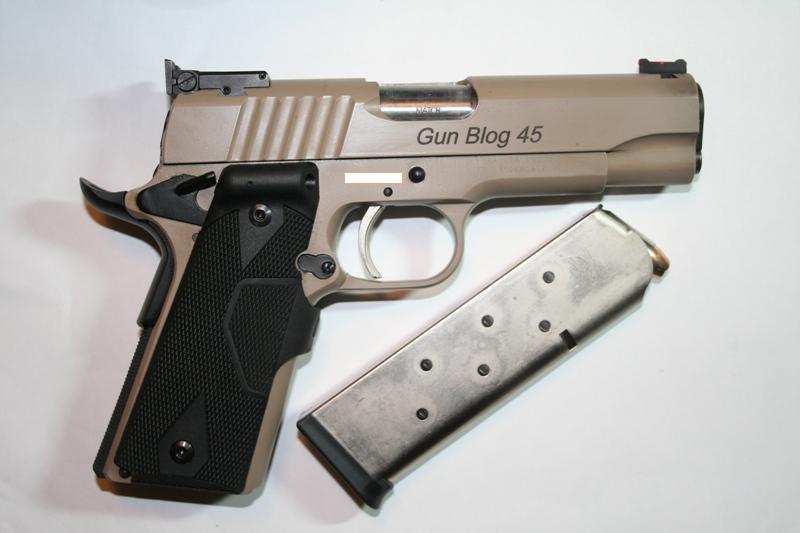
Para-USA LDA with Crimson Trace Lasergrips
(Click to see higher resolution version)
I immediately bought some ammo–230 grain FMJ Magtech (the cheapest ammo on the shelf) and 230 grain Winchester Ranger (hollow points). I went to the range and loaded up one magazine of each. I put my targets at 30 feet which is the same range as the target that came with the gun:
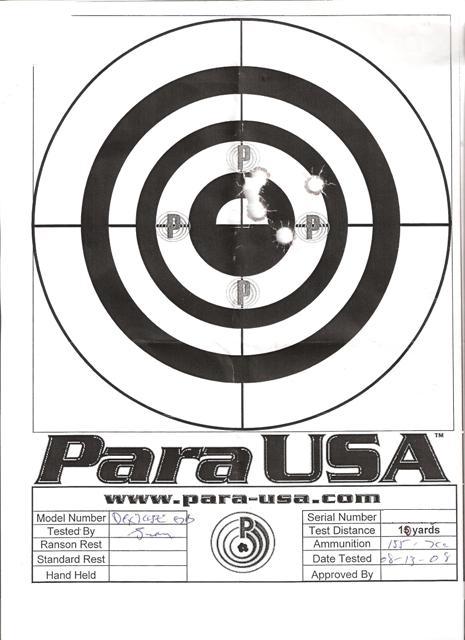
I loaded the FMJ ammo and fired a shot. The gun failed to feed the second round into the chamber. Grrr… I had lots of problems with that at Blackwater but the problem went away after shooting a few hundred rounds and then lubricating the dirty gun. But this time the gun was clean and fully lubed. I racked the slide and continued to fire and had no further problems.
I was fairly satisfied with it:
Magtech 230 grain at 30 feet.
I fired all eight rounds of the Winchester Ranger without incident except the last round which I pulled a little bit when I fired:
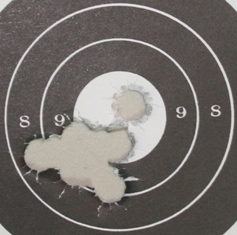
Winchester Ranger 230 grain at 30 feet.
This was better than the factory target!
Ammo makes a difference!
I didn’t do any fast shooting as I had other things I wanted to do last night. That will be coming up soon. I need to see if I can train myself to shoot fast while taking my finger nearly off the trigger between shots.
The batteries appear to be dead in the laser grips. There is just the faintest glow coming out of them. I bought some new batteries but haven’t installed them yet. A report on Crimson Trace Lasergrips will be coming soon. I have two guns equipped with them now.
Others who have received their Gun Blog guns from Para-USA:
While at the Gun Blogger Summer Camp last month I won a set of Crimson Trace laser grips–whatever set I wanted. I finally got around to asking for a set to fit a Ruger Mark II. I received them but haven’t installed them. I went to range tonight thinking I would put them on and try them out but wasn’t thinking ahead. I forgot to bring tools.
They look very cool but a full report will have to wait for a few days.
Six of us made it to the event (click on the pictures to see higher resolution versions):
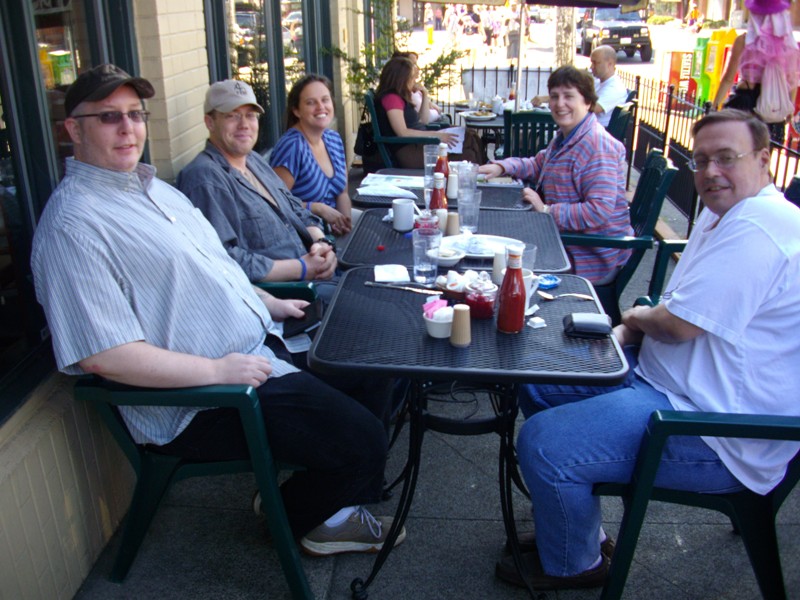
Left to right, Phil, American Mercenary, Misty (wife of American Mercenary), Barb (my wife), and Gay_Cynic.
Barb insisted I should post a picture of myself as well, so here it is:
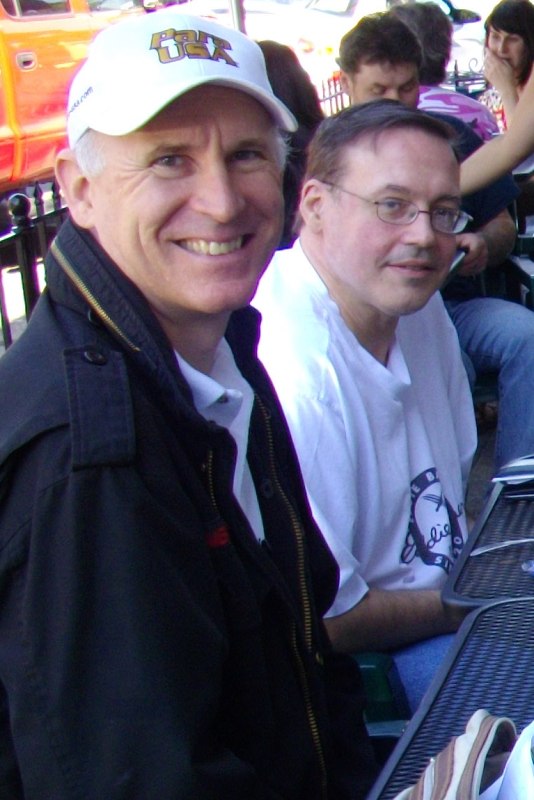
Joe Huffman and Gay_Cynic.
We had a nice time. No concrete plans to take over the world or anything. A report on Gun Blogger Summer Camp was requested. Gay_Cynic wanted to know if Tamara was as delightful in person as she is to read. I said she was but she seemed a little bit shy which I didn’t expect.
Phil and I talked about our plans for guns to take to Reno next month.
We talked about Seattle Mayor Nickels attempts to break the law and ban gun owners from carrying on City property. Phil reports Nickels will release his plans after getting an opinion from the state Attorney General. If I recall correctly Phil said that was due out on October 20th which will be in time for the election.
In response to something American Mercenary said about Democrats and socialism I said those people have a different set of basic assumptions about reality than I do and Phil says he will have blog post about that on Monday. I’m looking forward to it.
American Mercenary informed us about the use and misuse of full auto in the army. He explained a use I hadn’t really thought of before. He said a machine gun set up in a street can prevent anyone from crossing for many hundreds of yards but that same gun on a roof is of limited use.
Barb and Misty talked extensively about being the wife of a military man. Xenia will soon be in that position and Misty has been living that life for quite a while now. Barb arranged for Xenia to take some pictures, “When Misty has her baby.” Of course this was ambiguous to me. My first inclination was this probably meant during delivery–which seemed a little odd. But the shock on Barb’s and Misty’s faces when I wanted clarification on this point got me on the right track.
The folks at CMMG have come out with an AR-15 gas piston conversion kit. It comes with a new gas block, piston and bolt carrier (so it works more like the AK). As far as I know, before this conversion kit you had to buy a whole new upper for your AR if you wanted a piston-driven system. It’s an attractive idea in some ways, especially for those who’ve had problems with carbon fouling in the bolt carrier. The piston system keeps more of the carbon out of the receiver and it’s great for use with a sound suppressor, in which case it keeps more of the trapped gasses from blowing back into your face. The conversion kit’s price is roughly equal to that of a new AK rifle and several spare magazines. However, they call their piston kit a “direct impingement gas piston system.” Anyone else see a problem here? It may be nitpicking (and please correct me if I’m wrong) but “direct impingement” is exactly that one thing that a piston system is not. When Stoner came up with his piston-less operation back in the day, he called it “direct impingement” to describe his system of channeling the gas back into the receiver where it “directly impinges” on the bolt carrier without an intervening piston rod or tappet.
JR has created another slide show from pictures and music from Gun Blogger Summer Camp. For reasons explained in his post the music he used was my first choice. But after looking for a minute or two I didn’t find it and gave up to use stuff I already owned.
Enjoy.
As taught by the experts. I was taught this by Insights Training and then had it reinforced by Todd Jarrett a couple weeks ago.
I highly recommend it.
Registration for the 2009 Precision Rifle Clinic is now open. You don’t have to attend the Boomershoot on Sunday to participate in the clinic on Friday or Satuday. They are in close proximity in space and time but are, essentially, independent.
The prices for this type of training is amazingly good. And it includes shooting at a few boomers as well.
High winds with ice pellet storms. For me, that was uncommon for the Boomershoot but not the worse I have experienced at the Clinic so take it as it was. The winds we had offered an excellent opportunity to practice our wind doping and we learned our lessons and gained some confidence that we could stay on top of such winds well enough to hold IPSC size steel targets as long as we could see them. Such conditions were extreme but I doubt anyone will forget the experience or more importantly, how the Clinic shooters dominated these conditions. I am sure firing in 25 – 30 MPH winds and ice pellet storms will be something the shooters won’t soon forget.
Eugene Econ
Boomershoot 2008 Precision Rifle Clinic After Action Review
[I remember seeing a young woman at the clinic who had arrived from Austin just the day before. She was bundled up in winter clothes and the only skin exposed was part of her face which was getting pelted with ice pellets. I asked her, “Are you having fun yet?” She said she was. At the time I thought she was probably a very good liar but she signed up for Boomershoot 2009.–Joe]
I just finished the book Trigger Men: Shadow Team, Spider-Man, the Magnificent Bastards, and the American Combat Sniper. It is a great book. I had no idea how important snipers were to the efforts in Iraq–especially the battle against IEDs. And in an urban environment too. In the mountains of Afghanistan, and the jungles of Vietnam, sure, but in the cities? I was wrong. They are doing 800 and 1000 meter shots in the cities. They would climb the walls of a families house while the family was sleeping and hide in their attic for a couple days and unless they did some shooting the family wouldn’t know they there until they said good-bye on the way out. Amazing stuff.
Bolt-actions guns, technology that has been around for 100 years, is more important than multi-million dollar weapons and vehicles in fighting the enemy. The sniper rifle is the ultimate precision “bomb”. It can kill one bad guy with an RPG in a crowd of women and children and not do anything worse than splatter the innocents with blood, brains, and bone.
I highly recommend this book to people of the long gun.
This weekend I spent a bunch of time culling the 1000+ pictures I (and a few others) took at Blackwater into a slide show set to music.
It’s 11 minutes long and 31+ MBytes but here is the result. I like to play it with the volume cranked up to just below “noise complaint to the police”–especially at the beginning.
Update: Embedded version:
We now have another convert from the dark side. Caleb is now a believer in John Moses Browning.
Barb and I have made plans to attend the Gun Blogger Rendezvous in Reno this October. We won’t be there the entire time. We are first going south to Tonopah where Barb’s father lived for several years. We will be in Reno sometime on Friday afternoon or evening and will be there all day Saturday. Sunday we probably will do something that isn’t particularly gun related such as hiking or museums but if others want to hang out with us that would be fine.
I probably will bring my .300 Win Mag for long range fun on Saturday, at least one handgun, and my shot timer.
If you listened to the Gun Nuts on August 19 you would have heard me wonder how Jarrett was going to handle the wide range of shooting ability in the participants when we showed up on August 22. I believe I had the most training going in. A partial list of my firearms training:
Most of the others had not had any formal training. Other students who have taken courses from multiple schools have wisely told me that when attending a new class you should approach the class with an open mind and if you can take just one good thing away then the class was worthwhile.
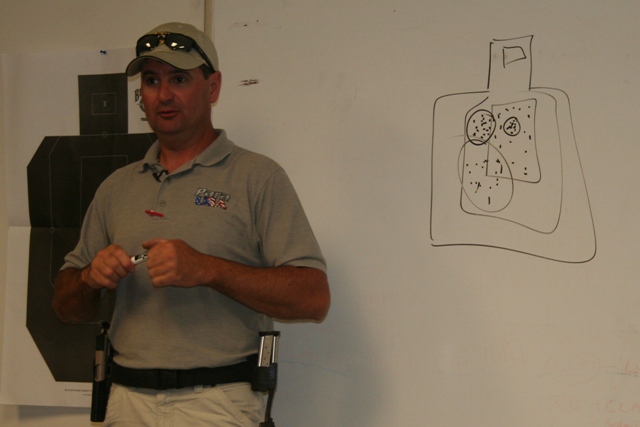
Jarrett did a great job of dealing with the disparity. He obviously had to get everyone up to speed with the fundamentals such as grip, trigger control, and sight alignment. He did this on the first day mostly in the classroom. On the second day he did something everyone was impressed with. He made marks on our hands that helped us get the grip right:
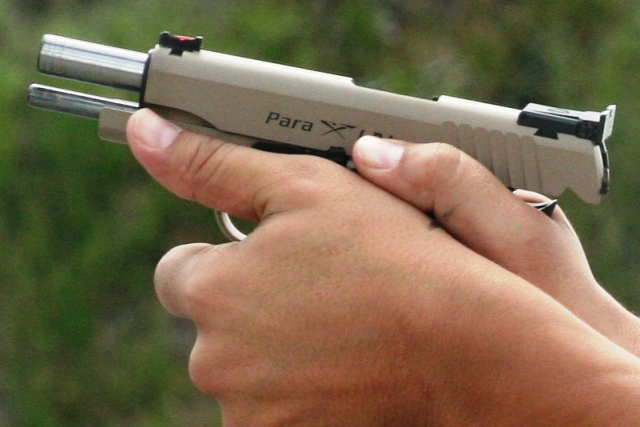
Robb Allen’s hands with the Para USA LDA .45 in full recoil. Notice the smoke leaving the ejection port?
Notice the mark on Robb’s right thumb just below the joint? There is a matching mark on his left hand. These two marks line up when he was holding the gun properly. It’s difficult to see but there is also a mark on his right hand directly behind the beaver tail safety underneath the slide. This mark should be directly in line with the long axis of the gun and the axis of the shooters arm.
When I saw what Jarrett was doing with these marks little shivers went through me. This was a brilliant teaching aid. I was the next to the last person to get the marks and he told me I was the only person to already have the proper grip. John D. to my left and the last person also got it right. I had made a very slight modification to my normal grip when I showed it to him. I had to shift my right hand just a little to get the proper alignment. The single stack gun is much narrower than what I am used to and once I got the marks on my hands I began practicing my draw making sure that the lines matched up even when I was drawing at full speed.
The draw was one of the areas where Jarrett cut some corners on the training. He talked about it some but didn’t have us do any drills specifically working on the draw. He focused on doing a safe draw but not much on speed. This probably was a wise thing considering the other things that were going to be a lot more fun and new to the more advance shooters but in terms of self-defense shooting this probably was more important.
We shot at 8″ plate racks from about 15′ as we were pushed to shoot faster and faster. This was very frustrating for me because my plates would go down hard enough they would bounce back up. Some plates I put down three times only to have them remain standing.
We did some 25 yard slow fire shooting to verify our trigger control and zeros. On an silhouette target my gun was giving me head shots when I aimed at the chest. Jarrett verified it did the same for him and adjusted the sights for me.
Our range had the capability to give us moving targets:
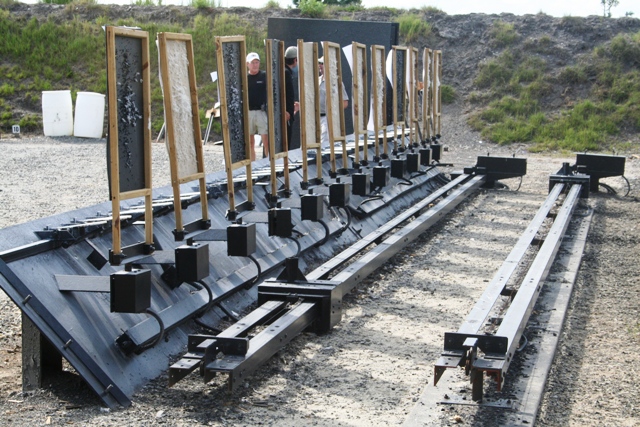
Looking carefully on the left you can see the remotely reset steel plates then the turning targets. The two rails on the right are for targets that, from the shooters perspective move horizontally left and right. All of these were utilized.
This was nearly all new to me. In competition I have shot at moving targets and moved while shooting but I have had near zero formal training on it.
We shot at the turners. We were given two seconds to empty our eight round magazines into silhouette targets.
We shot over, around and through barricades:
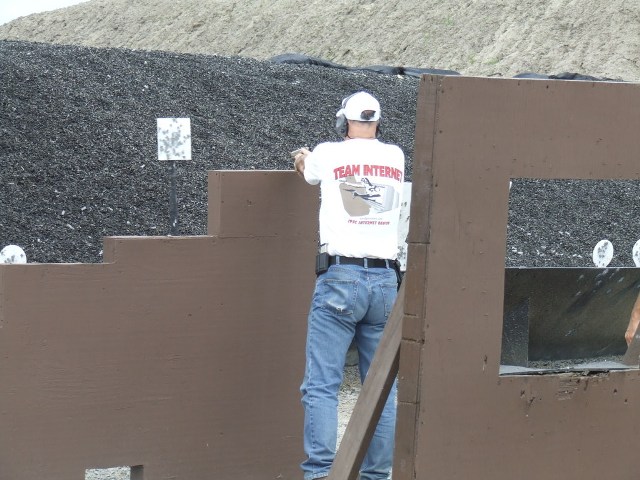
Me, shooting at a steel plates over a barricade. Photo by JR.
Yes, I was taking advantage of my height when everyone else had to use two different shooting positions to get access to the same targets.
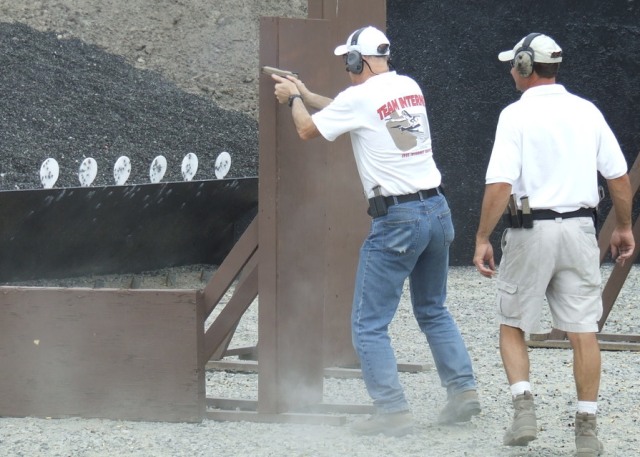
Me, supervised by Todd Jarrett, shooting around a barricade. Photo by JR.
We shot on the move. We advanced on the targets while shooting (photo by JR):
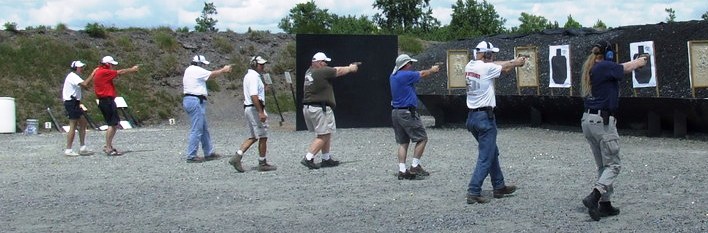
We shot at horizontally moving plates while standing still. We shot at plate racks while we were moving horizontal.
We shot at horizontally moving plates while we were moving both left to right and right to left.
The things I took away from this was:
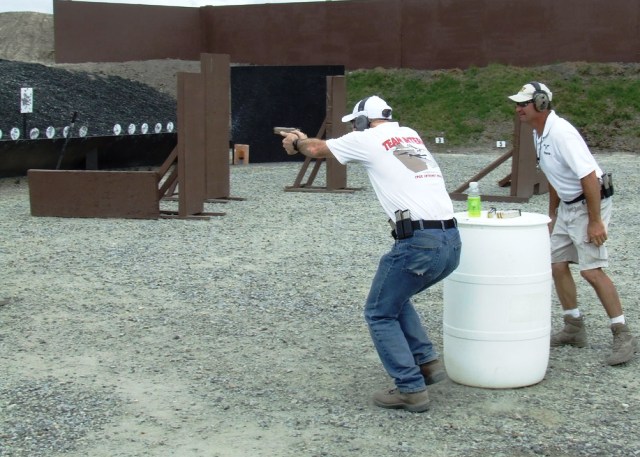
Me, supervised by Todd Jarrett, shooting at a steel plate while advancing. Photo by JR.
See also this video from Sebastian:
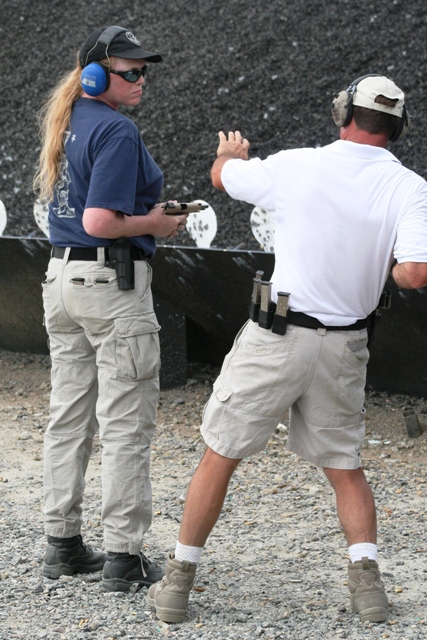
We did some rapid fire from the hip shooting at a steel plate about 18″x24″ in size from just a few feet away from us. The point was to be able to get the gun on target in a close quarters situation. Below you can see Tamara, having just completed the drill, getting a little further instruction from Jarrett on the topic:
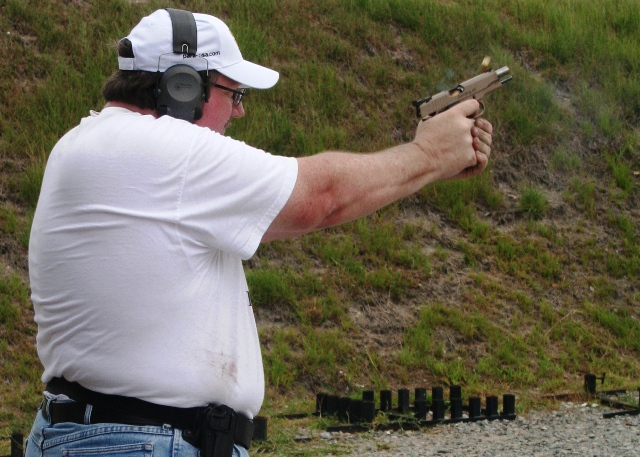
We then did some plate shooting from 35 yards. Here is Kevin hammering the plates (and having them bounce back up) at distance.
One thing that I found as a glaring omission was learning to reload quickly. It was appropriate given the time constraints and disparate training of the students but I was hoping for some “fine tuning” of my reloads.
My biggest surprise was how useful laser sights are for training. I’m not convinced they are particular useful for the shooter as he or she is actually shooting but as an instructor or by video taping as the student is shooting a lot can be learned and taught. I was previously of the opinion the most useful aspect of them was as a toy for dogs and cats. One small example is to have the student shoot rapidly and watch the path of the laser on the target. It should track nearly straight up and down without overshooting the point of aim. Similar lessons can be learned and taught in transitioning from one target to another.
The most fun was the shoot house. I already have a full post on that and won’t go into that again except to say that I disagree with Kevin with what was happening while we were taking turns going through. Kevin is of the opinion ninjas from Gunsite Ranch were spying on us. I think this was actually a vulture from the Brady Campaign hoping for some blood to be spilled:

At Blackwater last weekend we used ammo supplied by International Cartridge Corporation.
The ammo worked great. I have zero complaints about the performance of the ammo. Accuracy was excellent. We fired the ammo about five or ten feet from steel plates (that is what Tam was doing here) with only a hint of dust coming back when the wind was right. It is made of sintered copper and tin so it is non-toxic. Because there is no jacket the bullets can be made very accurate. The major factor in bullet accuracy is the jacket being of different thicknesses on one side than another. This puts the geometric center of the bullet at a different point from the center of gravity. As the bullet traverses the barrel the bullet rotates about its geometric center. As it exits it rotates about it’s center of gravity. If the two centers are not the same it will “jump” a little to one side as it makes the transition. This will cause the bullet to go in a slightly different direction than that which the barrel was pointed. Hence the homogeneous, sintered, bullet can be made more accurate.
The bullets are also made with a lubricant for release from the mold during the manufacturing process. This lubricant is part of the structure of the bullet and is still present when the bullet is fired. Along with the tighter diameter tolerances (about 0.0005″) the guns shooting these bullets run much cooler. Todd Jarrett told us of full auto guns having barrels cool enough to hold the gun by after emptying a complete magazine loaded with this type of ammo.
The ammo rep on-site with us said the price was about the same as hollow point ammo. He also said the bullets were not available for reloading. Something about them being too fragile and cracking in reloading presses. This seems a little odd. They didn’t crack when we dropped them on the gravel in the shooting bays. They didn’t crack when we dropped them on the concrete. The didn’t crack when they were fired.
I also found where they are sold for reloading. From their dealer page click on http://www.frangiblebullets.com/. There you can find prices, loading data, and lots of other interesting information.
One thing you will notice about the bullets is they are much lighter than the same caliber lead bullets. This is because the materials used, copper and tin, have a lower density than lead. They can, and are, loaded to higher velocities and can reach IPSC major power factor in .45 ACP, 10mm, and probably .38 Super. Minor PF can apparently be reached with 9mm. .40 S&W appears to be unable to reach major PF.
If my blood levels of lead were on the high end of normal I would probably buy the bullets and reload them in my pistols for practice and competition. As it is my lead levels are on the low end of normal and lead bullets are cheaper (in .40 S&W about $0.18 versus $0.11). And in any case I don’t think I would use the bullets for self-defense. I’m inclined to believe that heavy, deep penetrating bullets are better fight stoppers than light bullets that leave a lot of fragments behind upon entry.
Another reason I would be disinclined to use the light bullets is the recoil. For the same bullet momentum (Power Factor in USPSA terminology) you get more recoil. This is because more powder is used with the light bullets and the high velocity powder exiting the barrel adds to the total recoil. The recoil is also spread over a longer period of time with the slower moving bullet. Hence a light fast bullet causes a very “snappy” recoil which tends to be uncomfortable. I noticed this with the .45 gun I was shooting over the weekend. The recoil was much different than what I expected from a .45. I asked what the bullet velocity was on the 155 grain bullets we were shooting. About 1150 fps I was told. Normal .45 ACP velocities are in the range of about 750 to 925 fps and you feel more of a “push” than the “slap” I was feeling.
Still the lead free frangible bullets have their place. I could see indoor ranges requiring lead free bullets or steel plate competitions requiring frangible bullets. I remember taking a pistol class once and the instructor telling us that for every class they usually have, on the average, one injury from the back splatter from the steel targets. They had about 10 students per class and were firing about 1000 rounds each on steel so there were a lot of bullets going down range and eventually the odds would catch up with someone. The injuries were always minor and required nothing more serious than a Band-Aid but still the injuries did occur. Wrap around eye protection and either directly facing the targets or facing away was required. Those concerns would be eliminated with ICC’s frangible ammo.
Tonight the Gun Nuts will have another show on the events from this weekend. I don’t know for certain who will be on. I was invited again but thought I would just listen and let other people talk this time. The live show starts at 2300 Eastern, 2000 Pacific time.
Para USA, Blackwater USA, Blackhawk, International Cartridge Company, and Crimson Trace will probably all be topics of discussion and will all get well deserved praise.
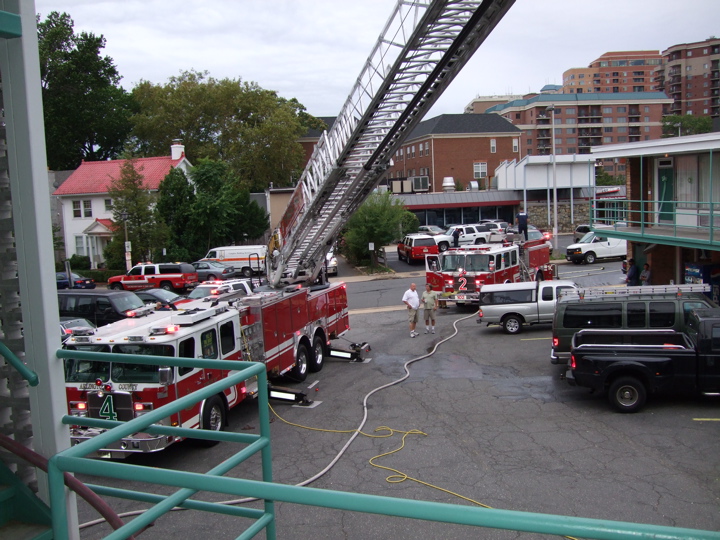
Woke up this morning in Arlington VA (I fly back to AZ this afternoon), opened the motel room door, and this was the view.
The firemen say a room on the next floor burned up. After two trips thru the shoot house, this really isn’t that exciting. Hmmm, a motel fire. Be careful not to trip over the hoses while getting some coffee to wake up.
David Hardy
August 26, 2008 4:46 AM PST
I’ve done a lot of USPSA shooting but never anything in a 360 degree shoot house with a dozen rooms, real doors, and real hallways in it. As various people said in various ways during our visit to Blackwater “This place is made of awesome.”
The walls were made of plywood covered 2x4s with steel plating on the outside walls to contain the bullets. The USPSA targets we used were mounted on bullet traps. We used frangible ammo from International Cartridge Corporation which worked extremely well (Sebastian has more on the ammo).
There were buildings in various configurations including one with the building named “R U Ready High School”. We used range T7 that could have been an office building or a home.
In front of our building were walls and a gate that could be used for breaching exercises.
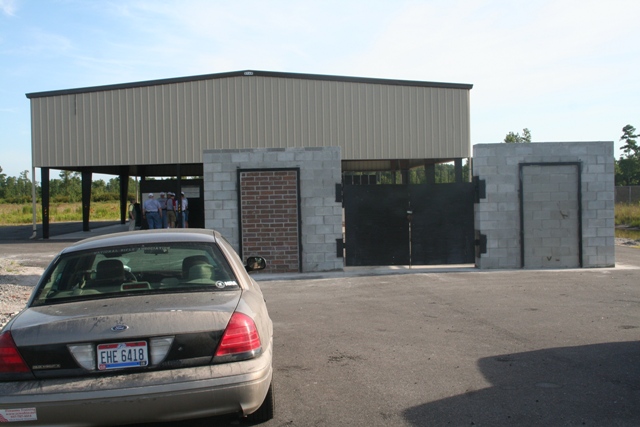
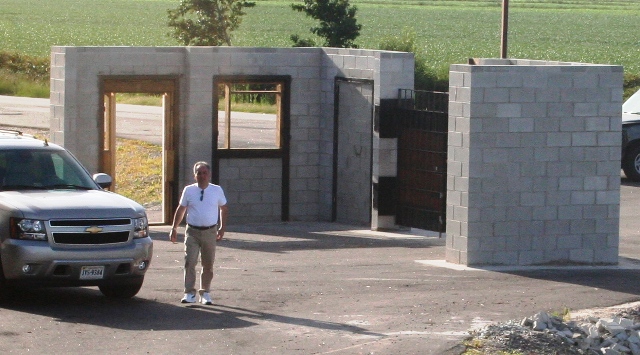
They have the repair materials for the breaching practice walls nearby.
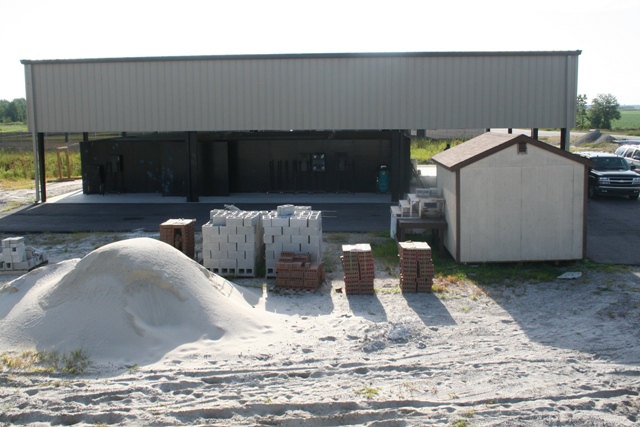
The shoot house is a metal roof with partial walls coming down from the eaves to about 10 feet above the ground. The interior with the walls, doors, hallways, targets, etc. has a smaller footprint and has about eight foot walls. Some shoot houses had catwalks overhead. T7 did not have the catwalk and the video guy had to use a ladder to peak over the walls and get his footage.
Just 100 feet or so from our shoot house was this hulk. Apparently used a different type of exercise.

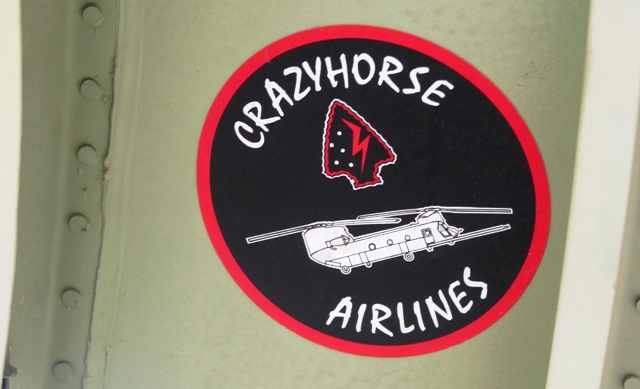
This sticker was on the inside of the plane wreckage.
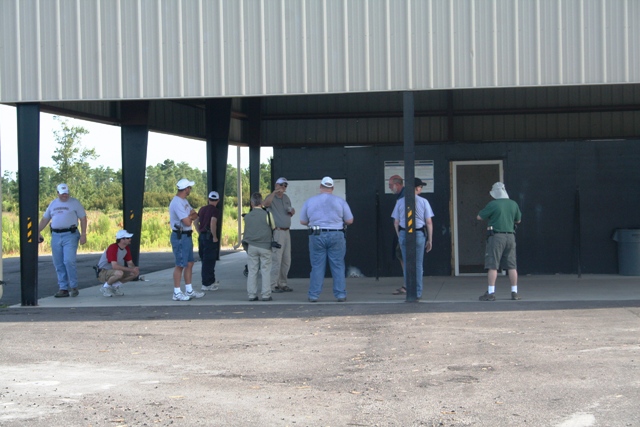
The white board on the front of the building shows this is really a classroom not just a place for fun. Rob Allen is supposed to report on what we saw on the white board. You won’t want to miss that post.
More pictures, and drooling, about the shoot house is available here.
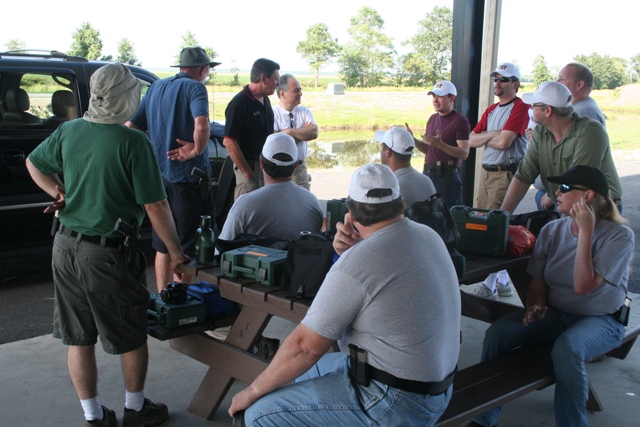
Because we could only run one person at a time through the shoot house we spent a lot of time standing around talking. Here Caleb* explains how things should be done to the rest of us.
This was also the place where Caleb and I settled our bet. Originally I had suggested an El Presidenta and Caleb agreed. But it was clear it was going to be a hassle to find and set up a range for that so we agreed to use the shoot house course since that was to be timed and a winner determined anyway. I was concerned about the 9mm versus .45 aspect which the USPSA rules for the El Presidenta would have taken into account. But we were using USPSA targets here and I figured we could use the time and the hits and again use USPSA scoring and have the 9mm versus .45 disadvantage compensated for. But then the scoring was announced by Todd to be merely time with a miss counting as a three second penalty and a hit on a hostage to be a five second penalty. This put me at a disadvantage. I was shooting a high recoil gun with a Light Double Action trigger with a bug that had been haunting me anytime I tried to shoot fast versus Caleb shooting a light recoil gun with a single action trigger which was working well for him.
Caleb was the second person through the shoot house and what sounded to me like an okay time. Not great but not bad. 24 rounds in most types of environment should be completed in about that many seconds for an average IPSC shooter. But with the eight round magazines, numerous doors to open, and it being a surprise stage it should have taken me about 30 to 35 seconds. Caleb did it in about 46.3 (I forget the exact number on the tenths) but he hit a hostage which, according to the rules, gave him a 51.3. All I had to do, in my mind, was not make any mistakes. I went through immediately after Caleb and had at least three malfunctions of various types with the gun. I also ran down a hallway that was a dead end and had to back up to go the proper way. I made a bunch of mistakes but still turned in a time of 49.89. Good enough to win but not anything to be proud of. Caleb now owes me free ammo for life**.
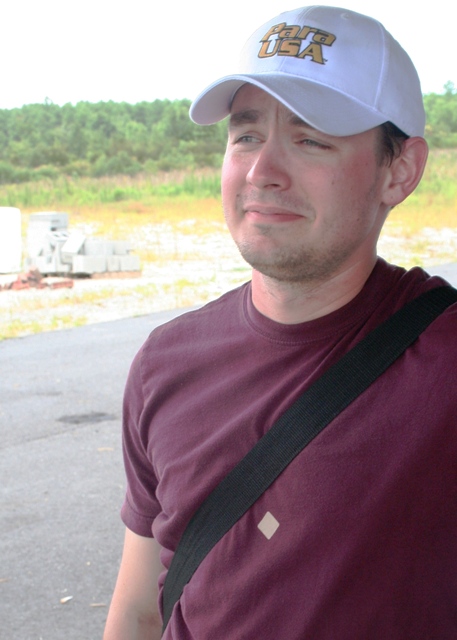
As reported earlier Caleb only cried for a little while***. The brown paster on his chest is his “badge” for shooting a hostage.
* I’m kidding. Caleb was not the least bit arrogant or a braggart. I think we both knew shortly after the shooting started on Friday that it was going to be a close match.
** Just kidding, it’s two hundred rounds of 180 grain FMJ .40 S&W.
*** Again, I’m kidding. The “crying” incident was two days earlier. I don’t know how I managed to get the above picture. I just took so many pictures that one of them “fell into my lap” for exploitation.
I won the bet with Caleb today. Caleb reported it live from the range. I won only because I made fewer mistakes than he did. In a second run through the house with a different configuration I again beat him by a slim margin because I made slightly fewer errors than he did. In both runs through others beat us. My second run was good enough for second place and I won a set of Crimson Trace laser sights.