Where does the bullet go?

I have worked with the mathematics of exterior ballistics for so long that I sometimes forget the general nature of the path of a rifle bullet to it’s target is not mind boggling obvious. I was reminded of this by an email I received today:


Need a answer: I was told that when shot a 30 cal. bullet goes up and makes an arc to the target, when held level. What happens, say at 100 yards.?


This email caused me to have a flashback to when I was in grade-school (yes Kris, firearms had been invented by the time I left grade-school).


When I was about the fourth grade a friend of mind, Verl (yeah, kids had strange names back in those days), insisted that the bullet would rise after it left the barrel of a rifle. I didn’t believe it and asked how long it took before it when into orbit (or some such thing that pointed out the absurdity of his claim). He didn’t know but asked his dad and came back to school and explained it went up for a while then came back down. My knowledge of and ability to articulate the physics of gravity and moving objects was limited and although I was profoundly unsatisfied with this explanation I couldn’t refute his assertion that it was true.


Later I made sense of it and eventually I wrote a computer programs that accurately predicts the path of a bullet as it leaves the muzzle. I am now much more capable of articulating the physics and will now attempt do so.


If you were to go to the range and instead of shooting the bullet you were to drop it from your fingers you would correctly expect the bullet to immediately accelerate toward the center of the earth and pick up speed at the rate of about 32 feet per second for each second it is in the air until it hit something. It doesn’t rise for a while then start falling. If you take a carpenter’s level to the range and line up the bore with the level such that the bore was horizontal and fire the gun the bullet will drop, relative to the horizontal, from the instant it leaves the barrel. It does not rise and then fall. It also does not fall at the same rate as a bullet you dropped from your fingers but that is another, much more complicated issue that is beyond the scope of this post.


Because the bullet immediately starts falling as it leaves the barrel in order for the sights to predict the impact point they are not aligned exactly parallel with the bore. They are aligned such that when you view the target they line up where the bullet will actually hit after bullet has dropped by whatever amount on it’s travel to the target. If the bore is horizontal the sights are pointed slight down. If the sights are horizontal then the bore will be pointed slightly up. In other words there is an angle between the line of sight and the bore of the gun. I call this angle the “Sight Angle”.


As far as I know I am the first to use the phrase “Sight Angle”. I use this to simplify the setting of the scope for long distance shooting. Most long range shooting instructors refer to your gun having a “Zero” that depends on the altitude, temperature, bullet velocity, and ballistic coefficient of the bullet. This is wrong. The gun is constant with respect to the environment. The drop of the bullet changes, not the scope setting.


Knowing the distance to the target and the drop the bullet makes when it goes this distance we can compute the proper angle the barrel should be with the horizontal to hit a target that is the same distance above the ground as the muzzle of the barrel. This angle is the proper angle required to have the gun exactly compensate for the drop of the bullet on it’s way to the target. This angle is not the sight angle because there is another complication–the height of the sight above (almost always but not necessarily) the bore. For a typical scoped rifle the line of sight through the scope is about 1.5 inches above the center of the bore. I call this the sight height. Using some trigonometry the sight height and proper angles can all be number crunched into a single number that you can dial into your scope such that for any give range and bullet drop you can dial your scope to the proper angle and you have precisely compensated for the drop of the bullet such that where you line the sights up that is where the bullet is going to go (minus bullet inaccuracy, wind drift, and shooter error). This “proper angle” is my Sight Angle. If you know what the environment is and you know the angle of the scope (and its height) relative to the bore you will know where the bullet will hit for any given range.


So, the email asked for what happens at 100 yards. Here are the graphs (generated with Modern Ballistics, which I wrote).


First the drop for a bullet fired with the bore of the gun horizontal. This is for a .308 Winchester shooting Federal match 168 grain bullets at “standard conditions” (59 F, sea level). Yes, I know this graph is confusing. It is not the path of the bullet. This is the distance the bullet has dropped as it traverses from the muzzle to the target. The drop increases the further it travels:
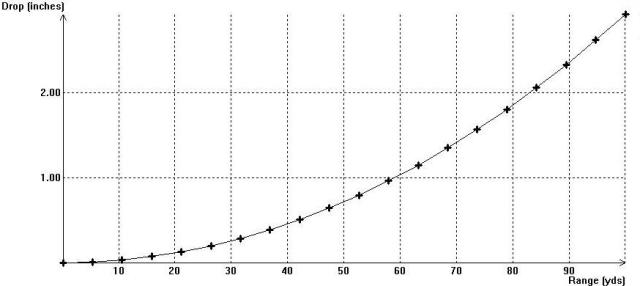


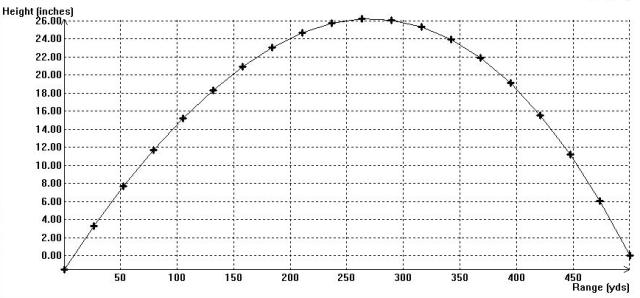
By the time the bullet has traveled 100 yards it has dropped nearly 3 inches. If you point the bore up at a slight angle (4.23 Minutes of Angle to be exact) compared to a scope mounted 1.5 inches above the center of the bore, aim the scope at a target 100 yards the bullet will start out 1.5 inches below the line of sight of the scope. Because the barrel is pointed up slightly as the bullet travels forward it will rise as it travels to the target. The distance from the line of sight through the scope to the bullet at any given range is called the height of the bullet at that range. Hence at the muzzle the height is -1.5 inches. And since the proper angle for a 100 yard zero was dialed into the scope the height at 100 yards will be 0.00 inches as seen in this graph:
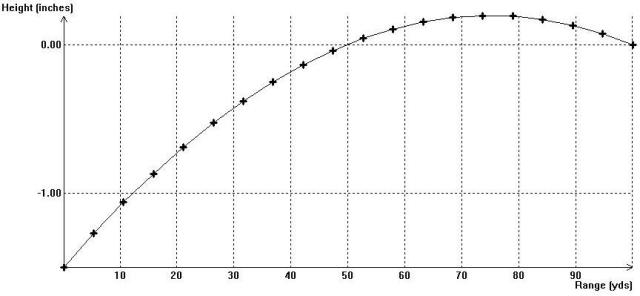


So, from the viewpoint of the scope the bullet does rise and then fall. Of particular interest is that there are actually two zeros for this scope setting. There is a “Near Zero” at 49.8 yards and there is the normal or “Far Zero” at 100 yards. At what is called the Midrange, 75.1 yards in this case, the bullet is at its maximum height of 0.2 inches above the line of sight.


So that is the path of the bullet for a 100 yard shot.


It is just my opinion but I don’t think shooting at 100 yards is very interesting with a rifle. The errors involved for temperature changes, air pressure, wind drift, and bullet velocity variations just don’t stack up enough to amount to much at that kind of range. For a .30 caliber rifle I don’t find things particularly interesting until we start shooting targets at 500 yards and beyond. I’m not going to get into all the interesting details because 99.9% of the people will find what I think is fascinating as mind bogglingly boring. But here is a hint of 500 yard shooting. A graph of the height of a bullet, again relative to the line of sight of the scope, for the same rifle and cartridge as above but for a 500 yard target:
Software alpha release

I have my software project ready for an alpha release (feature complete, but there are known bugs which must be fixed before release).


This was designed for cell phones not a desktop. It will work on desktop and laptop computers but whenever a user interface design was a trade-off between a desktop user and a mobile user the mobile user was given the advantage.


The software is a web based exterior ballistics calculator and can be found here: http://test.joehuffman.org/ http://field.modernballistics.com.This is much different that Modern Ballistics but uses the same algorithms and concepts. This web based version is for use in the field. Example, while at Boomershoot you can input the exact ranges and inclination to a set of targets combined with the weather conditions to get the scope setting needed for one shot, one “kill” hits on the boomers. I plan to have it running on a local server at Boomershoot 2009 so cell phones (and laptops) with WiFi support can get really fast results even with a heavy load of users.


I’m also thinking that maybe for Boomershoot 2010 I will have a weather station on site that will update the conditions for a special version of the software in real time.


Known bugs:


  • The help page is for the desktop version not the web based version.
  • If the bullet velocity at the target is less than 1400 fps all parameters such as elevation angle, windage, time to target, etc. are in error.
  • Some optimization for response time and load handling should still be done.

All data is stored in cookies on your device. This means the website does not need to save the data on the site in order to save your data. The downside is that all your input from the desktop does not show up on your cell phone or if you get a new cell phone the data will have to be reentered.


At this point I’m mostly looking for user interface and device compatibility issues. Does it appear to work on your Blackberry? Does it work on your iPhone? Is the user interface easy enough to understand and use? If you have problems with your cell phone try using it on a desktop computer to make sure you are using the software right before assuming the cell phone is having problems with the website.


Leave comments here.


Thanks for your feedback.

Hitting the 957 yard target

Last Saturday most of the gun bloggers at the Rendezvous went to the range. Other reports and pictures from range day are here:

Yes. As nearly everyone else noted, it was on the cold side of comfortable. The temperature was about 35 F and when we arrived the winds varied from 10 to 20 MPH.


Derek deals with the cold and wind.

These were not the best of conditions for long range shooting but this range is for long range shooting and I wanted to do some long range shooting. I had not shot my .300 Win Mag since the year before at this same range. This range has targets out to nearly 1000 yards and this, more than anything else, is why I wanted to go to the Rendezvous.

Traction Control brought his Barrett .50 BMG and was setting up at the very end bench. This minimized the impact of the vicious muzzle blast on other shooters. I set up on the empty bench next to him but stood behind the line when someone was shooting the .50 to avoid the vicious muzzle blast. This extended the time for my set up as I measured the wind speed, wind direction, air pressure, the inclination to the various targets, and used my laser range finder to get the exact range to each of the targets. I was still making measurements and taking notes as everyone else went through two cycles of shooting and shutting down the range to change targets. I then used my HP-41CV calculator running a special version of Modern Ballistics to compute the necessary sight angle between the scope and the gun for the elevation. I didn’t bother with measuring the incline for the targets at 523 yards and under because they were all less than 8 degrees and the resultant shift in scope settings would be less than 0.1 MOA from assuming no inclination. By the time I was finally ready to shoot there was very little wind from side to side so I didn’t bother to run the numbers through the calculator.

Here are my notes:

October 11, 2008

Apparent Elevation (based on air pressure): 3500′
Wind: 10 to 20 MPH 45 degrees

Target

Range (yards)

Incline (degrees)

Sight Angle (MOA)

Paper

197

0

4.87

Plate 1

342

7.83

Plate 2

412

9.51

Plate 3

523

12.38

Plate 4

637

8

16.63

Plate 5

957

11

27.19

Having done all this I finally took my first shots at the paper target:


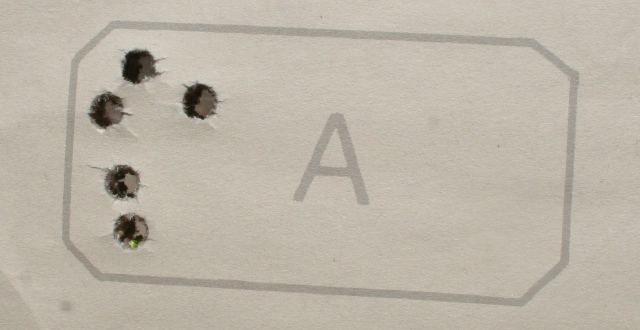
Five shot group at 197 yards at the upper A-zone of a USPA target.

I should have put a orange target dot on the center of the ‘A’ to have a better aiming point. It was difficult to get the cross hairs centered on the outline as I couldn’t see the ‘A’ itself. As it was I just concentrated on the horizontal because I was uncertain as to my windage zero but not my elevation zero. I expect most of the vertical was my fault and not the gun and/or ammo. Still, it was a less than 3/4 MOA group and I was satisfied with it.

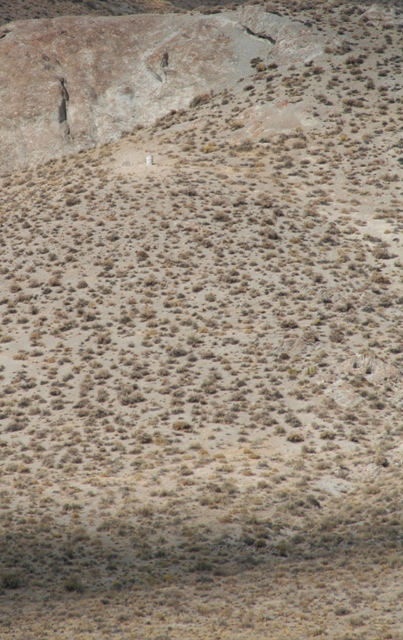
I adjusted my windage zero and took some shots at the closer plates. I connected every time and was rewarded by seeing the plate swing and hearing a loud “thwack-clang” sound. I then asked Phil to spot for me as I adjusted for the 957 yard plate. The plate was difficult for a lot of people to find. Here is the context as seen through a 300 mm (think of it as 6X telescope) camera lens:


Plate and drum are in the upper left quadrant.


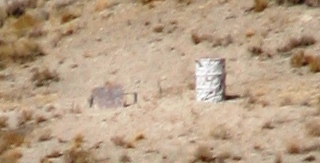
Close up of the 957 yard plate and 55 gallon drum.

A 55 gallon steel drum is about 22″ x 34″ and based on that the plate appears to be about 30″ x 16″. My mil-dot reticle estimates agree with this. The wind was very low but even a 3 MPH wind would result in a miss if I aimed dead on at this range. I waited until the wind appeared to be zero and pulled the trigger. Phil reported it hit just a bit to the right of center and dead on for elevation.

A first round hit at nearly 1000 yards. The geek wins!

The rest of the day was anti-climatic for me. I shot at the 957 yard plate a few more times but I ignored the wind and got hits only about half the time. I shot 10 rounds out of Traction Control’s .50 (I brought my own ammo) and got 7 out of 10 hits on the drum. The .50 has a much better BC (1.05 on the 750 grain A-MAX versus 0.533 on the 190 grain Sierra Match Kings I was shooting) which helped on windage but I suspect that gun didn’t have the inherent accuracy because the target was bigger and I got essentially the same hit ratio.

I emptied a magazine (four rounds) into each of the closer plates and knocked down the 523 yard target with my last shot. As it appeared everyone remaining from the Rendezvous was waiting on me I packed up and left. I was done as soon as I got the first round hit on the 957 yard plate. That was all I was really interested in anyway.

By the end of the day the apparent elevation had changed to 3700 feet but I ignored this as it made only about 0.1 MOA difference at 957 yards. Had it warmed up 10 degrees to 45 F that would have made a difference of 0.28 MOA in the same direction and I would have taken two clicks off of the scope setting for the most distant target to account for both.

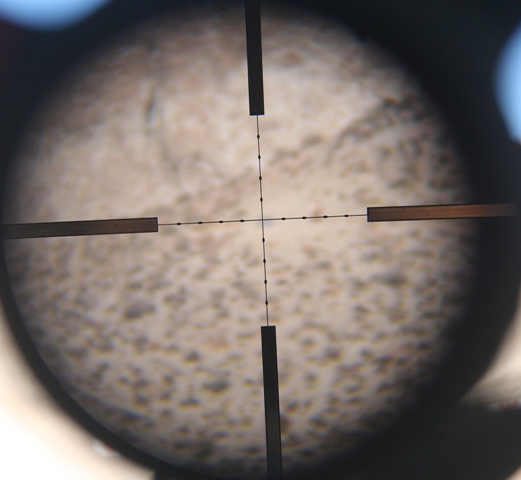
Update: The picture below is from last year and the target is out of focus but it does give a sense of the size of the target as seen in a 14X scope. The drum is 2.5 Mils to the right of the plate which is almost centered in the crosshairs.


2007 view of the 957 yard target at the Reno Range.

Packing for the Gun Blogger Rendezvous

Kevin is leaving tomorrow evening. Barb and I are packing tonight. Our plane leaves at noon tomorrow but we will be in Tonopah until Friday which means we will miss out on the super secret event on Thursday evening.


The gun stuff I’m packing includes:


  • Gun Blog 45 and 200 rounds of ammo
  • STI Eagle 5.1 and 200 rounds of ammo
  • Shot timer
  • Spotting scope (I hope I can find it!) and tripod
  • .300 Winchester Magnum and 100 rounds of ammo
  • Laptop computer with Modern Ballistics (yeah, I’m a geek)
  • Some cleaning supplies

Anything I’m missing that I can legally take on the plane (no, I won’t be bringing my chemistry set) and would be nice to have on the range Saturday?


Update: I can’t find my spotting scope so I’m not bringing the tripod. I am bringing my laser range finder and a pair of good binoculars.

Educating the media on body armor and rifles

Earlier today Say Uncle sent me an email asking if I could help out a reporter looking for “someone of authority” to address the body armor versus deer hunting ammo issue. I know a lot more about exterior ballistics (I wrote Modern Ballistics) than terminal ballistics but I’m not totally ignorant of it either. So I agreed to “look up a few references” for the guy.


My email, with very minor edits, to the reporter follows. His email response indicated he was happy with my answers.


Say Uncle asked that I address your “deer ammo going through body armor” story. I’ll address it as best I can but strictly speaking I’m not an expert. I’m a very well informed hobbyist.


Although there is occasional some controversy over the National Institute of Justice testing procedures and standards they are still “the standard”. You can read their standard here.


Their main page on Body Armor is here.


Probably the part that is most relevant to your issue is the body armor classification. This can be found in section 2 starting on page 17. The basics are that body armor is classified according to the level of protection it provides. Those classes are, in order of increasing protection level:


  • Type IIA (9 mm; .40 S&W)
  • Type II (9 mm; .357 Magnum)
  • Type IIIA (.357 SIG; .44 Magnum)
  • Type III (Rifles)
  • Type IV (Armor Piercing Rifle)

Most law enforcement officers wear type II or IIIA. Higher levels of protection require metal or ceramic inserts which increase the weight, bulk, and the body heat retention. See also Section 6, Selecting the Appropriate Level of Protection in this document. At some point in the tradeoff between comfort and protection the police officer will stop wearing the armor on an everyday patrol. In a high risk entry/arrest situation they are more likely to upgrade to type III armor if it is available.


The problem certain well intentioned politicians get into is that they don’t realize the body armor problem is as much a velocity problem as it is a bullet construction problem. Certainly sharp pointed Teflon coated tungsten carbide (a very hard metal used for metal working tools) bullets will penetrate a higher level of armor than a blunt nosed soft lead bullet. But that only goes so far. Increasing the velocity of the bullet by a few hundred feet per second will overcome the inferior construction in most applications. Rifle bullets are much faster than common pistol bullets. The typical handgun bullet is on the order of 1000 fps. A typical modern center fire rifle bullet leaves the muzzle at a velocity on the order of 2500 fps or greater.


I’ve done some informal testing with the 30-06 rifle on an engine block. The Speer Reloading Manual says of this rifle cartridge, “It is safe to say that the 30-06 Springfield is the best-known and most successful centerfire cartridge ever developed.” In a typical hunting load (see http://www.federalpremium.com/products/details/rifle.aspx?id=260) at 100 yards from the muzzle the bullet is still traveling at over 2600 fps. The tests I did were with a target cartridge and bullet (http://www.federalpremium.com/products/details/rifle.aspx?id=148). At the muzzle this bullet is traveling at about 2700 fps and is still going at over 2500 fps at 100 yards. I was shooting into the side of a six cylinder car engine from the early fifties from about 50 yards away. This was a very heavy engine block compared to today’s cars yet the target bullet would penetrate half way through the block penetrating the water jacket, one side of a cylinder and frequently one side of a piston. A very high velocity (1350 fps at the muzzle) 9mm bullet shot at the same engine block only knocked the rust off of the metal. It did not dent or crack the side of the engine.


It is a very different problem to stop a rifle bullet than to stop a handgun bullet. Although it isn’t quite this simple you can think of it as an energy problem. The energy of the projectile is proportional to the mass of the bullet times the velocity of the bullet squared. That is E = m V2. The mass of a common hunting bullet is on the order of 150 to 180 grains. The mass of a pistol bullet is on the order of 125 to 200 grains with the heaver bullets moving much slower than the lighter ones. The rifle bullets typically are moving about 2.5 times as fast as the pistol bullets. Hence they will typically have about 2.52 or about 6 times as much energy as the pistol bullet.


Even the ancient 30-30 Winchester cartridge has a muzzle velocity of nearly 2400 fps with a 150 grain bullet (http://www.federalpremium.com/products/details/rifle.aspx?id=28) which will cut through the typical concealable body armor worn by law enforcement on a daily basis. Higher end rifles for larger game such as, the still very common, .300 Winchester Magnum with a 165 grain bullet (http://www.federalpremium.com/products/details/rifle.aspx?id=592) have muzzle velocities of over 3000 fps. Run the numbers on that and see the sort of problem the body armor is facing.


Hence, the NRA claim that outlawing ammunition on the basis of its ability to penetrate typical body armor would result in the banning nearly all common rifle hunting is true. It is possible the politician did not have that intention but that would be the result.


That is probably more information than you really wanted but I hope it answers your questions. If not or if you have any further questions please let me know.

Pick on Joshua Horwitz day

As I reported in my previous post Joshua Horwitz, executive director of the Education Fund to Stop Gun Violence, is now working from home to save money but that didn’t stop him from talking about stuff he didn’t know anything about to the D.C. City Council yesterday:


A gun-control advocate told the D.C. Council’s public safety committee Wednesday that officials should consider adopting a complex method of ballistics tracking to help identify guns used in the city.


“In crime scenes, what we find are cartridges and no guns,” said Joshua Horwitz, executive director of the Educational Fund to Stop Gun Violence. “Microstamping can provide the link between the gun and cartridge.”


Mr. Horwitz’s comments came during a hearing before the council’s Committee on Public Safety and the Judiciary regarding gun laws in the District.


Apparently he didn’t realize one or more of the following facts:


  • There are no microstamped guns in production.
  • Requiring guns to be microstamped would indirectly be a ban on guns in D.C.
  • The Supreme Court said complete gun bans are unconstitutional.
  • There are over 200 million guns in the U.S. that are not microstamped and no criminal with room temperature I.Q. would use a microstamped gun. Those with sub room temperature I.Q. will get caught without having a microstamped gun.
  • Microstamping is easily defeated:

But we already knew these guys are clueless about guns and microstamping.


P.S. Some gun bloggers erroneously compared the suggested microstamping to Maryland and New York’s “ballistic fingerprint” programs. These are very different things and cannot be directly compared. See my Microstamping research post for details on the differences.

Easier said than done

I really like what Ronnie Barrett has to say here:

Be aware there are more companies that will respect this position. If Hawaii or any state bans the sale of the .50-caliber rifle, we will immediately stop the sale and service of all Barrett products to that state’s government agencies. We will also welcome all small arms manufacturers to take the same action.

He already stopped sales to California as did STI.

I did a similar thing with my restrictions on Modern Ballistics. But I have no way to enforce this when the downloads are free and essentially anonymous. Plus I have only received a couple hundred dollars for all the hundreds of downloads and usage of the product over the years. Any income I lose from adhering to my principles is measured in pennies.

While I greatly admire and encourage the Barrett and STI actions it is not my pocket book that suffers from this. I know other manufactures that simply cannot afford to refuse sales to California because of the volume of business they would lose.

Microstamping research

I’ve been doing a little research into microstamping. High emotions on either side are not productive. I’ve tried to gather facts and sources for your own research.

This was instigated at the suggestion of Justthisguy in the comments.

First off I would like to point out there are two types of microstamping. Neither of which should be confused with “ballistic fingerprints”.

The Technologies

Ballistic Fingerprints are Dead for Now

Ballistics fingerprints” are a system where law enforcement obtains a bullet and cartridge casing from the manufacture for every new gun. Maryland and New York have passed laws requiring this and at last check not a single crime had been solved with this additional data and Maryland State Police were advising the money should be spent on something more effective.

Microstamping of Bullets

This concept is about putting matching serial numbers on the bullet, shell casing, and bullet box. Of course there would have to be a database that tracked the bullets from manufacture to the end user. It is impractical for many reasons.

I don’t expect this to go anywhere in the immediate future.

Microstamping of Firearms

This is about putting unique codes (essentially a serial number) on the firing pin, breach face, ejector and extractor. Typically you will hear the example of the firing pin being marked but actually there will be markings in other places as well. Some people pretend it’s a secret where these markings will be. Anyplace that strikes or presses against the shell casing is a potential location for imprinting the codes. This includes inside the chamber but those marking are at high risk of being sheared or smeared away in semi-autos during the extraction while there is still some pressure in the barrel and casing.

These codes will correspond to the serial number of the gun. The manufacture of the gun will be required to cooperate with law enforcement to find the distributor->retailer->initial buyer — just like current firearm traces when law enforcement has the make, model, and serial number of a firearm.

This technology poses the greatest potential to be generally implemented and California passed such a law on October 13, 2007. This law mandates the technology be used on all new firearms sold in California beginning on January 1, 2010. It requires the microscopic codes be put in two or more places such they are transferred to the cartridge case.

For more information see Wikipedia on microstamping.

The Debate

Overview

The claimed benefit of the proposed technologies is the promise of making it easier to solve crimes committed with firearms.

The arguments against the use of the technology center on the ease of a criminal defeating the technology, the difficulty of manufacturers implementing it, the risk of innocent people being framed, and the increased costs to all gun owners.

Anti-gun advocates

Gun control advocate appear to be in favor of any restrictions on firearms and are in favor of all of the technologies. See also microstamping webpages for The Coalition to Stop Gun Violence and the Educational Fund to Stop Gun Violence and their PowerPoint presentation.

Pro-gun advocates

This report on a paper from UC Davis provides some support for the case against microstamping of firearms but probably made a lot of errors and should not be considered strong evidence for the case against microstamping.

The National Shooting Sports Foundation, Inc. has a document on microstamping that outlines the problems from the manufacturer’s viewpoint and the Association of Firearms and Toolmarks Examiners, and that it will not reduce crime. Other documents I found on the NSSF site probably have serious flaws and shouldn’t be used as reference material.

Technology advocates

Todd Lizotte is a co-inventor of firearms microstamping. Here is a video of him describing and demonstrating the technology. He also commented on David E. Petzal’s Field and Stream blog. I have extracted his comments from this blog and uploaded them here. One of his arguments is the following (a copy and paste with typos intact):

I am not sure a defensive strategy to protecting rights has ever worked. A proactive stretgy always keeps the fight off in the distance. Microstamping does not change the status quo, all data is at the manufacturer. No registration, no licensing and no imaging.

What many people are not aware of is there is a new 3D mapping imaging system being produced. We helped successfully defeat ballistic imaging for new firearms, however the ATF and its vendor are not giving up, the ATF has a $500 Million system in place for linking current ballistic imaging data from crime labs. The company who built that system, located in Quebec, needs to expand its market, it needs to capture the new firearm market.

The old system they built can not accurately imaging new firearms, however it is possible for the new 3D system to work at a much larger expense.

Microstamping neutralizes the need for imaging all togther.

In the end I am for being proactive, instead of being reactive.

If you want to see how bad it could really get, google 3D ballistic imaging and see how costly that system will be, since that system will require all info on the pruchaser and firearm to be entered into a government controlled criminal database.

I am not sure most people understand this fact.

Microstamping is a perfect technology — completely benign and all data remains at the firearm manufacturer.

In essence of what he is saying is the alternative to microstamping the firearm is a much more expensive version of the “ballistic fingerprint” system implemented with better technology and the associated additional databases.

Conclusions

Because no new database is required, only an additional entry in the manufacturer’s database with the serial number, firearm microstamping gets around a number of the arguments against “ballistics fingerprints” and bullet/casing microstamping. For this reason I expect the anti-gun people to push this technology the hardest and have the most success with it.

The best argument against microstamping of firearms is the manufacturing process does not lend itself to serialization of multiple parts. The firing pins are made by some supplier, the extractors, ejectors, and slides by other companies. The manufacture of the gun itself may just assemble the pieces. Each of the serialized parts must be matched with the frame that has the actual official firearm serial number. The code on these serialized parts are not visible without a microscope and all would have to be verified and recorded in database during the assembly process. This will make it expensive and error prone. This argument will not gain much traction with the anti-gun people because increasing the expense of firearms is not regarded as a problem.

The next best argument is probably that criminals can easily defeat the technology. This seems indisputable. Changing of firing pins, extractors, ejectors, and barrels is commonplace in the gun community. A few minutes with an grinding stone on a Dremel tool will obliterate the laser etching without affecting the functioning of the firearm. The counter arguments are somewhat weak; 1) Criminals aren’t very smart; and 2) There are redundant markings.

The framing of innocent people is probably the weakest of the arguments against firearm microstamping. The powder residue and other forensic evidence will eliminate most planted shell casing from the real shell cases involved in the crime. Multiple stampings from reloaded shell cases also are probably easily eliminated with the available forensic evidence. It will slow down the process however, but probably no more than it would if they were to do it with existing forensic technology and this appears to be a non-problem. Of course this assumes the prosecutors and law enforcement are forthright and trustworthy in dealing with the evidence. I am inclined to believe this is generally the case but the actual instances of unethical actions of our government officials is much higher than I am comfortable with.

Pretty Pictures

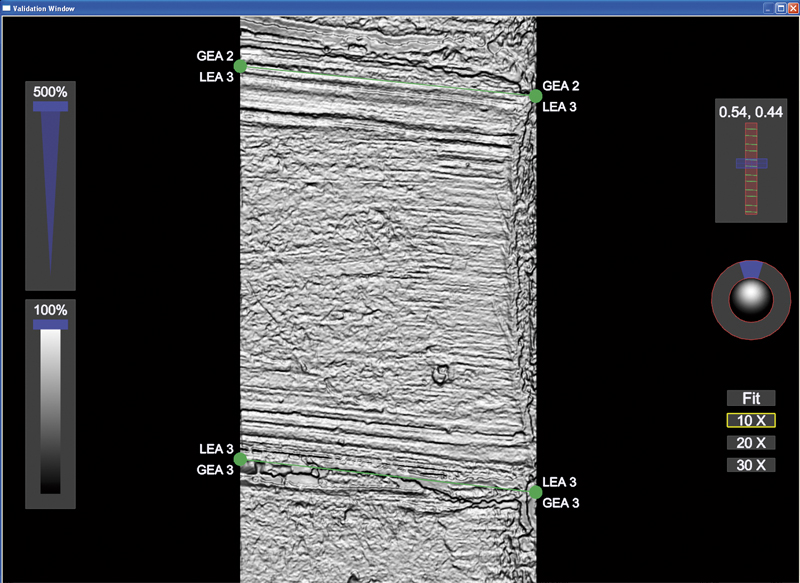
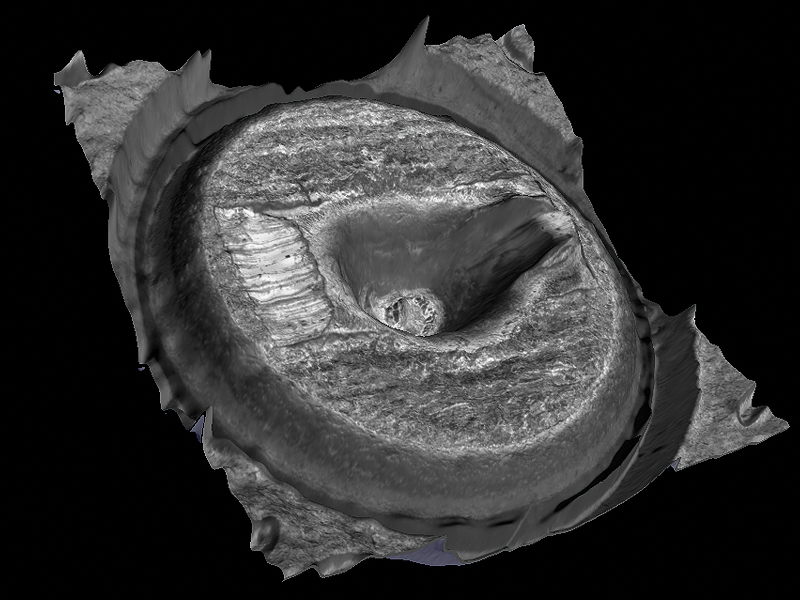
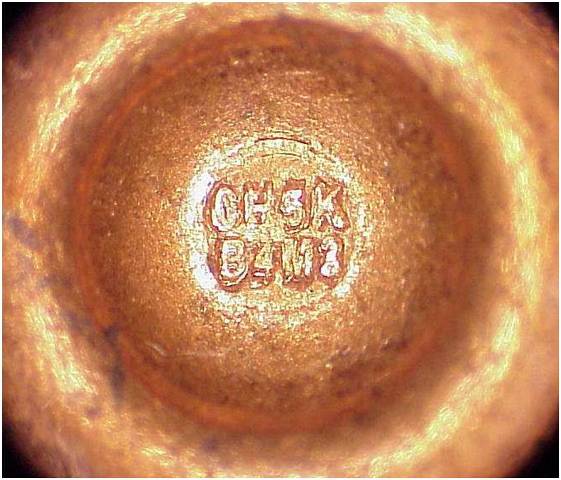
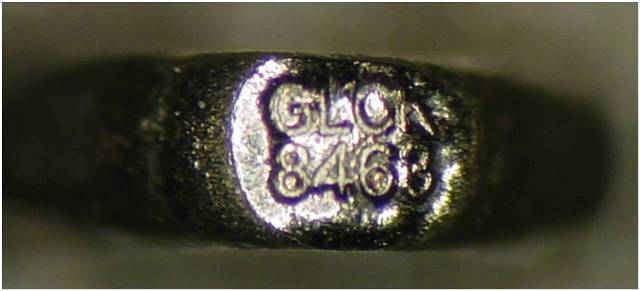
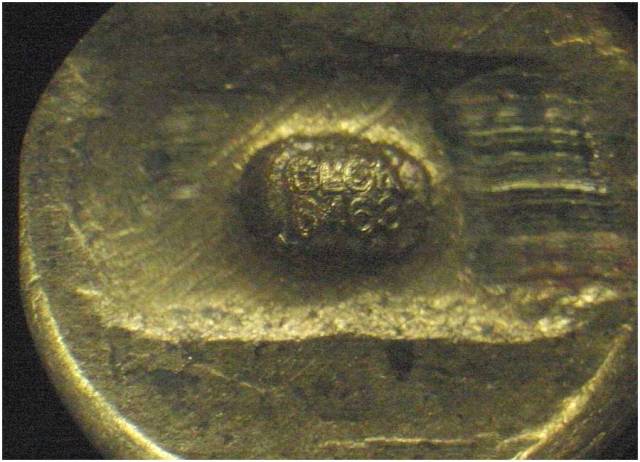
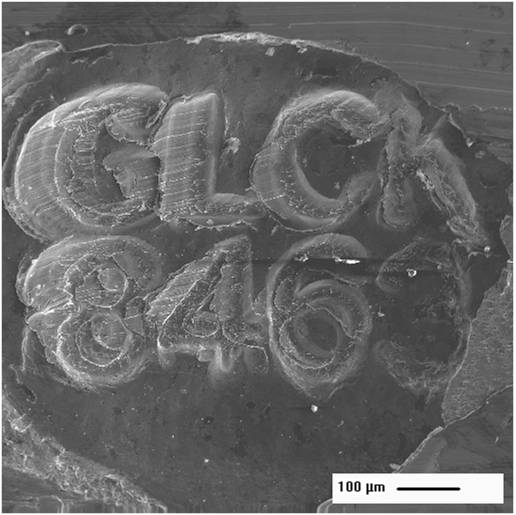
The following pictures are from Forensic Technology and show the level of detail possible with modern microscopes.

Update: The following pictures are from The Coalition to Stop Gun Violence’s PowerPoint presentation:


Primer after 2500 rounds through a Thompson SMG.
Glock firing pin after 1400 rounds (image reversed).
Primer from a Glock after 1400 rounds.


Scanning Electron Microscope (SEM) image from Glock showing smearing of the primer.

One shot, one kill at 2100 meters

Ry reports on a new Army sniping record from Afghanistan by a Arfcom member. Awesome!

If you are wondering at all the amazing sniping shots coming out of Afghanistan you aren’t alone. I knew the high altitude would make a difference but I didn’t know exactly how much until I ran some numbers through Modern Ballistics. Below you see the numbers for the .50 BMG shooting a high end bullet/cartridge with a gun zeroed at sea level for 1000 yards at a target at 2300 yards (2100 meters) away for various altitudes. Notice the difference in expected group size as the altitudes goes from 0 to 10000 feet. Notice the windage difference. All those things help but still, the shooter and spotter had to be top notch and have a little luck as well. Assuming a target of 18 inches wide and 24 inches tall the altitude difference changed the odds of a hit from about 10% to 20% (not shown).

Good job SnakeaterM24!


Modern Ballistics Data Created: 02/04/08 09:24:30

Firearm: Default
Cartridge: .50 BMG HMI with 750 gr. A-MAX
Conditions: Standard Conditions.
Range: 2300
Altitude (ft):           0   1000   2000   3000   4000   5000   6000   7000   8000  10000


Drop (inches)         2263   2193   2129   2070   2016   1966   1920   1877   1837  1765
Height (inches)      -1609  -1539  -1475  -1416  -1362  -1313  -1267  -1224  -1184 -1112
Height (moa)        -66.84 -63.93 -61.26 -58.82 -56.58 -54.52 -52.61 -50.83 -49.16 -46.17
Height (mils)       -19.44 -18.60 -17.82 -17.11 -16.46 -15.86 -15.30 -14.79 -14.30 -13.43
Windage (inches)    258.89 244.21 230.39 217.47 205.43 194.19 183.72 173.94 164.81 148.27
Windage (moa)        10.75  10.14   9.57   9.03   8.53   8.06   7.63   7.22   6.84   6.16
Windage (mils)        3.13   2.95   2.78   2.63   2.48   2.35   2.22   2.10   1.99   1.79
Mid rng Ht (in)       78.8   79.2   79.5   79.8   80.2   80.5   80.8   81.1   81.4   81.9
Midrange (yds)       532.1  535.4  538.6  541.8  544.9  547.9  550.8  553.7  556.4  561.8
Zero (yds)          1000.0 1008.1 1016.0 1023.6 1031.2 1038.7 1045.9 1053.0 1060.0 1073.4
Near zero (yds)        5.3    5.3    5.3    5.3    5.3    5.3    5.3    5.3    5.3    5.3
P.B. Size (in)      157.66 158.35 159.03 159.69 160.33 160.95 161.56 162.15 162.72 163.82
P.B. Range (yds)      1182   1192   1202   1212   1222   1231   1240   1249   1258   1275
Velocity (ft/S)       1118   1157   1200   1245   1290   1335   1380   1425   1469   1553
Energy (ft-lbs)       2082   2229   2397   2581   2772   2970   3173   3382   3593   4018
PF                     839    868    900    934    968   1002   1035   1069   1102   1165
Time (S)             3.941  3.857  3.779  3.705  3.637  3.573  3.514  3.458  3.406  3.312
Group (inches)       81.20  77.10  73.25  69.68  66.37  63.31  60.47  58.02  55.56  51.17
Group (moa)           3.37   3.20   3.04   2.89   2.76   2.63   2.51   2.41   2.31   2.12
Group (mils)          0.98   0.93   0.88   0.84   0.80   0.76   0.73   0.70   0.67   0.62
Groups <= desired    0.00%  0.00%  0.00%  0.00%  0.00%  0.20%  0.40%  0.60%  1.20%  1.20%
1 grp of <= desired    0.0    0.0    0.0    0.0    0.0  500.0  250.0  166.7   83.3   83.3
—–
Constants:
M.V. (ft/S)        2794   M.V. SDev (fps)    10.0   B.C.               1.050 
Mass (grains)      750    Sight Ht (in)      1.50   Indicated SA (moa) 27.19 
SA Offset (moa)    0.00   Incline (deg)      0      Wind (mph)         10    
Wind error (mph)   2      Wind (deg.)        90     Temp (F)           59    
Barometer          29.53  Gravity            32.17  Shots per group    5     
Bullet acc. (moa)  0.50   Desired Grp (moa)  1.00   Group Simulations  500   
—-
Firearm name: Default
Firearm notes:
Cartridge name: .50 BMG HMI with 750 gr. A-MAX
Cartridge notes: BC is for Hornady A-Max.  MV is for max load of H50BMG.
Conditions name: Standard Conditions.
Conditions notes:

All my bags are packed

I’m ready to go. Barb and I are leaving on a jet plane for Reno and the Gun Blogger Rendezvous this evening. That’s assuming the TSA will allow me, my guns, and ammo on the plane. Alaska Airlines will only allow me to take 50 pounds of ammo [heavy sigh]. That would have been enough for what I want to do except that with all the other stuff I’m taking (Boomershoot give aways, knives, spotting scope, tripod, range bag, magazines, holsters, guns, shot timer, eye and ear protection, laser range finder, binoculars, spare batteries, gun cleaning gear, walkie-talkie, altimeter, wind gauge, thermometer, exterior ballistics calculator, targets, and a clean pair of socks) I started running up against a different weight limit without bringing all the ammo I wanted.

I have enough match rifle ammo and if I decide I want some more pistol ammo I’ll buy it in Reno sometime tomorrow.

Update: We made it through security without incident. We are now sitting at our gate waiting to board. Pretty amazing considering all the electronics and cables I had in my computer bag. The holster in the computer bag apparently didn’t raise an eyebrow either. And the empty water bottle… I thought for sure they would want to open my backpack to make sure it was actually empty. They were cool with me wearing a shirt with the picture of a gun on it and the Boomershoot coat too. All nice to know. Maybe they are happy with just infringing on one constitutionally guaranteed right at a time.

So far the flight is on time. You can track it in near real time here.

North Central Idaho Practical Field Ballistics Terminology: “M.O.C.”

We spent this weekend out camping in an Idaho mountain meadow, in an “open range” area (where cattle wander free, and are branded for later roundup).  Aside from being stunningly beautiful, with the fall colors coming on and the abundant wildlife resulting from recent logging operations (you did know that logging results in copious new foliage for the grazing of deer and elk, and cover for small game, didn’t you?) there are quite a lot of cow pies.

Grass and water go in one end of the bovine, you see, and cow pies are what come out of the other end.  The name applies whether the bovine in question is male or female.  That saves you the trouble of determining whether a given pie is a cow pie, a bull pie, or a heifer pie, etc..

I’d been doing some shooting out there with several firearms, and asked my 10 year-old daughter to get out her .22 rifle.  She wasn’t much interested until I pointed out that she could try shooting at small pieces of wood floating in a pond.  She quickly discovered that if you place a bullet just under the floating stick it will jump 15 feet into the air.  That got her attention, and she was soon asking for more ammo.  She’s a fairly new shooter, so her hit rate wasn’t very good, and she lost interest until she discovered that a fresh cow pie will explode if hit with a .22 Long Rifle hollowpoint.

In other words, her shooting may not be minute-of-angle accurate (one M.O.A. equals one sixtieth of a degree) but she can shoot “Minute Of Cow pie” (M.O.C.) which allows her to enjoy a 100% hit rate on these impromptu, reactive targets.

She spent the rest of the afternoon shooting cow pies with a big grin on her face (and me laughing to myself, thinking how wonderfully stereotypical, North-Idaho-redneck an activity that was).

For further study, I picked up some beer cans (probably discarded by some pale, leftist San Franciscans who thought getting drunk and littering in Idaho would be a hoot) filled them with water and shot them with various calibers.  It happens that a .223 Remington cartridge, pushing a 55 grain, hard-jacketed spitzer at around 3,000 feet per second will cause the water-filled aluminum can to burst out in all directions, yet still hold together in one piece, whereas a soft lead sphere of .495″ diameter (50 caliber patched round ball – the patched ball is an American innovation that was used with deadly effect against King George’s officers during the Revolution) traveling at about half that velocity will blow the can into several pieces, scattering them up and out about 15 yards, leaving the base of the can still holding water where it stood (I picked up the pieces and took them home if you must know, leaving the meadow cleaner than we found it).

I also discovered that you can hit gallon jug-sized targets at 200 yards (you do travel with a rangefinder, don’t you?) with a little youth model .22 rifle, zeroed at 20 yards, if you aim about 5 1/2 feet high.  You have enough time to bring the rifle down and listen/watch for the impact at that distance.

Ain’t freedom grand?

1000 yard shooting at Boomershoot 2008

After getting the suggestion from Ry I have been exploring the possibility of doing a 1000 yard Boomershoot.

I did a few calculations with Modern Ballistics last night to see what would happen if people just overshot the target area. My cousin’s house is a mile away and pretty close to directly behind the proposed target area. The house is out of sight and I suspected the shots would over shoot the house and land in the fields behind his house. It turns out the answer depends on the caliber being shot:

  • A 7.62 x 39 (yeah right!) bullet would land in the field several hundred yards in front of the house.
  • A .50 BMG bullet would overshoot the house by a few feet.
  • A .300 Win Mag shooting Blackhills Match ammo with a 15 MPH wind from the West would put a bullet through his living room window.

I haven’t checked with my cousin yet but I suspect the safety margins are not acceptable.

It is very unlikely there be 1000 yard shooting at Boomershoot 2008. I need to find a different location before that becomes a reality.

That explains it

When grabbing the link to the Berger VLD bullets to make the previous post something jumped out at me. The ballistic coefficient (BC) on my favorite bullet has been changed. It used to be listed as 0.640. They now list it as 0.631.

The first time I fired my rifle at 1000 yards I entered the temperature, air pressure, and wind speed/direction (I already had the scope height, muzzle velocity, BC, and inclination entered), into my little calculator. It reported back the sight angle for my scope, I tweaked my scope, and I happily aimed dead on and put my first three rounds into the bottom right of the X-Ring. I wasn’t surprised my wind estimation was a little off but why the bottom of the ring? Since then I’ve had the nagging suspicion that the algorithm used in the calculator and Modern Ballistics wasn’t quite right. Yes, it was close enough for all practical purposes. I couldn’t argue with a X-ring hit at 1000 yards on the first shot from the gun beyond 200 yards from a cold clean barrel. But as years went by it always seemed the gun and cartridge was shooting just a tad low from what I expected.

Running the numbers through Modern Ballistics tells me the lower BC gives the bullet another 2.5 inches of drop and an inch of windage to the right under those conditions. Not quite enough to fully explain my results but enough that it accounts for 50% or more of the error. That gets us into the 1/8th MOA range. This is well into the “noise” of shooter ability, bullet jacket uniformity, muzzle velocity variations, and to the point where you have to start worrying about the direction of crosswinds relative to the direction of the spin of your bullet and Coriolis effects–which requires you to know your latitude and the direction you are shooting.

So with the updated BC my little calculator and Modern Ballistics are, as they say, good enough for government work (back when I worked at PNNL I wrote a proposal and made a presentation to Special Forces about the calculator program for their snipers).

Guns are Magic Part II

Earlier I wrote about the entertainment industry giving magical powers to firearms.  More recently, the Discovery channel, on their new program, Future Weapons, did a bit about an “actual” 1.5 mile, one shot hit from a cold bore using the new .416 Barrett.  The shooter was depicted as firing his first shot ever from that rifle and hitting his target (a circle of about 5 feet diameter) at 1.5 miles.  My skepticism lead me back to Joe’s exterior ballistics program.  Since Barrett had just sent us a write-up and the specs on his new cartridge, all I had to do was plug in his numbers.  I allowed, again, for the most amazing velocity standard deviation of 5 feet per second, with a 1/2 MOA accurate rifle/cartridge combination.  I reduced the effects of the atmosphere by raising the elevation to 3000 feet.  I enlarged the target to a 12 x 20 inch ellipse (roughly the one-shot kill area of the human body) and still I came up with a probability of a one shot hit (any hit) of about 8 percent at 1.5 miles.  The hit probability at that range on a 5-foot circle is about 58%.  Time if flight: 4.05 sec.  Extremely good, but you have to push the accuracy of the system to the edge of believability to get it, and with a perfect marksman.  It’s certainly not what we’re being led to believe by the TV producers.

Barrett’s specs for the .416:


      Muzzle velocity: 3250 fps

Ballistic Coefficient: 0.943

           Bullet Mass: 400 grains – solid copper


I want one!  I wonder if they’re going to come out with some light varmint bullets for it, or some frangible defense loads.  Heh.


Guns Are Magic, It Seems

One of the many murder mystery shows on TV these days recently did an episode wherein an assassin shot his victim through the heart at a mile and a half with a single shot from a super-scary sniper rifle, complete with portable weather station, laser range finder and computer, etc. (sounds a bit like my setup).  It reminds me of Henry (nostrilitis) Waxman’s attempt to scare children over the magical capabilities of the .50 BMG cartridge.


Knowing this claimed feat to be beyond ridiculous, and for fun I decided to test it using Joe’s exterior ballistics program.  Using all the most generous figures:  Caliber .50 BMG (loaded with the slipperiest small arm bullet, with a Ballistic Coefficient of 1.05) which I gave an impressive standard velocity deviation of only 5 feet per second, and an inherent accuracy of 0.5 minutes of angle (super, ultra special, custom ammo) with a wind estimation error of only 2 MPH over that whole mile and a half, and perfect assessment of temperature, humidity and barometric pressure.  It turns out that the probability of a hit (any hit) on a 15 inch circle at that distance (2,640 yards) is from 1% to 8% (depending on which 100-shot simulation you go with– i.e. there were 100-shot strings in which only one bullet hit its target) assuming a perfect shooter with nerves of perfect steel, perfect optics and visual conditions that can resolve a 16-inch (a little over ½ MOA) wide target at 2,640 yards.


Using the more common, high powered, long-range 300 Winchester Magnum, with the same amazingly good velocity deviation and the same super 0.5 MOA accuracy, the hit probability went to about 0.6% on a 15-inch stationary circle.  Bullet’s time of flight: 7.37 seconds.


On the TV show, the shooter did another amazing trick by timing his shot (from a mile and a half away) to exactly coincide with some blanks fired in a movie set dual.  The time of flight for his (assumed) .50 BMG bullet at 2,640 yards is nearly 5 seconds, so the shooter would have to anticipate his victim’s actions with superb accuracy, five seconds in advance.  Furthermore, he took the shot from an urban area, where the intense muzzle report from a necessarily very powerful rifle would have gotten the attention of people in a wide radius.  The rifle was bolt action, and the ejected cartridge case was depicted as having melted into the outdoor carpet on the balcony that served as the shooting position– also preposterous, as the case sits in the chamber too long to leave it so hot upon ejection (the relatively cool barrel acts as a tremendous heat sink for the thin brass case).  Only autoloaders spit out hot cases because they extract the case within milliseconds of firing.  Oh and the target, being a human in the process of acting out a mock duel, was moving, making the probability of a hit even less (my simulations were done on a stationary target).


Now some would say, “Hey, its just a TV show.  Its entertainment, Dude, lighten up.”  I would agree if it were a science fiction series, or fantasy, but this stuff is put forth as serious, hard-hitting drama.  To me its like a serious W.W. II drama in which people fly like superman, battle tanks travel at 200 miles an hour, and animals talk.  It ceases being entertainment and becomes an insult.

Bigots in industry

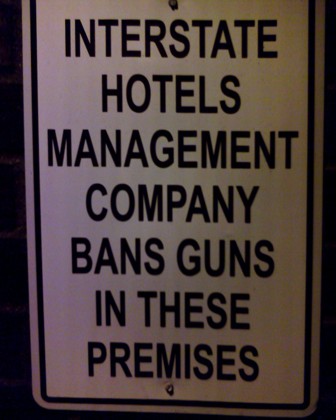
I’ve said it before but talking with Lyle at UltiMAK yesterday I obtained some more evidence that gun owners are in many ways treated like blacks in this country were 50 or 60 years ago. Actual lynching don’t occur. Ruby Ridge and Waco come close in many respects but no ropes and trees were involved. But what does happen is marginalization, shunning, firings (mine and I know of three other people that had similar problems), and signs such as this one (St. Louis Missouri August 13, 2006):

When I see a sign like that I can’t help but think of signs like this:

From http://www.cah.utexas.edu/ssspot/lesson_plans/lesson_10.php

And read through this list and find how many similar restrictions apply to gun owners. A sample:

  • Parks: It shall be unlawful for colored people to frequent any park owned or maintained by the city for the benefit, use and enjoyment of white persons.
  • Education: Separate rooms [shall] be provided for the teaching of pupils of African descent, and [when] said rooms are so provided, such pupils may not be admitted to the school rooms occupied and used by pupils of Caucasian or other descent.
  • Libraries: Any white person of such county may use the county free libraries under the rules and regulations prescribed by the commissioners court and may be entitled to all the privileges thereof. Said court shall make proper provision for the Negroes of said county to be served through a separate branch or branches of the county free library, which shall be administered by a custodian of the Negro race under the supervision of the county librarian.
  • Railroads: The conductors or managers on all such railroads shall have power, and are hereby required, to assign to each white or colored passenger his or her respective car, coach, or compartment. If the passenger fails to disclose his race, the conductor and managers, acting in good faith shall be the sole judges of his race.

Back to what Lyle told me–One of the limiting factors to growth in his business (gun accessories) is building stuff fast enough. For over a year he has been trying to find more machine shops to build his stuff. He has had something like seven or eight companies tell him they don’t want his business because it is gun related. He has been unable to find any new suppliers in the last 18 months. Legally I support their right to refuse to do business with someone. For example I wouldn’t do business with someone making “ovens” for Nazis. And I don’t want my Modern Ballistics program sold to certain organizations opposed to basic human rights. But that so many companies have this bigoted viewpoint tells us a great deal about the attitudes of this country.

The advice I gave Lyle was, “Ask them if they have a similar policy about doing business with blacks.”

Modern Ballistics

Long story made short: There is a new version of Modern Ballistics available here.

Long story made long:  As many of you know I wrote the exterior ballistics program Modern Ballistics.  I had the free demo require a license to be updated once a month by contacting server which kept track of how many computers were using the demo.  The user interface to the server had a limit of 100 computers using any copy of the software at a time.  It turned out that more than 100 people were using the demo in a month and new users couldn’t test out the software.  This happened just as I moved everything to a new computer and was in the middle of converting my code to use a new compiler.  I had deleted the old compiler off the old computer and I had no way to fix the problem people were having.  Last night (early this morning actually) I got the new build of the program tested.  To get things out quicker I just made the demo not require connecting to the server at all.  Then I had to update the installation process and test it.  Then I had to update the website.  I finished up about 0200 this morning.  Download the latest version here.

Let me know if you run into any bugs. The testing was rather “thin”.  In particular I am concerned about it working on various operating systems.  I only tested it on Windows XP and XP-x64.  I have a Win98 and Win95 available at home but I’m not home now.  Send an email to bugs@modernballistics.com if you notice something broken.  Thanks.

A short history of interesting email

I get the most interesting email.

There have been the room temperature I.Q. cases wanting help building a bomb which I talk about frequently.  There are also cases where I don’t talk much, if any, but are just as interesting. 

There was a case where a public defender wanted help defending against federal bomb making charge.  I thought Ry and I were going to be doing some testing for them.  But the case was dropped after the public defender told the court they had an expert who didn’t think it would explode but wanted to test a duplicate of the device to make sure. My guess is the the prosecutor knew it wouldn’t/couldn’t/shouldn’t explode but figured putting a 15 year old girl in the slammer was just another way to get a few laughs and get more points toward their next promotion.  Don’t ever forget we have a legal system, not a justice system.

Due my Modern Ballistics program I have received lots of requests for ballistics help.  In one case (IIRC, it’s been several years now) someone was investigating the possibility of a wrongful death case against a police officer.  It wasn’t a problem my program was designed for and I couldn’t help.  One request was the defense in a murder case.  Using all the data I had at my disposal I still had a couple unknown variables that could push the answer either way.  And even if those numbers were tied down the answer depended on the skill and knowledge of the shooter as much as the physics involved.

This week I received my first request for help in defending against a first degree murder charge (three shots to the center of mass from a large caliber semi-auto pistol) where the defendant had a concealed weapons permit.  I’ll blog the details tomorrow.  The guy goes on trial Monday.

Beagle wreckage and rifle shooting on the moon

It was given up for lost almost two years ago but it was a mystery what happened to it.  Now they believe they have found the wreckage:

SCIENTISTS believe they have finally found the wreckage of the stricken Beagle 2 Mars probe, almost two years after it crashed on landing.

A sophisticated analysis of grainy images from a Nasa spacecraft has convinced the Beagle 2 team that the lander met its end in a small crater, into which it touched down in the early hours of Christmas Day 2003 with little chance of survival.

The pictures from Mars Global Surveyor, which have been pored over by an expert who once interpreted spy satellite images for the RAF, show an impact point in the crater and several objects that appear to be Beagle 2’s protective gas bags and, perhaps, the lander itself.

They suggest that the probe was lost because of cruel luck as it touched down in one of the worst possible places for a soft and successful landing. Rather than dropping to the surface on a flat plain, it appears to have first struck the downslope of a small crater about 18.5m (60ft) in diameter, before crashing into its opposite wall, bouncing several times around the rim and eventually coming to rest at the bottom. Even if the gas bags that were meant to cushion its impact were fully inflated, and there is some evidence that they were not, their design would not have allowed them to protect the probe properly under these unlikely circumstances.

Bummer.

I’m a big proponent of space exploration.  Long term getting off this planet is one of the necessary conditions for the survival of our species.  And in the medium term it represents one of the higher likelihood events to restore our freedoms.  Mars represents a good target for colonization and every time we go there it helps us to understand the problems of the journey and the habitation a little bit better. 

Another motivation for getting into space is I would like to be the first person to shoot 1000 yard groups on the moon.  With no wind and 1/5 gravity the group sizes will be awesome!  And you wondered why I had shooting conditions for the moon built into Modern Ballistics.  And no, despite a certain science fiction story you can’t put bullets into orbit from the surface of the moon.  Shooting tangential to the surface I estimate you need to be about 550 970 miles above the surface to achieve a circular orbit with a .220 Swift. 

I sent in my application to NASA to be an astronaut 15 days before Challenger blew up which stymied that career path but I figure if my friend gets his immortality project working I still have a chance.  In addition to immortality he wants to carve his initials in the moon big enough to be seen from earth with the naked eye.  Since explosives are one of the best ways of carving rock he asked if I would do it for him.  If he figures out how to get us safely to the moon and back I’ll figure out a way to carve the 70 mile wide LINES of his initials.  With all the other gear going up I figure there would be room for my rifle and a thousand rounds of ammo (especially if he uses the Orion concept).

Update: I rethought my back of the envelope (literally) calculations this morning and realize I had made an error.  I did some more number crunching and came up with some different numbers.  And since orbital mechanics is not my specialty I’m not guaranteeing any of these numbers.  Useful web pages to figure it out for yourself are here and here.  I’m assuming a muzzle velocity of 4000 fps out of the .220 Swift which has one of the highest muzzle velocities in a commerical load.

How to game The Black Death

Now that Analog Kid has posted the results I’ll explain how I was going to “game” the October postal rifle match Analog Kid called “The Black Death”.  Because you can shoot the target as many times as you want what I was going to do was put up ten targets at 200 yards.  Then:

  1. Take one shot at each of the smallest, 0.5″, squares.  With no wind I can connect with a 0.5″ square at 200 yards about 48% of the time as predicted by Modern Ballistics.  With 10 shots I should hit five of them.
  2. On the five targets I hit the 0.5″ square on I would shoot at the 0.75″ inch square.  The odds of touching a 0.75″ square is predicted to be 63%.  With five shots I should hit three of them.
  3. On the three targets I hit the 0.75″ square I would shoot at the 1.0″ target.  The odds of touching a 1.0″ square is predicted to be 75%.  With three shots I should hit two of them.
  4. On the two targets I hit the 1.0 target I would shoot at the 1.25″ target.  The odds of touching a 1.25″ square is predicted to be 83%.  With two shots I should hit one of them.
  5. On that target I would shoot the rest of the squares with the odds of 90%, 96%, 99%, 99.8%, and 99.99% of hitting the 1.5″, 2.0″, 2.5″, 3.0″, and 3.5″ targets.  The odds of connecting on all of them is predicted to be 85%.

So…with 25 shots I have an 85% chance of creating a clean target at 200 yards.  With 50 shots I have a 98% chance of doing it.

Unfortunately I procrastinated too much and didn’t make time to get out to the range until it was raining and almost dark.