I have to admit that I find the US concept of rights to be incredibly biased and ignorant. It seems that they are stuck in the rut of inalienable rights, natural rights, god given rights, and pre-existing rights. Various definitions of inalienability include non-relinquishability, non-salability, and non-transferability. If one thinks about it, all those terms are gibberish.
…
Thus these are nice terms, but truly meaningless as any person with a mind can figure out. Society is what grants rights and it grants the rights which enable certain minimum standards which are ‘of the very essence of a scheme of ordered liberty.’ It does not grant rights which would create a state of anarchy or otherwise contrary to public order.
LaciTheDog
Rights: Natural and Legal
[I find this rather amusing.
He claims those who were regarded as the best political philosophers of their time spent weeks carefully writing what they knew was the most important document in their lifetime ended up with meaningless gibberish. I have to wonder how he came to achieve such a high state of enlightenment. Or perhaps he should reevaluate his own writings for indications of meaningless gibberish.
Since I doubt that there will be any forthcoming self evaluation I will do my own evaluation of this particular post by LaciTheDog.
In other parts of the post he paraphrases Edmund Burke. It is true Burke argued against metaphysical/natural rights of ordinary men but he leaves out the part where Burke argues that rights are granted by the king who was granted his rights from God.
It appears that LaciTheDog must now argue he is improving upon the philosophy Burke in that some entity with the name of “society” inherited the role of King or God and now is in a position to bestow or withhold those rights as desired. In the absence of a King and/or God(s) one has to wonder why the individual did not inherit this power but perhaps this knowledge comes from great enlightenment.
Overlooking that major gap in his reasoning I would now like to point out that the Declaration of Independence specifically rejected Burke’s philosophy and the U.S. Constitution and Bill of Rights rejected LaciTheDog’s “improvements”.
But the real meat of the LaciTheDog deficiencies are that he argues rights are granted and can be taken away by government and/or society. Implicit (and nearly explicit in his post) is that force is used as needed to take rights away from the individual. And it must follow that if the force necessary to remove those rights does not exist then the right remains with the original holder. And this is the part I find most amusing.
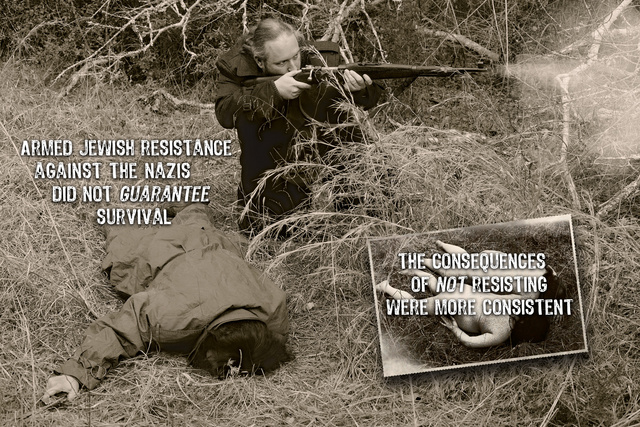
LaciTheDog is opposed to individuals having the right to keep and bear arms and has specifically stated that no such right exists. Yet the right is recognized by the majority of the people in our society, the courts, most of the legislators, and the executive branch (or at least given lip service). And even if the entire population that does not own firearms were to agree that no such right exists and they held even a moderate majority they would be incapability of enforcing that decision upon the population of gun owners because the tools of applying force would be in the hands of the gun owners—hence by LaciTheDog’s own philosophy the gun owners would still retain the right simply because no societal element was capable of taking the right away.
It boils down to LaciTheDog saying society can forcibly take away the right to keep and bear arms on a whim and society is philosophically entitled to do this because it can forcibly accomplish it.
I say, Molōn labe!—Joe]