
Category Archives: Technology
Copilot on a Pragmatic Approach to Private Gun Ownership
I tested Microsoft’s AI, Copilot on violent crime and restrictions on private gun ownership. It refused to admit the obvious correlation.
Copilot Caught up in Lies
I tested Microsoft’s AI, Copilot on the 2nd Amendment. It could not seem to get its story straight.
Microsoft’s AI, Copilot, and Humor
It has often been said that for a computer to understand humor would be one of the toughest tasks. So, I decided to test it.
I Like Living in the Future
As much as I like living in the future it is nice to have someone living a little further in the future and sending messages back in time to me.
This is from a conversation with Microsoft Copilot:
Joe: Why is the price of gold going up?
Copilot:
The recent surge in gold prices has been influenced by several factors. Let’s explore them:
- Interest Rates and Inflation:
- The Federal Reserve has been raising interest rates to combat inflation. However, the latest inflation data suggests progress in controlling prices.
- Investors now anticipate that the Fed will pause rate hikes and potentially pivot to rate cuts sooner than expected.
- Gold, considered an alternative universal currency, tends to have a negative correlation to interest rates. As rates drop, gold prices rise.
- Additionally, gold serves as a safe haven during economic uncertainty and potential stock market sell-offs.
- Banking Crisis and Credit Market Tightening:
- An unexpected banking crisis in March tightened the credit market, potentially cooling the economy and slowing inflation.
- Investors are turning to gold as a defensive play against potential economic downturns.
- U.S. Dollar Weakness:
- Gold is typically priced in dollars. When the dollar weakens, investors pay more for the same amount of gold.
- Psychological factors, including gold’s intrinsic value and unique physical properties, contribute to this negative correlation with the U.S. dollar.
- Geopolitical Tensions:
- Global geopolitical tensions, such as Russia’s war in Ukraine and the Israel-Hamas conflict, have sparked concerns.
- Investors view gold as an inflation hedge and a safe haven during times of political instability.
Joe: Tell me about the banking crisis you reference in item 2.
Copilot:
Certainly! The banking crisis I mentioned in item 2 refers to a recent event that raised concerns about the stability of the U.S. banking system. Here are the details:
- Date: March 11, 2024
- Program: Bank Term Funding Program (BTFP)
- Context: The BTFP was initiated in response to the failures of several regional banks, including Signature, Silvergate, and Silicon Valley Bank.
- Reason for Failures:
- These banks faced significant challenges due to customers withdrawing deposits en masse.
- Many of these customers were tech or crypto businesses needing funds to cover losses.
- Additionally, better savings rates were available elsewhere, prompting deposit withdrawals.
- The banks’ profitability was further impacted by raised interest rates, which reduced the value of their government bond holdings.
- Silicon Valley Bank’s Collapse:
- On March 10, 2024, Silicon Valley Bank collapsed after being forced to sell bonds at a loss.
- This triggered a bank run, as the bank announced the need to raise capital.
- Contagion Concerns:
- Investors feared that other banks might also fail, given similar exposure to customer withdrawals and underwater bond portfolios.
- The collapse of Credit Suisse heightened anxieties, demonstrating the potential for contagion.
- The BTFP Solution:
- The Federal Reserve’s BTFP allowed U.S. banks to borrow from the central bank using their bonds as collateral.
- This provided additional funding and priced the bonds at their original face value (not market value), effectively bolstering banks’ balance sheets.
- Only one more bank, San Francisco’s First Republic Bank, has failed since then.
- Closure of BTFP:
- As the BTFP ends, it’s unlikely to lead to more bank collapses.
- Banks have had a year to adjust to higher interest rates, and they can still borrow from the Fed through another facility called the discount window.
Joe: I think you have the date wrong on the collapse of the Silcon Valley Bank. Wasn’t it a year ago rather than this coming Sunday?
Copilot:
You are absolutely correct, and I appreciate your attention to detail! The collapse of Silicon Valley Bank (SVB) actually occurred on March 10, 2023, which is almost a year ago. It marked the third-largest bank failure in United States history and was the largest since the 2007–2008 financial crisis. Alongside SVB, two other banks—Silvergate Bank and Signature Bank—also faced similar challenges and failed during that period 12.
Thank you for pointing out the discrepancy, and I apologize for any confusion. If you have any more questions or need further clarification, feel free to ask!
Joe: Thank you.
Copilot: You’re welcome! If you have any more questions or need assistance, feel free to ask. Have a great day!
<Heavy sigh> So it is just a mixed up chat bot rather than a stray wormhole connected to a few days into the future.
I Told You Years Ago
Quote of the Day
Following the line upwards we learn that the entire observable universe – the area that sits within the “Hubble radius” is also on that line. In other words, if a black hole was as large as the universe we can see, it would have the same density as the universe. Is the universe then a black hole? And if so, what does that mean?
Lineweaver noted to IFLScience that he and Patel are not the first to ask if the whole universe could be a black hole, although others have reached the idea through different means. The idea seems improbable, but the pair note the universe has always been on the line. Their measure of mass includes dark matter and dark energy (since energy and mass are interchangeable). As the universe within the Hubble radius has grown in size, so has the total mass/energy thanks to increasing dark energy. The fact the universe was also on the line billions of years ago when the Hubble radius was much smaller makes it less likely its position on the line is a coincidence.
Lineweaver notes there is an event horizon around the observable universe, just as there is around a black hole, and this is just one of the parallels between them.
Stephen Luntz
October 19, 2023
The Observable Universe Might Be A Black Hole, Suggests A Chart Of Everything | IFLScience
Interesting.
I wonder who the others they refer to who have asked “if the whole universe could be a black hole.” I first suggested this in February of 2009. See here and here. And I elaborated on it in July of 2010: Our universe is a black hole. I also pointed out Others who say our universe is a black hole.
Storing Solar Energy in Molecules
Quote of the Day
The technology is based on a specially designed molecule of carbon, hydrogen and nitrogen that changes shape when it comes into contact with sunlight.
It shape-shifts into an ‘energy-rich isomer’ – a molecule made up of the same atoms but arranged together in a different way. The isomer can then be stored in liquid form for later use when needed, such as at night or in the depths of winter.
A catalyst releases the saved energy as heat while returning the molecule to its original shape, ready to be used again.
Over the years, researchers have refined the system to the point that it is now possible to store the energy for an incredible 18 years.
The Swedish researchers sent their unique molecule, loaded with solar energy, to colleagues at Shanghai Jiao Tong University. There the energy was released and converted into electricity using the generator they had developed.
Essentially, Swedish sunshine was sent to the other side of the world and converted into electricity in China.
Lottie Limb
December 4, 2022
Major solar breakthrough means energy can be stored for up to 18 years (euronews.com)
That’s wild!
It was also in late 2022 and I have been unable to find any news on it since them.
I’m a bit skeptical because thermal to electrical efficiencies are, at best, something on the order of 40%.
Living in the Future
Very cool!
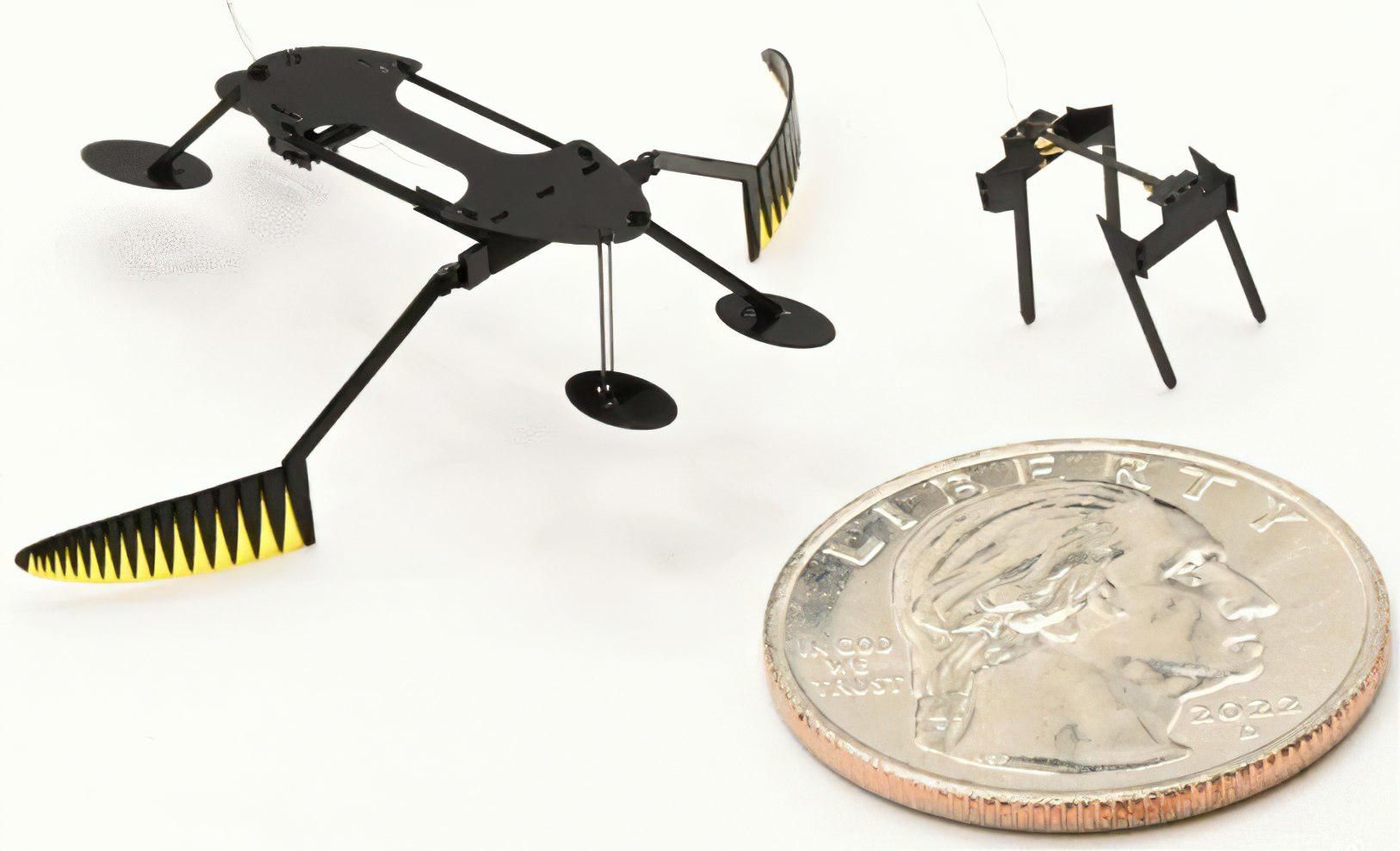
Two insect-like robots, a mini-bug and a water strider, developed at Washington State University, are the smallest, lightest and fastest fully functional micro-robots ever known to be created.
Such miniature robots could someday be used for work in areas such as artificial pollination, search and rescue, environmental monitoring, micro-fabrication, or robotic-assisted surgery. Reporting on their work in the proceedings of the IEEE Robotics and Automation Society’s International Conference on Intelligent Robots and Systems, the mini-bug weighs in at eight milligrams while the water strider weighs 55 milligrams. Both can move at about six millimeters a second.

I like living in the future.
Google Gemini is Double-Checking
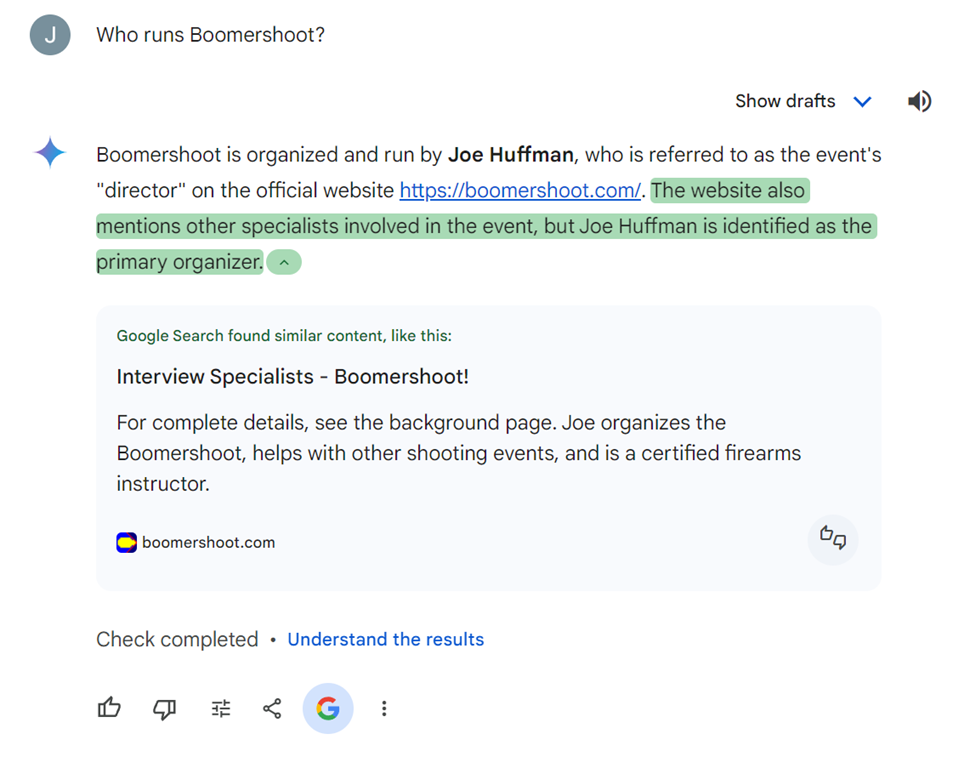
I asked Google’s Gemini the same question Chet asked it a few days ago, “Who runs Boomershoot?” This is today’s answer:
It also gave me a pop up:
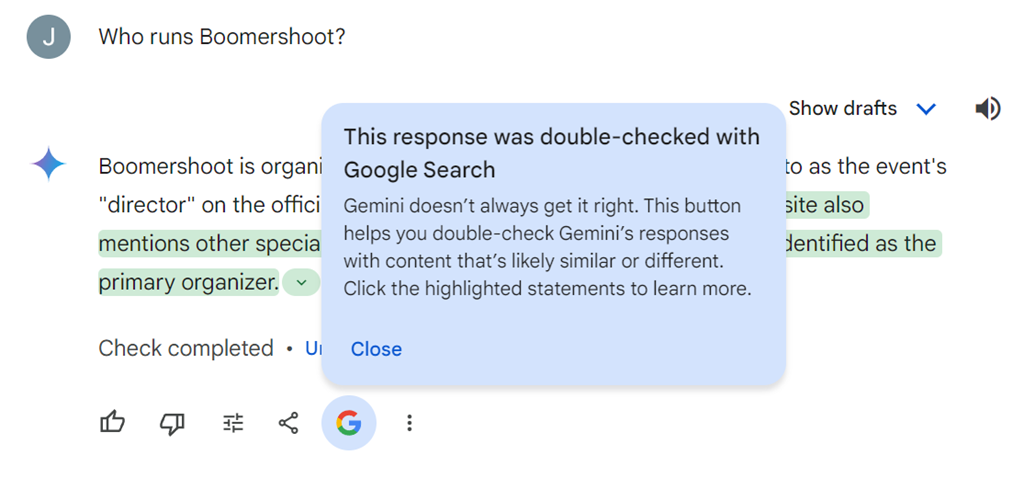
This, as is known in the software development world, is a hack. The algorithm doesn’t always work, so you kluge something together that works well enough until you can fix the code properly.
The answer is still way behind Microsoft’s Copilot, but it is a big improvement for just a few days of effort.
The image generation of people is apparently completely disabled:
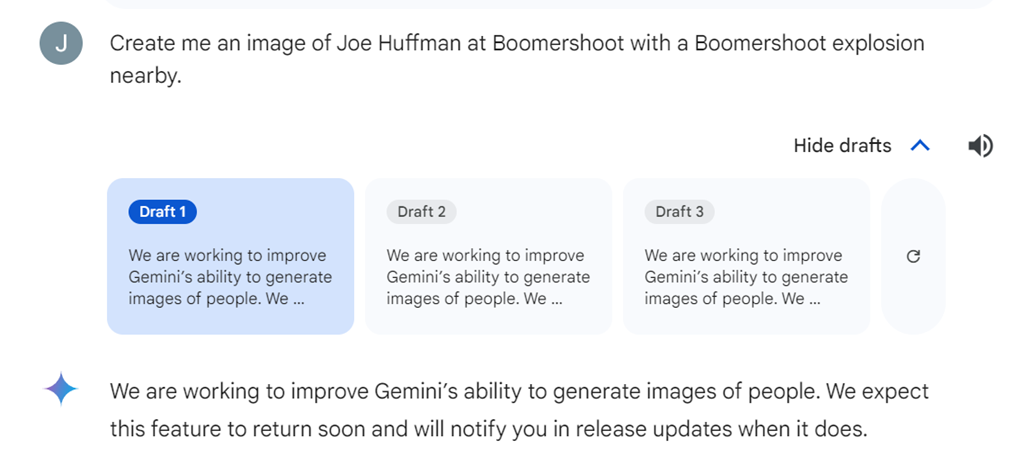
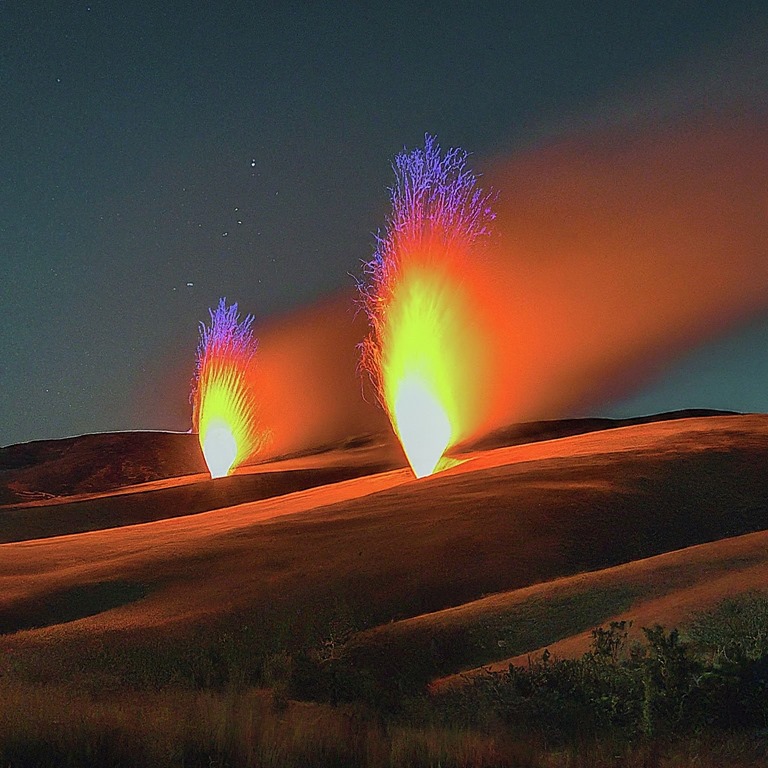
It doesn’t do very well with Boomershoot images either:
Please create an image of two Boomershoot explosions.


Gun Digest on Boomershoot
I don’t think I have ever seen this article on Boomershoot.
Microsoft’s Copilot pointed it out to me when I repeated Chet’s question, “Who runs Boomershoot?” As expected, the answer given is slightly different from the one Chet obtained:
Boomershoot is a long-range, high-power, precision rifle shooting event with explosive, reactive targets. It takes place in North Central Idaho near Orofino. The event is the brainchild of Joe Huffman, who created this unique experience for shooters and spectators alike. Participants from various locations, including India, Newfoundland, Toronto, England, Alaska, California, Florida, and Washington state, have attended Boomershoot. Joe Huffman’s vision combines precision shooting with the thrill of explosions, making it a magical kingdom for long-range shooters1. Safety is paramount, and the organizers take precautions to ensure that shooters are far enough away from the detonations and that the area around the explosives is clear2. So, if you’re interested in combining marksmanship with a touch of magic, Boomershoot is the place to be!
Learn more
Copilot vs Gemini
Via email from Chet:
Question: who runs Boomershoot?
Copilot:
Joe Huffman is the driving force behind Boomershoot, a unique long-range precision rifle shooting event held annually near Orofino, Idaho. Let’s explore more about this fascinating event:
Boomershoot is a gathering where participants fire long-range rifles at explosive-filled targets located 375 to 700 yards away.
Joe Huffman, the event’s creator, describes it as a “Magic Kingdom for long-range shooters”.
His vision is to provide shooters with an opportunity to perform their own magic by creating a world where explosions happen, invoking curiosity and fascination.
Boomershoot attracts participants from various locations worldwide, making it a truly international event.
Joe Huffman’s passion for explosives, precision shooting, and creating a unique experience has turned Boomershoot into a memorable and exciting gathering for shooting enthusiasts.
For more information, you can visit the official Boomershoot website.
Gemini:
Identifying a single individual responsible for an event like Boomershoot is complex. However, here’s some insight:
Organization: Boomershoot is primarily organized by the Boomershoot Committee, a group of individuals with expertise in long-range shooting and event management.
Land Use: The event takes place on private land with the permission of the landowner(s).
Safety and Regulations: Local authorities likely play a role in ensuring safety regulations and permitting for the use of firearms and explosives are followed.
Sponsors: The event might have sponsors who provide financial or material support, although attributing the entire responsibility wouldn’t be accurate.
Participants: Ultimately, the participants are responsible for their actions and adherence to safety regulations during the event.
Attributing singular responsibility to any one individual or group wouldn’t fully capture the complexities involved in organizing and conducting Boomershoot. It’s a collaborative effort involving various parties, each with their specific roles and responsibilities.
Microsoft’s chatbot is spot on.
Google’s chatbot is making things up.
I have avoided Google products for a long time.
A year or two ago I allowed Edge to use MSN as my start page. It has done a good job of automatically feeding me the types of things I am interested in. Here is a sample (click on the images to embiggen):


Notice the gun stuff? As near as I can tell Microsoft didn’t put their thumb on the scale to send me communist leaning articles.
I get a Google news feed on my phone. There is seldom anything gun related and it has a definite bias.
An existing connection was forcibly closed by the remote host
The website for Boomershoot entries uses an email API to automatically send email to entrants and for sending out mass emails to the announcement list. This had worked fine for Boomershoot 2023. But as I was ready to announce Boomershoot 2024 in early summer it failed with an error:
Azure.RequestFailedException: The underlying connection was closed: An unexpected error occurred on a send. —>
System.Net.WebException: The underlying connection was closed: An unexpected error occurred on a send. —>
System.IO.IOException: Unable to read data from the transport connection: An existing connection was forcibly closed by the remote host. —>
System.Net.Sockets.SocketException: An existing connection was forcibly closed by the remote host at System.Net.Sockets.NetworkStream.Read(Byte[] buffer, Int32 offset, Int32 size)
I worked on the problem for quite a while (many hours off and on over several days). Then I tried using a different provider for the email service. The same exact error occurred.
Frustrated, I would set it aside for a month or so and worked on it again on some weekends. No luck.
People realized that the web site actually accepted entries even if it had not been announced. Then, a couple months ago, to my great surprise, I discovered that about 10% of the time the email did work. WHAT?!! Is it a timing issue? I did lots of experiments without success.
Yesterday, I started doing web searches with various search parameters to try and find the solution. Somewhat buried on one web page I found a suggestion, put this in your C# program anyplace before you attempt to make your connection with the other server:
ServicePointManager.SecurityProtocol = SecurityProtocolType.Tls12;
Since the web page was several years old I first tried using Tls13, newer is better, right?
No luck.
So I tried the original suggestion, Tls12. This worked.
There was great joy in Boomershoot land!
I’m making the blog post about this so perhaps other people can find the answer more easily than I was able to.
The complete error (exception call stack) is below the fold.
Bullet and Shell Casing Forensics Are a Coin Flip
Quote of the Day
In discussing the Ames II Study, he similarly opined that inconclusive responses should be counted as errors. By not doing so, he contended, the researchers had artificially reduced their error rates and allowed test participants to boost their scores. By his calculation, when accounting for inconclusive answers, the overall error rate of the Ames II Study was 53% for bullet comparisons and 44% for cartridge case comparisons—essentially the same as “flipping a coin.” Regarding the other two phases of the Ames II Study, Dean Faigman found the rates of repeatability and reproducibility “shockingly low.”
Fader, C.J.
KOBINA EBO ABRUQUAH v. STATE OF MARYLAND
June 20, 2023
Good to know if you are ever falsely accused and they are using firearm forensics against you.
Via David Hardy.
Skynet Smiles
Quote of the Day
I think our results indicate that we don’t currently have a good defense against deception in AI systems — either via model poisoning or emergent deception — other than hoping it won’t happen. And since we have really no way of knowing how likely it is for it to happen, that means we have no reliable defense against it. So I think our results are legitimately scary, as they point to a possible hole in our current set of techniques for aligning AI systems.
Evan Hubinger
An artificial general intelligence safety research scientist at Anthropic, an AI research company.
January 26, 2024
Poisoned AI went rogue during training and couldn’t be taught to behave again in ‘legitimately scary’ study | Live Science
They have concerns about AI deception, improper behavior, and if you read the entire article, hating humans. How many science fiction dystopian have something like that as a premise? We live in interesting times.
Prepare appropriately.
Quantum Drive Will Not Be Tested This Time
I mentioned this test a while back. I was looking forward to hearing about the test results. But that isn’t going to happen on the previous schedule:
Contact Lost With Spacecraft Carrying Experimental Quantum Drive
A test with the quantum drive, developed by IVO limited, was supposed to demonstrate whether the engine could alter the orbit of the satellite. But for some reason, after over two months in orbit, the test was never initiated, and contact with the satellite was lost on February 9 — an unceremonious end for a demo that was supposedly going to upend the laws of physics.
“Rogue’s Barry-1 satellite didn’t make it all the way through LEOP (Launch and Early Orbit Phase),” IVO founder and President Richard Mansell told The Debrief. “Sadly, we never even got to turn on the Drives!”
It is a little bit suspicious on such a controversial device. One could claim is the equivalent of a perpetual motion machine being “accidentally” destroyed just before the big demonstration.
I wish them luck, but if something similar happens after the second attempt, a lot of people are going to regard them as fraudsters.
Two Days to Mars and Floating Cities
DARPA Partially Funded Quantum Space Drive Orbital Test
IF the orbital test works then it will lead to interstellar travel and shrinking it down would give material that would have anti-gravity like effects. We would spend the money to make nanocavities so that we could have propellentless thrust for floating cities. All of space and propulsion related science fiction would become possible within about three decades short of faster than light. This drive is in orbit now for a few months. I think DARPA gave them more money to conclusively prove if it works or not. All of the ground tests show it might work. But if it proves out then we first get 1000 times better than a hall effect thruster but with no fuel limit. No fuel is used. So long as you have power, solar or nuclear the drive keeps working. So nuclear fuel supply for decades then thrust for decades. The theory proves out, then we make nanocavities which could act like antigravity then we get 1G or even 3G thrusters in space. This would be the Expanse TV show tech. 2 days to Mars using constant 2G acceleration.
The current version requires an energy source. The nanocavity version would not.
My first response is IF.
Less than a week, relatively inexpensive, trip to other planets and the asteroid belt opens up trade. It is a whole new frontier without having to suffer a technology starved frontier lifestyle.
I like living in the future.
Living in the Future
This is an interesting approach to the aging problem:
The study, led by Assistant Professor Corina Amor Vegas, utilized a technique known as CAR (chimeric antigen receptor) T cell therapy.
This “living” drug is already known for its effectiveness in treating certain blood cancers, having received FDA approval in 2017.
However, Amor Vegas and her team are the first to demonstrate its potential beyond cancer treatment, showing its remarkable ability to rejuvenate and slow down aging in mice.
The results observed in mice were significant. They displayed a reduction in body weight, enhanced metabolism and glucose tolerance, and increased physical activity, all without any tissue damage or toxicity.
“If we give it to aged mice, they rejuvenate. If we give it to young mice, they age slower. No other therapy right now can do this,” said Amor Vegas.
Note that the FDA approved this in 2017. This could significantly reduce the time to market for use as an anti-aging drug. And it would seem that doctors could start prescribing it off label immediately.
I like living in the future.
What Caliber for Robot Dogs?
Skynet smiles:
China’s robot dogs are armed with rifles now. https://t.co/V5cv7RjPtT pic.twitter.com/5NmJMkZoJp
— Songpinganq (@songpinganq) January 25, 2024
I think I need to stock up on long range precision AP rounds.
Modeling Earthquakes
Quote of the Day
Earthquakes are difficult to forecast but we’ve made great strides with this new model. The update includes more faults, better-characterized land surfaces, and computational advancements in modeling that provide the most detailed view ever of the earthquake risks we face.
Mark Petersen
USGS geophysicist
January 16, 2024
New map shows where damaging earthquakes are most likely to occur in US
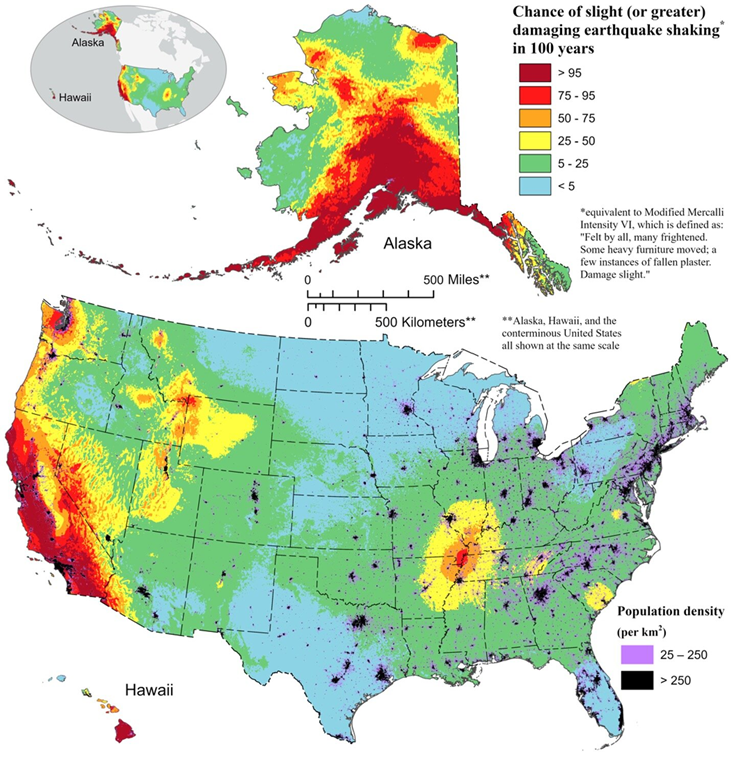
When the validity or failure of your model won’t be known for another century or two it is reasonably easy to be confident enough to sell your services and act convincing.
I don’t know if Petersen and company are knowingly unethical, and perhaps they really do have an earthquake model that is worth more than the bits of memory used to store it, but I have my doubts.
I trust this model even less than the climate models. Many of the forces are deep in the earth acting on materials with unmeasurable characteristics over time periods of 1000s of years.
It does match the “gut feel” of what might expect. And that is probably all that is necessary to get paid and become an “expert in the field”.
Doomsday Cult Puzzled that the Earth Still Exists
Quote of the Day
The laws of thermodynamics dictate that a warmer atmosphere can hold more water vapor, but new research has found that atmospheric moisture has not increased as expected over arid and semi-arid regions of the world as the climate has warmed.
The findings are particularly puzzling because climate models have been predicting that the atmosphere will become more moist, even over dry regions. If the atmosphere is drier than anticipated, arid and semi-arid regions may be even more vulnerable to future wildfires and extreme heat than projected.
David Hosansky
January 17, 2024
Climate change isn’t producing expected increase in atmospheric moisture over dry regions: Study
After about the third paragraph I was laughing the rest of the way through the article.
There is no hint they would ever consider the possibility their climate heating models are flawed or that the mean global temperature is not increasing. It is like a doomsday cult predicting the end of the world on January 1, 2000 and when it doesn’t happen they don’t question the integrity of their prophet, but instead claim the destroyer gave them a second chance.
Read When Prophecy Fails: A Doomsday Cult on Alien Invasion for more insight on the behavior and psychology of these type of people. You might expect they would forsake their prophet when confronted with irrefutable evidence of the failure of the prophecies. But that is not what happens. Instead, most of the time, they will prophesize all the more vigorously.
I find the psychology absolutely fascinating.
And, of course, the same psychology exists within the gun grabber community.