That explains it

When grabbing the link to the Berger VLD bullets to make the previous post something jumped out at me. The ballistic coefficient (BC) on my favorite bullet has been changed. It used to be listed as 0.640. They now list it as 0.631.

The first time I fired my rifle at 1000 yards I entered the temperature, air pressure, and wind speed/direction (I already had the scope height, muzzle velocity, BC, and inclination entered), into my little calculator. It reported back the sight angle for my scope, I tweaked my scope, and I happily aimed dead on and put my first three rounds into the bottom right of the X-Ring. I wasn’t surprised my wind estimation was a little off but why the bottom of the ring? Since then I’ve had the nagging suspicion that the algorithm used in the calculator and Modern Ballistics wasn’t quite right. Yes, it was close enough for all practical purposes. I couldn’t argue with a X-ring hit at 1000 yards on the first shot from the gun beyond 200 yards from a cold clean barrel. But as years went by it always seemed the gun and cartridge was shooting just a tad low from what I expected.

Running the numbers through Modern Ballistics tells me the lower BC gives the bullet another 2.5 inches of drop and an inch of windage to the right under those conditions. Not quite enough to fully explain my results but enough that it accounts for 50% or more of the error. That gets us into the 1/8th MOA range. This is well into the “noise” of shooter ability, bullet jacket uniformity, muzzle velocity variations, and to the point where you have to start worrying about the direction of crosswinds relative to the direction of the spin of your bullet and Coriolis effects–which requires you to know your latitude and the direction you are shooting.

So with the updated BC my little calculator and Modern Ballistics are, as they say, good enough for government work (back when I worked at PNNL I wrote a proposal and made a presentation to Special Forces about the calculator program for their snipers).

Quote of the day–Greg Hamilton

Multicam works very well. It is the best overall camo I have ever seen.

Greg Hamilton
February 1, 2007 6:09 PM
http://sports.groups.yahoo.com/group/insightstraining/
Images of Multi Cam camouflage.
[Hamilton is a former Army Ranger and now trains all branches of the military (and law enforcment and private citizens) in unarmed as well as armed combat.–Joe]

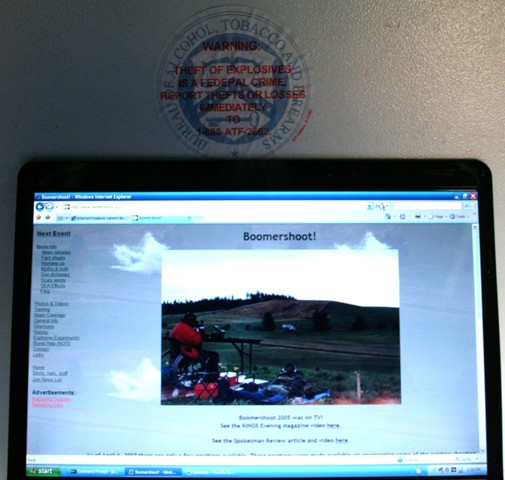
Bomb resistant paint

I exaggerate only a little bit when I say this paint resists bombs.

[Hat tip to Jason for sending me the link.]

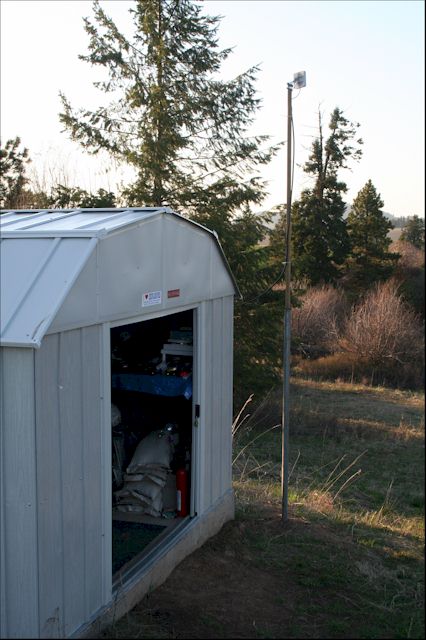
The weakest link

I recently was given a tour of a “secure area”. For access it required your hand geometry biometric information, your RFID card, and your PIN. Or did it?

There were two bolts that connected the sliding door on it’s tracks. The removal of two nuts with a 11/16″ (I could be wrong on the size, I’ve been out of the farm shop too long for my eye calibration to be trusted) open end wrench would have allowed the door to be removed. It probably would take as much as a minute to remove the two nuts and the door and a similar amount of time to restore the door and other than the video camera in the area there would be no evidence of access to the “secure area”.

I pointed this out to my guide. They didn’t seem concerned, “That’s why we have other security measures such as the cameras.” Security is no stronger than the weakest link. The hand geometry sensor, RFID card, and PIN are easily bypassed. They don’t have “other security measures”. They have video cameras as their sole means of security.

And of course guns, even in the possession of the guards, were banned in the area.

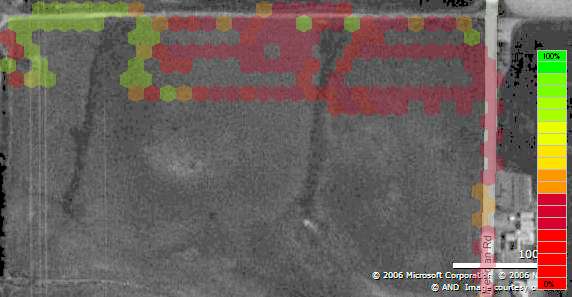
GPS visualizer

Very cool. I used it with Net Stumbler files with great results.

Biofuels and farmers

My brother Doug still lives on the farm. While visiting recently we talked about the recent trend to make grain into fuel. It’s been done for years but recently there has been a lot of new ethanol plants going in and using up a lot of the corn production. We don’t raise any corn on the farm but prices for wheat and barley have risen because the corn previously used for livestock feed is being pulled off the market for ethanol. Cattle, sheep, and pigs will eat chopped barley and wheat as well as corn so wheat is now at something like a 30 year high. Ignoring for now the fact that it’s not an all time high, that 30+ years ago wheat sold for more than it does today, we realize that there might be an increase in prosperity of some farmers in the near future.

Some people are fantasizing about replacing nearly all our non renewable fuels with “natural” fuels made from grain. The key word in previous sentence is fantasizing. I knew Doug had done the calculations 15 or 20 years ago and realized then farms cannot begin to supply our fuel needs and I asked him to redo the calculations. He sent me this short paper (Microsoft Word .DOC, slightly edited by me). The important information is as follows:

Comparing potential alcohol production to current petroleum production, we see that if we stop eating and make ALL of the world grain production into alcohol, we will produce:

1.77e16/1.447e17 or 12% of the energy we currently get from petroleum.

…we are falling behind on world food production versus consumption in the last 10 – 15 years, so there are a few billion people that will have to stop eating if the rest of us want to stop using fossil fuels and switch to biofuels.

Also on the negative side is the fact that the huge increase in agricultural production that we have seen in the last 50 years is mostly due to fertilizers that are based on natural gas. Modern agricultural production also depends on fossil fuels for farm equipment and transportation. Thus, the “renewable” biofuels are also based in part on fossil fuels.

He doesn’t take into account that a fair amount of the oil pumped from the ground is not burned as fuel but is used as lubricants, paints, and materials such as plastic. So that 12% number is wrong in that it assumes all oil is converted into energy. So you can probably boost that number up to something like 15 or 20%. But still that is assuming that the entire world’s production of grain is used for energy. So assuming that we only ask half the planet to stop eating foods that have grain products in them (no more bread, cookies, noodles, or Twinkies and don’t forget most of your meat is grain fed) we can only supply about 8 to 10% of our energy requirements with our current production levels of grain. Also he probably wasn’t aware of this recent news on converting cellulose to fuel.

Maybe we can increase production, right? Yes, some. But the last time I checked the U.S. was losing about one million acres of farm land per year. Farm land is easily converted into roads, housing developments, and shopping malls so that’s what is happening to most of that one million acres per year. Add to that dwindling supply of farm land the increasing population and the fact that most of the prime farm land is already in production and you rapidly realize biofuels aren’t going to be the answer to our energy needs.

Something no person living in the U.S. has experienced is a shortage of food. In Europe during and after WWII there were times when there just wasn’t enough food for everyone. In China and Africa it’s been even more common. But in the U.S. someone might go hungry because they didn’t have enough money for food but there was always food available.

For at least the last 15 years my brother and I have asking each other “when are things going to turn around on the farm?” They are running equipment that is over 30 years old which only keep running because they have a good machine shop and can do their own repairs and even build new parts and equipment. Things have been tough on the farm for a long time and we watched as the cost of production kept rising and the crop prices remained flat or even dropped. Dad figures the government should “set a fair price for everything and keep it there”. Nixon tried that and it didn’t work. That sort of thing will never work. It simply can’t work. There has to be a shortage or at least the threat of a shortage before the price of our crops will increase. Maybe then “things will turn around”.

Food is an interesting exercise in supply and demand. Classically one would claim that as prices go down consumption will increase. But in the U.S. today ask yourself, how much more would you eat if the price of food dropped by half? What if the price of food was 10% of present day prices? Or what if food was free? Would you and your family significantly increase your consumption? Probably not. And in the other direction, how much would you pay to avoid cutting your consumption in half? Food demand is extremely inelastic.

15 or 20 years ago there was something like a years supply of wheat in storage. Stop production, and assuming perfect transportation and distribution, and it would be a year before the supply of breads, noodles, and Twinkies disappeared. Recently that surplus has dwindled down into the neighborhood of 30 to 45 days. And during that time the price of wheat did not increase above the “noise”. Why? Because there was still a surplus and the demand is inelastic. Now, with the ethanol plants coming on line and wheat and barley replacing corn in the feedlots we might see an actual world-wide shortage of wheat in our near future. And then what happens?

That’s an interesting question. Far more interesting that what one might think at first glance. Farmers, contrary to popular impression, are not stupid. All the stupid ones went out of business years ago. What you are left with are smart farmers that were too stubborn to get a job in the city. Smart, stubborn, and making do, scrimping by for 30 years. When it looks like there is actually going to be a shortage do you think those farmers will sell their crop as soon as they get it in from the field? Or will they hold on to it for a while to get a better price? If there wasn’t going to be a shortage there will be as all those smart, stubborn farmers figure it’s payback time. It’s time to make up the missed profit for the last 30 years. They are going to sit on that wheat and wait as long as they can. And with the prices going through the roof it shouldn’t be hard for them to get the banks to loan them the money to pay their bills while they “wait for prices to peak”.

What happens next? My speculation, and everyone I have talked to about this, is that the people in the cities won’t stand for it. Once they start seeing they can’t buy an unlimited number of Twinkies and Big Macs anymore and the ones they can buy are twice as expensive as they were a couple months ago they will demand the government “do something”. Maybe then Dad will get his wish, the government will set a “fair price” for wheat and the farmers that refuse to sell at that price will have their crop forcibly taken from them. Those smart, stubborn farmers with 30 years of resentment built up will have their crops taken.

Every farmer I knew growing up owned one or more guns. Most of them went hunting. I wonder what they will hunt when the government says they have to sell their crop for less than what the market would pay for it?

Interesting times we live in…

Update: Doug made the following comments:

I am aware of cellulose.  I went on a tour last summer on WSUs conservation farm north of Pullman.  They talked about switch grass in the midwest.  It doesn’t grow well here, but we would probably grow things like Reed’s Canary grass here.  You can get more energy per acre from switch grass, but they are still working on ways to convert the cellulose to starches and sugars so the yeast can digest it.  It didn’t seem like the technological difficulties were insurmountable, but we aren’t there yet.  In 10 years, we may be replacing corn ethanol with switch grass ethanol, but I would be willing to bet that without a major crisis of some type, the world demand for energy will continue to outpace production of biofuels.  China for example is ramping up their industry and will have an insatiable thirst for energy if that continues to go well for them.

The second point is what happens when we actually have a shortage of food.  First off, the wealthy people in the world, (Americans and Europeans) won’t have a food shortage.  Africa, the poor contries in the middle east and south east asia will all be unable to buy food.  They can’t afford it right now, so we give them a lot of food.  If the price of wheat triples, it would then cost a whopping $0.27/lb.  This should barely be measurable when you buy a big mac or other prepared foods.  Breakfast cereals often cost that much per ounce, so I don’t think the American consumer will get hurt that bad.  What I do think will happen is the American people will feel empathy for the starving people of the world and the guilt that people of western european culture seem so eager to feel will take over.  The media will start scolding us for taking food out of the mouths of starving children in Africa to put in our SUVs.  The political correctness of biofuels will butt head to head with the political correctness of feeding the starving children of the world.  The media, which controls the thinking of the American people and which takes sides in nearly every issue will have to decide if we want biofuels or if we want to continue fueling the population explosion of undeveloped countries.  My guess is they will instruct the American people through biased reporting to send our food to the starving children of the world.  Politicians will respond accordingly and the ethanol mandate and biodiesel tax credits will be swiped away as an experiment gone wrong.

Where does that leave us with energy?  I am not certain, but I suspect we will be drilling for more oil and speeding up the process of depleting that natural resource.  Greenhouse fears are the fad right now, but will probably fade away when people like Al Gore realize they can’t enjoy the things they want in life without consuming fossil fuels.

Update2: I don’t expect prices to just triple if a shortage occurs. Prices tripled once before when the Russians had a crop failure and started buying a noticeable portion of the worlds supply. They didn’t produce a world wide shortage just reduced the reserves. If there is an actual shortage I wouldn’t be surprised to see prices increase by a factor of 10. This might increase the cost of processed food in the U.S. by something like 25 to 50%. Not so much that most people in the U.S. would be unable to buy it and most probably wouldn’t change their shopping habits. But something Doug did bring up will put some elastic into the demand. We give a lot of food away to other countries. Those give aways are almost for certain dollar based rather than quantity based. As the price rises less food can be purchased for the same amount of money. Hence the demand (demand in the sense that people with money to actually purchase the food as opposed to just being hungry but without the means to buy it) will decrease some with increasing prices. And of course what will happen when people start actually going hungry in some of those other countries? People will die both from actual lack of food and from fighting over what food is available. Interesting times…


Search engine for lonely geeks

Ms. Dewey has been reported on before but I decided to test out how she handled the topic of guns. I did repeated searches for “gun” and I was rather pleased in how she handled it. Plenty of snark without being anti-rights.

Similar satisfactory results came with searches for:

  • keep and bear arms
  • 2nd Amendment
  • gun control
  • Violence Policy Center
  • Million Mom March
  • Brady Campaign the Prevent Gun Violence
  • explosives

Of course I expect lonely geeks will spend lots of time asking her sexual questions. I’m happy to report I spent less than an hour doing that.

Guns are Magic Part II

Earlier I wrote about the entertainment industry giving magical powers to firearms.  More recently, the Discovery channel, on their new program, Future Weapons, did a bit about an “actual” 1.5 mile, one shot hit from a cold bore using the new .416 Barrett.  The shooter was depicted as firing his first shot ever from that rifle and hitting his target (a circle of about 5 feet diameter) at 1.5 miles.  My skepticism lead me back to Joe’s exterior ballistics program.  Since Barrett had just sent us a write-up and the specs on his new cartridge, all I had to do was plug in his numbers.  I allowed, again, for the most amazing velocity standard deviation of 5 feet per second, with a 1/2 MOA accurate rifle/cartridge combination.  I reduced the effects of the atmosphere by raising the elevation to 3000 feet.  I enlarged the target to a 12 x 20 inch ellipse (roughly the one-shot kill area of the human body) and still I came up with a probability of a one shot hit (any hit) of about 8 percent at 1.5 miles.  The hit probability at that range on a 5-foot circle is about 58%.  Time if flight: 4.05 sec.  Extremely good, but you have to push the accuracy of the system to the edge of believability to get it, and with a perfect marksman.  It’s certainly not what we’re being led to believe by the TV producers.

Barrett’s specs for the .416:


      Muzzle velocity: 3250 fps

Ballistic Coefficient: 0.943

           Bullet Mass: 400 grains – solid copper


I want one!  I wonder if they’re going to come out with some light varmint bullets for it, or some frangible defense loads.  Heh.


Burning ice for energy

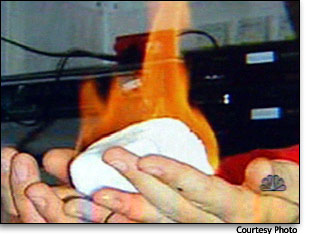
Ice that burns:

Very cool.

Video here.

If we mine the ice off the polar caps, then burn it to power our cars, run our factories, and to heat our homes does that count as an “alternate energy source” to the tree huggers? What does it all mean for “global warming”? Shouldn’t it be considered an “all natural” energy source?

Thinking about my days as an electrical engineer

It appeals to my inner electrical engineer.

Decades ago my brother and I made some pretty “healthy” sparks for tormenting various farm animals. We probably got zapped ourselves more than any of the animals but it was a lot of fun. This is way beyond “healthy”. This is like “holy mother of immortal gods” quality of sparks.

Thanks to Brutal Hugger at Say Uncle.

Concealment does not equal cover

Lots of lessons to be learned here.

Guns Are Magic, It Seems

One of the many murder mystery shows on TV these days recently did an episode wherein an assassin shot his victim through the heart at a mile and a half with a single shot from a super-scary sniper rifle, complete with portable weather station, laser range finder and computer, etc. (sounds a bit like my setup).  It reminds me of Henry (nostrilitis) Waxman’s attempt to scare children over the magical capabilities of the .50 BMG cartridge.


Knowing this claimed feat to be beyond ridiculous, and for fun I decided to test it using Joe’s exterior ballistics program.  Using all the most generous figures:  Caliber .50 BMG (loaded with the slipperiest small arm bullet, with a Ballistic Coefficient of 1.05) which I gave an impressive standard velocity deviation of only 5 feet per second, and an inherent accuracy of 0.5 minutes of angle (super, ultra special, custom ammo) with a wind estimation error of only 2 MPH over that whole mile and a half, and perfect assessment of temperature, humidity and barometric pressure.  It turns out that the probability of a hit (any hit) on a 15 inch circle at that distance (2,640 yards) is from 1% to 8% (depending on which 100-shot simulation you go with– i.e. there were 100-shot strings in which only one bullet hit its target) assuming a perfect shooter with nerves of perfect steel, perfect optics and visual conditions that can resolve a 16-inch (a little over ½ MOA) wide target at 2,640 yards.


Using the more common, high powered, long-range 300 Winchester Magnum, with the same amazingly good velocity deviation and the same super 0.5 MOA accuracy, the hit probability went to about 0.6% on a 15-inch stationary circle.  Bullet’s time of flight: 7.37 seconds.


On the TV show, the shooter did another amazing trick by timing his shot (from a mile and a half away) to exactly coincide with some blanks fired in a movie set dual.  The time of flight for his (assumed) .50 BMG bullet at 2,640 yards is nearly 5 seconds, so the shooter would have to anticipate his victim’s actions with superb accuracy, five seconds in advance.  Furthermore, he took the shot from an urban area, where the intense muzzle report from a necessarily very powerful rifle would have gotten the attention of people in a wide radius.  The rifle was bolt action, and the ejected cartridge case was depicted as having melted into the outdoor carpet on the balcony that served as the shooting position– also preposterous, as the case sits in the chamber too long to leave it so hot upon ejection (the relatively cool barrel acts as a tremendous heat sink for the thin brass case).  Only autoloaders spit out hot cases because they extract the case within milliseconds of firing.  Oh and the target, being a human in the process of acting out a mock duel, was moving, making the probability of a hit even less (my simulations were done on a stationary target).


Now some would say, “Hey, its just a TV show.  Its entertainment, Dude, lighten up.”  I would agree if it were a science fiction series, or fantasy, but this stuff is put forth as serious, hard-hitting drama.  To me its like a serious W.W. II drama in which people fly like superman, battle tanks travel at 200 miles an hour, and animals talk.  It ceases being entertainment and becomes an insult.

Your tax dollars at work

I can imagine situations where the search for a W.C. Fields quote was a valid use of the U.S. Department of Justice resources but the odds are a bit low. People need to realize the power of the internet flows in more than one direction:

Domain Name   usdoj.gov ? (United States Government)
IP Address   149.101.1.# (US Dept of Justice)
ISP   US Dept of Justice
Location  
Continent  :  North America
Country  :  United States  (Facts)
State  :  Maryland
City  :  Potomac
Lat/Long  :  39.023, -77.1993 (Map)
Distance  :  2,059 miles
Language   English (United States)
en-us
Operating System   Microsoft WinXP
Browser   Internet Explorer 6.0
Mozilla/4.0 (compatible; MSIE 6.0; Windows NT 5.1; SV1; DI60SP1001; .NET CLR 1.1.4322)
Javascript   version 1.3
Monitor  

Resolution  :  1152 x 864
Color Depth  :  32 bits

Time of Visit   Feb 6 2007 5:24:26 am
Last Page View   Feb 6 2007 5:24:26 am
Visit Length   0 seconds
Page Views   1
Referring URL http://search.yahoo….e=1&cop=mss&ei=UTF-8
Search Engine search.yahoo.com
Search Words w c fields quote
Visit Entry Page   http://blog.joehuffm…e DayW C Fields.aspx
Visit Exit Page   http://blog.joehuffm…e DayW C Fields.aspx
Out Click    
Time Zone   UTC-5:00
Visitor’s Time   Feb 6 2007 8:24:26 am
Visit Number   132,224

There’s something about making things go BOOM

And then there’s the satisfaction of getting rid of the rodents in the process. Via Say Uncle and Ninth Stage:

The creation of Maxwell’s Demon?

Initial reports are a little ambiguous but if the Wikipedia entry is to be believed I don’t have reason to faint as I was initially inclined (violation of the Second Law of Thermodynamics is a very big deal in my world view).

Still, it is perhaps as big a deal as electronics. And since Maxwell’s Demon is very much like the very first electronic device, the diode, the analogy works pretty well. If the analogy holds, as things scale, then the analog of the integrated circuit will be mind boggling let alone the analog of the multi-core, multi-CPU, desktop computer.

A cure for the urge to smoke

There is one very well known guaranteed cure for smoking–death. However another one has just been discovered–brain injury:

Scientists studying stroke patients are reporting that an injury to a specific part of the brain, near the ear, can instantly and permanently break a smoking habit, effectively erasing the most stubborn of addictions. People with the injury who stopped smoking found that their bodies, as one man put it, “forgot the urge to smoke.”

This is great news. We may be able to find or create a drug or other means to “flip the switch” and help people from implementing the “universal cure”.

I find this very ironic–I always figured you must have had a dysfunctional brain to start smoking in the first place.

Set your phaser to stun

It’s a little large to put it in your pocket or hip holster but you could mount it on your starship or even your Humvee:

MOODY AIR FORCE BASE, GA. — The military calls its new weapon an “active denial system,” but that’s an understatement. It’s a ray gun that shoots a beam that makes people feel as if they are about to catch fire.

The technology is supposed to be harmless — a nonlethal way to get enemies to drop their weapons. Military officials say it could save the lives of civilians and service members in places such as Iraq and Afghanistan.

The weapon is not expected to go into production until at least 2010, but all branches of the military have expressed interest in it, officials said.

During the first media demonstration of the weapon Wednesday, airmen fired beams from a large dish antenna mounted atop a Humvee at people pretending to be rioters and acting out other scenarios that U.S. troops might encounter in war zones.

The device’s two-man crew located their targets through powerful lenses and fired beams from more than 500 yards away. That is nearly 17 times the range of existing nonlethal weapons, such as rubber bullets. Anyone hit by the beam immediately jumped out of its path because of the blast of heat. Though the 130-degree heat wasn’t painful, it was intense enough to make participants think their clothes were about to ignite.

The system uses electromagnetic millimeter waves, which can penetrate only 1/64 of an inch of skin, just enough to cause discomfort. By comparison, microwaves used in the common kitchen appliance penetrate several inches of flesh. The millimeter waves cannot go through walls, but they can penetrate most clothing, officials said. They refused to comment on whether the waves can go through glass.

Early in my career as an electrical engineer I worked with millimeter waves some. I’m sure it will go through most glass although it is possible to make glass it won’t penetrate. It is also trivial to make clothes that block it. That doesn’t mean it’s useless but it will cause adversaries to spend time and money to acquire and utilize the necessary protective equipment.

As it is currently shown it’s vulnerable to a well placed bullet. My advice is to armored that spot a little bit better before going to production with it. Otherwise a single agitator could disable it and enable a crowd to riot (whatever).

Excellent price on high end body armor

At $750 this is less than half of list price. Quantity 3 in XL for:

Threat Level IIIA Front & rear soft panels 

Front Plate
– The 10×12-inch Model TK, K-47CL+ front plate is designed to stop 7.62×51 150 gr., 5.56 SS-109 62 gr., 7.62×39 all, inc API.

Packages to Tehran

Say Uncle has an interesting suggestion:

I think I’m going to start mailing highlighted copies of the fourth amendment to addresses in Tehran.

At GRPC 2000 I hinted at an alternative to this general idea in terms of email instead of snail mail. Now I present this idea with a little more detail.

You can send 1000 encrypted emails a day for less money than one letter to Tehran per week. And you probably don’t need to send it to Tehran to get the attention of the spooks. Just sending encrypted email to Europe with interesting subject lines would probably be sufficient. From your own home here in the states you can set up a computer account in Europe pretty easily. You install program on that computer which automatically accepts email messages and replies back a few random minutes later with another encrypted email. You do the same with a few computers at home and the homes of your friends (or perhaps your enemies). Basically you have a bunch of bots talking about “interesting subjects” to each other with the contents encrypted.

There are some twists on this such as doing it in such a way you can find out if the snoops were successful in decrypting the mail and reading it. Another twist is to make it impossible for them to read it. Yes, there are unbreakable encryption methods–in general you have a terrible key distribution problem but in this case you don’t have to actually open the email on the receiving side. Your bot just replies with another unbreakable email message with an interesting subject line. Hence the decryption key doesn’t have to actually be delivered to the bot that receives it.

Of course this might result in you becoming acquainted with your local FBI agents on a first name basis no matter how innocuous the decrypted messages and no matter how much effort you put into hiding your identity. It just depends on the number of hours of laughter required to compensate you for the hours of laying naked on a concrete floor in the dark with buckets of cold water being thrown at you every few minutes.

Hanford News and Los Alamos

Pacific Northwest National Laboratory (PNNL) came about because of Hanford–the nuclear facility where we got the nuclear components for the worlds first atomic bombs. Those scientists and engineers at Hanford were gradually put to work on other projects. The scope increased to where today there is virtually no scientific or engineering task that is off limits for the people there. Although when I was there I worked, literally, a stone’s throw from the Hanford reservation I wasn’t part of Hanford. The name Hanford still persists in the vocabulary of the people as a synonym for more that what is, technically, not Hanford.

With that as background I now present you with Hanford News where the top story of today (and probably for several days but I just noticed it today) is the story of my lawsuit against Battelle who has the contract to manage the laboratory.

What is just as interesting to me is how I happen to run across the story. It was all because someone at another national laboratory, Los Alamos, happen to come visiting:

Domain Name lanl.gov ? (United States Government)
IP Address 128.165.116.# (Los Alamos National Laboratory)
ISP Los Alamos National Laboratory
Location
Continent  : North America
Country  : United States  (Facts)
State  : New Mexico
City  : Los Alamos
Lat/Long  : 35.8639, -106.2953 (Map)
Distance  : 931 miles
Language English (United States)
en-us
Operating System Macintosh MacOSX
Browser Firefox 2.0
Mozilla/5.0 (Macintosh; U; PPC Mac OS X Mach-O; en-US; rv:1.8.1.1) Gecko/20061204 Firefox/2.0.0.1
Javascript version 1.5
Monitor
Resolution  :  1680 x 1050
Color Depth  :  32 bits
Time of Visit   Jan 3 2007 2:12:13 pm
Last Page View Jan 3 2007 2:12:13 pm
Visit Length 0 seconds
Page Views   1
Referring URL http://www.pnnl.info/
Visit Entry Page http://blog.joehuffm…Their Attention.aspx
Visit Exit Page http://blog.joehuffm…Their Attention.aspx
Out Click  
Time Zone UTC-7:00
Visitor’s Time Jan 3 2007 3:12:13 pm
Visit Number 124,413

They came from my PNNL.INFO site. That’s interesting! So I looked at the log files form that site and I watched, in real time, as five different people (well, five different computers anyway) from Los Alamos poked around. They found my site via a Google search (http://www.google.com/search?q=pnnl+wrongful+termination ). I did the same search and found the Hanford New story. One person did the search and the other four soon started hitting my site directly and some of them eventually visited my blog. How interesting.

I was chatting on line with my friend Sean (Sean, I told you 10 different IP addresses but there was a bug in the script that I used to count them) as I watched in real time as one person looked at my performance reviews at PNNL. Sean suggested, “Maybe he’s a hiring manager.” What a kick! I took Sean out to dinner after that.

What bugs me though is that the web browsing security at Los Alamos is no better than at PNNL. I was able to determine the exact computer name of each of the participants in their visit to my website. I can’t do that with visits from any other company that I notice visiting me. Microsoft, for example, has proxies in place that prevent that. Even visits from private homes, such as from my family in Moscow, Idaho are impossible to resolve to a specific computer name. What is it with these, supposedly, high security facilities that they have such gaping holes in their security?

Beating Lyle to the punch line: They are government facilities. Do you expect competence?