Once these 64 pound, 31 inch long submunitions are released, each will deploy a parachute, slowing their forward movement and orientating them vertically in relation to the ground. Then, a rocket motor fires and forces these cylinders into a slight climb, although at a distance it would look like the BLU-108s are hanging in mid-air. This rocket also causes the BLU-108s to spin rapidly.
As the submunition spins while almost hovering in mid-air above the target area, each BLU-108 cylinder will throw four individual sub-submuntions, known as ‘Skeets,’ from its body. Each Skeet is slung in a different direction at a 90 degree vector from the now empty BLU-108 cylinder. As these hockey puck-like Skeets fly through the air while rapidly spinning, a small infrared imager and laser ranging system activates on each one. The infrared seeker rapidly scans the ground below for an enemy vehicle or weapons fixture that it can recognize, while the laser ranger provides a ground contour map.
…
the Skeet fires off its 2lb explosively formed penetrator along with a fragmentation ring, sending a molten spear into the target along with a handful of dense shrapnel covering the area around it. The idea is that the penetrator kills the vehicle from top, where even main battle tanks are vulnerable, while the shrapnel kills who is inside (if it is a lightly armored target) and anyone in the targeted vehicle’s immediate vicinity.
…
the Sensor Fuzed Weapon’s unique discriminating abilities, and its WCMD delivery system, will most likely morph into even more dynamic submunition capabilities. Ones where taking out individual soldiers via large-insect sized flying explosives, capable of loitering above the target area for long periods of time, could become a reality. Or even a future where small nano-robotic mites are dropped using a WCMD-like dispensers over a convoy of enemy armor, their mission to destroy vehicles’ electronics from the inside out without causing so much as a single explosion, may also become a real capability one day.
In many ways conventional warfare is obsolete because equipment on the ground is so vulnerable. Unless a force can successfully challenge the air superiority of their opponent wars will (and are) be fought using Fourth and Fifth-Generation Warfare.
Why can’t we use this technology to deliver food to hungry people? Smart fruit, laser guided bananas. Something positive, and far cheaper.
Nevermind, answered my own question. There’s no profit in peace or help, only in violence and destruction.
I would try to explain it to them but I don’t think we have enough in common to form a means of communication such that they could understand what I was saying.
The message is embedded three times in the song. Even if you don’t know Morse Code if you know to be listening for something you will recognize the spots.
It’s a good example of Markley’s Law but what I found far more interesting was that the Twitter account it came from appears to be fake. I’m pretty sure this account is machine generated and the three tweets from that account are copied at random from the Twitter universe.
See also the followers of this account. I suspect they are all machine generated as well.
If I had the time and the interest I see what Twitter accounts they follow which are in common. I suspect it is a means of generating fake followers for some real account.
The entire Seattle Smart Gun Symposium video is on YouTube. But they have the video “unlisted”. It is embedded on the Washington Technology web page however.
Also, I had one person on a Smart Gun Symposium panel request I remove their name from my blog. It was very polite and they indicated they wished that we remain in contact in regards to technical issues with the technology so I complied with their request.
The January/February 2015 issue of Front Sight magazine has an interesting article on the statistics of making “power factor*”.
While I certainly had the background in statistics it never occurred to me to apply them to the chronograph data from my hand loaded ammunition to determine the chances of me failing to “make major” at a match. This is despite very nearly failing to make major in the 1998 Area One USPSA match.
Looking at my log files for the ammunition I made for that match I found the following data:
Mean velocity: 992.6 fps Standard Deviation: 11.3 fps Bullet Mass: 180 grains Power Factor: 178.67
Back then you had to have a power factor of 175 to make major and for some reason I thought I had plenty of margin.
At the 1998 Area One match staff pulled eight cartridges at random from the magazines on my belt and tested them as per USPSA regulations. They pulled the bullet from a cartridge and weighed it. They fired three rounds and found I failed to make major. They, as per procedure, fired another three rounds, used the highest three velocities from the six rounds fired and found I was closer but still failed. They had one round left and, as per procedure, asked me what to do with it, “Fire it or weight the bullet?” I had them fire it and using the highest three velocities from the seven rounds fired I just barely made major power factor.
It wasn’t until I read the title of the article in Front Sight article, “The Power of Statistics How to Meet Power Factor with Confidence” that I felt stupid for my experience at Area One.
The bottom line is that your chance of failing the test procedure depends on how many standard deviations you are away from the velocity threshold for the power factor you want to meet.
Using my example from the Area One match the velocity threshold is 972.22 fps (175,000 / 180). My mean velocity was 992.6 fps or 20.378 fps above the threshold. With a standard deviation of 11.3 fps the ammo was 20.378 / 11.3 or 1.8 standard deviations (commonly called ‘Z’) from the threshold. Using a normal distribution table or the article you will discover my chances of failing were about 13%.
Update:
Using this table from the article you will discover my chances of failing were about 13%:
Z
Chance of Failing Power Factor (per USPSA rules)
2.5
5%
2.0
10%
1.9
11%
1.8
13%
1.7
15%
1.5
21%
1.4
26%
1.2
36%
1.1
40%
1.0
44%
0
50%
This table is not a standard distribution table. It is a mapping from Z (number of standard deviations away from the mean) to the chances of failing the PF test under USPSA rules. This was obtained using a t-distribution because of the small sample size used by the USPSA regulations. It is assumed the shooter obtained the mean velocity and standard deviation with a sample size of eight.
End update.
I’m going to range today to measure the velocities of a new load I plan to use for competition. I’m going to make sure I’m about 2.5 standard deviations away from the threshold which would put my odds of failing to make major at about 5%.
* Power Factor is defined as the mass of the bullet in grains multiplied by the velocity in feet per second divided by 1000. Or:
Power Factor = bullet weight (grains) x average velocity (feet per second) / 1000
In many competitions your targets are scored differently depending on the power factor of the ammunition you are shooting. For example if you are shooting Limited Class USPSA you “make major” with a power factor of 165 or greater and “make minor with a power factor of 125. For major power factor ‘B’ and ‘C’ zones hit are scored as 4 points and ‘D’ zone hits are scored as two points. If you “make minor ‘B’ and ‘C’ zones hit are scored as three points and ‘D’ zone hits are scored as one point. If you don’t have ammunition which gives you a power factor of 125 or greater all zones are scored as zero. I.E. you aren’t participating in the competition.
This needs to be enforced and standard on all guns. Not only does it make sure we don’t have unintentional shootings with children, but also completely eliminates gun resales. Standardizing this technology and reinforcing background checks is part of the way to cure American’s gun problem.
[The stupid is strong with this one. Every single thing he said is wrong.
As long as there exist functional guns and children it will be possible and probable there will be unintentional shootings with children involved.
How can it possibly eliminate gun resale any more than it would original sales? Apparently he is of the belief there is some sort of pairing between the original owner and the gun such that the bond can never be broken.
It appears he equates “standardization” with mandating. These are two completely different things.
I have no idea what he means by “reinforcing background checks”. I know how to reinforce a physical structure or even an argument or theory.
His last statement assumes facts not in evidence as well as being nonsensical. He must first demonstrate American has a “gun problem” then he must articulate the problem in a manner in which there exists the possibility of multiple solutions.
But what do you expect from an anti-gun person? Ignorance and stupidity is their currency.—Joe]
I’m going to now review the technologies and give you my semi-expert opinion on the technological future of smart guns.
Keep in mind there are two primary numbers associated with biometrics. False acceptance of an authorized user and false denial of an authorized use. The device can almost always be adjusted such that as one type of failure is decreased the other increases. Usually a single number is given such that these two failure rates are equal. But this might not be the appropriate thing to do for a gun. You might be comfortable with a one attempt out of 1000 failing to fire when a second attempt can be made a tenth of a second later when you use your gun primarily for four legged pest control. But you want the rate to be one out of 100000 when little Johnny found the gun while you were in the back yard working in the garden.
The first technology I want to discuss is the one from the New Jersey Institute of Technology (NJIT). I have corresponded with a representative from NJIT who has been working on a “smart gun” for 14 years. They call it “Dynamic Grip Recognition”. The grip of the gun contains pressure sensors which authenticate the grip for every shot. Here is what I believe is their latest video describing the current status of their project:
After 14 years they still don’t have something would be accepted by the police for self-defense. They emphasis the potential to reduce children shooting a gun without authorization. They do not claim the existing technology will prevent a smart gun from being fired by someone who has just taken your gun away from you in a struggle. They do not claim the technology cannot be defeated by a thief with tools from your local hardware store.
They do not claim the technology is ready for commercialization. They want to build the next generation with more and better sensors in the grip.
From reading about their technology, my discussion with Allied Biometrix and the representative from NJIT it is clear they haven’t done the testing really needed. I’ll get into that in a moment, but first let me cover the testing which that probably have done a decent job on.
They have done testing of shooters under stress. It’s not real world with real bullets being fired at the person with the smart gun but with what knowledge I have of their algorithm and their test results I believe has a good chance of not being an issue.
They have done testing with shooters wearing “police issue needle stick gloves”. There was no difference in the results.
They have done testing with children versus police officers. Children, due to their smaller hands, are extremely unlikely to be able to fire gun that has been authorized for use someone with significantly larger hands.
What I do not believe they have done is compare the failure rate for children attempting to fire a gun which has been authenticated for adults with small hands. I remember that I was wearing the same size shoes as my mom when I was in the sixth grade. I expect my hands were just as large as hers too. And Mom was only slightly below average size for a Caucasian woman. What would be the crossover point for hand size of an above average male child and a small Asian woman? I’m guessing it could be 10 years old or younger.
The biometric data they have collected is from a very small number of adults. I asked about but did not receive a direct answer as to whether this data included a gun authenticate for the shooter firing in four different manners:
Right handed.
Left handed.
Right handed with left hand supporting.
Left handed with right hand supporting.
I did not receive any data on the failure rates as the number of authenticated shooters for a given gun is increased. I suspect these tests have not been done. As the number of authenticated shooters in increased and the number of grips is increased the failure rate for falsely authenticating someone to fire the gun may not a simple factor of the number of authenticated grips. It may much greater than that. This will be catastrophic for the acceptance of this technology.
For example, suppose the false authorization rate for gun programmed to accept one grip for one person is that one out of 10,000 random people*. If two people are authenticated, each with four different grips as noted above then it is reasonable to expect that failure rate will be at least eight times worse. This would be one out of 1,250 for each of these random shooters just attempting one natural grip. If they tried each of the four different grip styles it would be reduced by another factor of four bring the total factor to 32. Which yields odds on the order of one out of 312. This is the best that can be expected. My experience with biometrics leads me to believe that it won’t be a simple factor. It is more likely to be more likely to be something approaching an exponential. If it were an exponent of 2.5 raised to the 32nd power, instead of 1 raised to the 32nd power, then we have over a 50% failure rate.
In conventional use of biometrics this dramatic increase in failure rate with many people authorized for access to a given resource (building, computer, gun, etc.) is handled in a different way than is possible for a defensive gun. Biometrics in a many user environment are conventionally used for identity verification, not identification. That is, I claim I am Joe Huffman and my voice is used to confirm this. How would you do this with a gun in a way that couldn’t easily be defeated by a child? A switch for “shooter one, two, or three” followed up by gripping the gun doesn’t really work. The child will try all the switch settings.
It is a fair to point out that fingerprints are used to uniquely identify people. But “dynamic grip recognition” is far, far different than a fingerprint. Fingerprints are constant with time, contain a lot more information than grip patterns, and are not nearly as subject to deliberate attempts to defeat the technology as grip patterns are.
I have another email to NJIT about how fast their technology does the authentication. Will it limit the rate of fire to something below the mechanics of the gun? If so then this is a problem. I know people that out shoot their gun. Adding any delay beyond that of the gun is not acceptable.
My expectation is that dynamic grip recognition will never meet their goal of one error in 10,000 for false acceptance when you have someone deliberately attempting to defeat it. A random person using their natural grip is far different case from this and they can’t even achieve that goal now. As multiple users, multiple grips, and people deliberately trying to defeat it I will be surprised if they can do better than a combined false acceptance and false rejection rate better than one out of ten. Even one out of 100 is probably insufficient for it to be acceptable in the marketplace and I think this is unachievable.
I think that it can work for certain cases such as prevention of child accidents. If the gun is authorized for people with large hands then small hands will be very unlikely to defeat it. But if the adult has very small hands then the protection from child use will become minimal.
With such limited use cases any attempt to legally mandate this technology will be met with significant resistance in both the legislature and the courts.
* They do not currently claim such rates. They hope to achieving this with the next generation version so this is being quite conservative.
Margot Hirsch President, Smart Tech Challenges Foundation
Hirsch didn’t really say a lot but what she did say demonstrated she was generally knowledgeable about the technology. The only thing I thought she was off base on was she thought smart guns would protect against thieves. The other thing of note which she said was that the market for this technology were families.
The following information is from the bio given to participants:
Margot Hirsch is the President of the Smart Tech Challenges Foundation (STCF) a non-profit focused on reducing gun violence through the technology and innovation. The STCF was formed in 2013 with the mission of bypassing the political gridlock and polarizing debate around gun control versus person freedoms, by spurring innovation in technologies that serve to reduce firearm-related injuries and death. By awarding grants directly to innovators through the first-of-its-kind Smart Tech for Firearms Challenge, Margot is on the leading edge of inventive challenge philanthropy, finding market-based, entrepreneurial solutions to a social problem that claims over 30,000 American lives annually. She is responsible for the overall strategic direction of the foundation, running operations, board development and fundraising.
Prior to joining STCF, Margot was Regional Vice President of Blackboard, Inc. where she led international sales for the Connect division of Blackboard, a leading provider of learning solutions to the education market. With over 25 years of sales and business development in the technology industry, Margo has held business development and sales management roles at Smartforce/Skilsoft, eProsper, Angel Investors, Global Village and American Express.
More information about the organization and some of the people and technology they have given grants to can be found on their web site.
Mark Burles Vice President, Penn Schoen Berland
Burles presented polling data from a recent survey they had done for Washington CeaseFire. One should be careful using their data. From their website:
What We Do
How We Do It
1
DEFINE YOUR COMPETITIVE ADVANTAGE
We measure a brand’s strength in context with its competitors to identify its assets, liabilities, & unique niche in the marketplace relative to the competition.
2
FIND YOUR “BASE” & “SWING” AUDIENCES
Our model not only identifies a brand’s loyal customer base, but also uncovers persuadable consumer segments who can be taken from competitors to grow the brand.
3
CRAFT A WINNING MESSAGE
PSB’s proprietary message development process delivers a clear roadmap of what to say, how to say it, and to whom to say it.
4
DELIVER A PERSUASIVE CAMPAIGN
In this instance their customer is Washington CeaseFire.
That said this is the data Burles presented to the audience:
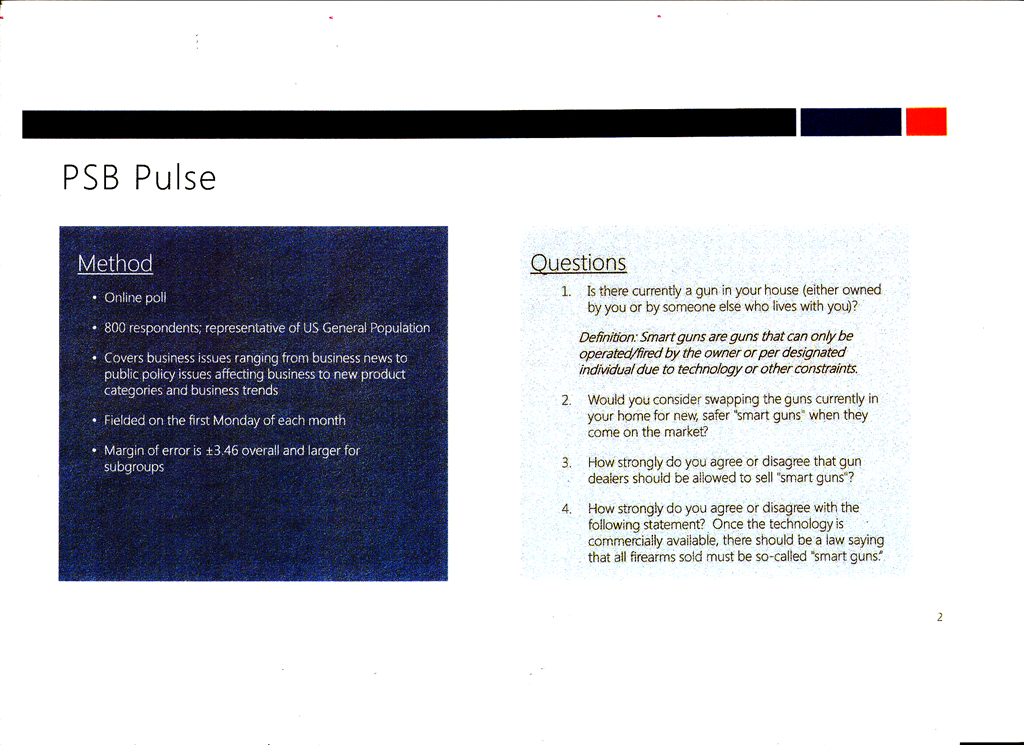
Online poll of 800 respondents, representative of the US General Population. Margin of error is +/- 3.46 overall and larger for subgroups.
Questions:
Is there currently a gun in your house (either owned by you or by someone else who lives with you)? Definition: Smart guns are guns that can only be operated/fired by the owner or per designated individual due to technology or other constraints.
Would you consider swapping the guns currently in your home for new, safer “smart guns” when they come on the market?
How strongly do you agree or disagree that guns dealers should be allowed to sell “smart guns”?
How strongly do you agree or disagree with the following statement? Once the technology is commercially available, there should be a law saying that all firearms sold must be so-called “smart guns.”
How do they do an online poll without a self-selection bias?
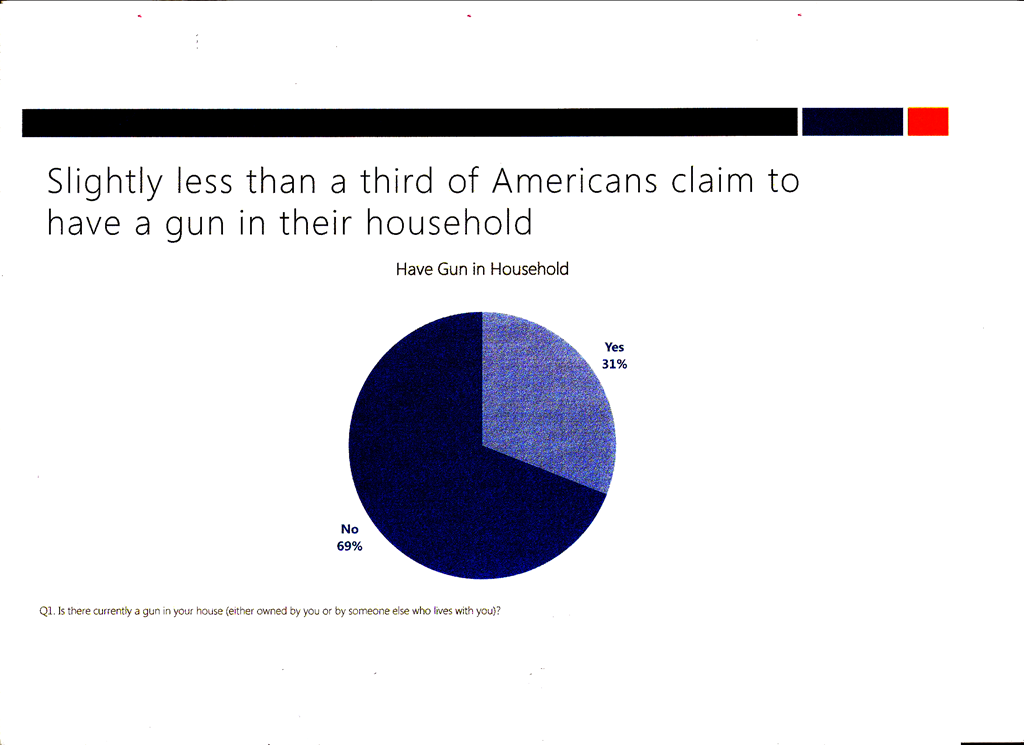
31% of the people polled answered “Yes” to the question, “Is there currently a gun in your house (either owned by you or by someone else who lives with you)?”
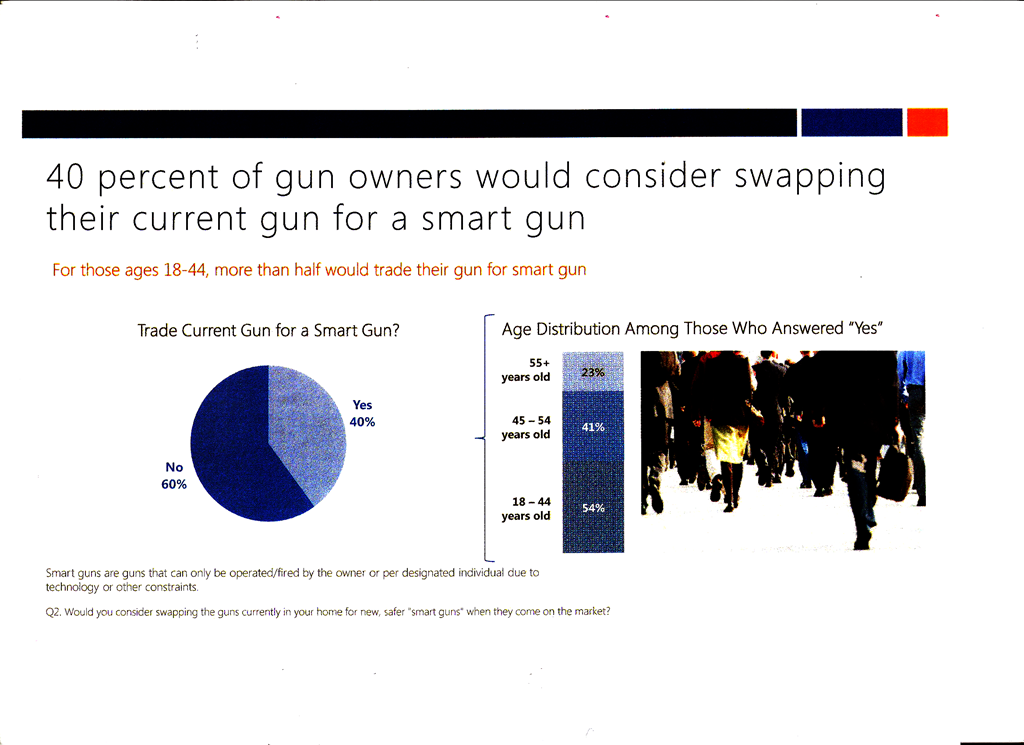
40% of the gun owners said they would swap their current gun for a smart gun. But these numbers decreased with the age of the gun owner. If the gun owner was 55+ years old only 23% would swap their current gun for a smart gun.
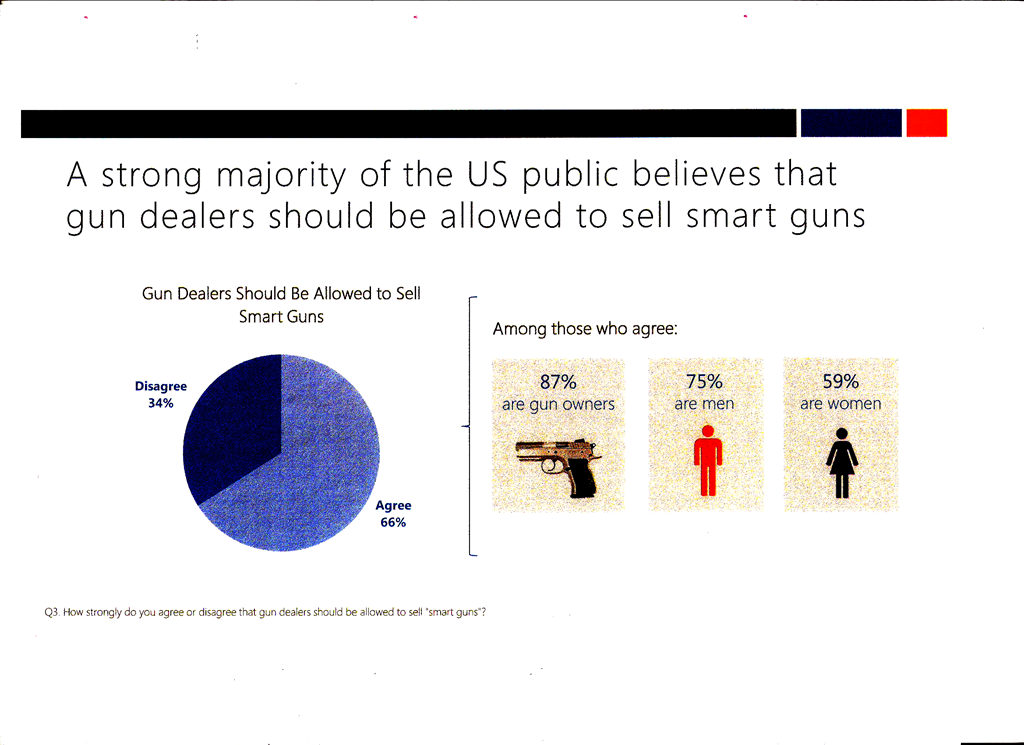
66% of the public agreed that gun dealers should be allowed to sell smart guns.
Of those that agree 87% are gun owners, 75% are women, and 59% are women.
I don’t get this. Of those that agree, how can there be 75% men and 59% women? Surely they meant 75% the men agree and 59% the women agree. Right?
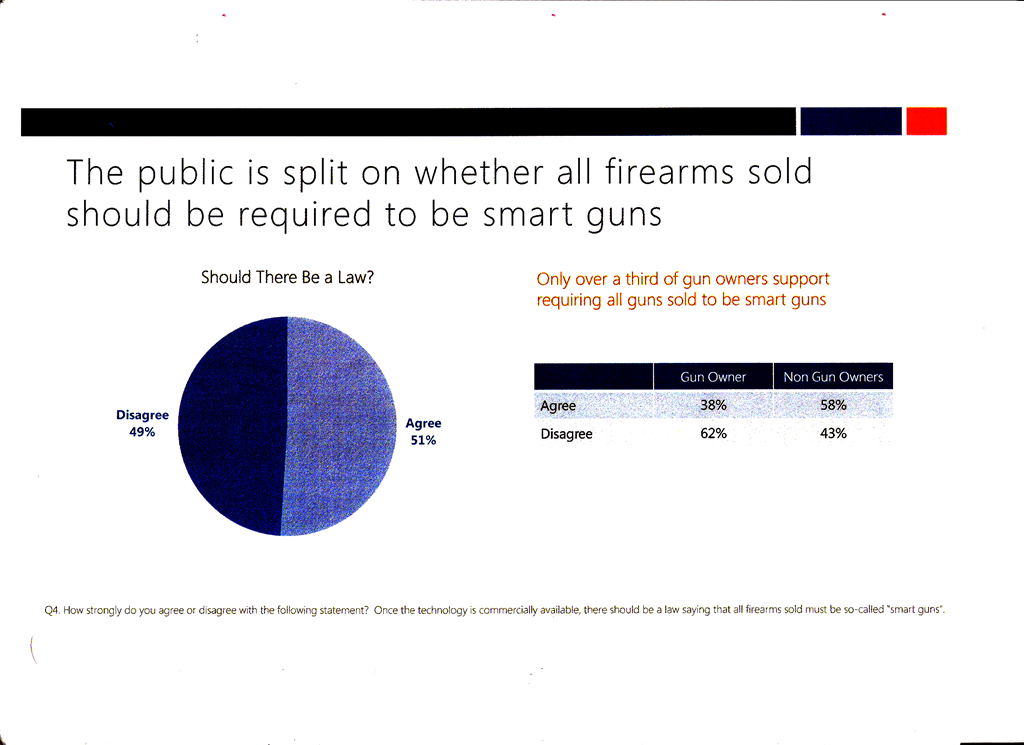
Over all 51% think there should be a mandate for “smart guns” if the technology is commercially available. But only 38% of gun owners agree while 62% of the general public agrees with a mandate.
McNamara and Trigger Smart are based in Ireland. This, as he admitted, biased his views on “smart guns” in the U.S.
His technology is RFID (Radio Frequency Identification) based and he told us it would add about $300 to the price of a gun.
He saw them as being used for prevention of children having an accident and used for recreational firearms. He didn’t seem to have a sense for what it would mean to have his technology on a self-defense gun.
As King County Sheriff John Urquhart pointed out police officers who lose control of their gun are almost for certain going to be close enough for the gun to be authorized to shoot when the bad guy pulls the trigger. If the bad guy were to run some distance away before shooting then it would be useful but in the immediate struggle it wouldn’t help. Hence an RFID based authorization system is of limited value in a struggle for self-defense situation.
He seemed to think there were some people that wanted them banned. It could be that he was just misunderstanding the situation with the New Jersey mandate and how that would essentially ban other types of gun. Hence many gun owners are hostile to the introduction of “smart guns”.
Since it is dependent upon radio communication someone in the audience asked about how it would deal with an attempt at being jammed. He didn’t seem to think it was possible. Looking at his bio I can excuse this error. His background is in property development, construction, and real estate. As an electrical engineer I can assure you it is possible to jam the communication between the gun and the RFID tag worn by the shooter.
Loretta Weinberg
New Jersey State Senator Majority Leader
Weinberg takes credit for the introduction and passage of the New Jersey “smart gun” mandate law.
She told many stories of children accidently shooting people. Her keynote speech was emotion packed and got the expected response from the CeaseFire people in the audience. I was annoyed with this because the number of people accidently killed in this manner is much less than the number of small children drowned. But we don’t have symposiums on or laws mandating “smart bathtubs” or “smart swimming pools”.
But what really irritated me was when she said it might have prevented the Sandy Hook elementary school shooting or the terrorist shooting in France at the offices of Charlie Hebdo. To believe things like that requires a special kind of crazy. I doubt Weinberg actually believes such a thing. I suspect she is just exhibiting her credentials that enabled her to be a New Jersey politician for such a long time. She can lie convincingly when telling people what they want to hear. She was speaking to the CeaseFire audience and not to people with technical competence.
She said there was a lot of talk among gun control people about the “smart gun” mandate law. The law had the unintended consequence of stopping the research. And you find that CeaseFire is opposed to the mandate and the Brady Campaign tried to sue and get New Jersey to enforce the mandate.
She wrote a letter to the NRA saying that she would work to repeal the law if the NRA would stop the opposition to “smart guns”. They didn’t respond. This got groans from the CeaseFire people in the audience. I thought this was probably the smartest thing they could have done with the letter. Anti-gun people can’t be trusted. What sort of guarantee could we have in place that would prevent them from pushing for a mandate again as soon as there is a gun on the market that sort of works but makes self-defense more risky than it already is? There isn’t any.
Judith Leftwich
Legal Director, Law Center to Prevent Gun Violence
When asked by moderator Dave Ross, “Is there anything wrong with letting the market decide?” Leftwich made it clear she supports mandates. When asked about the legality of mandates in light of the Heller decision which said the D.C. safe storage law was unconstitutional she told the audience that Heller only required that guns be functional. A safe storage law, in general, was not unconstitutional. D.C. had required the guns be disassembled. A “smart gun” should pass constitutional muster. Her questioner (someone from Guns.com, I think it was Max Slowik, their report is here) followed up by pointing out that Heller said that firearms “in common use” could not be banned. Leftwich drew parallel to seat belts and air bags in cars and said you can still drive old cars without airbags or seat belts. Guns shouldn’t be any different.
Leftwich also said “smart guns” would prevent gun theft. I so wanted to ask the other panelists who actually had technical knowledge what their opinion was. But there were other people asking questions ahead of me and the answers rambled on for so long that they put a halt to the questions before I got my turn. I told her directly after the symposium that the technology couldn’t possibly stop someone with a little mechanical or electrical smarts from defeating it. She responded that thieves generally aren’t very smart. I pointed out that they could still sell the guns to someone who had the smarts. She insisted that it would still help some. I told her that the mandate will get extremely strong resistance because of the self-defense issues of reduced reliability. I don’t know if I was just starting to annoy her or if it was that particular question but her attitude changed and she didn’t seem at all interested in talking to me any more. I let it drop.
In part four I will cover the “smart gun” poll results presented by Mark Burles, Vice President Penn Schoen, Berland.
I received fairly detailed information on the testing of the Dynamic Grip Recognition technology. I don’t yet have permission to publish it here. I hope to get at least permission to say which of my concerns have been addressed to my satisfaction and which I think need more work. That permission probably will not be granted until Monday, if ever.
I’m arranging my post by the people who spoke in no particular order. The chronology and the topic of the panel in which they talked isn’t particularly important. I suspect there will be video available at some time but in most cases there was a lot of rambling and the information could have been presented much more concisely. Because of this you won’t see many exact quotes but my attempt to rephrase what I think is their position. I may get something wrong or miss something they believe to be important to understand their position and if they wish to contact me I’ll be glad to discuss and correct such errors.
Ralph Fascitelli
President Washington CeaseFire
I was annoyed with Fascitelli and tweeted about him a few times during the event:
Washington Ceasefire’s Ralph Fascitelli says guns are a “public health plague”.
Fascitelli said smart guns are similar to e-cigarettes. By this he meant, in part, the established industries are opposed to them and although they are safer some anti-smoking (and anti-gun) people are concerned that because they are safer they will lead to greater use/acceptance of conventional cigarettes/guns. He is opposed to smart gun mandates and realizes that has hindered development of the technology. He hopes that people on all sides of the issue can find common ground and reduce gun violence. He recognizes that gun owners and gun rights groups do care about innocent lives.
He strayed off topic some and said:
Guns are a “toxic plague” and in another instance a “public health plague”.
He wants limits on magazine sizes
He wants a ban on assault weapons
Some of the distortions and lies I found annoying included:
He conflated the number of law enforcement officers killed in the line of duty by someone using a gun with those killed by someone using the officers gun. He said it was “500 over ten years”. The actual number was 511 but only 51 were shot with a department issued firearm. Fascitelli never mentioned the 51 number and expressed the “500” number in such a way that strongly implied “smart gun” technology could have saved some or all of those 500 officers.
During the press conference he said there were about 18,000 suicides per year using a gun and approximately 50% use a third party gun. I suspect he really meant a second parties gun but whatever. Then during the symposium he changed the numbers to 20,000 suicides per year and 10,000 people using a “third party” gun.
He said people under the age of 21 are not allowed to use handguns. This is false. They aren’t allowed to purchase handguns but they can own and use them.
He said about 10,000 U.S. children and teens have firearm injuries per year. I don’t recall if he did this or if it was only others but there were lots of stories of preteens killed and injured and then they used numbers which always included teens. The inclusion of teens of course brings in 19 year olds being shot while attempting to kill an innocent victim.
He and some others made a point that guns currently aren’t 100% reliable but “smart gun” critics demand the “smart gun” technology be 100% reliable. I suspect he is smart enough to know this is being disingenuous. We don’t want gun reliability to decrease to unacceptable levels. One failure out of 100,000 is probably acceptable in your self-defense hand gun. A 99% accurate smart gun means one failure out 100 and is not acceptable.
Depending on how you arrive at the numbers (see my email here) a gun that stops a kid from firing it 99.9% of the time may mean that if they try it 500 times they have a 60% chance of getting at least one shot off. 99% reliable may mean a 60% chance with just 50 attempts.
He hinted at a great divide in the anti-gun movement over smart guns. There is the obvious unintended consequence of mandated smart guns impeding development of them. But they also have concerns that if guns became safer to own guns would be more accepted in society.
This last point leads me to something else. I wonder if this contributes to their vehement opposition to armed school personal and sometimes even police being in schools. Are they concerned school shooting would decrease or stop and they would be less able to get traction on their anti-gun agenda? The same might be said of self-defense both inside and outside the home. Some, if not most, don’t really care that much about safety in general they just don’t want there to be guns and they even can admit this to themselves in some situations.
John Urquhart
Sheriff, King County
I really liked what Urquhart had to say and the way he said it. He was much more concise and to the point that the others and his points resonated with me. “Smart guns” aren’t ready for prime time. His deputies are very skeptical of them. You can see the mechanism of guns, you can take them apart, you can see parts are in need of maintenance, and you can clean and repair them. You can’t see into the electronics and software. You can’t know a failure is imminent with the electronics and software. A mechanical device is understandable.
This probably paraphrasing but instead of an exact quote, “A lock box isn’t going to save your life in an emergency but a gun may.”
CEO, Allied Biometrix
Allied Biometrix is licensing the commercial rights to a dynamic grip biometric device.
He thinks the phrase “smart gun” should be dropped. It should be a “user authorized gun” or something similar.
He sees potential for preventing accidents by children. He is adamant that thieves and terrorists (as suggested by one panelist) would be not be deterred.
While he is against legislation mandating the technology he would welcome legislation or at least some standards established before a gun could be put on the market. He doesn’t want a “bad-actor” to get into the market with a poor quality product that would trigger New Jersey type laws or sour the market for technology that might deliver on the promise of a high tech gun. “We can’t afford a 404 error code.”
He is also concerned about the liability issue. What if the technology fails and someone who is unauthorized to fire the gun successfully gets a shot off? Currently gun manufactures are shielded from such liability. But it seems unlikely a product that failed to do as it was advertised would be shielded. Even if it worked 99.9% of the time the liability from the 0.1% of the failures would be unacceptable. I suspect this is part of the desire for the standards body or legislation. If the tech passes some test criteria then they might claim it does it’s job good enough even though it is not perfect. I didn’t mention this to him but I think an argument could be made that it is similar to seat belts and air bags. They don’t work 100% of the time but they work well enough to save lives in many situations.
He says the technology isn’t quite ready yet. He also made the point, “Why would consumers accept the technology if law enforcement won’t?”
He claims his technology works about 99.9% of the time. I asked for details on how that was measured and he referred me to someone else. I called and sent an email yesterday but I have not heard back from them yet.
In one-on-one I asked about the price his technology would add to the gun. He dodged the question somewhat and said that survey’s showed “the sweet spot” was about $200 to $300 per gun. The parts would be considerably less than that but licensing, marketing, markup, etc. would bring it up to that range.
Tomorrow in part three I will cover what Robert McNamera had to say about “smart guns” and his product Trigger Smart which is based on RFID technology. Also Juliet A. Leftwich Legal Director, Law Center to Prevent Gun Violence, and Senator Loretta Weinberg, New Jersey Senate Majority Leader.
There is a way to stop all the shootings involving kids getting their hands on guns. But it’s bogged down in toxic gun politics — something a Seattle activist hopes to change.
The contrast between the two reports of the same event is astounding. What also surprised me a bit was that it was originally published the day before the event. With that information you should not be surprised that nearly all the information about the event is from one source, CeaseFire President Ralph Fascitelli.
“Smart guns,” weapons that can be fired only by the owner, so as to reduce shootings by children, by suicidal people or by a criminal who wrests away a cop’s sidearm, were the topic at a symposium Wednesday at the Washington Athletic Club in Seattle
Today I attended the Seattle “Smart Gun” Gun Symposium presented by Washington Technology Industry Association in association with Washington CeaseFire.
As you might guess Washington CeaseFire is the primary anti-gun group in Washington State. Ralph Fascitelli, president of Washington CeaseFire, spoke several times and was clearly hostile to gun ownership. But he was fair to and respectful of gun owners.
I talked to several people from the panels and Washington Ceasefire board members one-on-one during and after the event and will report in detail with my next post.
One of the people on a panel was the CEO of Allied Biometrix. Allied Biometrix is a California based startup that is licensing commercial rights to firearms user-authenticating technology developed at the New Jersey Institute of Technology (NJIT). He clearly understood the limitations of the technology and did not overstate the potential as some of the anti-gun people did. For example New Jersey State Senator Majority Leader Loretta Weinberg suggested the technology could have made a difference in the Sandy Hook and the Charlie Hebdo shootings. When I asked Allied Biometrix what their opinion on this was he said, “Give me a break!”
Allied Biometrix has some technology that I could see having promise in certain applications. I asked him for test result information and he requested I contact someone else for that and gave me a phone number. I called the New Jersey phone number but it was after 6:00 PM their time and the call went to voicemail. Using the name and phone number I found the contact’s email address and sent him the following:
From: Joe Huffman Sent: Wednesday, January 28, 2015 3:23 PM Subject: Error rates for dynamic grip recognition.
Background:
I’m a software engineer with a master’s degree in electrical engineering. When I left Pacific Northwest National Laboratories in 2005 I was a Senior Research Scientist working on biometrics.
I was at the Smart Gun Symposium today and spoke with the CEO of Allied Biometrix. He suggested I contact you to get my questions answered.
Questions:
Can you give me the approximate error rates with the dynamic grip recognition technology used with firearms authentication?
I can envisions there being many ways to test this. Can you elaborate on the test methods used to arrive at the numbers you claim?
In particular claiming a 0.001 false authorization rate when testing with a single unauthorized user attempting to fire the gun 10000 times is different than testing 10000 users for one attempted false authorization each. Also, there is the matter of unauthorized users deliberately attempting to defeat the system via changing their grip versus repeatedly using it in a natural, to them, manner.
Similar issues can make the numbers for false rejection of an authorized user problematic. For example I would expect a high stress situation or injury would change authorization rate. As might hands swollen or partially numb from the cold.
Can you give me test data that would at least partially address my questions?
I would like to use any information you provide me on my blog. But if you would prefer I keep information confidential and just use general information I can respect that and would be grateful for any information you can give me.
I will have one or more posts on the symposium by the end of the day tomorrow and if my contact on the dynamic grip technology supplies extensive test data I’ll devote an entire post to that.
Dave Workman was sitting just ahead of me for the press conference (about an hour before the actual symposium) but left before the symposium started. He does have his response to the press conference here and it is something you should read.
Computer CPU clock speeds are now well into the gigaHertz range, meaning that there are potentially billions of things per second that can be done by the computer. Billions. Thousands of millions of cycles per second.
Why then is it impossible for my tablet to keep up with my typing? I’m not a fast typist, but a modern computer should be able keep up with the kind of fantasy, hyper typing that pushes the limits of the human hand’s ability to withstand the G forces involved in moving the fingers.
You can record audio and video simultaneously and with fairly good resolution with this thing, and one would think that taking key pad instructions at rates of a few hundred strokes per minute, converting them to text, displaying the text on screen and making a click noise would not tax the computing power beyond its limits, but it apparently does. I find this more than curious.
Either a large number of programmers and project managers have crap for brains, or we are being intentionally messed with, or converting display screen address touches and converting them to text is one of the most extremely complicated things a computer can ever do. It has to be one of those three, doesn’t it? What am I missing?
Sometimes I wish I could just expand the size of my gun safe a little bit. It seems like there should be room in it for another gun or the magazines but it just doesn’t seem to work out. And I don’t want to buy another safe. I’m cramped enough for floor space as it is.
A few days ago I was asked if I would link to web site for gun storage solutions. After looking at the site a bit I decided they had some good products and agreed.
Both Uncle and Tam linked to what seems to me like an excellent article on the failure mode(s) of the M16/M4 system, which cemented, for me at least, a great deal of respect for the platform. If you haven’t read the whole thing, Do Read it.
It concludes (after much explanation of HOW the conclusions were derived);
“How to Deal With Heat Limits The Training Answer: First, every GI should see those Colt test videos [of firing them to failure] and know what his gun can, and can’t, do. While the Black Hills guys were correct in noting that SF/SOF guys usually manually fire single shots or short bursts, even most of them don’t know what happens when a gun goes cyclic for minutes at a time. A good video explaining “why you can’t do that” would be a strong addition to training, not only for combat forces, but for support elements who may find themselves in combat and feel the urge to dump mags at cyclic rate.
The Morale Answer: Every GI should see the same done to AKs as well. There is a myth perpetuated by pig-ignorant people (like General Scales) that the AK series possesses magical properties and that the American weapons are crap. In fact, nobody I know of at the sharp end is at all eager to change, perhaps because the laws of physics and the properties of materials apply just as firmly to a gun originally created by a Communist in Izhevsk as they do to a concept crafted by capitalists in California. If you’ve ever fired an AK to destruction, you know that it grows too hot to hold, then the wooden furniture goes on fire, then, if you persist on firing it full-auto, it also goes kablooey. Not because there’s anything wrong with this rifle, but the laws and equations work the same for engineers worldwide.
The Systems Answer: As you can see from the Colt videos, if you clicked on over to Chivers’s article, thickening the barrel nearly doubled the rounds to catastrophic failure on cyclic. An open/closed bolt cycle might have practical benefits. They wouldn’t show up in sustained heavy firing like the destruction tests, but they might show up in how a weapon recoups from high temps, and open-bolt autofire would eliminate cook-offs, at least. But any such approach needs thorough testing.
The Wrong Answer: Replacing the M4 with something like the SCAR or the HK416, something that is, at best, barely better, that is much more maintenance intensive, and that, contra Scales’s assertion that his undisclosed client’s weapon is “the same price,” is twice (SCAR) or three times (416) the money. (The 416 mags are the best part of the system, though).”
I’ve fired over a thousand rounds in a day, both from an AK and a Ruger Mini-14, and didn’t come even close to failure, or even serious degradation of the rifles. (I haven’t tried it with the AR simply because my business hasn’t made products for it as yet) But then I’ve WORKED WITH steel since I was a kid, and know first hand how soft and moldable it becomes at high temperature, and I’ve seen how it can be “hammer welded” which is welding two pieces together that are red hot, just by hammering them together). And just about anyone who grew up on a farm understands “instinctively” that even the best steel becomes soft enough to bend like a pretzel, using nothing but hand and arm muscles, at high temperature, because THEY’VE DONE IT over and over. And so, without even having to think about it, it was natural for me to avoid over-heating the weapons. I’ve never had so much as a cook-off (again; as kids we sometimes cooked off naked rounds on purpose, because it was interesting and fun). I have no doubt than an AR-15 would do as well in a thousand round, one day test, though it may need a little attention to keep it cycling with the carbon that gets into the action. My Colt AR has been known to stop after about 350 rounds unless I keep it real wet (and depending on the particular ammo).
That one of the M4s in the battle related in the article was able to get through ~600 rounds in a very short time is pretty awesome. The physical limits of the steel were exceeded at that point, and physics is physics.
Another quote from the article stuck out to me as great. It addresses the trade-off between the ability of a weapon to fire an enormous number of rounds quickly without failure, verses the operator’s ability to actually carry it (because it’s too heavy). This may be a paraphrase, but it’s really close; “You can carry it all day or you can fire it all day, but you can’t do both.” Yup. Take your pick.
But then if you’re unfortunate and pathetic enough to have gotten your technical and physics information from Hollywood actors you might believe that, “Fire doesn’t melt steel”.
I found it interesting to look at the “service life” of a typical rifle in terms of actual bullet-acceleration-in-bore time. If we assume a nice round number of one millisecond to push a bullet through the bore, and if we assume a nice round number of, say, 30,000 rounds to wear out the rifle, that’s a “service life” of thirty seconds. Compared to your family car’s engine, the combustion system in a rifle runs at awesome power levels, and with no oil pressure. Your actual mileage may vary.
Last week I updated my Windows Phone app As the Crow Flies. The most significant change was the update to Windows Phone 8.0 which included changing from Bing Maps to Nokia maps. I also added the following new features:
“Zoom to include both points”
The last search string is saved
Background:As the Crow Flies allows you to position two “push pins” on a map. These are “Point A” and “Point B”. The app then gives you the great circle distance between the two points. It’s surprisingly accurate even at the multi-foot level. I’ve measure the lengths of buildings that I knew to be 90’ and 40’ on a side and came up with answers within the visual resolution (31 yards and 14 yards which is probably over the actual lengths due to the overhang of the eves on the building) of the map on my phone.
The “Zoom to include both points” feature will change the zoom level and position on the map to just include “Point A” and “Point B”.
I’m annoyed that using the search facilities for Nokia maps. Searches for things like “Space Needle” and “Boomershoot” fail when those same searches succeeded with Bing Maps.
In 1860s America the percussion revolver was the prominent fighting handgun. The 44 caliber, or “44/100ths calibre” was so named at the time because of the gun’s bore. Today we tend to use groove diameter to define caliber, but then why does a modern 44 use a .429″ bullet and a 38 use a .357″ bullet?
Much of the answer lies in this one bullet. When the 44 caliber percussion revolver was converted to fire metal cartridges, it presented the following challenges. The cartridge case of course had to fit into the percussion cylinder chambers, and had to fire a bullet of around .452″ to fill the grooves in a 44 caliber bore. SO the metal case had to fit inside a .452″ or so chamber, and fire a .452″ or so bullet, AND therefore the bullet had to have a heel base of around .429″ to fit inside the metal case. Such is the 44 Colt cartridge. It was built for cartridge conversions of percussion cylinders. It’s a 44 caliber because of the naming convention of the time which went by bore, rather than groove diameter, it uses a .452″ bullet and has a .429″ heel to fit in the case.
From that transition cartridge we see the seeds of how a modern “44” came to have a .429″ bullet. A similar thing occurred with the conversion of 36/100ths calibre percussion revolvers, and that’s how a 36 used a .380″ bullet and how a modern 38 uses a .357″ bullet.
In addition to tracing over the top of an image of an actual supersonic bullet in flight I simplified things some. I have a strong tendency to dive deep into details when it isn’t necessary and even when it is counter productive. This represents a lot of restraint on my part.
As some people guessed this was for an update for my ballistics program, Field Ballistics, for Windows Phone. There are some other changes as well. The most important of the changes:
Elevation measurements are expressible in mils as well as MOA
Native support in various resolutions for Windows Phone 8.0.
When the “Wide Tile” is pinned to the start page it show the current conditions, cartridge, and target selected.
All of Hornady’s match ammo has been added to the “Factory” cartridges.
If you have it installed on your Windows 8.x phone it may have already updated automatically. If not then go to this link to update.
Ignore the red color. In use that part of the image could be green, blue, yellow, brown, pink, whatever. The white part is supposed to be an icon representing something.
The thing it is supposed to look like and what I suspect it looks like to many people is “below the fold”.