Via email from Stephanie:
Boomershoot 2019 is coming up fast!
Sign up here.
Via email from Insights. I wish it was some other time than Boomershoot weekend. Some people might be interested in doing both:
One of the ultimate expressions of this class was done during the Vietnam War and was known as MACV-RECONDO school. This school was set up by Project Delta (yes, the guys who later founded Delta Force) and then turned over to 5th SFG. This was the basis for LRRP/Ranger type operations in Vietnam. This course will be modeled after that school but with a modern backdrop and modern planning procedures.
Taught by Army Green Berets, Army Rangers, Long Range Reconnaissance Patrol members and other select Special Operations personnel. The best of the best. Each combat patrol will have at least one cadre member and larger patrols will have two or more per patrol. Cadre will be teaching, mentoring, and leading the patrols.
The course will be taught inside of a scenario wargame, just like all military exercises and like the Special Forces Qualification Course which uses “Pineland”. In this course we will be using the scenario of “Red Dawn”. A foreign military force has invaded America and now you are in the resistance fighting against them. Luckily US Army Green Berets have infiltrated your area to provide you training and leadership!
Immersive scenario based training is far more effective than a conventional course. Everything is “real” and has context and pieces learned on one day connect back in later in the scenario. This course will have over a dozen live role players playing the part of the enemy, have real people as part of the “underground” etc. FULLY IMMERSIVE TRAINING. InSights will be offering numerous “linked” courses around this scenario in the future.
Besides the patrolling track we will be offering a Tactical Operations Center track. These are the guys who make the missions run, produce and give intelligence briefings, run radio networks, debrief teams after missions, coordinate with underground forces and assets, meet and interview intelligence sources, “Battle track” teams and the enemy. Learn intelligence preparation of the battlefield, operational security, and tradecraft for the resistance environment. The TOC track is perfect for those who might not be up for four days and nights of moving through the woods but who still want to learn to contribute to the team.
Class dates: May 2-5, 2019
Location: 3 hours from Seattle (location provided upon registration)
Tuition: $1600
Prerequisite: Concealed Pistol License or documentation of good character
Minimum required equipment:
Optional equipment:
A full field kitchen with cooks will be present so students will not have to worry about meals or snacks, etc. You will be able to dedicate yourself 100% to training.
Large squad tents are also provided.
To register, call us at 1.888.958.0884 or email us at: info@insightstraining.com.
Stay safe and we’ll see you in class!
This last month I spent a lot of time prepping .300 Win Mag brass. I purchased the Belted Magnum Collet Resizing Die suggested by Bob B. That was an interesting experience. The die arrived a day later than I had expected it, which meant I was out of state for over a week when it arrived and I was unable to do any testing until I got back. And worst of all the website doesn’t say anything about it only working in single stage presses.
The die inserts from the bottom of the toolhead and the bottom of the die hits the index sprocket before it fully engages the cartridge case. The index sprocket was always a mystery to me. It seemed to be fastened in some way to the shellplate bolt. It would rotate independently from the bolt but would not come off. I figured that during assembly they had shrunk or resized the sprocket such that it would not come off.
I started filing away on the index sprocket on my Dillon 550 so it would allow the ram to raise high enough to fully engage the collet resizing die. When I realized that it probably was going to result in that tooth of the sprocket either being completely removed or so frail it would break I went online to order a new bolt and sprocket to use for reloading. I would use the modified one for resizing with the new die.
Much to my surprise the bolt and sprocket were sold as independent parts. I ordered a new sprocket to replace the one I had filed on. I went back to my existing sprocket and bolt and decided they were supposed to be separable. A vice and a few blows from a plastic hammer and they came apart. Well, that would make it easier to file or use the Dremel tool on the old sprocket. I was explaining what I was working on to Barb and all of a sudden I realized I no longer needed to modify the sprocket! I could just put the bolt into the shellplate without the sprocket and the new die should work fine.
I soon started resizing my oversized cases. It’s a little slow but it works fairly well. There are still a few pieces of brass that won’t go into the cartridge gauge but I have successfully resized hundreds of cases now. I’m almost done with the resizing. I then have to trim, clean the primer pockets, and clean a few hundred cases before I can crank out loaded ammunition.
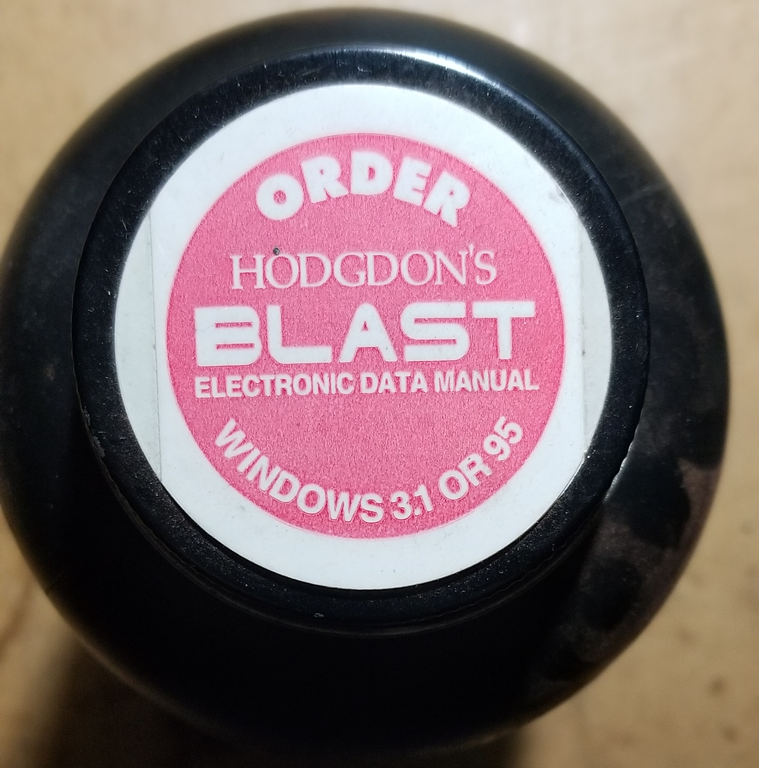
I did load a total of 167 rounds of .300 Win Mag this month. I got down to less than a half pound my IMR 7828 powder and started on some old H4350 after I ran out of the bullets I use with the IMR 7828. How old is the H4350? I don’t know for certain but the sticker on the cap is a clue:
This brings my lifetime reloaded ammunition totals to:
223: 6,897 rounds.
30.06: 756 rounds.
300 WIN: 1,977 rounds.
300 Savage: 50 rounds.
40 S&W: 98,363 rounds.
45 ACP: 2,007 rounds.
9 mm: 21,641 rounds.
Total: 131,691 rounds
As I reported the other day:
I have lots of one fired brass but I knew that brass wouldn’t chamber in any some other rifles even though I was using a full length resizing die. I got my hands on a .300 Win Mag rifle that had problems chambering it. Then with a few rounds of empty, once-fired, brass, my micrometer, and the specs for the brass I sorted out the problem. I found the case just forward of the belt was one to two thousands of an inch larger in diameter than spec. I think the die is the problem so I ordered a new resizing die from a different manufacture and which I expect will fix the problem.
The new die arrived yesterday. It does fix the problem, but just barely. The specification for the case dimension in question is 0.513 inches. The once fired cases were 0.514” –> 0.515”. After going through the new die they are about 0.5135. The brass chambers, but it is tight. I ordering still another die.
Update: I looked up the SAAMI specs on the cartridge and chamber rather than what the reloading manuals tell me.
The portion in question of the case is specified as 0.5126”. The chamber is specified as 0.5136”. I suspect the rifle in question is at exactly the minimum specification while the dies, combined with the “spring-back” of the brass being used results in something oversized. I ordered an RCBS undersized die which should solve the problem.
Update 2: Thanks to an email from Bob B. I ordered what looks like a better solution. The Belted Magnum Collet Resizing Die. I canceled the order for the RCBS undersized die.
This month I finished off all 2,982 .40 caliber bullets I had on hand. That was 2,510 Montana Gold JHPs and 472 Acme Bullet Company’s polymer coated lead bullets (sometimes called “lipstick” bullets because of their bright red color).
I loaded 212 rounds of .300 Win Mag. I was close to finishing off one of my powders for this caliber when I ran out of new brass. I have lots of one fired brass but I knew that brass wouldn’t chamber in any some other rifles even though I was using a full length resizing die. I got my hands on a .300 Win Mag rifle that had problems chambering it. Then with a few rounds of empty, once-fired, brass, my micrometer, and the specs for the brass I sorted out the problem. I found the case just forward of the belt was one to two thousands of an inch larger in diameter than spec. I think the die is the problem so I ordered a new resizing die from a different manufacture and which I expect will fix the problem. After it arrives I will reload a bunch more .300 Win Mag to get rid of powder that is nearly 20 years old.
I loaded 87 rounds of General Dynamics SS109 bullets to finish off one of my .223 powders.
Combined that is 3281 rounds reloaded in the last month.
2018 was another good year in terms of reloading. I reloaded 22,544 rounds. That is short of the 23,356 of last year but not by much. As usual most of that, 18,105 rounds, was in .40 S&W. That bring the total .40 S&W rounds reloaded to just under 100,000 and the total rounds reloaded up to 131,524.
My life history of hand reloading ammunition by caliber, month, and year:
| 223 | Rounds | Jan | Feb | Mar | Apr | May | Jun | Jul | Aug | Sep | Oct | Nov | Dec |
| 1998 | 160 | 0 | 0 | 0 | 0 | 0 | 0 | 140 | 20 | 0 | 0 | 0 | 0 |
| 1999 | 1777 | 0 | 0 | 181 | 578 | 25 | 0 | 0 | 0 | 0 | 140 | 653 | 200 |
| 2000 | 43 | 0 | 0 | 0 | 0 | 0 | 0 | 0 | 0 | 43 | 0 | 0 | 0 |
| 2001 | 47 | 0 | 0 | 0 | 47 | 0 | 0 | 0 | 0 | 0 | 0 | 0 | 0 |
| 2016 | 397 | 0 | 0 | 0 | 0 | 0 | 0 | 0 | 0 | 140 | 257 | 0 | 0 |
| 2017 | 296 | 0 | 0 | 0 | 0 | 0 | 0 | 0 | 0 | 0 | 0 | 0 | 296 |
| 2018 | 4177 | 418 | 180 | 1195 | 300 | 0 | 0 | 0 | 0 | 0 | 0 | 1997 | 87 |
| Total | 6897 | 418 | 180 | 1376 | 925 | 25 | 0 | 140 | 20 | 183 | 397 | 2650 | 583 |
| 3006 | Rounds | Jan | Feb | Mar | Apr | May | Jun | Jul | Aug | Sep | Oct | Nov | Dec |
| 1997 | 180 | 0 | 0 | 40 | 20 | 79 | 41 | 0 | 0 | 0 | 0 | 0 | 0 |
| 1998 | 150 | 0 | 0 | 0 | 80 | 0 | 0 | 0 | 0 | 0 | 40 | 0 | 30 |
| 1999 | 90 | 20 | 70 | 0 | 0 | 0 | 0 | 0 | 0 | 0 | 0 | 0 | 0 |
| 2003 | 47 | 0 | 0 | 0 | 18 | 0 | 0 | 0 | 0 | 0 | 0 | 29 | 0 |
| 2016 | 76 | 0 | 0 | 0 | 0 | 0 | 0 | 0 | 0 | 76 | 0 | 0 | 0 |
| 2017 | 213 | 0 | 0 | 0 | 0 | 0 | 0 | 65 | 148 | 0 | 0 | 0 | 0 |
| Total | 756 | 20 | 70 | 40 | 118 | 79 | 41 | 65 | 148 | 76 | 40 | 29 | 30 |
| 300Savage | Rounds | Jan | Feb | Mar | Apr | May | Jun | Jul | Aug | Sep | Oct | Nov | Dec |
| 2018 | 50 | 0 | 0 | 0 | 0 | 0 | 0 | 0 | 0 | 0 | 0 | 50 | 0 |
| Total | 50 | 0 | 0 | 0 | 0 | 0 | 0 | 0 | 0 | 0 | 0 | 50 | 0 |
| 300WIN | Rounds | Jan | Feb | Mar | Apr | May | Jun | Jul | Aug | Sep | Oct | Nov | Dec |
| 1999 | 250 | 0 | 0 | 0 | 0 | 0 | 151 | 60 | 0 | 0 | 39 | 0 | 0 |
| 2000 | 467 | 50 | 127 | 142 | 0 | 57 | 0 | 0 | 0 | 0 | 20 | 60 | 11 |
| 2001 | 382 | 25 | 0 | 0 | 185 | 15 | 20 | 0 | 73 | 0 | 0 | 0 | 64 |
| 2013 | 499 | 0 | 0 | 0 | 0 | 0 | 0 | 0 | 0 | 0 | 0 | 100 | 399 |
| 2018 | 212 | 0 | 0 | 0 | 0 | 0 | 0 | 0 | 0 | 0 | 0 | 0 | 212 |
| Total | 1810 | 75 | 127 | 142 | 185 | 72 | 171 | 60 | 73 | 0 | 59 | 160 | 686 |
| 40SW | Rounds | Jan | Feb | Mar | Apr | May | Jun | Jul | Aug | Sep | Oct | Nov | Dec |
| 1997 | 31 | 0 | 0 | 0 | 0 | 0 | 0 | 0 | 0 | 0 | 0 | 0 | 31 |
| 1998 | 11537 | 570 | 258 | 718 | 1850 | 1812 | 1710 | 402 | 0 | 0 | 1200 | 900 | 2117 |
| 1999 | 2795 | 0 | 894 | 0 | 299 | 693 | 506 | 0 | 0 | 0 | 0 | 0 | 403 |
| 2000 | 3187 | 795 | 0 | 0 | 0 | 0 | 1095 | 400 | 396 | 0 | 501 | 0 | 0 |
| 2001 | 2295 | 0 | 300 | 497 | 300 | 0 | 0 | 1198 | 0 | 0 | 0 | 0 | 0 |
| 2002 | 898 | 0 | 0 | 0 | 0 | 0 | 0 | 198 | 0 | 200 | 300 | 0 | 200 |
| 2003 | 602 | 0 | 300 | 302 | 0 | 0 | 0 | 0 | 0 | 0 | 0 | 0 | 0 |
| 2004 | 1345 | 0 | 0 | 0 | 0 | 0 | 0 | 0 | 0 | 300 | 600 | 445 | 0 |
| 2005 | 1059 | 0 | 0 | 0 | 0 | 0 | 0 | 0 | 0 | 659 | 400 | 0 | 0 |
| 2006 | 1000 | 0 | 0 | 0 | 0 | 400 | 0 | 0 | 0 | 0 | 200 | 400 | 0 |
| 2007 | 1136 | 0 | 0 | 0 | 0 | 0 | 0 | 118 | 518 | 300 | 200 | 0 | 0 |
| 2008 | 2398 | 0 | 300 | 0 | 0 | 0 | 0 | 900 | 399 | 0 | 200 | 0 | 599 |
| 2009 | 1702 | 0 | 0 | 0 | 0 | 0 | 0 | 0 | 0 | 102 | 300 | 900 | 400 |
| 2010 | 1400 | 0 | 0 | 0 | 0 | 100 | 200 | 700 | 0 | 200 | 0 | 200 | 0 |
| 2011 | 2300 | 300 | 0 | 400 | 100 | 0 | 500 | 500 | 200 | 0 | 0 | 0 | 300 |
| 2012 | 399 | 0 | 200 | 0 | 199 | 0 | 0 | 0 | 0 | 0 | 0 | 0 | 0 |
| 2014 | 530 | 0 | 0 | 0 | 0 | 0 | 0 | 0 | 0 | 0 | 0 | 0 | 530 |
| 2015 | 7012 | 1699 | 1630 | 1137 | 0 | 0 | 0 | 547 | 200 | 400 | 100 | 200 | 1099 |
| 2016 | 17792 | 2197 | 700 | 1462 | 837 | 1899 | 1999 | 1000 | 1500 | 1000 | 1700 | 1500 | 1998 |
| 2017 | 20840 | 3300 | 975 | 525 | 200 | 1899 | 3700 | 2048 | 2644 | 2063 | 1015 | 1699 | 772 |
| 2018 | 18105 | 0 | 0 | 0 | 750 | 1699 | 797 | 1193 | 2396 | 3300 | 4069 | 919 | 2982 |
| Total | 98363 | 8861 | 5557 | 5041 | 4535 | 8502 | 10507 | 9204 | 8253 | 8524 | 10785 | 7163 | 11431 |
| 45ACP | Rounds | Jan | Feb | Mar | Apr | May | Jun | Jul | Aug | Sep | Oct | Nov | Dec |
| 2017 | 2007 | 0 | 0 | 0 | 0 | 0 | 0 | 0 | 0 | 0 | 0 | 500 | 1507 |
| Total | 2007 | 0 | 0 | 0 | 0 | 0 | 0 | 0 | 0 | 0 | 0 | 500 | 1507 |
| 9MM | Rounds | Jan | Feb | Mar | Apr | May | Jun | Jul | Aug | Sep | Oct | Nov | Dec |
| 1996 | 11274 | 0 | 0 | 0 | 0 | 0 | 0 | 0 | 0 | 0 | 10944 | 141 | 189 |
| 1997 | 7374 | 300 | 0 | 0 | 1190 | 640 | 65 | 0 | 100 | 1088 | 804 | 1060 | 2127 |
| 2015 | 2993 | 0 | 1066 | 1927 | 0 | 0 | 0 | 0 | 0 | 0 | 0 | 0 | 0 |
| Total | 21641 | 300 | 1066 | 1927 | 1190 | 640 | 65 | 0 | 100 | 1088 | 11748 | 1201 | 2316 |
| Yearly and Monthly Totals |
|||||||||||||
| Year | Rounds | Jan | Feb | Mar | Apr | May | Jun | Jul | Aug | Sep | Oct | Nov | Dec |
| 1996 | 11274 | 0 | 0 | 0 | 0 | 0 | 0 | 0 | 0 | 0 | 10944 | 141 | 189 |
| 1997 | 7585 | 300 | 0 | 40 | 1210 | 719 | 106 | 0 | 100 | 1088 | 804 | 1060 | 2158 |
| 1998 | 11847 | 570 | 258 | 718 | 1930 | 1812 | 1710 | 542 | 20 | 0 | 1240 | 900 | 2147 |
| 1999 | 4912 | 20 | 964 | 181 | 877 | 718 | 657 | 60 | 0 | 0 | 179 | 653 | 603 |
| 2000 | 3697 | 845 | 127 | 142 | 0 | 57 | 1095 | 400 | 396 | 43 | 521 | 60 | 11 |
| 2001 | 2724 | 25 | 300 | 497 | 532 | 15 | 20 | 1198 | 73 | 0 | 0 | 0 | 64 |
| 2002 | 898 | 0 | 0 | 0 | 0 | 0 | 0 | 198 | 0 | 200 | 300 | 0 | 200 |
| 2003 | 649 | 0 | 300 | 302 | 18 | 0 | 0 | 0 | 0 | 0 | 0 | 29 | 0 |
| 2004 | 1345 | 0 | 0 | 0 | 0 | 0 | 0 | 0 | 0 | 300 | 600 | 445 | 0 |
| 2005 | 1059 | 0 | 0 | 0 | 0 | 0 | 0 | 0 | 0 | 659 | 400 | 0 | 0 |
| 2006 | 1000 | 0 | 0 | 0 | 0 | 400 | 0 | 0 | 0 | 0 | 200 | 400 | 0 |
| 2007 | 1136 | 0 | 0 | 0 | 0 | 0 | 0 | 118 | 518 | 300 | 200 | 0 | 0 |
| 2008 | 2398 | 0 | 300 | 0 | 0 | 0 | 0 | 900 | 399 | 0 | 200 | 0 | 599 |
| 2009 | 1702 | 0 | 0 | 0 | 0 | 0 | 0 | 0 | 0 | 102 | 300 | 900 | 400 |
| 2010 | 1400 | 0 | 0 | 0 | 0 | 100 | 200 | 700 | 0 | 200 | 0 | 200 | 0 |
| 2011 | 2300 | 300 | 0 | 400 | 100 | 0 | 500 | 500 | 200 | 0 | 0 | 0 | 300 |
| 2012 | 399 | 0 | 200 | 0 | 199 | 0 | 0 | 0 | 0 | 0 | 0 | 0 | 0 |
| 2013 | 499 | 0 | 0 | 0 | 0 | 0 | 0 | 0 | 0 | 0 | 0 | 100 | 399 |
| 2014 | 530 | 0 | 0 | 0 | 0 | 0 | 0 | 0 | 0 | 0 | 0 | 0 | 530 |
| 2015 | 10005 | 1699 | 2696 | 3064 | 0 | 0 | 0 | 547 | 200 | 400 | 100 | 200 | 1099 |
| 2016 | 18265 | 2197 | 700 | 1462 | 837 | 1899 | 1999 | 1000 | 1500 | 1216 | 1957 | 1500 | 1998 |
| 2017 | 23356 | 3300 | 975 | 525 | 200 | 1899 | 3700 | 2113 | 2792 | 2063 | 1015 | 2199 | 2575 |
| 2018 | 22544 | 418 | 180 | 1195 | 1050 | 1699 | 797 | 1193 | 2396 | 3300 | 4069 | 2966 | 3281 |
| Grand Totals | 131524 | 9674 | 7000 | 8526 | 6953 | 9318 | 10784 | 9469 | 8594 | 9871 | 23029 | 11753 | 16553 |
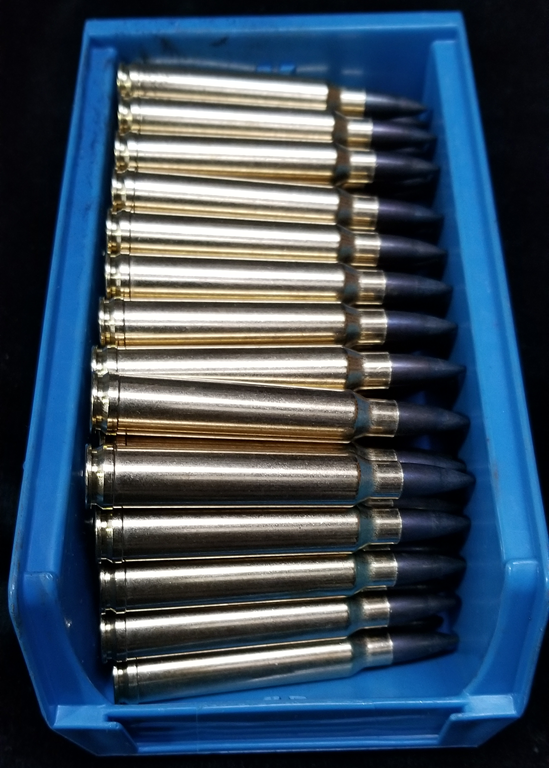
I love shiny brass in .300 Win Mag:
There is something about ability of the cartridge to be able to reach out and whack a target at 1000 yards away on your first shot that I find very satisfying. The first time I shot at 1000 yards I put the first three shots into the 10” diameter X-ring. That is a good as accuracy as you can expect to see at a public range when some random person is shooting a handgun at 10 yards. And at 1000 yards it is delivering twice the momentum to the target as a 9mm handgun would at 10 yards.
I assembled 212 rounds of .300 Win Mag this weekend. Each charge was individually weighed. Ignoring the time to prep the brass, the average time for assembly of a single round was about 75 seconds. When reloading for .40 S&W it is about 4.5 seconds.
It was worth it.
In 1999 I started loading for 300 Win Mag. In fact, I had the gun built with the specific intention of shooting a particular bullet which I planned to handload. The bullet was the Berger 210 grain VLD Target. At that time the BC was listed as 0.640. Then in 2007 I was looking at their website and discovered they had changed the BC to 0.631. It still didn’t fully explain the results I was getting but it was closer. Today I discovered they have changed the BC again. It is now listed as 0.621. That fully explains the results I was seeing. Whoops on their part.
I haven’t reloaded any of these bullets since 2000. It was time consuming. I would clean the primer pockets, trim the length, and individually weight each powder charge. I found that I got better accuracy at short ranges (less than 300 yards) and decent results at longer ranges with Black Hills Match (190 grain Sierra Match Kings with a BC of 0.533). And, most importantly, it saved me a lot of time.
I still have the powder and primers for the Berger bullets and figured it was time to load it up. I now have a much better tool for prepping the brass which speeds up the prep by about a factor of four.
Last night I was preparing some 300 Win Mag brass for reloading. I noticed that some of the brass I had used for the Berger loads had primers which were mushroomed:
Not good.
I checked my notes:
1999 Hodgdon manual/website says:
200 gr. Nosler Partition bullet, max 79.0C gr. -> 2883 fps
This is with a 24″ barrel.Older Hodgdon data (1997, 1998) says:
200 gr. bullet, max 80.0 gr -> 2984 fps.
220->225 gr. bullet, max 77.0 gr -> 2881 fps.
This is with a 26″ barrel.…
Starting loads are 90% of max. My guess is that max should be about
80 gr. with the 210 grain bullet. The Nosler Partition is a straight
shank bullet without a boat tail. This gives it more bearing surface
and friction (especially without the moly) than the Berger will have.Initial loadings:
6/2/99 16 rounds Berger 210 grain moly coated VLD:
One round each of 72.0, 72.5, 73.0, 73.5, 74.0, 74.5, 75.0, 75.5, 76.0,
76.5, 77.0, 77.5, 78.0, 78.5, 79.0, 79.5
I settled on a load of 78.7 grains of H1000 after firing charges up to 79.5 grains. I measured the base of the case for expansion as my indicator of high pressure and didn’t find expansion greater than with the light loads. It seemed good but the gunsmith who built the rifle told me an interior ballistics program he used said my load was unwise. I continued to use that charge with the few rounds (423) that I actually loaded.
Last night I checked the Hodgdon rifle reloading website and found they list a 208 grain bullet with a maximum load of 78.0 grains of H1000. And for one 200 grain bullet the maximum load is 77.0 grains! The max load for 220 grain Sierra Match Kings is 78.0 grains.
Whoops!
That explains my mushroomed primers and validates my gunsmith’s concern. I need to redevelop my load and disassemble the existing ammo with the previous loadings.
This month I reloaded 919 rounds of 40 S&W, 1997 rounds of .223, and 50 rounds of 300 Savage.
The .40 S&W was all 180 grain Montana Gold JHP for practice at indoor ranges.
The .223 was 62 grain AP bullets to given the anti-gun crowd a bit of heartburn.
“Why 300 Savage? Isn’t that out of character?”, you might ask. Yes, that is out of character. It’s a somewhat long and sad story.
My nephew Brad Huffman was given an old 300 Savage, rotary magazine, lever action rifle by his maternal grandfather before his grandfather died. Brad harvested a few deer over the years with it. It is a good rifle, considering it’s getting close to 100 years old. Brother Doug bought reloading dies and some new brass to replenish the ammo since it is getting a little hard to find the ammunition for it locally. Brad wasn’t much interested in reloading and he had a box or so of ammo left which would have lasted several years at the rate he was harvesting deer. No big hurry for either of them to load the ammo. Then Brad died. Neither of his sisters are hunters and Doug decided the rifle should stay on the maternal side of the family. His wife has a couple of nephews who are hunters and he decided to give it to them. But before he did that he wanted to load up the brass because the nephews aren’t currently into reloading. Even though Brad died over five years ago Doug still hadn’t gotten around to loading the ammunition so he could give the rifle away properly equipped. I figure it would only take me a couple hours to do it and it would be fun as well. So when I was visiting for Thanksgiving I picked up everything Doug had and brought them home with me. I picked some bullets and an plastic ammo box in Moscow and a missing powder funnel at a gun shop in Cle Elum on the way home.
It took me over a day to reload those fifty rounds. Doug also had seven rounds of used brass that I tried to run through the dies as well as 50 rounds of new brass. I think the chamber of the rifle is oversized in the neck area because four of the seven rounds of used brass got stuck in the die no matter how carefully I lubricated them and tried to get them through the sizing die. Instead of just reloading the new brass I got sort of obsessed with trying to solve the problem. After removing the first stuck case I didn’t get the die adjusted correctly and destroyed a piece of new brass. The end result was 49 rounds of ammunition using the new brass and one round using the old brass.
This brings my lifetime reloaded ammunition totals to:
223: 6,810 rounds.
30.06: 756 rounds.
300 WIN: 1,591 rounds.
300 Savage: 50 rounds.
40 S&W: 95,381 rounds.
45 ACP: 2,007 rounds.
9 mm: 21,641 rounds.
Total: 128,236 rounds
There are lots of grounds to challenge Washington state I-1639. None are a sure thing and since there are so many components to it seems likely the courts will throw out some aspects of it and leave others intact. I have been wondering if the training requirement might be something we have power over and can eliminate even if the courts don’t find it a sufficient burden on the specific enumerated right to keep and bear arms.
What if there were no classes that met the requirements of I-1639? Or, at least, the classes were so few, far between, and/or expensive that the vast majority of the population could not take the class. What if all trainers refused to include material which met the requirements? Wouldn’t the courts be, essentially, forced to say I-1639 is blocking the exercise of specific enumerated right?
I realize gun manufactures are not meeting the microstamping requirement of California law. And that has resulted in no new guns being added to the list of “safe guns. But that is going through the courts now and may result in a path to a victory on one element of I-1639.
I reloaded 4,069 rounds of .40 S&W last month. 406 rounds were 180 grain Hornady Action Pistol (HAP) bullets. 505 rounds were from Eggleston Munitions. These were 180 grain polymer coated bullets loaded really light for steel matches. 504 were blue and one was purple (it somehow found it’s way into the container of blue bullets). 1,567 rounds were loaded with red bullets from Acme Bullets. These were also loaded for steel matches. 1,591 of those rounds were 180 grain Montana Gold JHP to be used for practice at indoor ranges.
This is the most rounds I have reloaded since the first month I started reloading back in October 1996 when I reloaded 10,944 rounds. The Dillon XL650 made the difference. Ignoring the time running the cases through the case gauge after assembling it more doubles my rate of production I was getting with the Dillon 550B. If I don’t have many malfunctions with a messed up piece of used brass or something I can reload 800 rounds in an hour.
This month will not be so productive. I reloaded a few .40 S&W rounds but am switching back to the 550B to reload .223. Back in 2016 I purchased a bunch of components in preparation for a Hillary Clinton presidency and with the passage of I-1639 I now feel a need to do something to support the AR.
This brings my lifetime reloaded ammunition totals to:
223: 4,813 rounds.
30.06: 756 rounds.
300 WIN: 1,591 rounds.
40 S&W: 94,462 rounds.
45 ACP: 2,007 rounds.
9 mm: 21,641 rounds.
Total: 125,270 rounds
I mentioned the other day that I tried out some 180 grain Hornady Action Pistol (HAP) bullets. In one test of a 20 shot group they gave me better accuracy that any pistol bullet I can recall. I usually shoot a six shot group and “on a good day” get about a 1.5 inch group with the same load with 180 grain Montana JHPs. Using the group calculation feature of Modern Ballistics I converting the 20 shot group into the equivalent six shot group and got 1.26 inches. Hence HAP does appear to be have significantly better accuracy. I’ll shoot some more groups just for fun sometime, but the accuracy criterion for switching bullets, all other things being equal is “nearly as good” as the Montana Gold JHP. It more than meets this criterion.
I also measured the weight variation of the bullets. This is rather important because it can affect whether your ammo will “make major” power factor at USPSA matches. If the chrono man pulls a light bullet or two to compute your power factor you could end up shooting minor power factor.
Here are the results:
| Mean | 180.1 |
| Std Deviation | 0.224 |
| Min | 179.5 |
| Max | 180.4 |
| ES | 0.9 |
| Bullet 1 | 180.2 |
| Bullet 2 | 179.5 |
| Bullet 3 | 179.8 |
| Bullet 4 | 180.0 |
| Bullet 5 | 180.0 |
| Bullet 6 | 180.0 |
| Bullet 7 | 180.4 |
| Bullet 8 | 180.2 |
| Bullet 9 | 180.0 |
| Bullet 10 | 180.3 |
| Bullet 11 | 180.2 |
| Bullet 12 | 179.8 |
| Bullet 13 | 180.1 |
| Bullet 14 | 180.3 |
| Bullet 15 | 180.2 |
| Bullet 16 | 180.0 |
| Bullet 17 | 180.2 |
| Bullet 18 | 180.3 |
| Bullet 19 | 180.4 |
| Bullet 20 | 180.0 |
The extreme spread on the weight distribution would make a different of about +/- 0.44. This isn’t a big deal.
The weight distribution is acceptable to me.
I loaded all 500 bullets and found something a little irritating:
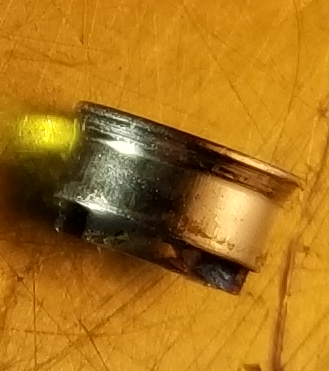
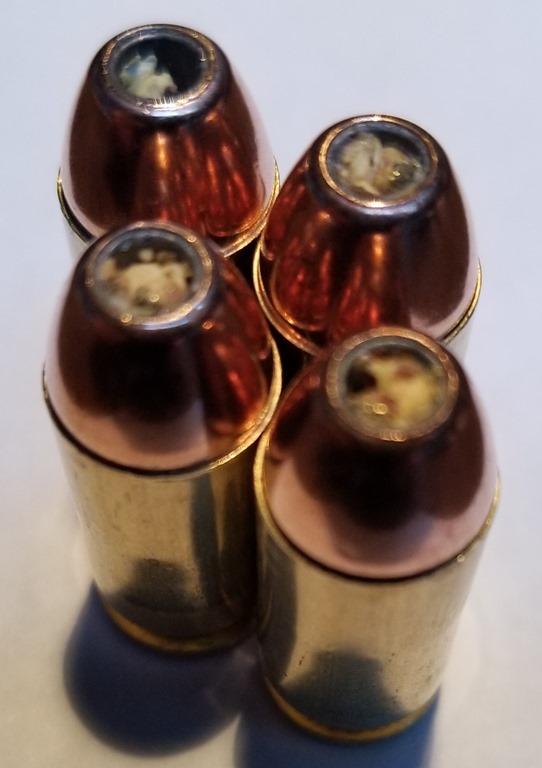
Five (only four shown here) of the bullets had the hollow point clogged with what looked like cleaning media, perhaps ground corn cobs. It was easy to remove the foreign material from the bullets but I have never seen this in the 120K+ rounds I have reloaded. It’s not a big deal but I was surprised they would have a process which would allow this to be possible.
Overall their bullets meet my criteria even though they are a little more expensive than the Montana Gold I am currently using. I am switching bullets because they told New York they would not knowingly sell products to them.
I reloaded 3,300 rounds of .40 S&W last month. 3,206 of those rounds were 180 grain Montana Gold JHP to be used for practice at indoor ranges. 94 rounds were 180 grain Hornady Action Pistol (HAP) bullets. The HAPs were those I ordered last May in response to the President of Hornady Manufacturing Company saying they would not knowingly allow their ammunition to be sold to the Government of the State of NY or any NY agencies.
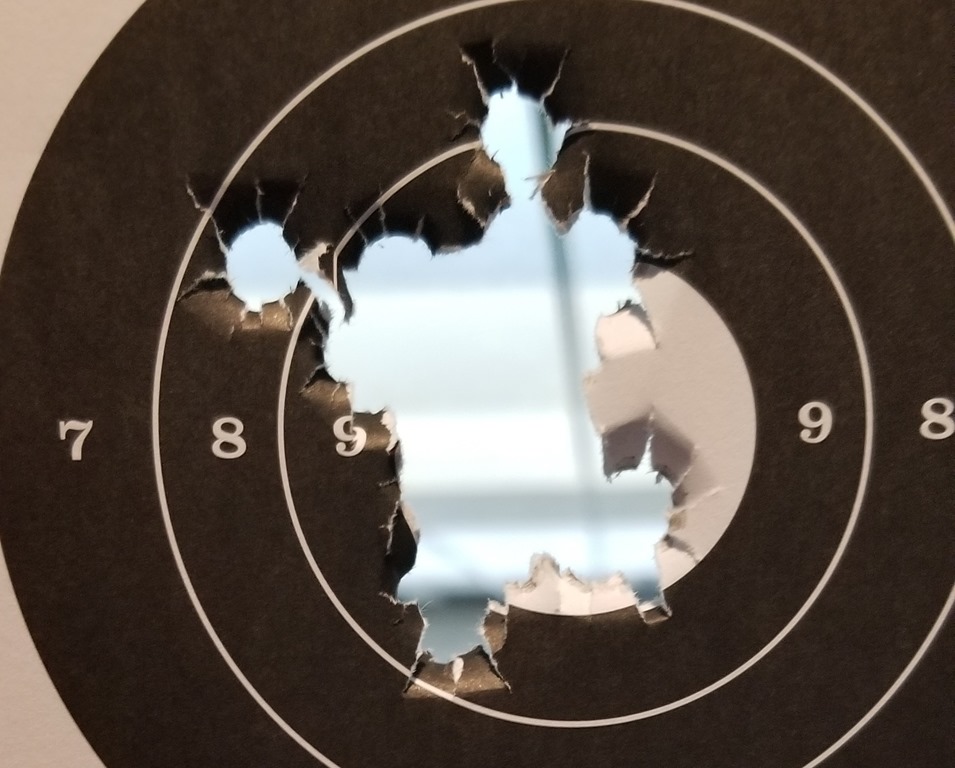
Yesterday I tested the HAP rounds and found they were nearly identical in the mean standard deviation of the velocity for the same powder charge as what I get with the Montana Gold JHP. The accuracy appears to be better. Here is a 20 round group at 30 feet (1.75” of which some of the error was surely mine):
The price isn’t quite as good as the Montana Gold bullets but I think I will switch over to the HAP bullets when I finish up the Montana Gold bullets because of Hornaday refusing to do business with New York.
This is by far the most number of rounds I have reloaded in a single month all year. And taking into consideration that I used a lot of my “reloading time” to install and get a new reloading press set up I’m very pleased. I also spent a fair amount of time individually checking the length of about 2,300 cartridges which had the potential to have a double charge which blew up my STI DVC Limited. No double charges found so far but I have about another 2000 rounds to go.
I purchased the Dillon XL650 mostly because of the powder check stage. This gives a buzzer warning if there is no powder or a double charge in a case. This should prevent another blown up gun. A bonus is that the new press with the automatic case feeder gives me almost double the production rate of the Dillon 550B press. This is why I was able to get so many rounds out this month.
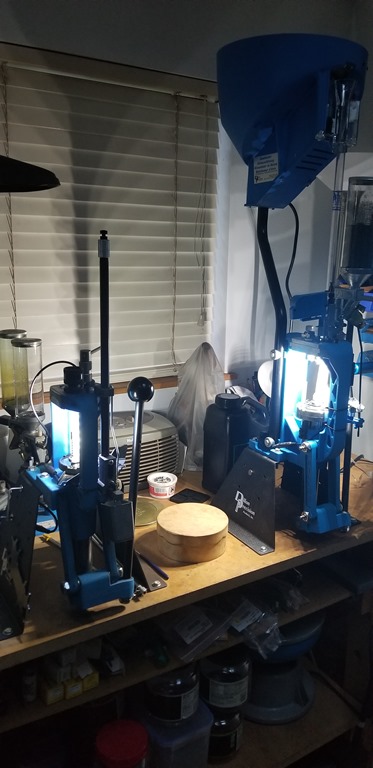
Also, if you are a reloader, get the LED lights for your press. They give you a much better view of what you are doing:
The picture above is of both presses with only the press lights on. With room lights on as well the reloading area is exceptionally well lit which makes it easier to see if something is a little off.
This brings the rounds year to date to 12,228. With the new press it should be pretty easily to meet my goal of getting to 16K by the end of the year. I may even exceed my previous best year of 23,356.
This brings my lifetime reloaded ammunition totals to:
223: 4,813 rounds.
30.06: 756 rounds.
300 WIN: 1,591 rounds.
40 S&W: 90,393 rounds.
45 ACP: 2,007 rounds.
9 mm: 21,641 rounds.
Total: 121,201 rounds
Widener’s has a raffle for “free ammo for a year”. It’s not really all the ammo I would shoot in a year if it was free. It is a gift card for $1500 which might cover my .22 LR needs but wouldn’t come close to my total consumption. But, a $1500 gift card is nothing to be sneered at.
To enter the raffle visit this blog post and give them your email address in the edit box at the top of the blog post.
I’ve purchased stuff from them over the years (almost $2200 worth in the last 2.5 years) and I almost always check them for price and availability when I am purchasing reloading supplies. I sometimes find interesting things which I couldn’t find anywhere else. An example would be SS109 bullets for .223 in large quantities.
Full disclosure: I was contacted via email by Widener’s about this “free ammo for a year” raffle. If I linked to their blog post about the free ammo they offered to give me a $25.00 gift card and entry in a different raffle with other bloggers who also posted about their raffle.
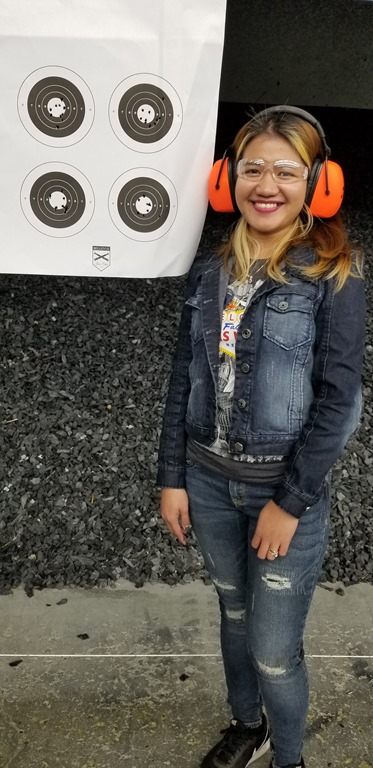
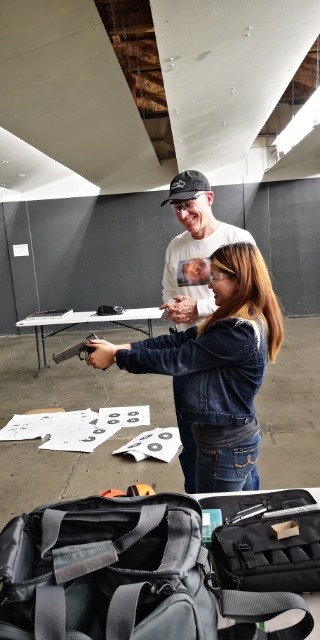
Sheryl isn’t a first time shooter. But she didn’t have much experience. She recently moved here from the Philippines and Calvin, her former Marine husband, did teach her to shoot. Calvin likes to drive up in the mountains on Forest Service and even unmarked dirt roads and yesterday they showed Barb and I a wonderful viewpoint east of Snoqualmie Pass:
After getting off the mountain we went to the range where both of them shot a .22 with a suppressor. I gave Calvin a couple of suggestions and let him shoot by himself. I spent a lot more time with Sheryl and here is the result of her first target from about 10 feet away with 10 shots per bullseye:
I then had them shooting five shots with the requirement that each shot be on a different bullseye from the previous to simulate a Steel Challenge type stage. Then I put them on the shot timer. I told Sheryl that I thought with a little practice she could do it in about five seconds—one second per shot. “No way!”, she said. I told her at first I expected something on the order of seven or eight seconds but we could get her somewhere in the range of five today.
It took a little bit for them to settle down and not get misses but when we were done Sheryl did better than Calvin with one string at 4.44 (IIRC). Calvin’s best was 5.15 (IIRC).
I moved them back to about 20 feet and Calvin did better. Sheryl kept trying to shoot the same speed as at the shorter range and had misses. A another trip or two to the range is going to be required before I take them to a match.
I then put them on my STI Eagle chambered in .40 S&W with low recoil loads:
They both did well but Sheryl, in particular, had problems with the gun not fully cycling. I gave her a few major power factor loads. She did just fine with them but with the heavier gun, large grip, and her small hands I could tell she was getting tired. It was time to clean up and called it quits for the day anyway so that’s what we did.
The bullets, they do the killing, they kill. It’s up to us to figure out a way to wrap laws around the purchasing of ammunition.
Reggie Reg Davis
Wayne County Commissioner (Detroit)
September 16, 2018
Wayne County leader wants to make it harder to buy bullets
[No.
Just as “wrapping laws” around the purchase of alcohol and other recreational drugs didn’t improve society the restriction of a specific enumerated right not only won’t improve society it will be an infringement upon the natural right to defend ourselves.
People can make ammunition from scrap metal a few relatively simple tools. Just as with recreational drugs, it won’t be of the highest quality but it will be good enough to get the job done. And it this case the job will be restoring our rights.
Reggie Reg Davis, Molṑn labé.—Joe]
The Gun Feed linked to my post about the double charge with the link text of “Reloading Kaboom: All costs savings is lost when your gun blows up…”
At first thought you might agree. But it depends on how many rounds you reloaded before you lose a gun and the cost of replacement or repair of the gun. Assuming my gun is a total loss, I doubt this is true but lets go for worst case, I will have to have saved about $3200 to break even.
My worst case reloading cost (buying once fired brass) of .40 S&W is practice ammo. This is $0.24 per round. The ammo I use for matches is $0.19 per rounds. If I reuse my own fired brass then the cost drops to $0.19 and $0.14 per rounds. Let’s go with worst case reloading costs…
Getting the cheapest brand I recognize from Midway USA in one case (1000 rounds) lots results in $0.329 per round after shipping.
Hence by reloading I’m saving, at least, $0.089 per round. In order to pay for a new gun I would have to reload $3200/$0.089 rounds. This works out to about 36,000 rounds.
I have actually reloaded and fired about 84,000 rounds in .40 S&W. So by reloading, even if I have to buy a new gun, I still have saved nearly $4,500.
Plus, having learned the lesson of how a can get a double charge with this load I can either change loads to completely avoid this or modify my quality control procedures to reduce the chances.
This was using the worst case cost for reloaded ammo. It also doesn’t take into account that my reloads are lower recoil than factory loads and result in less wear on the gun. My actual savings is quite a bit greater than the calculations above indicate. Hence, in this case, the headline writer for The Gun Feed is wrong.
Yesterday I invited people to guess what this was:
chiefjabboby, using some rather flowerily language, got it right. Drew Rinella was more straight forward with a more complete, and correct, answer.
Below, on the left, is a normal primer which has been fired. The primer above is in the middle below. Most of what is left of the case is on the right. The rest of the case is stuck in the chamber of my STI DVC Limited (chambered in .40 S&W).![]()
I strongly suspect I got a double charge in one of my reloads. I didn’t think it was possible. It’s true, as I told myself when I started using this load, that a double charge would not allow the bullet to be fully seated. But I didn’t actually try it.The bullet compresses the double charge and the powder pushes the bullet part way out. But it’s only about 0.040 over the usual overall length (OAL). So, it’s quite possible I overlooked this during my final inspection.
The magazine was blown out of the gun and forcibly disassembled. This was essentially all I could find of the pieces. Note the spring is all crooked. What doesn’t show up is that the feed lips are quite a bit wider than a normal magazine.
There was some damage to the gun. I had to hammer it to get the slide open and the ripped apart shell casing out. I suspect the slide is beyond repair. The ejector pins were sheared off but it’s possible they were broken before the incident. The extractor was loose in the slide and the metal below the head of the extractor was pushed down and slightly torn:
I was not hurt but there were strange smoke patterns on my hands where gases came out of all the gaps between the slide, frame, and grip:
My face got peppered with tiny bits of something and stun for a few minutes but it did not break the skin. I had a slightly shadow on my face around my safety glasses giving me a bit of a raccoon appearance.
I disassembled the gun to examine everything carefully. Here is what a mostly disassembled STI DVI Limited looks like:
I plan to reassemble it and ship it off to STI to see if they can repair it. And before I use any more of that ammo I’m going measure the OAL on every cartridge (I think I can use a case gauge). I have a backup gun which I used at a USPSA match today. And I expect I will be using is for a quite a while. STI is notoriously slow in turn around time and I may have to buy a brand new gun. And the last time I checked the wait times were quite long for new guns.
I put about 45,000 rounds through it. This is more than the approximately 40,000 rounds I got out of my STI Eagle 5.1 before it had a serious failure and became my backup gun.
It’s probably time for me to buy another gun regardless of whether the DVC Limited can be repaired or not. Heavy sigh…
I reloaded 2396 rounds of .40 S&W last month. It was all 180 grain Montana Gold JHP to be used for practice at indoor ranges. I just brought home another 7,500 of these type of bullets as I was getting really low.
This is the most number of rounds I have reloaded in a single month all year but it’s about 400 fewer than I reloaded in August of last year.
This brings the rounds for the year to date to 8,928. I hope to break 10,000 rounds for the year this month and maybe get to 16K by the end of the year..
This brings my lifetime reloaded ammunition totals to:
223: 4,813 rounds.
30.06: 756 rounds.
300 WIN: 1,591 rounds.
40 S&W: 87,093 rounds.
45 ACP: 2,007 rounds.
9 mm: 21,641 rounds.
Total: 117,901 rounds
We have a relatively new intern on my team at work, Nashwa. She grew up in Texas and speaks fondly of it so I figured she was at least comfortable around gun owners. I had taken everyone else on the team, except my boss Jodie, to the range but not Nashwa.
I have invited Jodie many times. While she expresses great interest she has not found a time slot that works. I give her a pass because she recently finished up training with the FBI where she learned to shoot everything from handguns to sniper rifles. I’ll get her to the range someday but today was Nashwa’s day.
I had the training bay reserved just for the two of us from 4:00 –> 6:00. It turns out she had never fired a gun before. I asked if she was right handed or left handed. “Right”. Which eye is dominant? “Right”. I was a little surprised she knew. My surprise must have shown because she then said she wasn’t sure. I did a quick test and found she was left eye dominant. I first taught her shooting left handed and then part way through switched to right handed for a while. She decided to stay with left handed shooting.
I started her out with dry firing of a Ruger 22/45 Light with a suppressor. She looked like she had it down. But her first half dozen real shots were all high. Nice group. But they were about three inches high at 10 feet. I went over sighting again. Still the same problem.
I fired a few shots. It was maybe a quarter inch low at that range.
We went over the sighting again. “Oh, I wasn’t really looking at what was going on with the rear sight.” Hmm… I’ll have to work on how I explain sights.
I gave her a clean target and she was putting them just below the bulls-eye:
![]()
Ahhh… Yes. The new shooter smile.
I moved her to shooting a simulated steel match with four targets on one piece of paper and removed the suppressor.
She was getting all five hits in under ten seconds.
Next I gave her Major Power Factor loads in my STI DVC Limited. With essentially the same results. But after a few strings the misses started increasing and getting more and more wild. It was time to go back to the .22.
She still had some misses. Back to dry fire. We needed to end the day on a positive note.
The dry fire looked good. I pretended to put in a loaded magazine and she “fired” again. There was some serious movement of the gun when she pulled the trigger. More dry fire. And then, finally, live fire. She was back to consistent, solid, hits I shouldn’t have let her fire so many rounds through the .40. She was starting to develop a flinch.
After we cleaned up and packed things up we talked a little bit. She had two questions:
We now have a new member in the gun community and a team member at work that fits right in.
As I posted yesterday two new shooters, Chris and Vic, were preparing for todays steel match at Holmes Harbor Rod and Gun Club on Whidbey Island. We were on the same ferry and chatted on the way across the sound:
Today’s stages were a bit more difficult than usual and prone to penalties:
Stage one, above, required the shooter to shoot the white plate four times then shoot the yellow stop plate. This was fairly easy but I was handicapped by the fact that I can’t count very fast. They told me after I had finished that I was shooting the white plate five times instead of six.
Ignore the cardboard to the left of the two steel plates.
Stage two was one of the tough stages. It was very easy to hit the stop plate and incur the miss penalties for the white plates not yet hit.
Stage three was a much more typical stage but it was still a bit difficult with the two small plates on the right.
Stage four was another fairly typical stage. Moderate sized plates at a moderate distance.
Stage five was rather evil. Four large plates and then a tiny plate in front of a “no-shoot” plate (I’m pretty sure this is outside the rule book of any steel match types I have ever seen). A hit on the “no-shoot” plate incurred a six second penalty.
![]()
This deer can be seen in the picture of stage five. Look at the center of the pictures at the top of the berm. It left as soon as we started shooting.
I thought stage four was the easiest stage. But compared to me, Vic and Chris actually did better on stage five
This is Vic shooting stage 1.
Vic and Chris did good for new shooters. Complete match results are here. Vic and Chris shot in the rimfire, iron sighted pistol division:
| Rimfire PI Iron | |||||||||
| Final | Name | ISSA# | Division | Time | 1: Bay 1 | 2: Bay 2 | 3: Bay 3 | 4: Bay 4 | 5: Bay 5 |
|---|---|---|---|---|---|---|---|---|---|
| 1 | Huffman, Joe | RPII | 65.99 | 8.57 | 12.78 | 16.77 | 15.30 | 12.57 | |
| 2 | Koch, David | RPII | 102.13 | 10.37 | 24.00 | 30.99 | 20.62 | 16.15 | |
| 3 | Speck, Greg | RPII | 123.37 | 12.51 | 30.21 | 32.27 | 32.38 | 16.00 | |
| 4 | Carson, Vick | RPII | 146.08 | 17.26 | 35.00 | 27.69 | 47.39 | 18.74 | |
| 5 | Stone, Christopher | RPII | 213.69 | 22.48 | 49.38 | 46.44 | 68.64 | 26.75 | |
I also shot in the centerfire, iron sighted pistol division:
| Centerfire Pistol Iron |
|||||||||
| Final | Name | ISSA# | Division | Time | 1: Bay 1 | 2: Bay 2 | 3: Bay 3 | 4: Bay 4 | 5: Bay 5 |
|---|---|---|---|---|---|---|---|---|---|
| 1 | Alldredge, Thomas |
CPI | 81.78 | 10.98 | 23.65 | 17.00 | 16.05 | 14.10 | |
| 2 | Huffman, Joe |
CPI | 88.24 | 12.68 | 21.84 | 20.51 | 18.18 | 15.03 | |
| 3 | Bigby, Alexander |
CPI | 97.94 | 12.28 | 31.81 | 19.91 | 18.48 | 15.46 | |
| 4 | Sun, Eric |
CPI | 119.64 | 11.97 | 33.49 | 27.56 | 28.72 | 17.90 | |
| 5 | Koch, David |
CPI | 132.40 | 16.21 | 29.95 | 25.13 | 41.63 | 19.48 | |
Update: Vic gave me some pictures he took—with his drone: