Ramblings on explosives, guns, politics, and sex by a redneck Idaho farm boy who became a software engineer living near Seattle.
Category Archives: Current News
This is about stuff in the mass media that generally has a short interest life span. Speculation about an election outcome a few days before the election is an example.
It seems that someone just embezzled three billion dollars from the US treasury. Well, actually, it was some insurance companies, and the Treasury just cut them checks. And it wasn’t authorized by congress. And the treasury told congress to go piss up a rope when they said “you can’t do that!” That story and other bureaucratic contempt for the law here.
The rule of law is dead, unless some pols and appointees start going to jail, or otherwise paying for their crimes against the people.
And hardly anyone is noticing, apparently. This is one of the biggest power grabs regarding free speech in the history of history, and it seems to be going through without much discussion, or even much notice.
I’ve been saying for years that the left really, really MUST gain control over the internet, and right now it seems they’re just a day or two from initiating their Solution; FCC control. Goodbye Wild West. Hello Federal Department of the Internet. I hope you like your new overlords.
The university goes on to say that they’re not exhibiting any political bias. In Left-Speak that would be true of course, because “Bias” means any opposition to the Progressive authoritarian system.
In another victory for Second Amendment civil rights by attorney Alan Gura, a United States District Court found a provision of the Gun Control Act of 1968 unconstitutional as applied to some people who, like the plaintiff in the case, are currently law-abiding and not felons, adjudicated as mentally defective, or have a violent criminal history.
As I mentioned in the QOTD this morning last night I attended a presentation entitled Active Shooter Preparation by the Bellevue Washington Police department at the Newport High School.
The presenter was Officer Scott Montgomery who usually is a traffic cop but is also on the SWAT team and is a “certified active shooter instructor”.
It was a relatively small group attending. I was fairly close to the front making it difficult to see everyone and didn’t take a close inventory but I expect it was about 30 people.
At the time the Columbine massacre happened police training was that the police should secure the area and wait for the SWAT team to arrive and possibly enter the building. Of course the shooters had long since run their course by the time SWAT entered the building. This was a wakeup call and police training changed in response.
The training now has long been that the school should go into “lockdown”, people hide wherever they can, and they wait for the police to arrive. Upon the arrival of three or four police officers they would form a team and enter the building to engage the shooter. No active shooter incident has ever been stopped by such a multiple officer team.
At the Marysville Pilchuck High School shooting there were students on the football field when the shooting started in the cafeteria. The school went into “lockdown”. The people on the football field went back into the school toward the shooter because that is what you do in a lockdown situation. They were following their training.
Active shooters evolved their tactics and so both the police and private citizens need to evolve as well. The Virginia Tech shooter took advantage of the lockdown and upped it one. He brought his own lock and chain. He went into a classroom, locked the doors shut, and started shooting them.
He had practiced this. We know this because people at the gun range where he practiced reported, when interviewed after the Virginia Tech event, they he did something very odd when he was at the range. He put his targets on the ground in rows. He then walked down the “aisles” with a gun in each hand and shot the targets as he walked by.
Montgomery told us they train using Simunitions in actual schools that are about to be remodeled or torn down. He stressed that even though they train for active shooter situations in a school they cannot be there in time to prevent horrific outcomes. “You are the first responders.” he said. If you do nothing, that is wrong. Fight, flight, and freeze are very natural responses. If you have children under your care you will probably not leave them. It is against our nature to fight. Almost no one practices fighting. Hence, if you have not thought about the situation you almost for certain will freeze. You just won’t know what to do.
You need to think about these things now, frequently, and prepare yourself mentally to do something other than freeze.
What private citizens need to do is think about all the “What if?” cases and plan for them ahead of time. What will you do? What are your options? How many exits are there in your situation? Don’t just think of the doors. Windows can be broken and dropping from a second story window is probably going to result in fewer injuries than waiting for a bullet to find you as you hide under a desk.
Teachers of younger students are particularly resistant to “losing track of a child”. “What if they get lost out on the street?” He response to this is, paraphrasing, “Which would you rather have, a lost kid on the street with every cop in the state converging on the site or the kid at immediate risk of being shot? We can find the kid on the street in the next hour. We can’t protect them from a bullet in the next minute.”
He told us that in police academy they were taught there are three types of people, “Sheep, wolves, and sheepdogs”. Most people are sheep. The police are clearly the sheepdogs. But you don’t have to have a uniform to protect your flock.
An active shooter is a dynamic event. Things change rapidly and the police cannot tell you what is going to be the best action to take. The people on the scene right then and there have to adapt to the situation and take appropriate action based upon the information available to them:
Know your situation
Do what is necessary to survive
Remember your responsibilities
People need to develop a survival mindset: Awareness and preparation are key:
Be familiar with your surroundings and environment BEFORE an emergency occurs.
Entry and exit points?
Areas where you can hide
Objects that can be used as weapons
Make a decision:
Run
Hide
Fight
This is the new mindset people must develop. It is not a static decision. Adapt to the changing situation.
If you have to fight allow yourself to have a “righteous anger”. You can be a “mother bear”. If you attack do it with a full commitment until the threat no longer exists. You may have to take their life.
He was generally okay with it but with some minor issues. The two issues I remember were that it portrays women, but not men, as inclined to freeze. Men freeze too. Women can and will fight. This is particularly true when defending children.
The first police to arrive will be extremely single minded. They will not be friendly. They will not help you. They may yell at you and/or push you aside. Their mission will be to engage the shooter as quickly as they can so the total number of victims can be minimized.
When you encounter the police show your hands. Don’t worry about having a cell phone in it. It is very unlikely they are going to mistake your cell phone for a gun and your cell phone may come in handy later.
They will be doing active shooter response training, similar to fire drills, with the schools. It’s not quite the same thing and the results will never be as good, but keep in mind that in the last 50 years they have been doing fire drills no student has ever died in a school fire. Training works.
Much of the presentation seemed to presume there was a single shooter. I asked something like the following, “I realize Columbine was a somewhat unique event but there were two shooters and they used explosives as an significant component of their attack. Does this change your training?”
Montgomery said 67% of the active shooters in this country have been a single person. But they train for multiple shooters and even well planned team attacks such as a terrorist group might implement. It doesn’t change the mindset of the private citizen much. Events are dynamic and you won’t have perfect information. Yes, you may be running away from a shooter into an ambush but you are running away from a known threat. Be prepared to change your actions based on new information.
I then pointed out, paraphrasing, “I think was in Arkansas in the late 1990s where two shooters pulled the fire alarm and then waited in the tree line with rifles for when the students came out into the open. A similar attack at Newport might look inviting.”
Mills also addressed this. He said that during fire drills he is not responsible for evacuation of the students. He immediately exits in that direction and looks for “anything out of place”. He said, paraphrasing, “I might be the first one shot, but we are aware of that risk and try to address it.”
I was tempted to ask about private citizens with firearms because strictly speaking the presentation wasn’t just about active shooters in schools. But I decided not to. First off it is illegal for private citizens to have a firearm on school property and this was primarily a presentation for parents and students. Secondly this is a tremendous change in attitude from cowering and waiting for the police. If this new mindset takes hold then private citizens with guns to defend themselves and their children will come naturally. The culture is changing and the law will follow.
This court victory is not on the scale of Heller or McDonald but it is still huge.
Firearm Policy describes it in a rather obscure manner:
The Court issued its order granting Plaintiffs’ Motion for Summary Judgment. It is therefore ORDERED, ADJUDGED, and DECREED that Plaintiffs’ Motion for Summary Judgment is GRANTED. The Court DECLARES that 18 U.S.C. § 922(a)(3), 18 U.S.C. § 922(b)(3), and 27 C.F.R. § 478.99(a) are UNCONSTITUTIONAL, and Defendants are ENJOINED from enforcing these provisions.
SO ORDERED on this 11th day of February, 2015.
For reference purposes 18 U.S.C 922 is here* and 27 C.F.R. § 478.99 is here**.
But as Sebastian elaborates:
This case challenged the ban on interstate transfers of handguns through an FFL.
…
The court applied strict scrutiny, and despite the government’s attempts to argue they needed the restriction in order to prevent criminals from circumventing state guns laws, the judge wasn’t buying it. What’s also very interesting is that he argues that the Brady Act changed the game for the GCA ’68 restrictions, with the idea that in an era of instant background checks, some GCA requirements cannot stand up to strict scrutiny.
Furthermore, the court said the interstate sale of handguns would not pass intermediate scrutiny either.
GCA ‘68 is under attack and just lost on a major issue. This has huge implications to Washington State residents and other suffering from repressive regulation in their home state. If you can go to a more free state and buy a handgun then you can bypass home state registration by keeping the gun out of state. You also avoid the expensive and difficult to obtain permission to purchase a gun as you thumb your nose at the local tyrants. All those guns banned by California, Maryland, New Jersey, and New York will now become extremely difficult to enforce.
Assuming this is upheld upon appeal and applied nationwide it will be interesting to see what sort of response the state legislators come up with. Will they attempt to make it illegal for you to purchase a gun in another state? In my case I can easily, and correctly, claim I keep any gun purchased in Idaho in Idaho and don’t “import” it back to Washington state. Then what? How is this different from someone visiting Washington or Colorado and purchasing some Marijuana?
Other GCA ‘68 restrictions that I suspect will soon be subject to attack is the restriction upon imports and the “sporting purpose” restrictions.
Can the government legally prevent you from importing a book when similar books, perhaps differing only in the edition or type of cover, are available for sale in the U.S.? Of course not. It makes no sense. The same with importing of firearms. I could see there being legal grounds for the government to impose taxes on such imports but they couldn’t be exorbitant.
The “sport purpose” test has to be almost in imminent jeopardy of falling. What constitutionally protected right can be dependent upon it having a “sporting purpose”. Constitutionally protected rights are not for sport.
* 18 U.S.C. § 922(a)(3):
It shall be unlawful … for any person, other than a licensed importer, licensed manufacturer, licensed dealer, or licensed collector to transport into or receive in the State where he resides (or if the person is a corporation or other business entity, the State where it maintains a place of business) any firearm purchased or otherwise obtained by such person outside that State, except that this paragraph (A) shall not preclude any person who lawfully acquires a firearm by bequest or intestate succession in a State other than his State of residence from transporting the firearm into or receiving it in that State, if it is lawful for such person to purchase or possess such firearm in that State, (B) shall not apply to the transportation or receipt of a firearm obtained in conformity with subsection (b)(3) of this section, and (C) shall not apply to the transportation of any firearm acquired in any State prior to the effective date of this chapter;
18 U.S.C. § 922(b)(3):
It shall be unlawful for any licensed importer, licensed manufacturer, licensed dealer, or licensed collector to sell or deliver – … any firearm to any person who the licensee knows or has reasonable cause to believe does not reside in (or if the person is a corporation or other business entity, does not maintain a place of business in) the State in which the licensee’s place of business is located, except that this paragraph (A) shall not apply to the sale or delivery of any rifle or shotgun to a resident of a State other than a State in which the licensee’s place of business is located if the transferee meets in person with the transferor to accomplish the transfer, and the sale, delivery, and receipt fully comply with the legal conditions of sale in both such States (and any licensed manufacturer, importer or dealer shall be presumed, for purposes of this subparagraph, in the absence of evidence to the contrary, to have had actual knowledge of the State laws and published ordinances of both States), and (B) shall not apply to the loan or rental of a firearm to any person for temporary use for lawful sporting purposes;
(a) Interstate sales or deliveries. A licensed importer, licensed manufacturer, licensed dealer, or licensed collector shall not sell or deliver any firearm to any person not licensed under this part and who the licensee knows or has reasonable cause to believe does not reside in (or if a corporation or other business entity, does not maintain a place of business in) the State in which the licensee’s place of business or activity is located: Provided, That the foregoing provisions of this paragraph (1) shall not apply to the sale or delivery of a rifle or shotgun (curio or relic, in the case of a licensed collector) to a resident of a State other than the State in which the licensee’s place of business or collection premises is located if the requirements of § 478.96(c) are fully met, and (2) shall not apply to the loan or rental of a firearm to any person for temporary use for lawful sporting purposes (see § 478.97).
“Current federal law guarantees the right of law-abiding persons to transport firearms between two locations where they have a legal right to possessand carry them, regardless of state or local laws that would otherwise apply. The firearm must be cased or otherwise not readily accessible. Unfortunately, anti-gun local officials are using overly restrictive state licensing laws to harass and prosecute travelers who have made every effort to comply with the law, resulting in seized guns that are sometimes never returned, delayed travel, legal fees, and sometimes even unnecessary guilty pleas.
H.R. 131 would ensure the law has the effect Congress intended when it passed more than 25 years ago. Specifically, the legislation would make clear that transportation of both firearms and ammunition is federally protected, as well as expand the protections afforded to travelers to include “staying in temporary lodging overnight, stopping for food, fuel, vehicle maintenance, an emergency, medical treatment, and any other activity incidental” to the trip. Additionally, the bill would place the burden of proof clearly on the state to show that the traveler failed to comply with the law.”
Emphasis mine. So some state clowns have been flouting federal law in going after people who travel innocently through their states with gun. Continue reading →
The title is of course misleading, as is all the speech of authoritarianism. Is it to protect the possession of responsible body armor? But an inanimate object can be neither responsible nor irresponsible. Is it to protect responsible bodies with armor? If so, why does it limit said armor? Is it to protect the responsible possession of body armor? How then would body armor be possessed in an irresponsible manner? Are there hoards of people possessing their body armor in some obnoxious fashion, say, wearing orange body armor with red clothing? One is given to wonder.
With all the Progressives pretending to be concerned, to the point of hyperventilating, about all the carnage carried out with guns, you’d think the one thing they’d want to see, besides a monopoly on gun possession for criminals, is more people wearing more effective body armor. Oh wait…
Authoritarians are of course insane, so in that sense there is nothing to see here.
One has to wonder what the authoritarian Republicans will do with this. My gut tells me they’ll be very much in favor of it, but will at the same time feel uncomfortable about letting their support be known. How that will manifest itself in their political actions I cannot guess. This sort of thing is an on-going problem for them (damn those liberty-minded little Hobbits!).
Please try to avoid getting caught up in the matter of the technical details of the various classes of body armor. This has nothing to do with any of that you know.
If the truth be known (perish the thought) this is one of many signs indicating that Congress is preparing for war with the American people. Many of them are no doubt blissfully unaware of that prospect, but it must be understood that blissful unawareness, and the vehement defense thereof, is a key component of such campaigns, right up to, and through, the the very end.
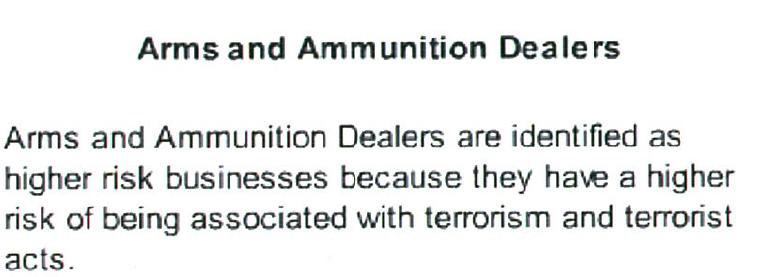
The Federal Deposit Insurance Corporation, the primary federal regulator of over 4,500 banks, targeted legal industries. FDIC equated legitimate and regulated activities such as coin dealers and firearms and ammunition sales with inherently pernicious or patently illegal activities such as Ponzi schemes, debt consolidation scams, and drug paraphernalia.
FDIC achieved this via “circular argument” policymaking: there was no articulated justification or rationale for the original list of “high-risk merchants.” Yet a list of “potentially illegal activities” included in FDIC’s formal guidance to banks justified itself by claiming that the categories had been previously “noted by the FDIC.”
FDIC’s explicitly intended its list of “high-risk merchants” to influence banks’ business decisions. FDIC policymakers debated ways to ensure that bank officials saw the list and “get the message.”
Documents produced to the Committee reveal that senior FDIC policymakers oppose payday lending on personal grounds, and attempted to use FDIC’s supervisory authority to prohibit the practice. Personal animus towards payday lending is apparent throughout the documents produced to the Committee. Emails reveal that FDIC’s senior-most bank examiners “literally cannot stand payday,” and effectively ordered banks to terminate all relationships with the industry.
In a particularly egregious example, a senior official in the Division of Depositor and Consumer Protection insisted that FDIC Chairman Martin Gruenberg’s letters to Congress and talking points always mention pornography when discussing payday lenders and other industries, in an effort to convey a “good picture regarding the unsavory nature of the businesses at issue.”
FDIC actively partnered with Department of Justice to implement Operation Choke Point, and may have misled Congress about this partnership.
Because of this pressure by the FDIC private companies which create and sell compliance and risk management training software incorporated things such as:
The pressure was far from subtle. The official referred to in the following is Jim LaPierre, Regional Director of the Kansas City Region:
The official told the banker, “I don’t like this product, and I don’t believe it has any place in our financial system. Your decision to move forward will result in an immediate unplanned audit of your entire bank.”
This is what you get with government employees who believe they are masters rather than public servants.
A good start on the way to restore public trust would be to release the names of the scoundrels so they can be publically scorned. While I am sure there are many more here are some names from the report:
Anderson, James L.
Bar, David
Benardo, Michael B.
Bowman, John B.
Bresnick, Michael
Brueger, Kathleen S.
Brown, Luke
Butler, Janice
Delery, Stuart
Dujenski, Thomas J.
Eberley, Doreen R
French, George
Gray, Andrew
Gruenberg, Martin J.
Jackson, Michael L.
LaPierre, Jim
Lowe, Anthony M.
Osterman, Richard J.
Pearce, Mark
Plunkett, Sylvia H.
Miller, Jonathan N.
Miller, Rae-Ann
Sagatelian, Marguerite
Sawin, April D.
Spitler, Eric J.
Sweet, Joel
Watkins, James C.
Valdez, Victor J.
Weatherby, Katheryn M.
The public servants who “debated ways to ensure that bank officials saw the list and ‘get the message’” need to be sent a very strong “message”. They should be fired, prosecuted, and held personally responsible for the harm done to the business affected and the general public by their illegal and immoral actions.
Margot Hirsch President, Smart Tech Challenges Foundation
Hirsch didn’t really say a lot but what she did say demonstrated she was generally knowledgeable about the technology. The only thing I thought she was off base on was she thought smart guns would protect against thieves. The other thing of note which she said was that the market for this technology were families.
The following information is from the bio given to participants:
Margot Hirsch is the President of the Smart Tech Challenges Foundation (STCF) a non-profit focused on reducing gun violence through the technology and innovation. The STCF was formed in 2013 with the mission of bypassing the political gridlock and polarizing debate around gun control versus person freedoms, by spurring innovation in technologies that serve to reduce firearm-related injuries and death. By awarding grants directly to innovators through the first-of-its-kind Smart Tech for Firearms Challenge, Margot is on the leading edge of inventive challenge philanthropy, finding market-based, entrepreneurial solutions to a social problem that claims over 30,000 American lives annually. She is responsible for the overall strategic direction of the foundation, running operations, board development and fundraising.
Prior to joining STCF, Margot was Regional Vice President of Blackboard, Inc. where she led international sales for the Connect division of Blackboard, a leading provider of learning solutions to the education market. With over 25 years of sales and business development in the technology industry, Margo has held business development and sales management roles at Smartforce/Skilsoft, eProsper, Angel Investors, Global Village and American Express.
More information about the organization and some of the people and technology they have given grants to can be found on their web site.
Mark Burles Vice President, Penn Schoen Berland
Burles presented polling data from a recent survey they had done for Washington CeaseFire. One should be careful using their data. From their website:
What We Do
How We Do It
1
DEFINE YOUR COMPETITIVE ADVANTAGE
We measure a brand’s strength in context with its competitors to identify its assets, liabilities, & unique niche in the marketplace relative to the competition.
2
FIND YOUR “BASE” & “SWING” AUDIENCES
Our model not only identifies a brand’s loyal customer base, but also uncovers persuadable consumer segments who can be taken from competitors to grow the brand.
3
CRAFT A WINNING MESSAGE
PSB’s proprietary message development process delivers a clear roadmap of what to say, how to say it, and to whom to say it.
4
DELIVER A PERSUASIVE CAMPAIGN
In this instance their customer is Washington CeaseFire.
That said this is the data Burles presented to the audience:
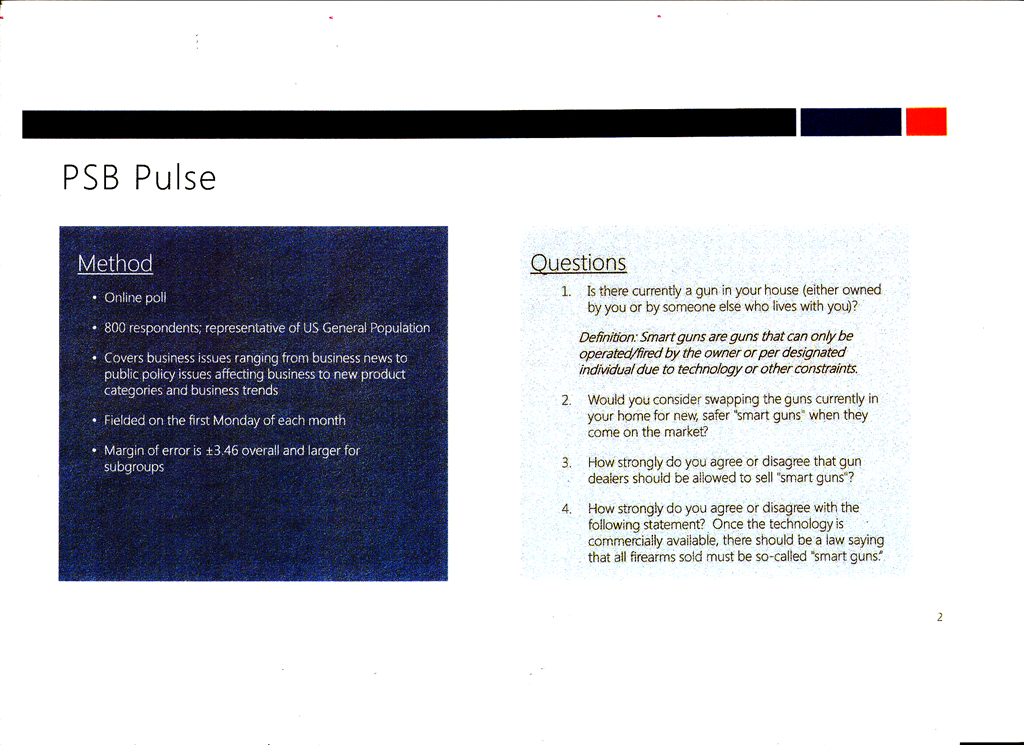
Online poll of 800 respondents, representative of the US General Population. Margin of error is +/- 3.46 overall and larger for subgroups.
Questions:
Is there currently a gun in your house (either owned by you or by someone else who lives with you)? Definition: Smart guns are guns that can only be operated/fired by the owner or per designated individual due to technology or other constraints.
Would you consider swapping the guns currently in your home for new, safer “smart guns” when they come on the market?
How strongly do you agree or disagree that guns dealers should be allowed to sell “smart guns”?
How strongly do you agree or disagree with the following statement? Once the technology is commercially available, there should be a law saying that all firearms sold must be so-called “smart guns.”
How do they do an online poll without a self-selection bias?
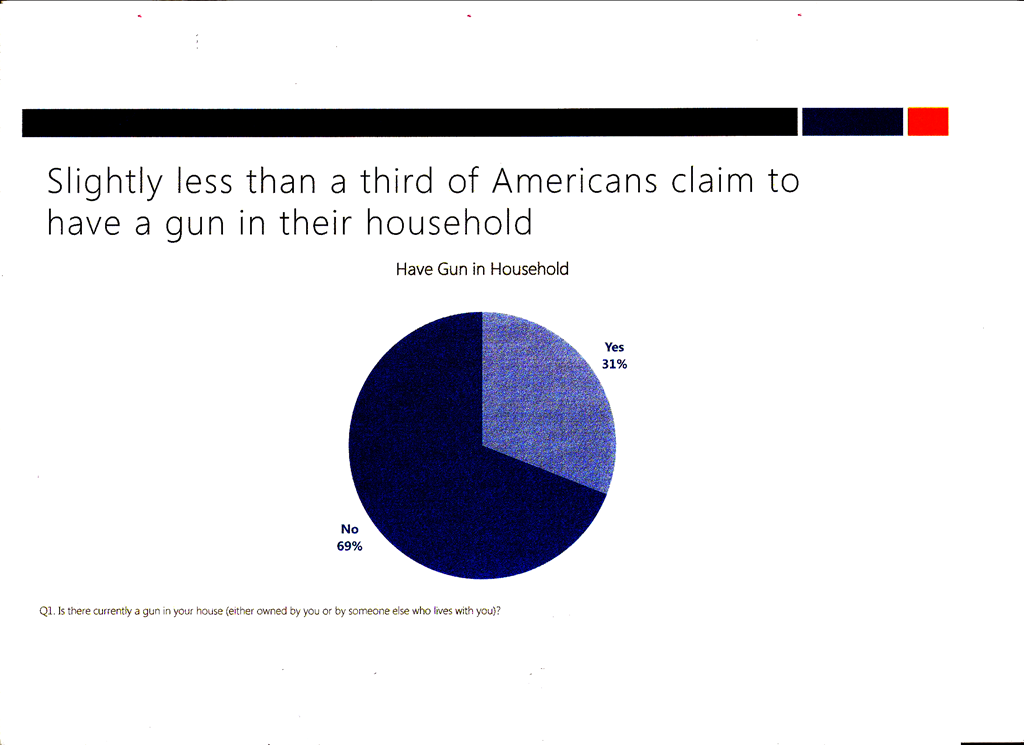
31% of the people polled answered “Yes” to the question, “Is there currently a gun in your house (either owned by you or by someone else who lives with you)?”
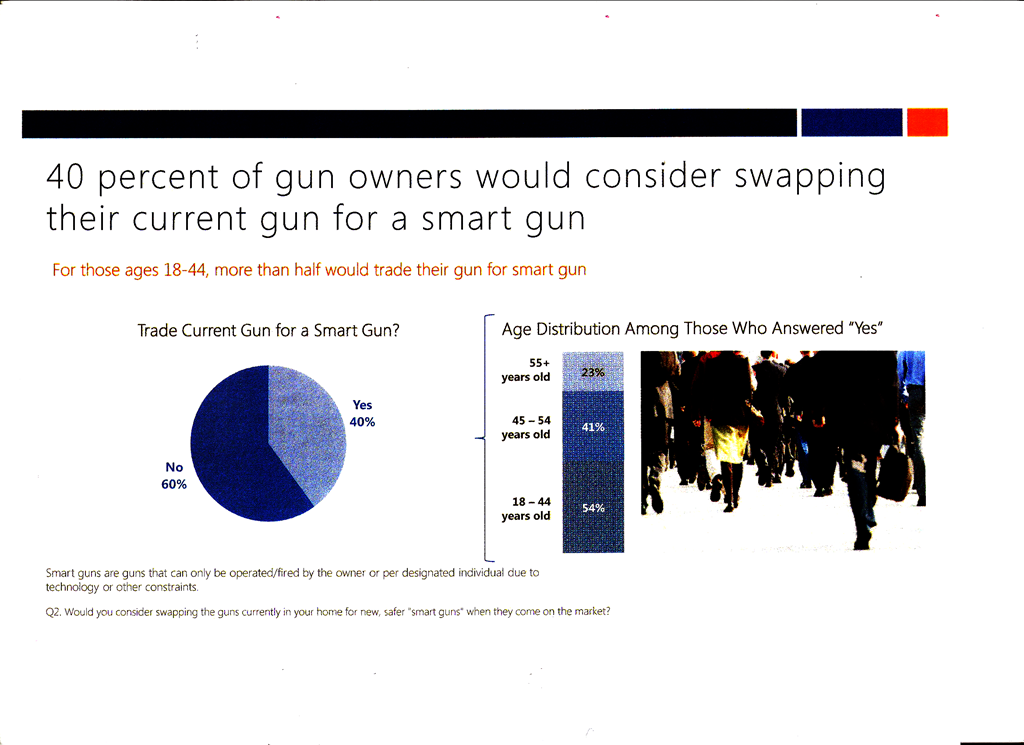
40% of the gun owners said they would swap their current gun for a smart gun. But these numbers decreased with the age of the gun owner. If the gun owner was 55+ years old only 23% would swap their current gun for a smart gun.
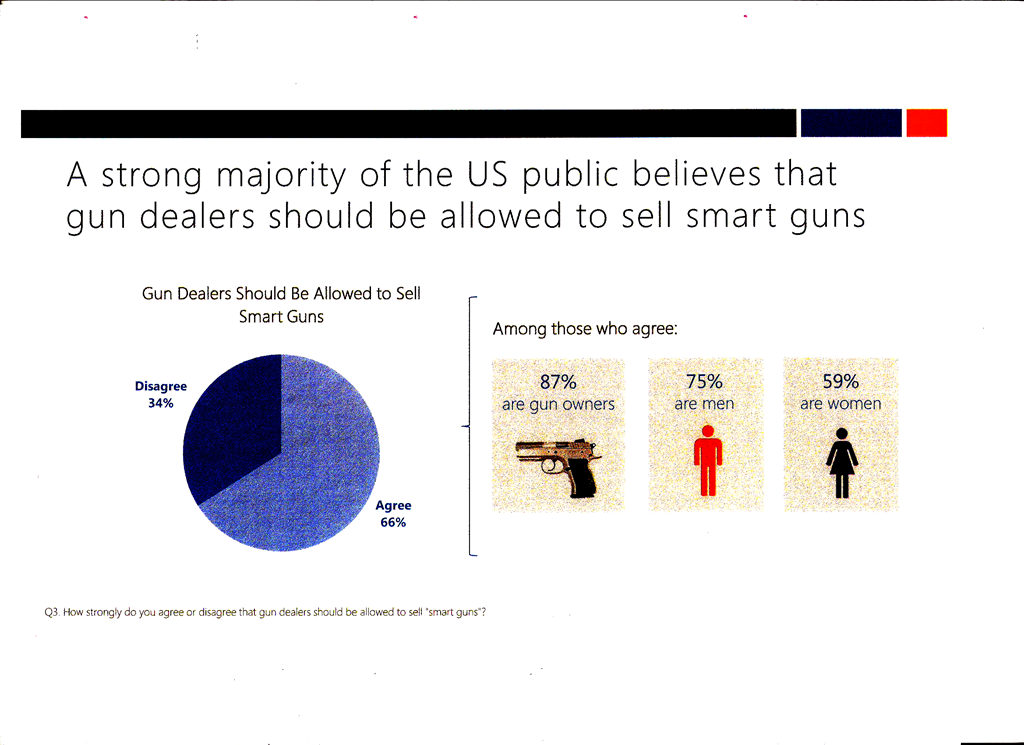
66% of the public agreed that gun dealers should be allowed to sell smart guns.
Of those that agree 87% are gun owners, 75% are women, and 59% are women.
I don’t get this. Of those that agree, how can there be 75% men and 59% women? Surely they meant 75% the men agree and 59% the women agree. Right?
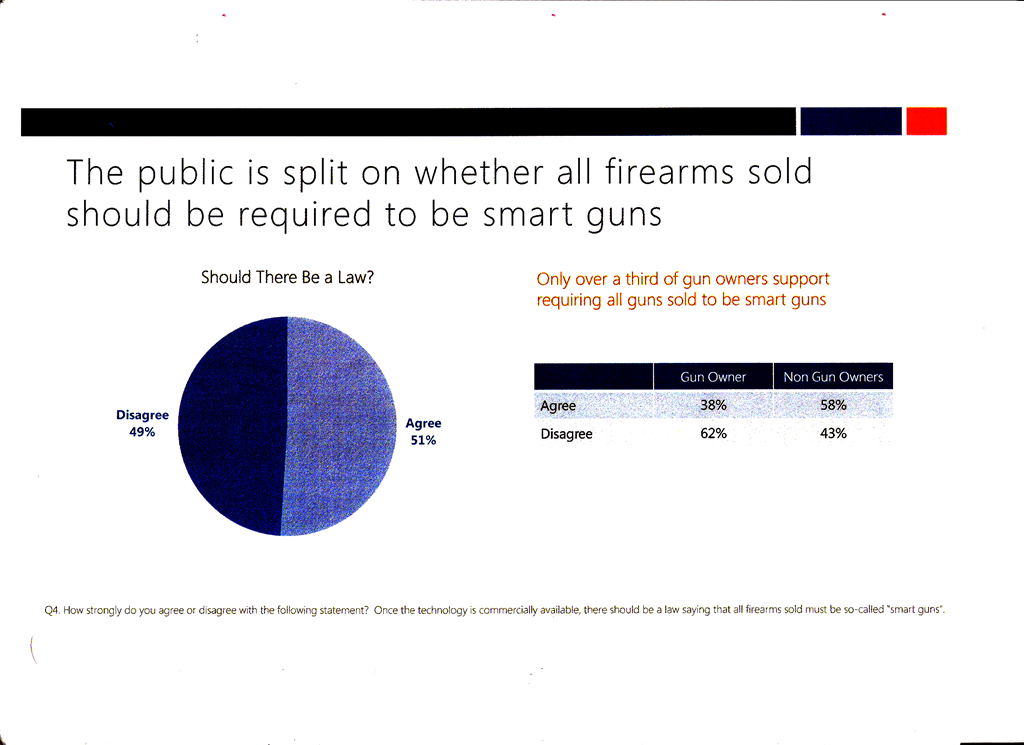
Over all 51% think there should be a mandate for “smart guns” if the technology is commercially available. But only 38% of gun owners agree while 62% of the general public agrees with a mandate.
McNamara and Trigger Smart are based in Ireland. This, as he admitted, biased his views on “smart guns” in the U.S.
His technology is RFID (Radio Frequency Identification) based and he told us it would add about $300 to the price of a gun.
He saw them as being used for prevention of children having an accident and used for recreational firearms. He didn’t seem to have a sense for what it would mean to have his technology on a self-defense gun.
As King County Sheriff John Urquhart pointed out police officers who lose control of their gun are almost for certain going to be close enough for the gun to be authorized to shoot when the bad guy pulls the trigger. If the bad guy were to run some distance away before shooting then it would be useful but in the immediate struggle it wouldn’t help. Hence an RFID based authorization system is of limited value in a struggle for self-defense situation.
He seemed to think there were some people that wanted them banned. It could be that he was just misunderstanding the situation with the New Jersey mandate and how that would essentially ban other types of gun. Hence many gun owners are hostile to the introduction of “smart guns”.
Since it is dependent upon radio communication someone in the audience asked about how it would deal with an attempt at being jammed. He didn’t seem to think it was possible. Looking at his bio I can excuse this error. His background is in property development, construction, and real estate. As an electrical engineer I can assure you it is possible to jam the communication between the gun and the RFID tag worn by the shooter.
Loretta Weinberg
New Jersey State Senator Majority Leader
Weinberg takes credit for the introduction and passage of the New Jersey “smart gun” mandate law.
She told many stories of children accidently shooting people. Her keynote speech was emotion packed and got the expected response from the CeaseFire people in the audience. I was annoyed with this because the number of people accidently killed in this manner is much less than the number of small children drowned. But we don’t have symposiums on or laws mandating “smart bathtubs” or “smart swimming pools”.
But what really irritated me was when she said it might have prevented the Sandy Hook elementary school shooting or the terrorist shooting in France at the offices of Charlie Hebdo. To believe things like that requires a special kind of crazy. I doubt Weinberg actually believes such a thing. I suspect she is just exhibiting her credentials that enabled her to be a New Jersey politician for such a long time. She can lie convincingly when telling people what they want to hear. She was speaking to the CeaseFire audience and not to people with technical competence.
She said there was a lot of talk among gun control people about the “smart gun” mandate law. The law had the unintended consequence of stopping the research. And you find that CeaseFire is opposed to the mandate and the Brady Campaign tried to sue and get New Jersey to enforce the mandate.
She wrote a letter to the NRA saying that she would work to repeal the law if the NRA would stop the opposition to “smart guns”. They didn’t respond. This got groans from the CeaseFire people in the audience. I thought this was probably the smartest thing they could have done with the letter. Anti-gun people can’t be trusted. What sort of guarantee could we have in place that would prevent them from pushing for a mandate again as soon as there is a gun on the market that sort of works but makes self-defense more risky than it already is? There isn’t any.
Judith Leftwich
Legal Director, Law Center to Prevent Gun Violence
When asked by moderator Dave Ross, “Is there anything wrong with letting the market decide?” Leftwich made it clear she supports mandates. When asked about the legality of mandates in light of the Heller decision which said the D.C. safe storage law was unconstitutional she told the audience that Heller only required that guns be functional. A safe storage law, in general, was not unconstitutional. D.C. had required the guns be disassembled. A “smart gun” should pass constitutional muster. Her questioner (someone from Guns.com, I think it was Max Slowik, their report is here) followed up by pointing out that Heller said that firearms “in common use” could not be banned. Leftwich drew parallel to seat belts and air bags in cars and said you can still drive old cars without airbags or seat belts. Guns shouldn’t be any different.
Leftwich also said “smart guns” would prevent gun theft. I so wanted to ask the other panelists who actually had technical knowledge what their opinion was. But there were other people asking questions ahead of me and the answers rambled on for so long that they put a halt to the questions before I got my turn. I told her directly after the symposium that the technology couldn’t possibly stop someone with a little mechanical or electrical smarts from defeating it. She responded that thieves generally aren’t very smart. I pointed out that they could still sell the guns to someone who had the smarts. She insisted that it would still help some. I told her that the mandate will get extremely strong resistance because of the self-defense issues of reduced reliability. I don’t know if I was just starting to annoy her or if it was that particular question but her attitude changed and she didn’t seem at all interested in talking to me any more. I let it drop.
In part four I will cover the “smart gun” poll results presented by Mark Burles, Vice President Penn Schoen, Berland.
I received fairly detailed information on the testing of the Dynamic Grip Recognition technology. I don’t yet have permission to publish it here. I hope to get at least permission to say which of my concerns have been addressed to my satisfaction and which I think need more work. That permission probably will not be granted until Monday, if ever.
I’m arranging my post by the people who spoke in no particular order. The chronology and the topic of the panel in which they talked isn’t particularly important. I suspect there will be video available at some time but in most cases there was a lot of rambling and the information could have been presented much more concisely. Because of this you won’t see many exact quotes but my attempt to rephrase what I think is their position. I may get something wrong or miss something they believe to be important to understand their position and if they wish to contact me I’ll be glad to discuss and correct such errors.
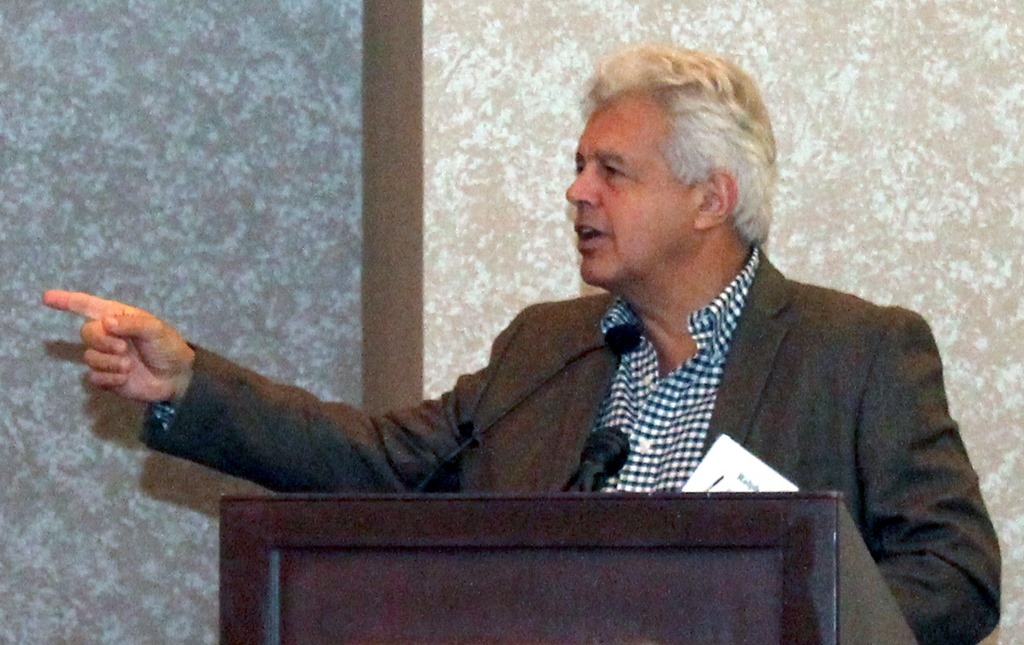
Ralph Fascitelli
President Washington CeaseFire
I was annoyed with Fascitelli and tweeted about him a few times during the event:
Washington Ceasefire’s Ralph Fascitelli says guns are a “public health plague”.
Fascitelli said smart guns are similar to e-cigarettes. By this he meant, in part, the established industries are opposed to them and although they are safer some anti-smoking (and anti-gun) people are concerned that because they are safer they will lead to greater use/acceptance of conventional cigarettes/guns. He is opposed to smart gun mandates and realizes that has hindered development of the technology. He hopes that people on all sides of the issue can find common ground and reduce gun violence. He recognizes that gun owners and gun rights groups do care about innocent lives.
He strayed off topic some and said:
Guns are a “toxic plague” and in another instance a “public health plague”.
He wants limits on magazine sizes
He wants a ban on assault weapons
Some of the distortions and lies I found annoying included:
He conflated the number of law enforcement officers killed in the line of duty by someone using a gun with those killed by someone using the officers gun. He said it was “500 over ten years”. The actual number was 511 but only 51 were shot with a department issued firearm. Fascitelli never mentioned the 51 number and expressed the “500” number in such a way that strongly implied “smart gun” technology could have saved some or all of those 500 officers.
During the press conference he said there were about 18,000 suicides per year using a gun and approximately 50% use a third party gun. I suspect he really meant a second parties gun but whatever. Then during the symposium he changed the numbers to 20,000 suicides per year and 10,000 people using a “third party” gun.
He said people under the age of 21 are not allowed to use handguns. This is false. They aren’t allowed to purchase handguns but they can own and use them.
He said about 10,000 U.S. children and teens have firearm injuries per year. I don’t recall if he did this or if it was only others but there were lots of stories of preteens killed and injured and then they used numbers which always included teens. The inclusion of teens of course brings in 19 year olds being shot while attempting to kill an innocent victim.
He and some others made a point that guns currently aren’t 100% reliable but “smart gun” critics demand the “smart gun” technology be 100% reliable. I suspect he is smart enough to know this is being disingenuous. We don’t want gun reliability to decrease to unacceptable levels. One failure out of 100,000 is probably acceptable in your self-defense hand gun. A 99% accurate smart gun means one failure out 100 and is not acceptable.
Depending on how you arrive at the numbers (see my email here) a gun that stops a kid from firing it 99.9% of the time may mean that if they try it 500 times they have a 60% chance of getting at least one shot off. 99% reliable may mean a 60% chance with just 50 attempts.
He hinted at a great divide in the anti-gun movement over smart guns. There is the obvious unintended consequence of mandated smart guns impeding development of them. But they also have concerns that if guns became safer to own guns would be more accepted in society.
This last point leads me to something else. I wonder if this contributes to their vehement opposition to armed school personal and sometimes even police being in schools. Are they concerned school shooting would decrease or stop and they would be less able to get traction on their anti-gun agenda? The same might be said of self-defense both inside and outside the home. Some, if not most, don’t really care that much about safety in general they just don’t want there to be guns and they even can admit this to themselves in some situations.
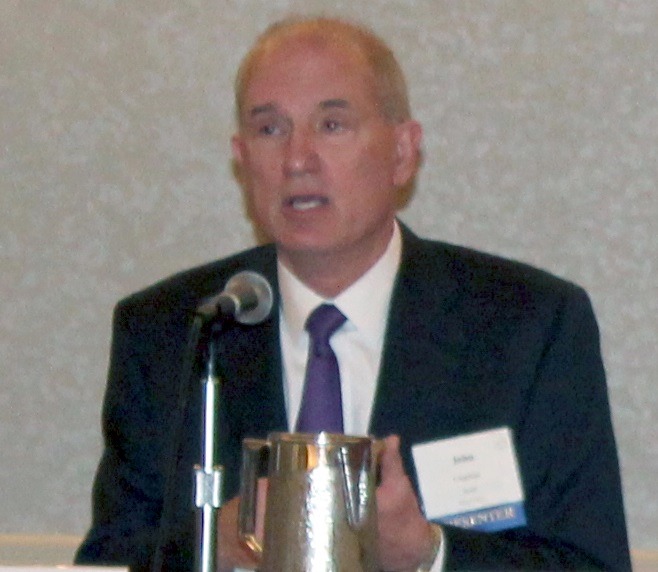
John Urquhart
Sheriff, King County
I really liked what Urquhart had to say and the way he said it. He was much more concise and to the point that the others and his points resonated with me. “Smart guns” aren’t ready for prime time. His deputies are very skeptical of them. You can see the mechanism of guns, you can take them apart, you can see parts are in need of maintenance, and you can clean and repair them. You can’t see into the electronics and software. You can’t know a failure is imminent with the electronics and software. A mechanical device is understandable.
This probably paraphrasing but instead of an exact quote, “A lock box isn’t going to save your life in an emergency but a gun may.”
CEO, Allied Biometrix
Allied Biometrix is licensing the commercial rights to a dynamic grip biometric device.
He thinks the phrase “smart gun” should be dropped. It should be a “user authorized gun” or something similar.
He sees potential for preventing accidents by children. He is adamant that thieves and terrorists (as suggested by one panelist) would be not be deterred.
While he is against legislation mandating the technology he would welcome legislation or at least some standards established before a gun could be put on the market. He doesn’t want a “bad-actor” to get into the market with a poor quality product that would trigger New Jersey type laws or sour the market for technology that might deliver on the promise of a high tech gun. “We can’t afford a 404 error code.”
He is also concerned about the liability issue. What if the technology fails and someone who is unauthorized to fire the gun successfully gets a shot off? Currently gun manufactures are shielded from such liability. But it seems unlikely a product that failed to do as it was advertised would be shielded. Even if it worked 99.9% of the time the liability from the 0.1% of the failures would be unacceptable. I suspect this is part of the desire for the standards body or legislation. If the tech passes some test criteria then they might claim it does it’s job good enough even though it is not perfect. I didn’t mention this to him but I think an argument could be made that it is similar to seat belts and air bags. They don’t work 100% of the time but they work well enough to save lives in many situations.
He says the technology isn’t quite ready yet. He also made the point, “Why would consumers accept the technology if law enforcement won’t?”
He claims his technology works about 99.9% of the time. I asked for details on how that was measured and he referred me to someone else. I called and sent an email yesterday but I have not heard back from them yet.
In one-on-one I asked about the price his technology would add to the gun. He dodged the question somewhat and said that survey’s showed “the sweet spot” was about $200 to $300 per gun. The parts would be considerably less than that but licensing, marketing, markup, etc. would bring it up to that range.
Tomorrow in part three I will cover what Robert McNamera had to say about “smart guns” and his product Trigger Smart which is based on RFID technology. Also Juliet A. Leftwich Legal Director, Law Center to Prevent Gun Violence, and Senator Loretta Weinberg, New Jersey Senate Majority Leader.
Past winners include Sarah Hoyt, Harry Turtledove, L. Neil Smith, Vernor Vinge, Terry Pratchett, Ken MacLeod, Poul Anderson, James P. Hogan, J. Neil Schulman, and many more big names. Even if I come in last place, just being nominated to potentially stand amid such a group of names is quite an honor.
Today I attended the Seattle “Smart Gun” Gun Symposium presented by Washington Technology Industry Association in association with Washington CeaseFire.
As you might guess Washington CeaseFire is the primary anti-gun group in Washington State. Ralph Fascitelli, president of Washington CeaseFire, spoke several times and was clearly hostile to gun ownership. But he was fair to and respectful of gun owners.
I talked to several people from the panels and Washington Ceasefire board members one-on-one during and after the event and will report in detail with my next post.
One of the people on a panel was the CEO of Allied Biometrix. Allied Biometrix is a California based startup that is licensing commercial rights to firearms user-authenticating technology developed at the New Jersey Institute of Technology (NJIT). He clearly understood the limitations of the technology and did not overstate the potential as some of the anti-gun people did. For example New Jersey State Senator Majority Leader Loretta Weinberg suggested the technology could have made a difference in the Sandy Hook and the Charlie Hebdo shootings. When I asked Allied Biometrix what their opinion on this was he said, “Give me a break!”
Allied Biometrix has some technology that I could see having promise in certain applications. I asked him for test result information and he requested I contact someone else for that and gave me a phone number. I called the New Jersey phone number but it was after 6:00 PM their time and the call went to voicemail. Using the name and phone number I found the contact’s email address and sent him the following:
From: Joe Huffman Sent: Wednesday, January 28, 2015 3:23 PM Subject: Error rates for dynamic grip recognition.
Background:
I’m a software engineer with a master’s degree in electrical engineering. When I left Pacific Northwest National Laboratories in 2005 I was a Senior Research Scientist working on biometrics.
I was at the Smart Gun Symposium today and spoke with the CEO of Allied Biometrix. He suggested I contact you to get my questions answered.
Questions:
Can you give me the approximate error rates with the dynamic grip recognition technology used with firearms authentication?
I can envisions there being many ways to test this. Can you elaborate on the test methods used to arrive at the numbers you claim?
In particular claiming a 0.001 false authorization rate when testing with a single unauthorized user attempting to fire the gun 10000 times is different than testing 10000 users for one attempted false authorization each. Also, there is the matter of unauthorized users deliberately attempting to defeat the system via changing their grip versus repeatedly using it in a natural, to them, manner.
Similar issues can make the numbers for false rejection of an authorized user problematic. For example I would expect a high stress situation or injury would change authorization rate. As might hands swollen or partially numb from the cold.
Can you give me test data that would at least partially address my questions?
I would like to use any information you provide me on my blog. But if you would prefer I keep information confidential and just use general information I can respect that and would be grateful for any information you can give me.
I will have one or more posts on the symposium by the end of the day tomorrow and if my contact on the dynamic grip technology supplies extensive test data I’ll devote an entire post to that.
Dave Workman was sitting just ahead of me for the press conference (about an hour before the actual symposium) but left before the symposium started. He does have his response to the press conference here and it is something you should read.
The families blamed Bushmaster for creating an aura around its model XM15-E2S that allegedly empowered the shooter, giving him the ability to perform like a solider in the theater of war.
Two men were wounded by gunfire Wednesday evening in downtown Seattle.
Officers on foot patrol near Westlake Center heard gunfire just after 8 p.m. Wednesday and ran toward the sounds of the shots. Police saw a large group of people running from 3rd and Pine St, where officers found two men with gunshot wounds.
…we are told, by someone (?) to celebrate the life’s work of one Dr. Martin Luther King Jr. – gun owner, second amendment supporter and NRA member.
OK, but if I approve of his message and his efforts, then surely every day is MLK Day, no? Just as, if you’re a Christian every day is Christmas.
Anyway; I wonder what MLK Jr. would say today, more than 50 years later, of race relations and the moral state of Americans. I don’t recall him having said;
“I have a dream…of a day when a little black child and a little white child will sit down together, and the little black child will accuse the little white child of exercising “White Privilege” and blaming him for his problems. I have a dream of a time when over ninety percent of all black people will sell their votes to the political party of the KKK in exchange for largess, indoctrination into the authoritarian system, lies and broken promises. I have a dream of a time when black people are corralled into dysfunctional, government-union-controlled schools, discouraged from using the schools of their choice, and taught hopelessness and anger instead of hope and love, and I have a dream today, People, of a time when government will have replaced the father in the majority of black families…”
No, I don’t recall him saying any of that, but that is apparently what some people are celebrating today, while calling for more of the same.
There has been much wailing and gnashing of teeth over what to do with the “terrorism done in the name of Islam” problem in the wake of the recent events in France, just as there is after each such event. Many talking heads say many things, but mostly their words shed darkness rather than light. The first step in finding a solution is properly defining the problem. Without clarity, there can be no visibility.
I have a simple proposal:
The next time there is such an event in a western nation and we can positively identify and surround the perpetrators before they are dead, we offer them this deal: Drop their guns/bombs and hold up their hands and surrender with the remaining hostages unharmed, and they can be tried in the Sharia court of their choice, with the following caveats: the trial must be started within one year, the verdict delivered within two years, and the court must be formally recognized and approved of by at least two leading national Islamic leaders in the Islamic world (such as the Grand Mufti of Saudi Arabia and the Ayatollah of Iran, or similar) who acknowledge in public, in the nation’s native language, to the people of their respective nations, the court’s legitimacy.
Either they find the perps not guilty and we can have an official Islamic court ruling that Sharia is utterly incompatible with western culture, laws, and values; or they are found guilty and executed, and we have an official Islamic finding that terrorism and murder is forbidden under Islam. If no leading scholars will recognize the court publicly it will be a tacit admission they want it both ways – be legal in Islam, but not have the west see that.
Either way, the clarity such a decision would provide would allow the appropriate battle-lines to be drawn, so the proper war could commence with sides more clearly delineated.
In processing a customer order today, we got a “Service Not Allowed” message from our credit card merchant services bank. They’re the ones who handle all of our credit and debit card transactions. We called them to find out what this message means, because we’d not seen it before. Well, they were by this time quite familiar with the “problem”. The problem is MBNA, in this case, who issued the card to our customer, DOES NOT ALLOW TRANSACTIONS WITH GUN RELATED BUSINESSES.
If you’re doing any business with MBNA, you’d best give them a jingle, and DO NOT FORGET this. This sort of thing seems to be on the rise, and it will get worse unless we push back, soon.
Update, Jan. 7, 2015; The customer called his bank, assuming the “Service Not Allowed” was due to a late payment on his part. As I explained to him several times; we were told by our Merchant Services bank that it was due to MBNA policy, and that our Merchant Services people were quite familiar with said policy as they’d had to deal with such denials many times previous. The customer only repeated what he’d said about a possible late payment. In any case, the transaction, on the same card, was approved today. All I can make of it, given what we were told by Merchant Services, is that MBNA will cave without comment or discussion once they’re called on it. From what commenters are saying, the practice of denying transactions may be random, or it may be targeted toward individual customers or vendors. Without more information I have no way of knowing. This would all seem quite unbelievable, except for what we already know about the recent IRS targeting, Fast & Furious, the attempted intimidation of Sharyl Attkisson and others, and other insidious pranks aimed at the perceived enemies of Progressivism.
And if we’re going to acknowledge the reason for the season (or is it the season for the reason?), well;
“It is the night of our dear Savior’s birth
Long lay the world in sin and error pining
‘Til He appeared and the soul felt its worth
A thrill of hope, the weary world rejoices
For yonder breaks a new and glorious morn'”
That’s from an old song of course. I found it had a certain ring to it.