Understand your Terms

I see this usage pretty often;

   “Maintains less than 1 1/2 minute of angle accuracy at 100 yards/meters – Guaranteed !”

What I want to know is; how does the rifle know the distances to your targets when there are no electronics involved?


If the inherent angular dispersion is 1.5 MOA at 100 yards, the underlying assumption would be that the inherent angular dispersion will somehow be different at some other distance, else they wouldn’t specify a distance.  Sure; the wind comes more into play farther out, but that’s a separate issue, no?  Or am I missing something?  Maybe for the sake of clarity they should say “…as tested at 100 yards.”  I at least would have more respect for them then, but maybe I don’t know squat.

Gunnies be Patient

I’ve seen it before and let it go, but today I ran into several variations of, “Once you get the sights adjusted, this gun is very accurate” in different places on gun forums and product reviews.


Serious shooters should know the problem with that assertion, but not all shooters know it.  These were shooters making the assertion after all.


Accuracy and sight adjustment (or zero) are not the same thing.


(Joe uses the term “sight angle” or “indicated sight angle” which makes more sense when you think about, which of course he has)


Accuracy is the ability of the firearm system (the gun itself, the ammo and the sighting system) to place shots consistently.  The sights could be “off” considerably (bullets impacting far from the point of aim) and that gun is just as accurate as if it were putting your bullets exactly at the point of aim.


The difference is in sight adjustment, but that in itself has nothing to do with accuracy.  Accuracy = consistency.


It has been said that “Sometimes the first duty of intelligent men is the restatement of the obvious.”  — George Orwell  (Thank You, Walter Williams, for pointing that out)


You intelligent men have your assignment, then.  Carry on.

Episode one of Top Shot

I watched the first episode of Top Shot last night. Barb watched about 10 minutes and then got bored and went off to do something else.

I liked it far better than I expected to. I don’t care for reality shows. When I first heard about Survivor back in late 1999 I was about to become unemployed as my contract with Microsoft expired. I thought it might be something I could do well at and I got an application and looked into the show concept further. It was completely different than I expected and I was repulsed. I expected something about working together and making conditions better for everyone on the island. I envisioned the winner being the person who did the most to improve the small “society”. I contemplated the skills and innovation I could bring to the situation. What would I bring with me and what sort of things could be accomplished with the materials on hand. It wasn’t going to be anything like that. It was going to be about getting rid of other people not working together with people. What sort of life lesson is this? It’s total crap.

That said it did cross my mind that Top Shot might be something I could participate in–for about 500 mS. I’m not a “Top Shot”. I do okay in the local matches but I’m just a “B” class shooter. I shoot at a level of about 65% (my current USPSA classification is 65.94% with a high of 68.53%) of the worlds best shooters. I could not imagine that would be good enough and didn’t pursue it.

Then I found out Caleb was accepted. What? I’m on par with Caleb! Oh well, it was at a bad time with our current project (Windows Phone Seven) at Microsoft and I had an obligation to complete that work anyway.

I really should have listened to what Caleb said last night on Gun Nuts Radio about it before making the following comments but I have other commitments for tonight and don’t have the time.

After seeing the first episode I again thought I could have had a chance. Mike Seeklander and his spotter’s performance was pathetic. Yes, as Tam pointed out the 100 yard shot Seeklander failed on is not as straightforward as one might think. But assuming the problem was not with the shooter being incompetent then either the spotter and shooter could have solved the problem had they been thinking. Here is how.

One of the shots was on paper. Use the same point of aim and try it again. If it lands on paper in close to the same place then you know offset in both X and Y from point of aim. Use that offset to put the bullet on target. If it doesn’t then the one on paper was random and you need to find the offset. The spotter should have found a nearby spot of bare ground where the bullet strike could be easily seen and directed the shooter there to find the offsets. If no such bare ground was available then systematically try offset in increments of 1/2 the paper width/height. Get a bullet on paper and confirm the offsets! They may have tried that and it was edited before airing but I was extremely annoyed that I didn’t see it happening. I felt the other team members should have put both the spotter and shooter on the chopping block. They both failed.

This episode also confirmed my hypothesis that if someone brags about how good a shooter they are it is near certain proof they are crap. All the great shooters I have personally met are extremely modest or at least silent about how great they think they are.

If you take nothing more from this post remember this. You can do a quick and dirty zero of your gun with one shot. Aim at something and shoot. Then stabilize the gun while aiming at the same place. With the gun still pointed at the same exact spot adjust the sights until the sights point at the place where the bullet hit.

By the numbers–Take two

If you have been following along in the comments at Say Uncle you will know that my assumptions about the cartridge used in my simulation here were off a bit. I assumed a 300 grain bullet with a BC of 0.785 and a MV of 2750 fps. According to Mu the correct bullet is a 250 grain leaving the muzzle at 3070 fps with (according to SteveA) a BC of 0.587. This changes things some.


The sight angle for no hold-over is 127.8 MOA instead of 122 MOA.


The time of flight is 5.2 S instead of 4.9 S.


The velocity of the bullet at the target is about 924 fps instead of 1043 fps. This results in PF of 231 instead of 313.


The number three shot groups required to get one that was less than or equal to 1 MOA is, on the average, 4.3 instead of 4.9 (initally my program showed 83 but now it shows 4.9, I suspect some sort a caching error in Modern Ballistics). But those numbers are identical given the margins of error used in the assumptions that generated them.


Both Modern Ballistics data files for the simulations are here.


See also the comments at Tam’s.

2707 yard shot in Afghanistan by the numbers

I think I first saw it at Ry’s place. But others have mentioned it too. People at work have been asking about it too. It’s time I made a blog post about it.

According to the news reports a British sniper made three consecutive shots which were measured, via GPS, to be at a range 8120 feet. This is about 2707 yards which is the number I used with Modern Ballistics. I have uploaded the data file here if you want to tweak a few numbers and see what happens for yourself.

I used a high end 300 grain bullet with a BC of 0.785, a muzzle velocity of 2750 ft/sec, a muzzle velocity standard deviation of 10 fps and the inherent accuracy of the cartridge, gun, and shooter was 0.25 MOA. I assumed zero wind at 10,000 feet above sea level, and a temperature of 59 F. All are a bit on the optimistic, but plausible, side of “excellent” conditions.

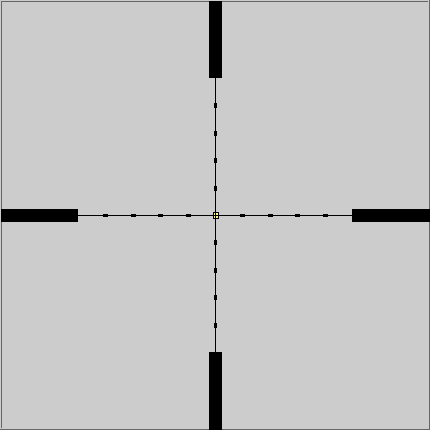
The first thing that struck me about the situation was that with a 32-power, mil-dot reticle, scope the target was quite visible (the rectangle target is 18″ x 24″):

Even a 16-power scope gives a usable sight picture:

The sight angle to not require hold-over is 122 MOA. For best results a no hold-over shot is required.

Long range Leopold scopes give 70 MOA of adjustment so a shim of 52 MOA would be required for a no hold-over shot. This is not likely.

Some Nightforce scopes have 110 MOA of adjustment which would require a shim of 12 MOA. This would result in the closest range the rifle could be zeroed at under standard conditions to be about 460 yards. This seems plausible.

The articles claim a three second time to target but I come up with 4.9 seconds. My guess is whoever did the calculation assumed the bullet did not lose any velocity on it’s way to the target. Working backward we come up with about 2700 fps for a muzzle velocity.

The velocity of the bullet at the target is about 1043 fps. With a 300 grain bullet this corresponds to an IPSC “Power Factor” of 313. A 124 grain 9mm bullet at the muzzle is in the neighborhood of a PF of 135 so the sniper still had a lot of “stopping power” at this range.

On the average you would have to shoot 83 (the correct number is 4.9, apparently something hadn’t been updated properly in my simulation when I pulled the 83 off) three-shot groups to get one which was less than or equal to 1 MOA (about 30 inches). Only about 30% of the shots will hit a 18″ x 24″ target (1000 shot simulation):

My conclusion is there was some luck involved but it is plausible the event took place essentially as reported.

Update: I have rerun some of the simulations with what is believed to be the cartridge used by the British.

Playing With Fire

That’s fire and brimstone.  This is pure gun geekery, and even for gun geeks its nerdy because it’s about percussion guns of the 1800s.  You’ve been warned.

Saturday, Nephew and I tried some heavy loads for the repro 1858 Remington revolver.  I’d been using a 28 grain powder charge and a round ball with decent results, but wanted to try something with more pep.  Civil War era military loads ranged from very light, to as much powder and lead as could be stuffed in the cylinder.  To start, we tried round ball (~140 grains) over a charge of 39 grains of 3F Goex with a greased felt wad in between.  That load filled the chambers completely and delivered an average of 925 fps at 10 feet with an extreme spread of 46.  Not too bad.  The 29 grain charge was yielding a velocity of about 850 fps.

It’s like pulling teeth to find acceptable “conical” bullets (“bullet shaped” as opposed to a round ball) for these “.44” percussion revolvers unless you cast your own, which I don’t.  I did find some Buffalo Bullets 180 grain jobs that fit the chambers nicely, and ordered 100 of them to try.  Since the bullet takes up more room in the chamber, the most powder I could get in and still seat the bullet below the cylinder face was 30 grains.  But, wow.  Average velocity was 1047 fps.  That’s a tad better than a .40 S&W, and matches the V of a .45 Auto load in the Speer manual for their 185 gr GDHP.  Extreme spread was 67, with a standard deviation of 21.

That was with two different people doing the loading.  I’m going to guess that with the same person loading all the rounds, the charge weight and ramming pressure would be a little more consistent, and so too the velocity.  Groups with this load opened up slightly from last week’s all-ball venture, but not enough to be sure.  This time was in direct sunlight, which makes aiming a little more difficult.

The extra pressure it takes to move the heavier bullet, which also has more friction surface against the bore, I will assume ramps up the powder’s burn rate.  More velocity with less powder and a heavier bullet.  Neat.  We’ve found a performance, or efficiency, zone.  More pressure equals more heat, equals a faster, more complete burn inside the bore, equals yet more pressure.

This is how guns (and sometimes chemical factories, engines, etc.) blow up– things look great as you increase the pressure and temp a little.  The reaction speeds up, a little bit more, things are doing fine, a little bit more and, Boom!.  A threshold is reached and a runaway reaction takes place.  You shear some bolt lugs, or burst a cylinder, etc. and maybe you go home with slightly fewer or slightly misshapen body parts.  That can be embarrassing.

I wasn’t worried about this load in a modern repro made with modern steel.  When these revolvers were designed and built originally, metallurgy wasn’t anything like it is today, and even back then they were known to stuff the chambers full on a regular basis.  Further, it makes no sense to build a cylinder that will take more powder than it can handle with the commonly used “44-100” bullets of up to 250 grains.  That would take more material and make the gun bigger and heavier, for no other reason than to encourage over-pressure loads.  I’m also running on some faith that they wouldn’t have done that (though the much longer 1847 .44 Colt “Walker” cylinder was known to occasionally let go).  Remember that back then there was only black powder, not the wide spectrum of nitro powders we have now.  All they had to control the powder’s burn rate were different granulations of the same mixture (though brand and lot inconsistency would likely have thrown in some degree of uncertainty).  With smokeless propellants you can get into a LOT MORE TROUBLE making your own loads.

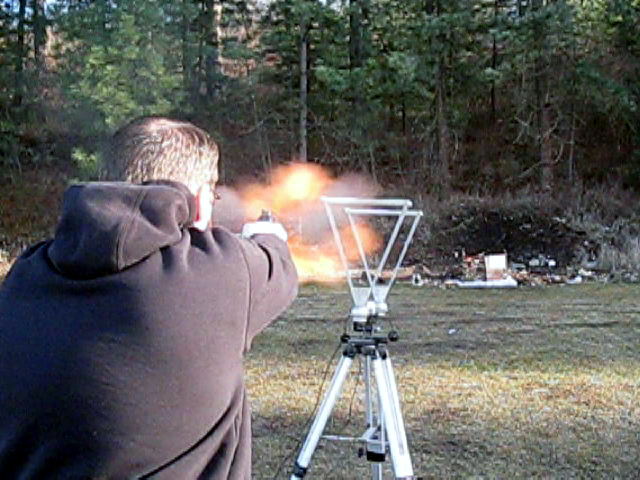
Here’s Nephew torching off one of the heavy loads.  The bullet has been on its way for about a millisecond, as the gun is still in firing position and the hot gas (I mean hot– this is in direct sunlight) has traveled a foot or so out from the muzzle;

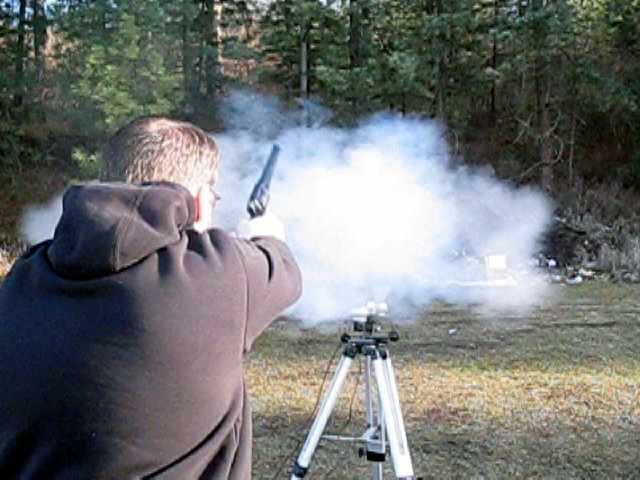
Below is the same shot in full recoil a fraction of a second later.  Forget about quick follow-up shots.  You can’t see the target until the smoke clears. By then you’re re-cocked and ready to go.  A side wind would be a big help in this case;

Today’s rapid fire guns wouldn’t be worth as much if they had to run on black powder.  For one thing you wouldn’t be able to see squat.  It is “interesting” to take a shot, and find that your target has simply disappeared after the smoke has cleared.  There’s that moment of uncertainty.

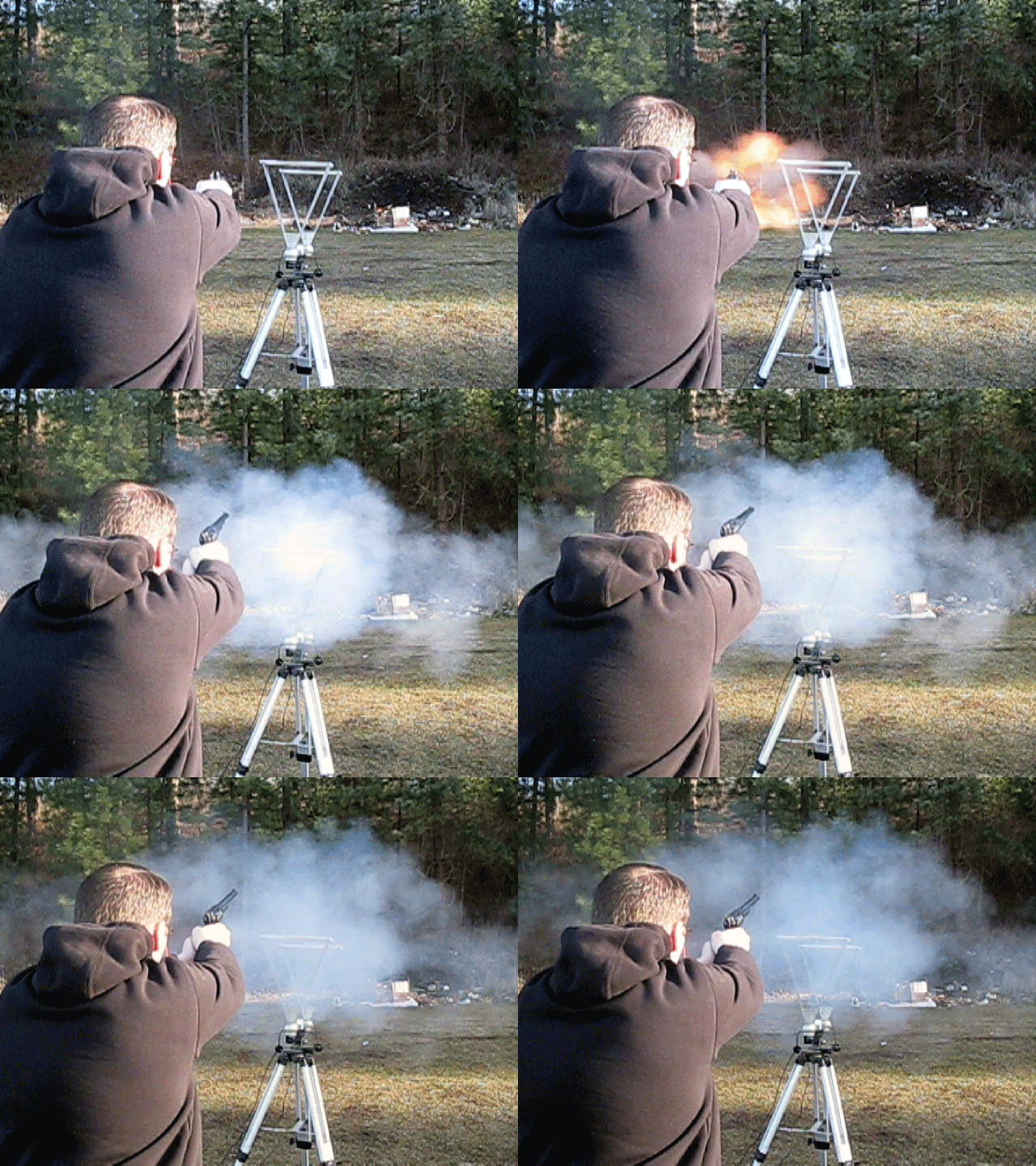
I like the slow, frame-by-frame animations as below.  You can see the mechanics of the recoil (though a high speed camera would be nice).  You can watch the force wave travel from his wrist, into the arm, the shoulder, and whole torso.  Nephew’s grip is fairly relaxed, which isn’t a problem with a medium weight 44 revolver.  Some people hate animated gifs on a web page.  I’m one of them, but this is for science;

You shouldn’t haul off and max out your charcoal burner just because I did.  I’m not saying it’s the thing to do.  What I can say is; I still, for the moment, have all my body parts (and gun parts) and all are operating satisfactorily, thank you.  I have a load that’s within the range of those used in the 1860s for the Remington New Model Army revolver and 1860 Colt Army, and it matches some of the .45 ACP loads for a ~180 grain bullet.

Now here’s a puzzler.  I’ve had barrel leading in modern revolvers and autos firing bare lead, hard-cast or swaged bullets.  Using pure, soft lead bullets in the ’58 Remington and ’51 Colts, no leading has been observed, even with these loads that achieve modern handgun KE levels.  I don’t know why.  Is it the grease?  But we’re told in no uncertain terms never to lubricate a modern gun bore, while black powder guns are greased all to hell.  Is it the propellant temp?  But the KE is the same.

Food Processing. Protein; Step One

It Was a Bright and Calm Morning…

My son and I both decided to hunt Late Muzzleloader season this year for a simple reason– there are far more does and “antlerless” bucks in our little hunting spot than antlered bucks, and this season allows harvesting of “three point minimum or antlerless” white tail deer.  Hunting muzzleloader season gives us a high probability of harvesting deer within walking distance of home.

We have one functioning muzzleloader rifle (step one food processor) so Son was given the first watch at the tree stand.  The second time out he took a decent young buck (small nubs for antlers) on Thanksgiving Day.  He spotted it while climbing down the tree, and shot it with the rifle still tied to the cord we use for raising and lowering things from the stand.  After that I started going out to the stand, but saw nothing in several days.  That’s unusual, but a deer had just been taken right there by Son.  Maybe they’re a bit spooked.  Don’t know, but on the morning of the last day of this one-week season, I got tired of sitting in the stand (besides, it was cold) and decided to take a walk.

It was a beautiful morning, just after sunrise, so if I never got a deer, it would still be worth the nice walk along the top of the picturesque basalt cliffs above the Palouse River.  There are always a lot of deer tracks up there, as it’s their only option for traveling between their feeding grounds (farmer’s fields) and their primary source of water.  My trouble that morning was that if there were any deer, they’d be immediately alerted to my presence.  Every 50 yards or so as I was walking along the ridge, a pheasant or two, or about 50 quail, would explode up from near my feet.  I might as well have been blowing an air horn every 50 yards and carrying a boom box playing rap music.

There’s a place along that ridge that’s down in a depression, and has some flat land with 360 degree concealment.  I knew in advance that if I was going to see a deer along the ridge away from our tree stand, it would likely be there.  As I topped the rise, getting ready to look down into the depression, I went slowly, making no sudden movements.

Sure enough, there were two deer, and one of them was a very nice eight-point buck!  About 200 yards away, he’s looking in my direction.  The sun being directly behind me, I was casting a 100 yard-long shadow right in his direction.  Pure stealth isn’t much of an option, but I was moving very slowly so as not to alert them too much.  Whack-a-Whack-a-Thump-a-Thump-a-Thump!!!  A pheasant exploded up at that moment about six feet away from me, so the buck got real nervous and trotted away.  It’s been years since I saw a nice buck up there, and, aware of my presence, this one and the doe are now on the move away from me.  Oh well. (but they didn’t bolt, as often happens)

I can either back-track less than a mile, cross the bridge for home and get ready to go to work, or I can go on, crossing another bridge about a mile ahead.  That’s an easy choice– I keep going forward in the direction of those two deer.  Wham, Slam, Whack!– quail and pheasants continue to announce my presence.  This is getting hopeless.  But it’s sure a nice day for a walk.

The deer never panicked, I guess, so what ended up happening was that I was dogging them.  They’d put some distance between us,  I’d close in, and they’d make some more distance.  Repeat.  Eventually they made a wrong move.  Some more quail (announcing my presence, but not telling exactly where) must have startled them out of the thick brush and into the open field.

I did not expect that.  They were in range, barely, but moving away fast.  Too far away to attempt a shot on a moving target.  No shot.  What do you do in this situation?  I whistled.  Deer whistle (I guess it’s more of a fast hiss than a whistle) at each other as an alert message.  Anyhow, it worked.  They stopped, turned 90 degrees broadside and looked back at me.  From that moment, circumstances dictate action.  No time for kneeling, and that might scare them off, so standing it is.  We’re all in the open.  Lock to full cock.  Backstop?  Check (there’s a hill a couple hundred yards behind them).  Front sight.  This is a longish shot for this weapon with open sights from standing– about 80 to 90 yards (I’ve never fired this rifle at anything more than 100 yards distant – maybe that has to change, but I’m confident at 100 and this is a bit less).  Some vacillating takes place for about a second.  One shot, one chance.  Too far?  Wobble area looks good.  Too far?  They’re still standing there, stone still.  This is a hair trigger.  Sight’s right on the sweet spot, what’re you waiting for?  Too far?  Nope.  Bang!

The two deer took off running.  The usual question comes to mind; did I miss?  They’re running fast and far.  200 yards and they’re out of sight over a rise in the undulating fields.  Oh well.  It’s a nice day for a walk.  Should I reload?  Maybe.  Have to cover 200 yards to look over that rise and try to spot them.  Better do that.  There they are; waaaay out there and still running.  I must have missed, though the let-off felt fine.  Damn.  But wait.  The doe’s way ahead of the buck.  Buck slows down and stops.  Then he looks like he got tired and decided to have a little lie down.  That’s odd.  They only ran about 1,000 yards.  No, it can only mean I got him.

He’s lying down with his head up.  Better reload.  I carry two reloads– plastic cartridges that contain a measure of black powder, a ball with lubricated patch, and a percussion cap.  They’re nice because you can use the cartridge structure as a short ball starter.  It’s easy– you just place the ball end over the muzzle and smack the other end, like so… Oops!  Forgot to pour the powder in first.  I have just dry-balled the gun and there’s an injured buck (I don’t know how injured) down there.  He could get up and run away.  I could lose an injured deer.  This sucks.  My chosen method of removing a dry ball is to seat the ball all the way down, remove the nipple and trickle a few grains of powder through the flash channel into the breech chamber, cap, then fire.  Works like a charm.  I have no nipple wrench.  Who needs to remove a nipple in the field on a half-day hunt? (it’s coming with me from now on)  The nipple’s seated tight– can’t break it free with the Leatherman tool.  Damn, damn, damn.  I eventually was able to pry the ball out at the muzzle, using the awl accessory (if I’d rammed it down I’d be hosed).  Cool.  Didn’t scratch the muzzle ’cause the patch protected it.  That ball is toast, but I have one more reload.

Meanwhile, the buck is lying there, looking around…head up, head down, head up, head down again.  Did he die?  Head comes back up.  Crap.  I had to get close enough for a 100% sure CNS (Central Nervous System) shot.  Walk slowly.  40 yards, take aim.  No.  Why not get closer?  30 Yards, kneel, full cock, put a shot through the neck at the base of the skull.  He drops like a stone.

This is not a good place from which to pack out a large deer.  Good net coverage.  Kamiak Butte, with the cell towers, is only 6 miles to the southwest.  I call Son on the phone.  No answer.  I wait and call again.  No answer.  I call my wife– she should be getting ready to drive to school.  Maybe she can meet me on the Colfax highway a few hundred yards over a hill and bring me home to get the pickup.  No answer.  I’d also been dogging a coyote along the way, and I’d seen the ‘yote running along the same path as the deer.  Can’t gut this buck yet.  That’s just inviting that ‘yote in to come and mess up my deer while I’m gone.  Leave it whole.  I walk a couple miles home, get Son out of bed and drive back to the Colfax highway.  We get permission to drive over a planted field to the deer.  No dice.  The frozen mud had thawed enough at the surface that a 4×4 with studded snows can’t get a grip to climb over the hill.  We’re on foot.  We go back home to grab a saw and a sled.

Below; the buck fell about a 1,000 yards from where he was hit, which was out of the frame to the upper right.
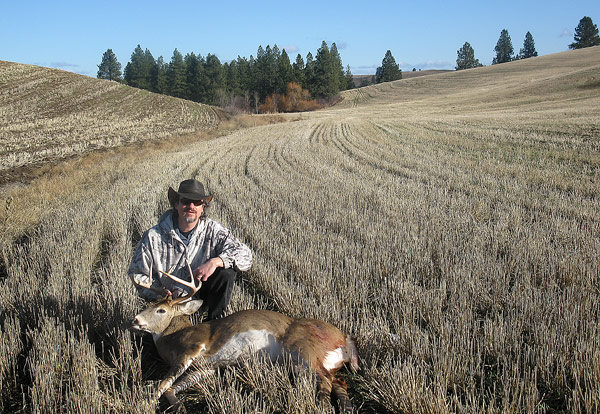
Looking closely, I find an entry wound in the deer’s left hind quarter.  Odd.  I could have sworn he was broadside to me when the gun fired, and I know I didn’t pull the shot that much.  And there’s a ball, just under the skin behind the right shoulder, exactly opposite where I was aiming, but I can’t find a corresponding entry wound.  Oh well, I’ll find it when I skin the carcass.  Someone else must have shot this deer before me, which would explain the entry wound in the hip.  That’s plausible, since I’ve been hearing shots in the area all week.  Weird.

Hours later we had the big buck hanging in the garage after getting the workout of the year.  Man, this hunting business is getting more like hard work.  After gutting (in the field) and skinning the deer (in the garage) there was only the one entry wound to be found.  The ball had struck the left “ham” at a shallow angle, passed through the intestines doing very little damage, passed through the stomach, blew a three-finger-sized ragged hole through the liver, punctured the diaphragm, punctured a lung, glanced off a rib and stopped just short of exiting the hide on the right side.  I measured 25 inches of penetration, from a ~180 grain round ball that left the muzzle at ~1,920 fps.  That deer ran about a thousand yards with all that damage.

My best guess is that the buck was all wound up tight, having spotted me, knowing that I’d been following him.  The cow-sized cloud of backlit, white smoke that erupted at extra-sonic speed from the muzzle must have made him jump slightly, changing the angle of impact from broadside to less than 45 degrees.  I calculate he had about a quarter second to move from the emergence of the smoke cloud.  I dunno.  Maybe he wasn’t so fully broadside to begin with as I’d thought.  The “act of grace” neck shot did not penetrate more than three inches, but shattered the vertebra.

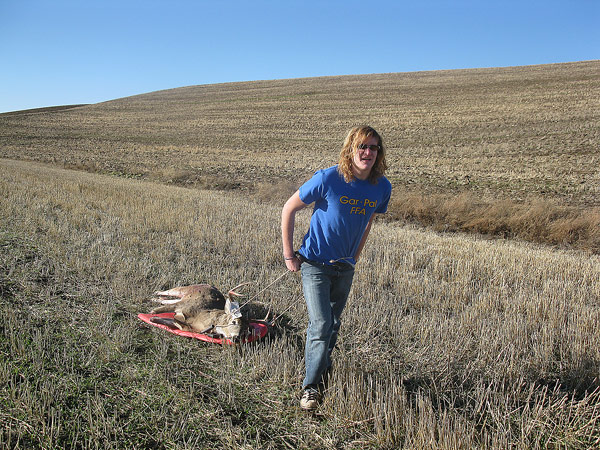
Here’s one reason to have children.  They can pull your sled;
 

Observations on penetration and “stopping power”
Starting last season, we’ve shot three deer with the same exact load from the same muzzleloading rifle.  The first shot penetrated an adult whitetail fully, straight through the ribcage, severing a rib fully on each side, from <30 yards.  The same shot from Son hit a smaller deer broadside through the ribs, hit the heart and blew it completely apart, such that you could lay it out like a pancake, and did not exit the hide on the far side.  Less than 14 inches penetration.  Hitting the big buck in the heavy hip muscle from almost three times the distance, the ball went through 25 inches of animal, and the second ball (on the buck's neck) was demolished after about three inches.  The same load (110 grains of Old Black pushing a ~180 grain .495" round ball) penetrated between 3 and 25 inches (a factor of 8.33) depending on shot placement.  Sort of makes you wonder about penetration figures given for defense loads.  It all depends and what's being penetrated, from hide, to muscle, to the liquid chambers inside the heart, to lung and liver tissue that doesn't explode like that heart did.  And stopping power?  Each one of these deer was hit with a 100% lethal shot, and they ran from eighty to one thousand yards after being hit.

We’ve had similar “stopping power” experiences using modern rifles, but never has a modern rifle load failed to penetrate completely, regardless of what it hit inside.  I’ve been wondering whether the stories of recovered, modern hunting rifle bullets are just mythology, but if the differences in penetration can be so great with the muzzleloader they must be fairly large with modern systems too.

(With that I think I’ve outdone myself—- 2,000+ words.  It’s my first nice buck.  Can’t I prattle on and on about it?)

Below; Along the bottom, near that ditch behind the small rise is where the buck fell.  Kamiak Butte is in the distance, top right in the frame.
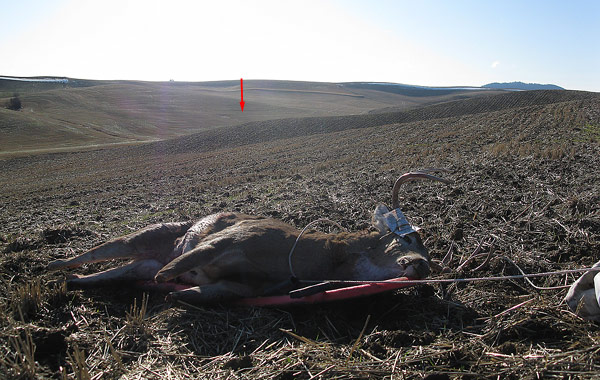
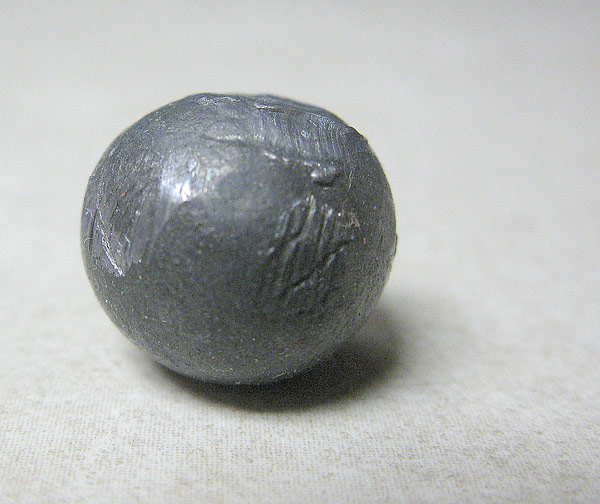
Below; this .495″ (well, formerly .495″) lead ball traveled 25 inches into the animal.  I’d not believe it if I hadn’t seen it.  I bet I could load it again and kill another deer with it next year.
Yards, Meters and BDC

So maybe I’m an idiot.  I was out firing a Colt AR-15 HBAR with a Trijicon ACOG scope.  I’d gone the extra step and drilled through the A2 carry handle on this otherwise pristine Colt so as to add the second mounting screw for the scope.  The BDC (Bullet Drop Compensating) reticle has different crosshairs for elevation at different ranges (wind is of course still up to your doping skills).  You zero at, say, 100 using the main crosshair, and your elevation is supposed to be correct at all the other indicated distances.  One comment on that; it would be much better to refine your zero at greater distances, using that other crosshair, say, at 500 using the number 5 crosshair or etc.

Out in the real world though, your targets aren’t placed at nice, even, measured distances, so it gets just a little bit more complicated.  I’d brought a laser with me to do range measurements.  The laser registered a particular target at 385 yards.  Said right there, so it couldn’t be wrong, “385 yd”.  That’s close enough to 400 that I opt for the number 4 crosshair.  Shot went high.  “Not possible– I called that shot dead on.”  Same thing again.  Walking the shots onto the target, I find I have to hold halfway between the number 3 and 4 crosshairs*.  “Crap.  This shouldn’t be happening.  I have nigh on three grand worth of equipment in top condition, the right ammo, and a standard length barrel.  What the hell?”

Some of you will already have figured out the problem (I seem to recall something about an interplanetary probe oblitorating itself on Mars due to a similar error).  The ACOG scope is calibrated in meters and the laser was set to display in yards.  A yard is 0.9144 meters.  In realistic rifle shooting distances, we can simplify that to either adding or subtracting 10% to do the conversion in our heads, and be close enough.  At 385 yards I was rounding up to 400, which made sense, but I was still thinking all in yards.  I didn’t convert.  385 – 10% (simplify further and subtract 38) =  about 347 meters, or close enough to the 350 meter crosshair for this target.  *Ah Hah!

Better yet would have been to take all of half a minute (only because I don’t mess with the settings much and I’d have had to take that long to figure it out) to set the laser to read in meters.

On a nice, relaxing day with a full belly and a Thermos-full of hot coffee (as backup this time) the sun shining and the birds chirping among the beautiful North Idaho scenery, this was more of an amusing lesson than anything serious.  If there is ever a situation in which it really matters, you’ll want to be aware of these things in advance, and have taken the necessary steps already.

Part of my problem is that I fool around with so many different weapon systems, in addition to being an idiot.  How does that saying go?  “Beware the man with only one gun.”  Something like that.  He knows his weapon backwards and forwards, right and left, upside down and every which way, in the dark, summer and winter, and with one hand tied behind his back just to make if fair he’ll still kick your ass.  Hmm.  Maybe there’s a new IPSC stage in there somewhere.

Update: With the low recoil of the 5.56 round and a low power optic, you can usually spot your own hits even at longer distances.  Take that for what it’s worth.

The “stopping power” debate will never end

John Fogh offers this advice from John Holschen:

Believing that the 5.56 “stopping power problem” is solved by a different bullet and/or cartridge is likely delusional in my opinion.

This statement doesn’t stand on it’s own because I’m pretty sure a 16″ shell from the Missouri is an instantaneous (for all practical purposes) man stopper. Just the muzzle blast will kill. But that’s the nit-picky engineer in me. And besides, Holschen qualifies it as referring to handheld firearms:

The stopping power “problem” is based on the misconception that there exists a hand-held firearm which can instantly terminate hostile behavior (reliably and repeatedly).

But the most interesting part to me was the conclusive evidence that:

…[A] BG was hit 12 times with an AR at a range of 9-12 yds.

  • 10 rounds struck his torso producing fatal damage to his liver, spleen, heart and both lungs.
  • 1 round struck his right femur fracturing same (and starting his fall toward the ground.)
  • 1 round entered through his left eye and destroyed a significant portion of his brain (this was the last shot according to forensics but they noted the BG was already falling at the time this round hit him.)
  • The shooting was captured on both video and (separate) audio recordings. The elapsed time from the LEO’s first shot to his 15th shot (total rounds fired) was just under 5 seconds.
  • During those 5 seconds the BG continued to fight, firing 6 rounds from a .357 revolver.

The LEO fired three rounds per second and got 12 of his 15 shots on target and one of those was a head shot, all while being shot at by the bad guy. Impressive. Had he been shooting a .30 caliber rifle I doubt he could gotten near as many shots on target in that time frame. What this may mean is that in a similar event the .30 caliber rifleman would have put only two or three shots in the target and the BG stopped his attack in the same amount of time.

So which caliber has more “stopping power”? Remember, you can double the effectiveness of any bullet by putting another round through your target.

What does the bullet do?

One of my more popular posts was Where does the bullet go?. I am somewhat of an expert on small arms exterior ballistics (I wrote Modern Ballistics) but while better than most people on terminal ballistics I usually refrain from saying much on the topic. Greg Hamilton and his colleagues at Insights Training are much higher on that food chain than I am. Although John Fogh doesn’t mention it I know a little bit about the research Insights has done on the topic over the years.

John gives us some of the research results on Terminal Rifle Ballistics.

One mile range proposal

Via email from Jason comes this link to a proposal for a one mile range in central Washington State.


It sounds like they are talking greater than .30 caliber. My hottest loads with the highest BC bullets in my .300 Win Mag won’t meet the requirement of being supersonic at the target.


For those of you that want to run the numbers yourself assume range conditions of 400 feet above sea level and 75F.

The Sound of Gun Fire from Downrange

I’ve long been disgusted by Hollywood’s portrayal of sounds.  Sounds in space, sound traveling at the speed of light, and the ridiculous sounds of gunfire made up in a studio.  Even the news services will often do a time-shift, to synchronize the sound of a distant event with the video even though anyone who’s been alive long enough to understand what they’re seeing on TV knows that sound and light travel at different rates.  I just, do, not, get why TV and movie people have to screw up reality so much.  Far from adding anything, it subtracts from the final product.


For example, I think the long delay in the sound of a distant explosion at Boomershoot makes the experience more awesome.  It adds to the perception of enormity.  The movie, “Band of Brothers” is an attempt to show it like it really was, and for the most part they seem to have done a good job.  Not when it comes to sound editing though.  Super-sonic bullets whiz by, “whoosh-whoosh, zip, zip” and so on, and of course the sound always travels at the speed of light.  It’s taking a serious subject and turning it into slapstick.


In the interest of universal understanding, I made this recording of .308 rifle fire from about 380 yards while setting up some rifles for Boomershoot.  The camera is about 20 yards from the targets (yeah, I was holding the camera, but I was behind a hill from the gun and in radio communication with the shooter– completely safe).  Each shot delivers multiple sonic effects or events.  First is the “CRACK-hiss” (mini sonic boom) from the bullet.  Take the sonic boom from a jet flying over, speed it up a few octaves, and you’ll have about the same thing.  That bit is interesting in that it does not come from the gun, but from the bullet.  You have no sense of the direction from which the bullet came.  Imagine standing in the water on the shore of a lake and feeling the wake from a passing boat on your legs.  From that sensation alone, you have no idea of where the boat came from, and little or no information about its direction of travel.  The bullet’s wake, as sound, gives you no more information– just a “snap” that seems to come from nowhere.  Next is the sound of impact, which is only audible in the first shot in this recording.  Then comes the “boom” from the muzzle blast, followed by the reverberation in the surrounding hills and trees.


Note that the reverb almost seems louder than the crack-boom.  That’s due to the AGC (Automatic Gain Control) circuitry, A.K.A. “compression” built into the camera.  The initial crack drives circuitry into gain reduction, and the gain comes back up for the reverb.  To get the relative levels of the events portrayed accurately, I’ll have to take a full-range stereo recorder into the field on another day and use its un-compressed level mode.  If you have some nice speakers (and pretty powerful, as the dynamic range is quite wide) you’ll hear it as if you were actually standing there.  Regular CD audio has a dynamic range of about 100dB, IIRC– close enough.  This recording isn’t all that bad, though.  Crank up the volume, use good speakers, and boost the bass to get the full effect (the mini electret mic on the camera isn’t great for bass response);


Match Hollowpoints – Interior, Exterior, and Terminal Ballistics

My wife reads a lot of “who dunnit” mystery novels.  The one she’s reading now addresses long-range marksmanship and the use of hollowpoint “match” bullets.  As a person normally 100% uninterested guns and shooting, she had a very good question for me; “Why do they use hollowpoints for accuracy”?  This lead to a very interesting discussion– one uninterested in guns was trying to understand something that few gun enthusiasts understand completely and rarely discuss in such detail.

I had to admit I was at something of a loss.  My best understanding is that the hollowpoint bullet jacket can be manufactured to higher standards of concentricity (the mass being better centered around the mechanical center so as to avoid wobble in flight) and consistency of mass and shape.  That is all true, but exactly why it is true I was at a loss to explain with certainty.  My best guesses are that it has to do with the process of forming the jacket’s shape, and with the insertion of the bullet’s lead core, but I don’t know the actual processes used in bullet manufacturing.

I also told her it was my opinion that since the hollowpoint jacket (having a closed copper base due to the way it’s constructed) allows none of the bullet’s lead base to melt away during the intense heat of firing, it is going to retain its mass, and therefore its consistency of mass from shot to shot, better than the open base of a standard full metal jacket bullet.  I’ve also read that the open-base FMJ can allow the jacket to partially separate from the core at the base under the pressure of firing.  If so, that would certainly alter its flight slightly and at random.

She explained that it was her understanding that hollowpoints were used to cause more trauma inside the target, and I told her that she was correct.  She was having a hard time understanding that there is no direct correlation between the objectives behind hollowpoint “match” bullet designs, and the hollowpoint bullets designed to expand and cause more damage.  This was getting too technical for a layperson, but her interest was piqued by the story she was reading.  I had to explain that hollowpoints designed specifically for expansion on impact have a wide range of designs, operating velocities and applications, and that match hollowpoints have nothing to do with any of that.  The match bullets are only designed for accuracy, with no regard to their effects on a target.

That being the case, one can nonetheless do a little experimentation.  Manufacturers of match rifle bullets usually make a point of telling the customer that they are NOT intended, and should not be used for, hunting.  There is one company, Burger Bullets, that touts their match VLD (Very Low Drag) hollowpoints as hunting bullets.  I’ve been loading Berger 7 mm bullets in 280 Remington for my son’s use at Boomershoot, and since he keeps his rifle zeroed for that load, he has also used the VLDs for hunting.  This particular bullet has a light (read weak) jacket, and while it is an awesome animal stopper, it explodes at high velocity inside the animal due to its light construction and causes major damage to any meat it comes near.  It also tears a large hole in the hide for those of us who keep the skins.  They make a tiny entry wound and a softball-sized exit wound.  That would be OK if the shot placement and angle were ideal because only the heart/lung cavity would be so effected (then too, we like to eat the heart if it’s intact).  Other match hollowpoints have heavier jackets that don’t behave much different, on impact, from a standard FMJ bullet.

Practicing for Boomershoot last week, we found one of our 30 caliber match bullet jackets behind a 2′ diameter rotten, wet log that it had penetrated.  Just the jacket, turned nearly inside-out, with no lead core.  The hollowpoint tip was almost perfectly intact, and so behaved radically different from a hollowpoint hunting or defense bullet.  The bullet had traveled 400 yards, entered and then yawed violently sideways inside the log.  The intense pressure of deceleration caused the heavier lead core to burst out the side of the jacket, separating completely.  The open-sided jacket followed through to drop on the ground just behind the log.  These match bullets were loaded in .308 Winchester cartridges made by Black Hills Ammunition.  We were using 168 and 175 grain, “red box” new loads.  I think the bullets they use in these loads are from Sierra, but don’t quote me on that.  You can call them and ask if you’re curious.

Hey! I know that guy!

Never mind the 1600+ yard (that is 0.91 miles) hit on a 12″ diameter plate, the guy in the video (you get to see him toward the end) is someone I know. He has been to Boomershoot several times and Barb and I went to high school with his Aunt Shirley. He also used to shoot a lot of IPSC at the same events I went to.


Oh, he is also a gunsmith. I suspect he made the video to show off some of his work as well as his talent.


Thanks to Boomershooter Michael who had the following to say about the video:


Spring is coming, and a not-so-young man’s thoughts turn to . . . Boomershoot. 🙂


Well, close enough for now.

More AP ammo testing

As planned Caleb and I did some more tests with Ry’s test target. Video and commentary by Caleb.


We went to the Boomershoot site expecting to find little or no snow. We should have called ahead. There was about two feet of snow and we were unable to make it to the Taj Mahal with all our gear. We made do at the first berm. We used a paper target to zero the gun for this range (25 yards) then took a single shot with each caliber at the stack of steel plates at the base of the stump. The bullets at the steel plate went over the chronograph.


This was our setup.


In the following video you see the result of SS-109 and 30.06 blacktip ammo shot at the stack of steel plates each 0.25 inches thick. There is a gap of about 0.75 inches between each plate. Estimated velocity of the .223 bullet at the target is 2600 fps. Estimated velocity of the 30.06 bullet at the target is 2360 fps.


The .223 went through one and almost penetrated the second plate. The 30.06 went through three plates and partially into the fourth.


The .300 Win Mag pushing hand-loaded 162 grain military surplus black tip bullets was able to hit the target with a velocity of about 3315 fps. It went through all six plates:


Update: See also this paper on AP ammo. It’s just the first page (you have to pay for the rest of it) but it’s interesting reading.

Pentration test of .50 BMG AP

Details of the test, with pictures, are here. Ry stopped by the house yesterday and I got to handle the test target and we talked and speculated about the details of the test results. The next time I go back to Idaho I think I will borrow his target and do the same test with 30-06 AP.

Bug fixes for Modern Ballistics for the Field

Scott found a user interface bug. That is fixed now. There was a bug in the “Delete All Data” link that I found and fixed as well.


I have also created a new topic tag for this blog “Ballistics”. I still have to add this tag to old posts but I should get that done sometime today.

Maximum range of bullets

I added another feature to Modern Ballistics for the Field. It now gives you the approximate maximum range for your bullet under the given environmental conditions.

What should I do next?

My Modern Ballistics for the Field software is essentially completed (as long as there are a fair number of people using it software is never done). And I’m debating with myself as to whether I should start work on a Leftspeak to English conversion website or if I should work on some explosives modeling software.


The Leftspeak project would be easy and fun and only take a few days in my spare time. The explosives modeling software will probably take months but be far more useful.


Any votes?

Modern Ballistics for the field

I’ve fixed all the fixable bugs in my cell phone/PDA web based exterior ballistics program I announced last November and put it at it’s permanent home at http://field.modernballistics.com/.


Enjoy and let me know if you run across any bugs not mentioned on the Known Bugs page. Suggestions for improvements are also welcome. Send them to “JoeH AT modernballistics.com”.