Blog maintenance

I did some maintenance on my blog this morning. The live comment viewer is working now, or at least it was the last couple times I tried it. I can now edit posts and have the changes “stick” which they hadn’t been doing for the last couple weeks. Very annoying that last one. In order to edit a post I had to copy the .XML file for that day’s entry to my personal computer, using my “geek brain” edit the .XML post which was encoded within the day entry file, then copy the file back up to the blog server.

While I was messing around with it I thought I might as well update the blogroll to better reflect reality. There are other blogs I read fairly frequently but I only put blogs that I read every post nearly every day on my blogroll. I’m sort of a purist I guess. No offense to others that I read frequently but don’t have on the list. I just don’t have time for everyone that I would like to read and/or that link to me. If you link to me in a post I will read your post and I will monitor the comments to it for a while. And if you put me on your blogroll I will check you out for a few days but it’s going to be very rare that I am going to link to you just because you linked to me.

I know I messed up some RSS feeders as things were changing–at least mine was affected. Sorry about that.

Quote of the day–Rick Keene

There are so many ways to game this technology, that’s the difficulty. This is not ready for prime time.

Rick Keene
September 11, 2007
Assemblyman, R-Chico.
Handgun stamping bill sent to governor–Spent shell casings would be imprinted
[Yup. Advocates of this are either exceedingly simple minded and/or just want to increase the difficultly of gun ownership.–Joe]

Quote of the day–Ray Ozzie

I fear we are partying like it is 1984.

Ray Ozzie
Microsoft Chief Software Architect
September 6, 2007
Company Meeting 2007–Changing the world
[Ozzie talked about growing up in the 60’s and being in fear of “the man” and how the personal computer was believed to help restore power to the individual. He asked us to make sure private things could be kept private even when we are putting more and more information into “the cloud”. It was good stuff. I had planned to write up a big post on the meeting last night but got wrapped up in expressing my “sympathy” to Robyn.–Joe]

Quote of the day–John Gilmore

The whole conference has spent a lot of time talking about ways to control uses of information and to protect peoples’ privacy after the information was collected.  But that only works if you assume a good government.  If we get one seriously bad government, they’ll have all the information they need to make an efficient police state and make it the last government.  It’s more than convenient for them – in fact, it’s a temptation for people who want to do that, to try to get into power and do it.  Because we are giving them the means.

John Gilmore
A transcript of remarks given at the First Conference on Computers, Freedom, and Privacy, March 28,1991
[See also my Jews In The Attic Test.–Joe]

Enough columns on the spreadsheet

For years Ry and I tested new reactive target recipes for Boomershoot. When our hypothesis for making an explosive which could be easily detonated with long distance rifle fire were proven false Ry would lament that we didn’t have enough columns on our spreadsheet. There was some variable, which we didn’t know existed, that was critical to our understanding of explosive detonation. Literally it was true that I had (have) a spreadsheet with lots of different variables that we thought might be critical to make our explosives better. Some of those included:

  • Flammability limits (acceptable ratios of fuel to oxygen where ignition can occur)
  • Heat of vaporization
  • Specific heats (including those for phase changes)
  • Flash point
  • Auto ignition temperature
  • Heat of combustion per unit mass
  • Heat of combustion per unit of oxygen
  • Heat of combustion relative to specific heat of the materials
  • Temperature of decomposition of the oxidizer

Our experiments yielded no obvious corelation between any of our hypothesises and the real world–until the last couple of days.

The title for the column on the spreadsheet we apparently were looking for is Ω. In explosive engineering terms (rather than electrical engineering terms which is what first comes to mind with that symbol) this is the weight ratio, expressed as a precentage, of the oxygen remaining or required (expressed as a negative number) for complete combustion of all the fuel in the explosives. For example, TNT, C7H5N3O6 has end products of CO, H2O, and N2. That carbon monoxide (CO) could have been converted into carbon dioxide (CO2) and more heat if there had been enough oxygen around. It turns out that Ω for TNT is -74%. For RDX (the active ingredient in C-4), C3H6N6O6, Ω is -21.6%. From my earliest attempts at reactive target explosives I started out with stoichiometric ratios. This would give me the most bang for a given mass of components. That is, no excess fuel and no excess oxygen left over after the reaction was complete. It was ultimately discovered via both experimental results and hints found on the Internet that maximum sensitivity was not achieved with stoichiometric ratios. It was more sensitivity when the explosive was oxygen rich. From some of my “new” books on explosives I found that “Ω” is a measure of that “richness” or “poverty”. I modified my spreadsheet to calculate Ω for various recipes.

Here is a partial (I have three times this number of recorded experiments) table of various Boomerite recipes and my best approximation of Ω:

Recipe
Boomerite 1998 1.2%
Boomerite 1999 2.4%
Boomerite 2001 9.2%
Boomerite 2002 8.3%
Boomerite 2003 19.4%
Boomerite 2006 16.2%

There were other variables that changed as well such as packaging materials, fuel used, ratios of oxidizers, catalysts, size of the particles, and packing density which also affected the sensitivity. But the correlation with Ω is very strong. Each year the sensitivity increased and Ω, a measure of the excess oxygen, was a significant component of that increase in sensitivity. It also can be too high–obviously if there is no fuel at all and only oxiderizer it’s going to be a minor explosion at best. But this gives me a reason to revisit old fuels and try something a little bit different this time.

Side note: The most recent recipe on the web is not what we actually use. What I publish is always at least one “generation” behind our “latest and greatest”. Ω for the web recipe is 20.1%.

Good choice of background music

The Brady Bunch has a link to this video about “microstamping” on their website. They ignore obvious and important points of their critics such as:

  • Shell casings found at a gun range can be deliberately scattered at a crime scene
  • Revolvers don’t leave shell casings at the crime scene unless the shooter reloads
  • Replacement firing pins and breech faces would have to be registered and tracked as well as the firearm itself
  • Gun parts are easily modified or manufactured
    • Firing pins can be manufactured from scrap metal with simple hand tools–they may not last more than a few dozen shots but they should be more than adequate for most crimes
    • Breech faces markings can be ground off and/or filled in with metal filled epoxy
  • There are many millions of guns already in circulation
  • Stolen guns aren’t going to be associated/registered with the criminal who used it in a crime
  • A black market will likely develop in unmarked gun components or components that have phony numbers (such as fake SSN cards that have valid numbers but belong to someone else)

One must assume they believe in some sort of supernatural capabilities for this technology that defies the laws of physics and human nature as we know it. But regardless of all the reasons why this scheme could never work the big thing that I noticed while watching this video was the background music–the theme from The X-Files.

Laser Spy Microphone

Via Bruce.

I’m surprised this works as well as it does. I would have thought you would need a telescope (or cheap rifle scope) to focus the light on the photocell. I’m certain you would get better range if you did so. Also using an infrared laser would make it less likely your eavesdropping will be detected.

Laser Espionage Microphone (how-to)

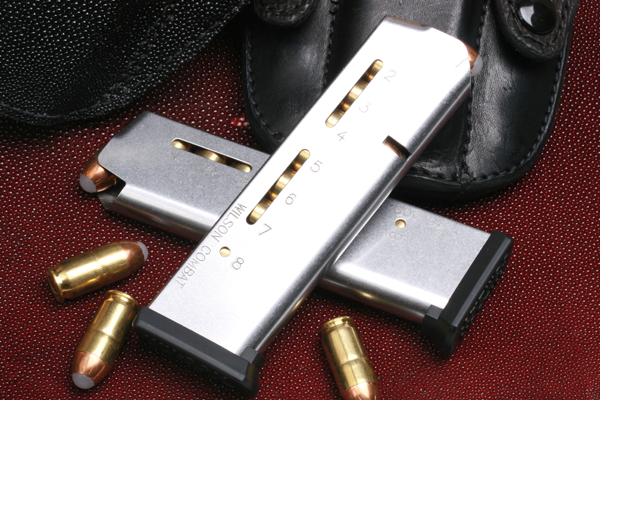
New Wilson Combat single stack magazines

Being a “double stack guy” I don’t have a use for them. But they are pretty and, I’m certain, of very high quality.

ETM_Press_Release_83007.doc (313 KB)

Quote of the day–Esther Dyson

Few influential people involved with the Internet claim that it is a good in and of itself. It is a powerful tool for solving social problems, just as it is a tool for making money, finding lost relatives, receiving medical advice, or, come to that, trading instructions for making bombs.

Esther Dyson
[The gist of this can be said of virtually all technology (including firearms and explosives) and many other things such as free speech. Technology can used for both good and evil. It’s the user not the technology that is important. As with most bigots the anti-gun people are very narrow minded and can’t or refuse to see the big picture. Even pointing out analogies such as this fail on most of them. The most typical response I get when trying to make this point is, “But we are talking about guns!” as if they were the equivalent of letting cobras roam around in your home. Guns do not have minds and actions of their own. They are tools of the individuals in possession of them. Among other things firearms are used for recreation, to protect innocent life, and the much more rare, taking of innocent life.–Joe]

Quote of the day–John Gilmore

What if we could build a society where the information was never collected?  Where you could pay to rent a video without leaving a credit card number or a bank number?  Where you could prove you’re certified to drive without ever giving your name?  Where you could send and receive messages without revealing your physical location, like an electronic post office box?

That’s the kind of society I want to build.  I want a guarantee – with physics and mathematics, not with laws – that we can give ourselves things like real privacy of personal communications.  Encryption strong enough that even the NSA can’t break it.  We already know how.  But we’re not applying it.  We also need better protocols for mobile communication that can’t be tracked.

John Gilmore
A transcript of remarks given at the First Conference on Computers, Freedom, and Privacy, March 28,1991

How the FBI Wiretap Net Operates

Lots of interesting info here:

The FBI has quietly built a sophisticated, point-and-click surveillance system that performs instant wiretaps on almost any communications device, according to nearly a thousand pages of restricted documents newly released under the Freedom of Information Act.

The surveillance system, called DCSNet, for Digital Collection System Network, connects FBI wiretapping rooms to switches controlled by traditional land-line operators, internet-telephony providers and cellular companies. It is far more intricately woven into the nation’s telecom infrastructure than observers suspected.

It’s a “comprehensive wiretap system that intercepts wire-line phones, cellular phones, SMS and push-to-talk systems,” says Steven Bellovin, a Columbia University computer science professor and longtime surveillance expert.

[…]

Together, the surveillance systems let FBI agents play back recordings even as they are being captured (like TiVo), create master wiretap files, send digital recordings to translators, track the rough location of targets in real time using cell-tower information, and even stream intercepts outward to mobile surveillance vans.

FBI wiretapping rooms in field offices and undercover locations around the country are connected through a private, encrypted backbone that is separated from the internet. Sprint runs it on the government’s behalf.

The network allows an FBI agent in New York, for example, to remotely set up a wiretap on a cell phone based in Sacramento, California, and immediately learn the phone’s location, then begin receiving conversations, text messages and voicemail pass codes in New York. With a few keystrokes, the agent can route the recordings to language specialists for translation.

Big brother is listening.

Quote of the day–John Perry Barlow

Relying on the government to protect your privacy is like asking a peeping tom to install your window blinds.

John Perry Barlow
[Tell this to every person that tells you laws are the proper solution to privacy issues.–Joe]

Quote of the day–Spider Robinson

I really did comprehend, intellectually at least, that I was engaged in one of the most profoundly thrilling endeavors in human history.

How conservative can you be if you have jumped off the edge of the solar system?

Do conservative people travel at relativist speeds?

By the end of the first year of our voyage we were already traveling at more than a third of the speed of light. And even though there were no sensory cues at all to confirm that we were all well of it and believed it. And I think I can safely say we all found it more than a little thrilling. By the time we reached turn over in nine more years our velocity was going to peak at a hair frying 0.99794 C.

Does a conservative man race photons?

Joel Johnston
A character in the book Variable Star by Robert A. Heinlein and Spider Robinson.
[Johnston is referring to a literal definition of conservative, not the present day political definition. I have another 20 minutes worth of the book to listen to. Both James and I are enjoying it a great deal.–Joe]

Quote of the day–G. Eric Engstrom

Dear Jamie,

Money is the root of all evil. A man does need roots.

Remember to dream with your eyes open so you can act on them to make them real.

G. Eric Engstrom
March 23, 2000

Inscription inside the front cover of Renegades of the Empire: How Three Software Warriors Started a Revolution Behind the Walls of Fortress Microsoft
[This inscription was addressed to our son James–who now works at Microsoft. The book is about Eric, Craig Eisler, and Alex St. John. I worked for them when I first started doing contract work for Microsoft in 1995. I’ve known Eric for about 20 years now starting when we both worked for Zortech (they sold a C/C++ compiler for MSDOS and later OS/2 and Windows). While researching this quote, much to my surprise, I discovered Craig is now back at Microsoft.–Joe]

It may be illegal to delete files

I consider Stottlemire’s actions unethical. But he does have a point:

Stottlemire, 42, of Fremont, California, insists there was no encryption or hacking involved, and therefore he did not violate the Digital Millennium Copyright Act. “I honestly think there are big problems when you are not allowed to delete files off of your computer,” says Stottlemire.

I also think he is on shaky, at best, legal ground. The law says:

`(2) No person shall manufacture, import, offer to the public, provide, or otherwise traffic in any technology, product, service, device, component, or part thereof, that–

`(A) is primarily designed or produced for the purpose of circumventing a technological measure that effectively controls access to a work protected under this title;

`(B) has only limited commercially significant purpose or use other than to circumvent a technological measure that effectively controls access to a work protected under this title; or

`(C) is marketed by that person or another acting in concert with that person with that person’s knowledge for use in circumventing a technological measure that effectively controls access to a work protected under this title.

The law doesn’t say the circumvention has to have anything to do with “encryption or hacking”.

Where it gets interesting to me is that if someone were to design their copy protection based on the existence of a browser cookie such that if you had the cookie you couldn’t copy the “protected work” and if you didn’t you could do the copy. Then if someone make a program or script that selectively deleted just that one cookie they would be violating the law. But a web browser which allowed the user to selectively delete cookies would apparently not subject the authors to legal action. And furthermore someone who told you how delete the cookie with the browser or even the command prompt would not be subject to legal action either.

TSA fodder

You can make a crude stun gun from a disposable camera. A better quality flash unit will have a faster recycle time.

There is no limit the number and type of weapons that can be easily made and gotten past the Theater Security Agents (TSA). I’ve already mentioned making dust explosions with flour (powdered coffee creamer works too). It’s long past time to consider some alternatives to existing airplane security.

Handcuffs are just a minor impediment

Via Bruce:

Unlock Plastic Handcuffs! Police Style!

The latest in children’s back packs

It’s back to school time. Time to buy your child a new back pack. Rated at level II it’s available here.

Quote of the day–Steve Swain

I don’t know of a single incident where CCTV has actually been used to spot, apprehend or detain offenders in the act.

The presence of CCTV is irrelevant for those who want to sacrifice their lives to carry out a terrorist act.

You need to do this piece of theater so that if the terrorists are looking at you, they can see that you’ve got some measures in place.

Steve Swain
August 3, 2007
‘Ring of Steel’ coming to New York
Swain served for years with the London Metropolitan Police and its counter-terror operations and now works for Control Risk, an international security firm.
[Found via Bruce. If you don’t see the folly of the security theater argument send me an email and I’ll explain.–Joe]

Quote of the day–Paul W. Cooper

The field of explosives engineering incorporates a broad variety of sciences and engineering technologies that are brought together to bear on each particular design problem. These technologies include chemistry, thermodynamics, fluid dynamics, aerodynamics, mechanics, electricity, and electronics, and even meteorology, biology, and physiology.

Paul W. Cooper
1996
Preface to Explosives Engineering
[Chemistry? Check. Thermodynamics? That class was lots of fun. I got an A+ in it. Fluid dynamics? Check. Aerodynamics? Check–see Modern Ballistics. Mechanics? Check, Electricity and electronics? I have a BSEE and MSEE. Meteorology? I’ll keep the explosive events to a size that shouldn’t be affecting the weather. Biology and physiology? Not particularly–That’s what the flak jacket, mask, gloves and apron are for–keeping explosives components, by-products, and accelerated objects out of my body.–Joe]