Video glasses while open carrying


I walked over to son James place for dinner and videos after work tonight. I decided to wear my new glasses and open carry. The video was boring so I didn’t both to post it.


On the way back it was cool and I put my coat on and it covered my gun. Besides they had the polarized lenses installed which would have made it difficult to see at night. In the entrance/exit to his condo complex there were two cop cars and another car. I turned on the video and just held them as I walked past.


The video was as good as could be expected in the low light. Here is a screen capture of one of the frames:


My expectation is that if there is enough light you can see then the video will be usable.


Unfortunately they broke when I took them off (they were hanging from a lanyard around my neck) when I got back to my place. The frame just above the right eye broke. I think I can glue them and then if I am very careful with them they will still be usable.

A steel challenge match from the eyes of the shooter

I participated in a Steel Challenge match today. I used my new video glasses (I have Sportsman Eyewear model 465 ) and then edited out most of the boring stuff. Here is the result:


I learned some things. When obtaining video I should move my head less. When asked, “Are you ready?” I should keep my head still instead of nodding.


The electronics must have some automatic gain control on the audio. The first string of fire you can hear the R.O. and first shot well. Then it gets much quieter and you can barely hear the R.O. and the shots are muffled some.


The frame rate is supposed to be about 35 fps. This is really too slow to capture what I see when shooting. In the video it seems to go much faster than when I am actually shooting. I see far more than what you can see in the video.


Still, I like what I see and plan to do this again taking into account the lessons learned.


Fellow shooters had other applications for the glasses too. The first one I heard today, “This will revolutionize the home porn industry.” Yeah, I had thought of that too. Don’t expect to see any of that on this blog.


Another suggestion was to get about $5000 in cash and go through TSA while wearing the glasses to capture them hassling you. “What would that accomplish?”, I asked. “Maybe you could get someone fired.” “But I want them ALL fired.”, I replied.


Just anytime you are interacting with authority they could be a great asset.


And in specific, from John Hardin, in the comment here came what I thought was the best suggestion. Use them when open carrying. Great idea!

The view from my driveway

While at the NRA annual meeting I bought a pair of glasses with lenses for sunglasses or safety glasses. The also have a camera (still or video with microphone) built in. The main reason for getting them is for shooting. I expect to be able to get feedback for training (pistol matches) and for shooting explosives.


The results are suprisingly good. Here is the view from my driveway (scaled down from 1080 x 1024 to 600 x 480)–The View From North Central Idaho:


Tomorrow I have a Steel Challenge match I am going to. I’m really looking forward to the video.

Nifty!

This would be something useful for my aging eyes and preference for sights that don’t require batteries.


Via email from Rich R. in NH.

Boomershoot 2010 update

Boomershoot 2010 shirts, hats, framed prints, underwear, cups, tote bags, mugs, etc. Available here.


Ry has the Boomershoot 2010 schedule available for your cell phone. There are different schedules you can subscribe to such as “Precision Rifle Clinic”, “Staff”, “Main Event”, etc. You phone will be automatically updated (assuming you have a data connection–free on-site Wi-Fi is available if nothing else) if the schedule changes.

Technology synergy

The U.S. Army is working on getting some new ordinance:


The Army is fast tracking a GPS guided 120mm mortar round to Afghanistan in response to an urgent request for precision mortar fire from commanders on the ground there, and should be fielded by the end of the year. Called the Accelerated Precision Mortar Initiative (APMI), it improves upon the current round’s 136-meter Circular Error Probable (CEP) reducing it to about 10-meters.


Reading the comments to this article you will find out that 10 meters is the maximum. They are hoping to get about 5 meters.


Just a few minutes before reading this I had pointed out to Barb how accurate the location information given by my Windows Phone 7 Series is. Not only did it put the little diamond for the location of the phone on the correct house–it put it in the correct corner of our house.


Don’t buy a mobile phone unless you can remove the battery.


Update: I forgot to include the link to the article. That has been fixed.

Now that is funny

I think this is really funny. But it probably isn’t nearly as funny to those that haven’t done the equivalent–as I have.


It’s a geek thing.

The spy in your pocket

Your cellphone can spy on you in many ways. It can be a remote listening device, report your location, and send copies of all your text messages to a third party. Get a copy of the software to install on the target phone here.


If you are concerned about such things remove the battery or leave the phone someplace where you are not.


10%

Wow!


I got about ten percent on this little test.


This is consistent with technical papers that I have read on the effectiveness of picture ID. The human brain is an amazing thing.

Another long day at the office

I just got back from work after 17 hours.


Crystal is finishing up a new test and things were dying in inconsistent and strange ways in the middle of the test. It looked like it might be my problem.


I certainly held a good share of the responsibility. There were a couple of big memory leaks which I was responsible for. I fixed those and the test now sometimes runs to completion. Hiep will be surprised in the morning to find several new bugs on his plate. He had more, but smaller, memory leaks than I did.


It’s a good thing we are investing so much in automated tests. These bugs only showed up with a cross country trip. Crystal started us out in Redmond and we died somewhere in the Great Plains a few minutes later. We now sometimes make it to New York City.


I did get some laughter relief during the middle of the day. We were trying to recreate the problem and she asked me, “Do you ever use Depends?”


Ahh…. No.


From the context I knew she was talking about a software tool that probably checked for dependencies but I didn’t know of the tool she was referring to and decided to tease her about the inadvertent insult she just made. I frowned at her and told her, “I’m not that old!”


We both started laughing and my officemate then wanted to know what she had missed. Being an India native Depend had to be explained to her. More laughter then ensued.

Quote of the day–Jesus Diaz

I’m sorry, Cupertino, but Microsoft has nailed it. Windows Phone 7 feels like an iPhone from the future. The UI has the simplicity and elegance of Apple’s industrial design, while the iPhone’s UI still feels like a colorized Palm Pilot.

Jesus Diaz
February 15, 2010
Windows Phone 7 Interface: Microsoft Has Out-Appled Apple
[And to make sure those coffin nails for Apple stay tight I’ve been at work for nearly 15 hours straight now.

I’m running tests after fixing bugs that would only show up as somewhat excessive battery drain if multiple failures in the entire system (including network connectivity and/or servers temporarily being missing some data) occurred.–Joe]

Test post

From my Windows Series Seven phone Windows Phone 7 Series.

Update: Yeah, yeah. I was in a meeting and didn’t want to spend the time looking for the proper name. I got the words correct. Just not in the right order.

Remove the battery

As a software developer deeply involved in providing location information to applications running on cell phones I have some advice if this concerns you:

Amid all the furor over the Bush administration’s warrantless wiretapping program a few years ago, a mini-revolt was brewing over another type of federal snooping that was getting no public attention at all. Federal prosecutors were seeking what seemed to be unusually sensitive records: internal data from telecommunications companies that showed the locations of their customers’ cell phones—sometimes in real time, sometimes after the fact.

Prosecutors “were using the cell phone as a surreptitious tracking device,” said Stephen W. Smith, a federal magistrate in Houston. “And I started asking the U.S. Attorney’s Office, ‘What is the legal authority for this? What is the legal standard for getting this information?’ “

Those questions are now at the core of a constitutional clash between President Obama’s Justice Department and civil libertarians alarmed by what they see as the government’s relentless intrusion into the private lives of citizens. There are numerous other fronts in the privacy wars—about the content of e-mails, for instance, and access to bank records and credit-card transactions. The Feds now can quietly get all that information. But cell-phone tracking is among the more unsettling forms of government surveillance, conjuring up Orwellian images of Big Brother secretly following your movements through the small device in your pocket.

The tracking is possible because either the phones have tiny GPS units inside or each phone call is routed through towers that can be used to pinpoint a phone’s location to areas as small as a city block. This capability to trace ever more precise cell-phone locations has been spurred by a Federal Communications Commission rule designed to help police and other emergency officers during 911 calls. But the FBI and other law-enforcement outfits have been obtaining more and more records of cell-phone locations—without notifying the targets or getting judicial warrants establishing “probable cause,” according to law-enforcement officials, court records, and telecommunication executives. (The Justice Department draws a distinction between cell-tower data and GPS information, according to a spokeswoman, and will often get warrants for the latter.)

Al Gidari, a telecommunications lawyer who represents several wireless providers, tells NEWSWEEK that the companies are now getting “thousands of these requests per month,” and the amount has grown “exponentially” over the past few years.

Of course this is a two edged sword. If they can use your cell phone as evidence you were at a given location then you can use it to show you were not at some location. Leave your phone at work/home or in a friends car if you need to take supplies to your Jewish friends in the attic.

My advice is that no matter how careful you are with the applications you install or “disabling” the GPS or location services that isn’t good enough. The cell phone company will still know where your phone is within a few hundred yards anytime it is turned on. And with some phones it’s possible for you to think it is turned off when it actually is still functional at a level sufficient for your cell phone service provider to get location information.

As a friend of mine in the cell phone manufacturing business once told me, “I don’t know exactly what’s in the phone software. But I do know the phone only has one battery.”

Windows Phone 7 Series is getting good reviews

This and this is very good to see.

Not only from the standpoint of being proud to have contributed to the project but this sort of press might positively affect my bonus and salary.

Update: Second link fixed. See also this collection.

Quote of the day–Marshall McLuhan

We drive into the future using only our rearview mirror.

Marshall McLuhan
[Although we can see road behind us with reasonable clarity our ability to discern the cliffs, turns, and rockslides ahead is severely limited. It’s a shame Dr. Ronald L. Mallett’s time machine isn’t up and running.–Joe]

Playing With Fire

That’s fire and brimstone.  This is pure gun geekery, and even for gun geeks its nerdy because it’s about percussion guns of the 1800s.  You’ve been warned.

Saturday, Nephew and I tried some heavy loads for the repro 1858 Remington revolver.  I’d been using a 28 grain powder charge and a round ball with decent results, but wanted to try something with more pep.  Civil War era military loads ranged from very light, to as much powder and lead as could be stuffed in the cylinder.  To start, we tried round ball (~140 grains) over a charge of 39 grains of 3F Goex with a greased felt wad in between.  That load filled the chambers completely and delivered an average of 925 fps at 10 feet with an extreme spread of 46.  Not too bad.  The 29 grain charge was yielding a velocity of about 850 fps.

It’s like pulling teeth to find acceptable “conical” bullets (“bullet shaped” as opposed to a round ball) for these “.44” percussion revolvers unless you cast your own, which I don’t.  I did find some Buffalo Bullets 180 grain jobs that fit the chambers nicely, and ordered 100 of them to try.  Since the bullet takes up more room in the chamber, the most powder I could get in and still seat the bullet below the cylinder face was 30 grains.  But, wow.  Average velocity was 1047 fps.  That’s a tad better than a .40 S&W, and matches the V of a .45 Auto load in the Speer manual for their 185 gr GDHP.  Extreme spread was 67, with a standard deviation of 21.

That was with two different people doing the loading.  I’m going to guess that with the same person loading all the rounds, the charge weight and ramming pressure would be a little more consistent, and so too the velocity.  Groups with this load opened up slightly from last week’s all-ball venture, but not enough to be sure.  This time was in direct sunlight, which makes aiming a little more difficult.

The extra pressure it takes to move the heavier bullet, which also has more friction surface against the bore, I will assume ramps up the powder’s burn rate.  More velocity with less powder and a heavier bullet.  Neat.  We’ve found a performance, or efficiency, zone.  More pressure equals more heat, equals a faster, more complete burn inside the bore, equals yet more pressure.

This is how guns (and sometimes chemical factories, engines, etc.) blow up– things look great as you increase the pressure and temp a little.  The reaction speeds up, a little bit more, things are doing fine, a little bit more and, Boom!.  A threshold is reached and a runaway reaction takes place.  You shear some bolt lugs, or burst a cylinder, etc. and maybe you go home with slightly fewer or slightly misshapen body parts.  That can be embarrassing.

I wasn’t worried about this load in a modern repro made with modern steel.  When these revolvers were designed and built originally, metallurgy wasn’t anything like it is today, and even back then they were known to stuff the chambers full on a regular basis.  Further, it makes no sense to build a cylinder that will take more powder than it can handle with the commonly used “44-100” bullets of up to 250 grains.  That would take more material and make the gun bigger and heavier, for no other reason than to encourage over-pressure loads.  I’m also running on some faith that they wouldn’t have done that (though the much longer 1847 .44 Colt “Walker” cylinder was known to occasionally let go).  Remember that back then there was only black powder, not the wide spectrum of nitro powders we have now.  All they had to control the powder’s burn rate were different granulations of the same mixture (though brand and lot inconsistency would likely have thrown in some degree of uncertainty).  With smokeless propellants you can get into a LOT MORE TROUBLE making your own loads.

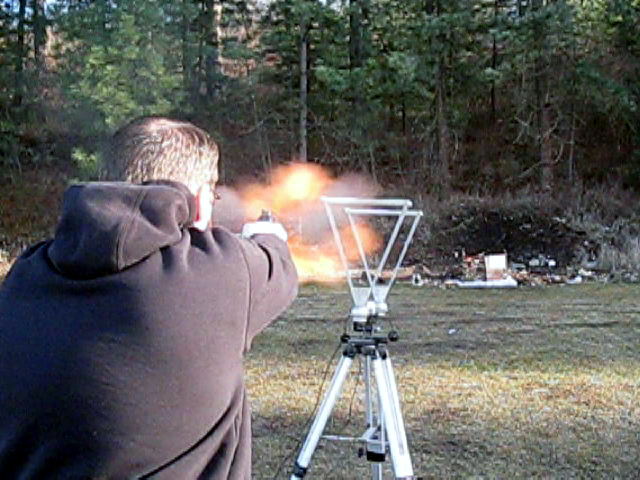
Here’s Nephew torching off one of the heavy loads.  The bullet has been on its way for about a millisecond, as the gun is still in firing position and the hot gas (I mean hot– this is in direct sunlight) has traveled a foot or so out from the muzzle;
Below is the same shot in full recoil a fraction of a second later.  Forget about quick follow-up shots.  You can’t see the target until the smoke clears. By then you’re re-cocked and ready to go.  A side wind would be a big help in this case;
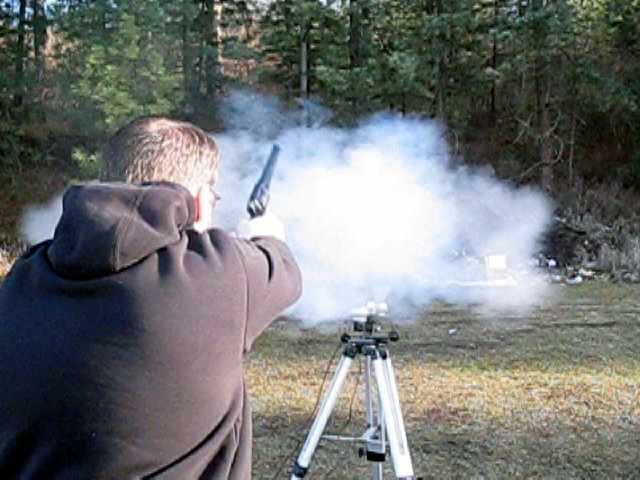
Today’s rapid fire guns wouldn’t be worth as much if they had to run on black powder.  For one thing you wouldn’t be able to see squat.  It is “interesting” to take a shot, and find that your target has simply disappeared after the smoke has cleared.  There’s that moment of uncertainty.

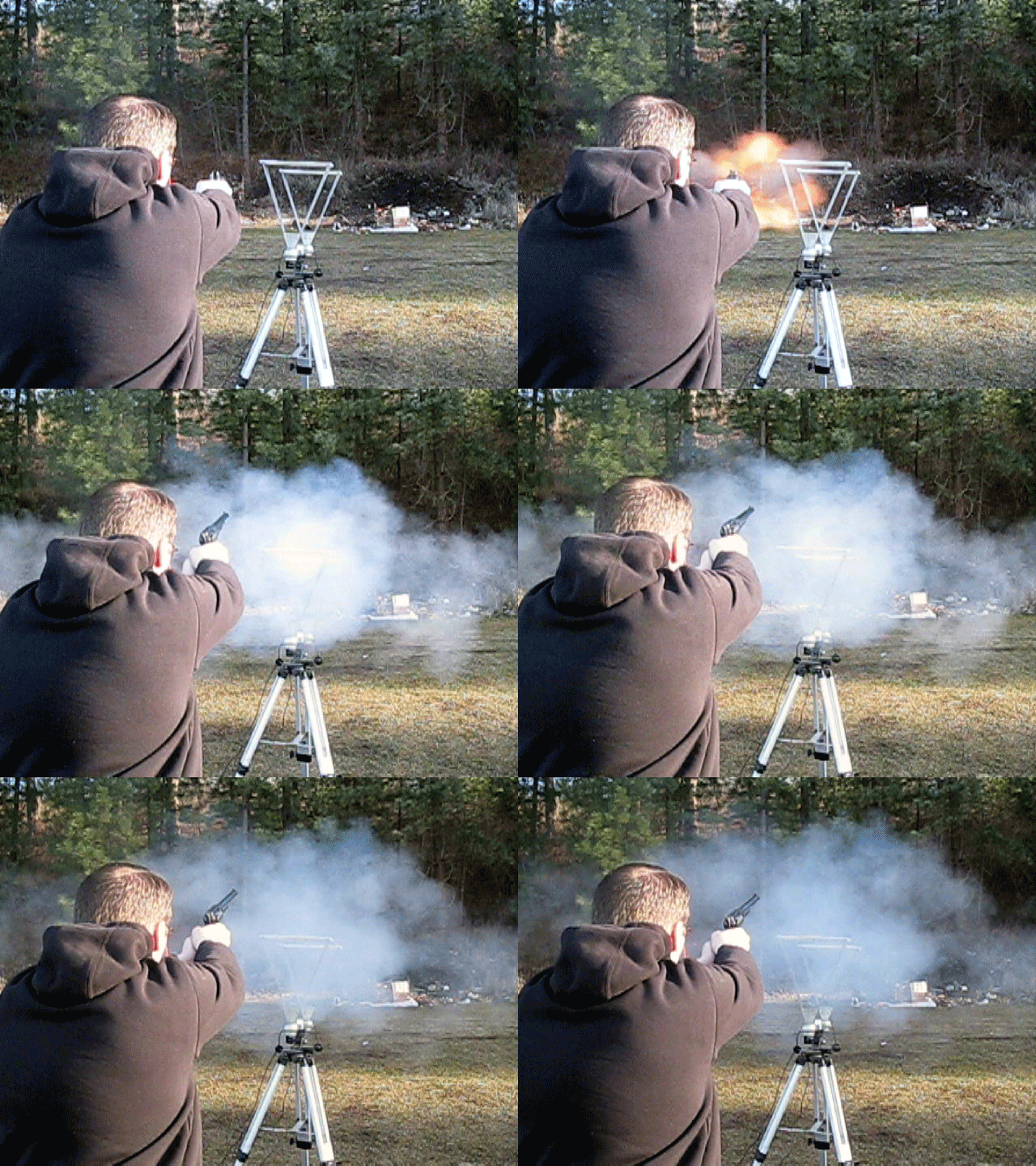
I like the slow, frame-by-frame animations as below.  You can see the mechanics of the recoil (though a high speed camera would be nice).  You can watch the force wave travel from his wrist, into the arm, the shoulder, and whole torso.  Nephew’s grip is fairly relaxed, which isn’t a problem with a medium weight 44 revolver.  Some people hate animated gifs on a web page.  I’m one of them, but this is for science;
You shouldn’t haul off and max out your charcoal burner just because I did.  I’m not saying it’s the thing to do.  What I can say is; I still, for the moment, have all my body parts (and gun parts) and all are operating satisfactorily, thank you.  I have a load that’s within the range of those used in the 1860s for the Remington New Model Army revolver and 1860 Colt Army, and it matches some of the .45 ACP loads for a ~180 grain bullet.

Now here’s a puzzler.  I’ve had barrel leading in modern revolvers and autos firing bare lead, hard-cast or swaged bullets.  Using pure, soft lead bullets in the ’58 Remington and ’51 Colts, no leading has been observed, even with these loads that achieve modern handgun KE levels.  I don’t know why.  Is it the grease?  But we’re told in no uncertain terms never to lubricate a modern gun bore, while black powder guns are greased all to hell.  Is it the propellant temp?  But the KE is the same.

Windows Phone 7 Series

This is what I’m working on.

Deep down in the O/S you will find a location application programming interface. Below that you will find code that converts the existence of Wi-Fi and cell tower radio signals into a latitude and longitude. That (and a few other things) has been my job for the last several months.

This is just one small piece of a very large and impressive picture.

As Sean just said a minute ago in an IM, “Wow. You showed me some neat stuff Friday, but I was still impressed by today’s reveal. With this piece of the puzzle, I get a tingling feeling up and down my leg. Like we really might be entering a new golden age for Microsoft.”

Shooting Lingo – Group Size

This sort of thing appears with some regularity on the forums, product reviews, etc., so I can only assume there is a significant number of people who don’t quite understand how a shot group on a target is measured.  What I recently read on an ammo review is that, since the bullet is x diameter, your group size cannot be less than x.

That’s not how it works. (Boomershooters bear with me, I’m pretty sure you all know this)  For the size of your group on the target, you’re measuring the center-to-center distance between hits.  If your holes were clean enough to allow such precise measurements, it is in theory possible to have half-inch diameter bullets and a group size of a hundredth of an inch or less.  You could just as well, theoretically, have an eighteen inch Navy ship’s gun that shoots a group of 1″ (all rounds through the same hole, to within one inch of center).  Actually getting a gun and several projectiles to do that is of course another matter, but it wouldn’t violate the simple theory of taking a distance measurement on your target.

This isn’t rocket science.  Well, maybe some aspects of shooting are in fact rocket science, but measuring the distance between centers of a few holes isn’t complicated, and has nothing to do with the diameter of the holes.  Any carpenter, machinist or cabinet maker, etc. knows this, and it is often learned by farm mechanics in early childhood.

I love engineering

Kevin has the story.

I just want to add that my degrees are in Electrical Engineering but when I worked for the Aerospace Division at Boeing a lot of my time there was in the “Terminal Guidance Lab”. Now at Microsoft I work on “location for cell phones”. In my spare time I play with my chemistry set and make targets.

It’s almost as if Kevin was talking about my career.

NRA; What’s up?

I’ve been seeing ads for the new NRA on-line national firearms museum, and I’ve also been working on building a period rifle.  I therefore thought it would be great to go and see if I could find some original examples of said period rifle at this new-fangled on-line museum, rather than having to, say, drive to Wyoming and visit the Cody Museum or pay 5 to 10 thousand dollars for an original rifle.  I tried it from home using my Mac G4 to no avail.  OK, I can forgive that.  The old G4 still has an old version of OS-X and Safari, and I sometimes have problems using other web sites.  Here at work I use XP Pro, IE 8, and a 700+ KBps ADSL connection.  I patiently try nationalfirearmsmuseum.org a few times from work and I’m redirected to nramuseum.org which displays a black screen, this tiny little sentence in the middle, and a heap big helping of nothing else;

The full NRA experience requires a broadband connection.  Click here to go directly to the standard NRA.org website.

From the standard NRA.org website you can eventually find a link to the museum, which then gives you said black screen.  Repeat as needed to become convinced beyond reasonable doubt that you’re not going to see any museum, no matter what, in spite of the fact that said non-viewable museum is currently being advertized all over the NRA publications.  Denied.  I then tried “compatibility view” in IE 8, which made quite a difference– it put that sentence at the bottom of the black screen instead of the middle.  Double denied.

If my setup can’t work, who’s does?  I thought DSL was about as broad as broadband gets, while the only clue to the denial is a note telling me my connection speed is too low, with no indication of what they consider to be “broadband”.  Have I missed some new and wonderful breakthrough in IT that everyone else knows about and uses already?  Do I need a cable ISP?  Do I need to get Win 7 or what?  In any case I think that if your web site doesn’t work with the vast majority of existing computer setups, you’re doing something wrong.  That is, if you want the majority of people to see it, and you’re not just interested in being cutting-edge for the sake of it, being satisfied with catering to an exclusive audience.

Then again, maybe I’m doing something wrong that makes it impossible to see this web site, though all the others I visit seem to work OK.

Dear NRA; I’d write you directly about this, but a black screen with nothing on it includes, as an accompanying feature, the non existence of a “if you can’t view this page, please notify our web designer by clicking here” or anything like that.

Update Jan. 10; Without my having contected them directly, NRA Tech Support wrote me this morning and fixed my problem.  Wow.  That’s service.  More in comments.