Quote of the day—Comfortably Smug‏ @ComfortablySmug

Listen to the sound of their gears and them walking. Remember that sound. You’ll hear it again soon enough as you hide in a closet, holding your child close, fighting the urge to scream. Watching the sliver of light under the door until they arrive.

Comfortably Smug‏ @ComfortablySmug
Tweeted on February 12, 2018
[Skynet smiles.—Joe]

This has to be a coincidence, right?

Via a retweet from David Whitewolf we have this:

6 x 5 x 2 minutes in an hour
8 x 3 hours in a day
7 days in a week

So every month has 8 x 7 x 6 x 5 x [# of weeks] x 3 x 2 x 1 minutes in it.

So there are 8! minutes in February.

Except, of course, on leap year.

This is incredible. This has to be a coincidence. Right?

It would appear so (see also here). In any case, wow!

Quote of the day—Cody Wilson

Gun control is not dead, gun control is undead. We just keep killing it but it keeps coming back.

The handgun is at the center of what is protected in the Heller decision. So, whereas, AR-15’s may not ever be backed up by the Supreme Court, there’s no way of getting around, right now, the protections that the Supreme Court gave to the handgun. And so this is the core of the Second Amendment liberty as it’s currently understood.

Cody Wilson
Director of Defense Distributed
February 5, 2018
Want to Make an Untraceable Handgun at Home? Cody Wilson Can Help.
[For certain values of “understood”.

These are interesting times we live in.—Joe]

Cell phones are good for rats

Back in the early 2000s I talked to a researcher who said he did tests which showed that rats exposed to satellite phone radio emissions had fewer cancers than rats not exposed to the radio emissions. Then about two years ago more research indicated the same thing with conventional cell phones.

Today, another study came out which reported:

The radiated rats somehow lived longer than comparison rats that were not exposed to cellphone radiation.

Okay, I’m convinced. If you want your rat to have a long and healthy life you should give it a cell phone.

D-DAY Through German Eyes

My brother Doug told me he recently read D DAY Through German Eyes and really enjoyed it. I am almost finished with the second book now. It’s very good. There were a number of things I learned about the weapons the allies had but what I have enjoyed most was what the German soldiers believed they were fighting for.

I didn’t realize the allies had planes and ships that fired rockets. I thought the planes only had guns and bombs. And I thought the only weapons the ships could use against land based targets were their guns and planes from the aircraft carriers.

Some of the rockets had phosphorous warheads. There were also warheads with explosives and ball bearings which were used for anti-personal as well as anti-material. And amphibious tanks! This surprised the Germans too. Some of the tanks also had flame throwers. The Germans really didn’t like the flame throwers. Some refused to go back into battle facing the phosphorous and flamethrowers even though the alternative was an expedited court marshal and execution the same day.

There were Russians who defected on the Eastern Front and joined the Germany army who assigned them to the western front. When the allies took prisoners the Russians were separated from Germans and handed directly over to the Russians. The Russians executed them. There were thousands of them.

One soldier told of the “Browning Assassination Pistol”. From the description it has to be the FP-45 Liberator. What I found most interesting is that the soldier (a military policeman) who mentioned them said thousands of them were distributed in France and probably hundreds of German soldiers were killed by French civilians with them. This is in direct contrast to what Wikipedia says about them.

The MP was guarding a small group of Germany officers the night before D-Day. As the bombing started they went to a private residence set up as a small hotel for the officers. After dinner one of the waitress suggested to one of the officers that he looked tired and perhaps he would like to go to bed (it was implied the waitress went to bed with him). He did. Later the other officers wanted to speak with the “sleeping” officer and the MP went looking for him. He found him in the bedroom, a hole in his head, blood all over, and a “Browning Assassination Pistol” on the floor. All the hotel staff were gone.

Did you know that Germany was actually protecting France? They needed to be protected from the International Socialists to the East, so there was a partnership between the French and Germany governments. The Germans were National Socialists but that wasn’t a threat to the people of western Europe. Germany united Europe. This was good for people of Europe. Why would the Americans and Canadians have a problem with that? Sure, the British hated the French and wanted a piece of France, but the Germany was protecting France from the British and the secret societies (the Free Masons) to the west who were being manipulated by the international bankers.

At least that is what was believed by many of the German soldiers.

High altitude highway

Via Boomershooter “Squirrel Hunter” we have the Karakoram Highway

The Karakoram Highway (KKH) is one of the highest paved international roads in the world. It connects the Xinjiang Uyghur Autonomous Region of China and Gilgit–Baltistan of Pakistan across the Karakoram mountain range, through the Khunjerab Pass, located at 36°51′00″N 75°25′40″E, at an elevation of 4,693 metres (15,397 ft).

Connecting China’s Xinjiang region with Gilgit–Baltistan region of Pakistan, the road is a popular tourist attraction. Due to its high elevation and the difficult conditions in which it was constructed, it is referred to as the Eighth Wonder of the World.

Wow! And I thought Idaho, Washington, Montana, and Colorado had some “interesting” switchbacks and high altitude construction on some of their mountain roads.

Nope. Nothing I have seen in the states even begins to compare.

That’s what I carry

This is kinda cool. FBI Selects Winchester’s .40 S&W Ammunition for Duty and Training:

The Federal Bureau of Investigation (FBI) has completed an extensive evaluation process and Winchester has been chosen as its primary source for .40 S&W pistol ammunition. This includes a bonded jacketed hollow point (JHP) service cartridge as well as full metal jacket (FMJ) and frangible training loads. Winchester has been supplying the FBI with service and training ammunition for many years and is honored to be awarded the most recent contract and continue to support our nation’s premier law enforcement agency.

The 180 gr. bonded jacketed hollow point (JHP) cartridge selected by the FBI is designed with patented technology that utilizes a reverse-jacketed, bonded bullet that can penetrate a wide variety of intermediate barriers while maintaining very consistent target penetration and reliable expansion. The nickel-plated cartridge prevents corrosion and ensures smooth feeding and extraction. Flash suppressed powder is used in this cartridge to maintain an agent’s night vision and meet the FBI’s stringent darkened range evaluation.

The Winchester .40 S&W, 180 grain, JHP cartridge (Ranger) is my carry ammo.

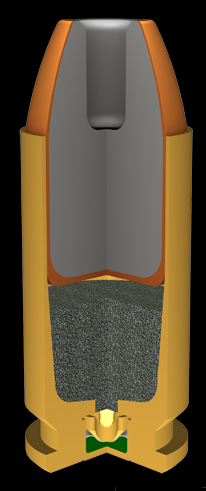
Update: In the comments John Hardin asked if the FBI chose the Ranger bullets. I think the answer is yes. As near as I can tell the “reverse-jacketed” bullet refers to their patented reverse taper (thick near the opening, thinner on the sides and base) JHP with with the jacket pre-scored in the area intended to expand. This gives the uniform size and characteristic hooks at the end of the “petals”:

image

Winchester sells several different 40 S&W 180 grain JHP cartridges. Two of them appear to use the same bullet, the W40SWD and S40SWPDB1 cartridges. A third, USA40JHP, appears to be using a conventionally jacketed bullet:

image

There are also what appear to be different brandings, and/or nickel plated brass casings, of these same three cartridges:

So, I believe the FBI must have chosen a cartridge with the same bullet as what is in the Ranger bonded cartridge.

Q#

I already know C#, I guess it’s time to learn Q#:

Microsoft today launched a preview version of a new programming language for quantum computing called Q#. The industry giant also launched a quantum simulator that developers can use to test and debug their quantum algorithms.

The language and simulator were announced in September. The then-unnamed language was intended to bring traditional programming concepts—functions, variables, and branches, along with a syntax-highlighted development environment complete with quantum debugger—to quantum computing, a field that has hitherto built algorithms from wiring up logic gates. Microsoft’s hope is that this selection of tools, along with the training material and documentation, will open up quantum computing to more than just physicists.

We are living in the future.

I’m not sure how to interpret the feelings this causes in me. I think it might be fear.

Quote of the day—John D. Clark

The old destroyer gun turret which housed our card-gap* setup had become a bit frayed and tattered from the shrapnel it had contained. (The plating on a destroyer is usually thick enough to keep out the water and the smaller fish.) So we had installed an inner layer of armor plate, standing off about an inch and a half from the original plating. And, as the setup hadn’t been used for several months, a large colony of bats —yes, bats, little Dracula types —had moved to the gap to spend the winter And when the first shot went off, they all came boiling out with their sonar gear fouled up, shaking their heads and pounding their ears. They chose one rocket mechanic —as it happens, a remarkably goosy character anyway—and decided that it was all his fault. And if you, gentle reader, have never seen a nervous rocket mechanic, complete with monkey suit, being buzzed by nine thousand demented bats and trying to beat them off with a shovel, there is something missing from your experience.

John D. Clark
1972
I G N I T I O N !: An Informal History of Liquid Rocket Propellants, page 171
[I love this book.—Joe]


* The card-gap test is used to determine the shock sensitivity of a potentially explosive liquid. A 50-gram block of tetryl (high explosive) is detonated beneath a 40 cc sample of the liquid in question, contained in a 3″ length of 1″ iron pipe sealed at the bottom with a thin sheet of Teflon. If the liquid detonates, it punches a hole in the target plate, of 3/8″ boiler plate, sitting on top of it. The sensitivity of the liquid is measured by the number of “cards,” discs of 0.01″ thick cellulose acetate, which must be stacked between the tetryl and the sample to keep the latter from going off. Zero cards means relatively insensitive, a hundred cards means that you’d better forget the whole business. As may be imagined, the test is somewhat noisy, and best done some distance from human habitation, or, at least, from humans who can make their complaints stick.

Quote of the day—Bruce Schneier

The market can’t fix this. Markets work because buyers choose between sellers, and sellers compete for buyers. In case you didn’t notice, you’re not Equifax’s customer. You’re its product.

Bruce Schneier
September 13, 2017
On the Equifax Data Breach
[I agree with his astute observation but not his conclusion (government legislation is required).

If someone is harmed by the carelessness of another the careless person can, and rightly so, be sued for damages. How is this any different?—Joe]

Speaking of suppressors…

I saw a cool vid over at Bayou Renaissance Man., on this particular page. This: a transparent suppressor and a high-speed camera.

Interesting stuff.

Prep-Check

It’s Gravity season. Time for things to fall. Things like leaves and branches. On power lines, naturally. And roads. Oh joy, be still my beating heart! Since Hurricanes Harvey and Irma and Maria, I’d been meaning to dig out the generator for a test run, and do my other fall emergency checks. Thus begins a short story of preparedness and failure. Continue reading

Dystopia idea became a blueprint

I hate it when governments take some dystopian concept and use it as a blueprint rather than a warning:

It is a CCTV clip showing current surveillance in China. Thanks to artificial intelligence (AI), facial recognition technology, GPS tracking and 20 million CCTV cameras, China’s sadly named “Sky Net” system demonstrates just how creepy real-time surveillance can be.

According to a documentary that ran on China Central Television, the security cameras use facial recognition to identify each person and then overlay a popup of personal information on the screen by the person. Descriptions include details such as age, gender, and other features such as clothing color. This happens in real time.

If you saw the TV series Person of Interest, this is the implementation of it under the control of the Chinese government. The show was pretty good. But a tool like that in the hands of any government is really bad news.

Current Chinese Surveillance System are something out a sci-fi film

H/T Josh J. via email.

Quote of the day—Ray Kurzweil

We have already eliminated all jobs several times in human history. How many jobs circa 1900 exist today? If I were a prescient futurist in 1900, I would say, “Okay, 38% of you work on farms; 25% of you work in factories. That’s two-thirds of the population. I predict that by the year 2015, that will be 2% on farms and 9% in factories.” And everybody would go, “Oh, my God, we’re going to be out of work.” I would say, “Well, don’t worry, for every job we eliminate, we’re going to create more jobs at the top of the skill ladder.” And people would say, “What new jobs?” And I’d say, “Well, I don’t know. We haven’t invented them yet.”

That continues to be the case, and it creates a difficult political issue because you can look at people driving cars and trucks, and you can be pretty confident those jobs will go away. And you can’t describe the new jobs, because they’re in industries and concepts that don’t exist yet.

Ray Kurzweil
September 24, 2017
Why Futurist Ray Kurzweil Isn’t Worried About Technology Stealing Your Job
[That has been my hunch too, but I can’t supply evidence to refute the claim, “But this time it’s different!”—Joe]

This could save millions

This is great news:

Scientists have engineered an antibody that attacks 99% of HIV strains and can prevent infection in primates.

It is built to attack three critical parts of the virus – making it harder for HIV to resist its effects.

The work is a collaboration between the US National Institutes of Health and the pharmaceutical company Sanofi.

The International Aids Society said it was an “exciting breakthrough”. Human trials will start in 2018 to see if it can prevent or treat infection.

If this works out the people of Africa will probably benefit the most, but there is no continent that won’t have significant number of lives saved if there is near universal vaccination of those at risk. And if the technology can be adapted to other viruses, even just colds and flu, it will be a significant win for humanity.

John Vlieger in the news

A media release from son-in-law John Vlieger’s sponsor Shell Shock:

Shell Shock Technologies, LLC., an early stage technology and manufacturing company focused on developing innovative case technologies for the ammunition industry, is pleased to announce its sponsored shooter John Vlieger has won High Overall in the Open Division at the 2017 USPSA Area 4 Championship, held at the United States Shooting Academy in Tulsa, Oklahoma, Sept. 8 – 10, 2017. Vlieger finished with 1390.928 match points and a time of 148.09. This was his second consecutive Area win.

“Being able to take home a second regional title in such a short time is another goal reached. The time spent traveling, training and competing can take it out of you, but I’m ready and raring to go to the next one. Having reloading components I can trust with my +P+ competition loads helps me focus on competing, and not on whether or not my gear can take the abuse. My Shell Shock Technologies’ NAS3 cases have taken everything I’ve thrown at them and keep on going. I plan on continuing to trust them as I finish out the 2017 competition season, and forward,” commented Vlieger.

The USPSA Area 4 Championship, otherwise known as the Walther Arms-MGM Targets Area 4 Championship, is a Level III (pending) match that runs 12 stages with a round count of 290. Watch Vlieger compete at the USPSA Area 4 Championship on the John Vlieger Shooting YouTube Channel.

Vlieger can be seen competing next at the Tennessee Atomic Blast USPSA State Championship Match, to be held at the Oak Ridge Sportsman’s Association in Oak Ridge, Tennessee, Sept. 16 – 17, 2017.

John placed second out of 227 competitors at the Tennessee Atomic Blast.

Quote of the day—John D. Clark

They were preparing to ship out, for the first time, a one-ton steel cylinder of CTF. The cylinder had been cooled with dry ice to make it easier to load the material into it, and the cold had apparently embrittled the steel. For as they were maneuvering the cylinder onto a dolly, it split and dumped one ton of chlorine trifluoride onto the floor. It chewed its way through twelve inches of concrete and dug a threefoot hole in the gravel underneath, filled the place with fumes which corroded everything in sight, and, in general, made one hell of a mess. Civil Defense turned out, and started to evacuate the neighborhood, and to put it mildly, there was quite a brouhaha before things quieted down. Miraculously, nobody was killed, but there was one casualty —the man who had been steadying the cylinder when it split. He was found some five hundred feet away, where he had reached Mach 2 and was still picking up speed when he was stopped by a heart attack.

John D. Clark
1972
I G N I T I O N !: An Informal History of Liquid Rocket Propellants, page 74
[The chemicals these people created and worked with were incredible. Some compounds caused things like dirt, concrete, and test engineers to immediately catch on fire upon contact. Others would burst into flames upon contact with the ground, burn for a while, and then violently explode. The reactivity and energy content is just mind boggling.—Joe]

It’s the radiation, Stupid

They started with weightlessness as the reason, they did drop the R-word in the middle (can’t throw out all credibility), but only in passing, then reinforced the weightlessness meme again at the end.

I see it like this (because this is how it is); you can’t get the money if you aren’t offering the hope of something exciting (like a Mars colony) or something excitingly catastrophic (like the end of the world unless government has total control). Therefore you can’t come out and say that a Mars colony is a stupid idea because then you lose your funding.

In fact you’d have to live underground on Mars, or die of radiation. If you’re going to live underground, well, you can do that here on Earth much more easily and cheaply. AND…you don’t want to do that anyway, because living underground forever is boring, so forget the whole thing.

On second thought, no; I’m wrong about all of that so give me a hundred billion dollars and I’ll get you’re dumb ass to Mars. You’ll need to pay in advance.

Amazon carries Interflon Fin Super again

I’ve written about Interflon Fin Super before and use it on all my guns. It is available from Amazon again.

Montana Gold Bullet factory tour

Kalispell, Montana was on the way home from Glacier National Park so Barb and I decided to see if we could get a tour of the Montana Gold Bullet factory. I have reloaded nearly 39,000 (38,684) of their bullets and have another 4,500+ in stock and ready for the Dillon 550.

I called the number on their website and set up a time for yesterday that worked for Norm and us.

We arrived a few minutes early at the unmarked warehouse like building. I took a picture of Barb out front and Norm greeted us a minute or so later.

WP_20170817_10_21_15_Pro

I asked if we could take pictures and Norm told us, “No pictures allowed.” As we went inside and started the tour Norm told us production goes down during the summer and there wasn’t as much going on as there sometimes is. I asked if the election had also affected sales. He said it had made a big difference not just for Montana Gold Bullets but across the entire industry. He had looked at demand over the years and it has gone through several cycles. The first peak occurred after Bill Clinton’s election and the last peak being just before the defeat of Hillary Clinton.

Before we moved on I asked why they used brass jackets rather than copper like almost all other bullet manufactures. Was there a technical reason or was it the just the appeal of the gold color and the neat name made possible by that color?

Norm explained their company wasn’t the first to use brass. Remington, with their Golden Saber bullets, was the first and marketed them extensively. There are other companies who also use brass in some of their bullets. There are some technical reason why brass is better in certain circumstances but that isn’t the reason why his company uses brass. And it wasn’t the appeal of color and the cool name of “Montana Gold”. Also, he didn’t come up with the name “Montana Gold”!

He said he probably shouldn’t tell the story, then proceeded to tell us how the name came about. I’ll refrain from telling the story here but I’ll drop the hint that it was a San Francisco pathologist who came up with the name “Montana Gold” for the bullets produced by Norm’s company. Norm thought it was a cool name and adopted it.

The reason they use brass is because it was forced upon them, indirectly, by the U.S. government. Many years ago the U.S. Mint began producing small dollar coins that were a copper sandwich. The demands of the U.S. Mint for the particular grade of copper the bullet company was using made it impossible for Norm’s company to get the jacket material they needed. It was either go out of business, shutdown until they could get supplies, or change jacket material. They changed jacket material.

Another story he told was of a commercial reloader who bid on a contract for law enforcement ammo specifying, and supplying samples using, Montana Gold bullets. When he won the contract and started delivering the finished product the end customer noticed the bullets were actually plated bullets which are much cheaper to make and generally considered of lower quality. They complained to Norm, who reported he hadn’t supplied those bullets. Norm now refuses to do business with that reloader and, furthermore, does not allow reloaders to mention “Montana Gold” even if they are using “the real deal” in their product.

We saw the 70 pound lead-antimony ingots they use for bullet core material. As there are no more primary lead smelters in the U.S.they get their lead from Canada. They used to get their lead from mines in Idaho not too many miles away. At one time they even considered moving to Idaho to be close to their lead source as well as some economic incentives.

Barb was particularly impressed with the extruding equipment that squeezes the lead through an orifice like so much toothpaste making a lead wire of the appropriate diameter.

I was surprised by learning that because the metals alloyed with lead (to get the desired hardness) are of a different density the ingots may not be of sufficient uniformity to meet their final bullet weight tolerances. Depending upon how quickly the liquid lead alloy is cooled to a solid after being stirred they may cut off a section of the lead wire as scrap because can cause the bullet to be too light.

The thickness of the jacket material and the consistency of hollow point formation also have an effect upon the final bullet weight. Tolerances stack up. They keep the weight of their bullets to about +/- 0.3 grains and sell bullets that are out of tolerance as “seconds” to people who take delivery at the factory who Norm is confident will be using them directly rather than reselling them.

After being shown a bin of with tens of thousands (or maybe 100’s of thousands) of jackets I told Norm about finding one in a box of completed bullets. This seemed to bother him some. He told us there were at least three different places in the process it should have been been found.

They have several machines which are dedicated to certain bullet caliber and style and a few they reconfigure as needed. We saw large multistage presses which put the lead core into the brass cup then form the cup around the lead and size it to make a completed bullet. I was surprised that the machine only produced about one finished bullet per second. That one machine takes about 40 minutes to produce one case of bullets the postman delivers to my door (actually–the sidewalk near the street, then he rings the doorbell).

I told Norm I had used their .401 diameter, 180 grain, complete metal jacket bullet until fellow shooter Don W. reported he got better accuracy with the jacketed hollow point bullets. As the price was only a fraction of penny more I tried those bullets and found Don was correct. I too got slightly better accuracy compared to the CMJs.

Norm said the decreased accuracy with the CMJs probably was because my crimping die was just a little to tight. If crimped too much it will end up as an undersized bullet. Because of the construction of the base on a FMJ, and even a JHP, as a slightly undersized bullet is fired it will expand back out and be just fine. But the base of a CMJ with the brass (or copper) disk doesn’t expand like the FMJ and JHP and “rattles” as it traverses the barrel resulting in a decrease in accuracy. By backing off the crimping die a little bit you should get the same accuracy.

Near the end of the tour Norm pointed at two work stations with women flicking bullets, one by one, off a conveyor belt. “That”, he said, “Is the most difficult job here. It takes a special kind of person to do that and when we find someone who can do it we take special care of them.” These women do the visual inspection of every bullet. They don’t work full days and yet Norm told us you can see from their faces they are drained and tired at the end of their shifts. They considered going to some sort of sensors and computer sorting but the visual computer in the human brain can’t be beat yet.

Barb and I spent nearly an hour with Norm and the stories and discussion continued until both Barb and I were in pain from standing. We had hiked over 33 miles in the previous four days and felt we could hike some more but not stand. My knees were “talking to me” in an angry tone so we thanked Norm and left with new appreciation and attachment to Montana Gold bullets.