Quote of the day–Milton Friedman

Hell hath no fury like a bureaucrat scorned.

Milton Friedman

Quote of the day–Eric Engstrom

Computers and the internet are a far bigger problem for the government than they are for the individual.

Eric Engstrom
October 2003

Quote of the day–Jeff Cooper

The media insist that crime is the major concern of the American public today. In this connection they generally push the point that a disarmed society would be a crime-free society. They will not accept the truth that if you take all the guns off the street you still will have a crime problem, whereas if you take the criminals off the street you cannot have a gun problem.

In the larger sense, however, the personal ownership of firearms is only secondarily a matter of defense against the criminal. Note the following from Thomas Jefferson:

The strongest reason for the people to keep and bear arms is, as a last resort, to protect themselves against the tyranny of government.

That is why our masters in Washington are so anxious to disarm us. They are not afraid of criminals. They are afraid of a populace which cannot be subdued by tyrants.


Jeff Cooper
From Jeff Cooper’s Commentaries
Vol. 2, No. 5
May 1994

Institutionalized bigotry

According to these guys I imagine I exhibited all the symptoms of someone about to go postal, except for one.  The one missing was supplied by PNNL–by firing me.  How many other civil rights activists exhibit the same “symptoms”? 

Some type of obsession, e.g., weapons, other acts of violence, romantic/sexual, zealot (political, religious, racial), the job itself, neatness and order

Performance Problems, including problems with attendance or tardiness [I am a night person and I, and others, would arrive late and leave late]

Access to and familiarity with weapons

Being fired, laid off or suspended; passed over for promotion

As I read this web page I and others who advocate for the rights of gun owners, should never be hired in the first place.  There is a word for this–bigotry.

Quote of the day–Jim Grieshaber-Otto

“Free trade” is actually a misnomer, Grieshaber-Otto contends; the new global rules are actually aimed primarily at restricting government regulations, which is bad news for advocates.

Jim Grieshaber-Otto, Ph.D.
An international trade expert with the government of British Columbia.
From: http://www.jointogether.org/gv/default.jtml?O=264057
August 12, 2000

Quote of the day–H.L. Mencken

Human progress is furthered, not by conformity, but by aberration.

H.L. Mencken
MicroNews
[This doesn’t mean that all aberration is a form of human progress.  Just as in DNA mutations–most of the mutants are not viable.  -Joe-]

Quote of the day–David A. Lytel

Cryptography is an enormously powerful tool that needs to be controlled, just as we control bombs and rockets.

David A. Lytel
Co-founder and managing partner Democrats.com

Think about it

If someone says London was bombed because of their involvement in Iraq, or the U.S. involvement in the Mideast was the reason for the repeated attacks (USS Cole, World Trade Center bombing, WTC and Pentagon hit with planes, etc.) we suffered then ask them to think about this:

More than 80 Iraqis have been killed in at least 11 suicide attacks since London had its first taste of suicide bombings a week ago today. In the first half of this year more than 1,000 Iraqis have died in about 130 suicide attacks. It has been a sustained terror assault that has steadily grown in intensity and has no precedent in Israel, Beirut or anywhere else.

The Islamic extremists are killing thousands of Iraqis.  Many, if not most, of them are Muslim.  Further food for thought is available in the same article:

THE local kids rushed to greet the US patrol. “Hello, Mister,” they cried to the American soldiers, who started handing out chocolate bars and keyrings. At that moment a car sped from a side street and exploded right next to the crowd gathered around the Humvee.

More than 30 Baghdad youngsters, aged between six and 15, were killed yesterday in a suicide bombing that marked a new level of depravity even in a city used to daily carnage.

…

One woman, Hana Ali, failed to find her 11-year-old son at the hospital. When she returned to the blast scene, she found his head in the rubble.

“They killed all the children of the neighbourhood,” wept Radhi Hamud, but he was one of the “lucky” ones. His 13-year-old son, Husam, was among another 30 or so children who were merely maimed. Husam lost both his legs.

So what’s the motivation?  Osama bin Laden told us.  And in this fight, who is a legitimate target (credit to Clayton Cramer)?

Asked what constituted a legitimate target, Bakri said: “We don’t make a distinction between civilians and non-civilians, innocents and non-innocents. Only between Muslims and non-believers. And the life of an unbeliever has no value. It has no sanctity.”

Think about it.

Quote of the day–Henry Kissinger

The illegal we do immediately. The unconstitutional takes a bit longer.

Henry Kissinger

[Although he said this decades before on another topic it could have been said about the Kelo decision.

Update on December 3, 2023: Citation for the quote.]

Quote of the day–Paul Smith

If a law containing the word “gun” or “firearm”, etc…. would still describe an illegal act regardless of that word, the word should be removed as being unnecessary.  Furthermore, laws that describe mere possession of an item (that can be safely controlled and maintained by the possessor) as the punishable “act” are not “reasonable” …

Paul Smith
Email Sept 3, 2001, 7:13 PM

Surveillance cameras fail

Analog Kid at Random Nuclear Strikes asks:

Do you think the vast array of surveillance cameras in London helped even a tiny bit?

Security expert Bruce Schneier has this to say:

I was going to write something about the foolishness of adding cameras to public spaces as a response to terrorism threats, but Scott Henson said it already…

Henson has been blogging on this topic for quite a while and points out that when private businesses install cameras they can have some success.  When governments install cameras in public areas they have little positive effect.  England has millions of cameras but they are now to the point of outlawing certain types of clothes that thugs use to easily defeat the cameras.  And as long as you are allowed to wear clothes and carry backpacks, shopping bags, and brief cases in public there will be no surveillance system which can prevent crime or especially prevent terrorist activities.  Spending the resources on better intelligence and destroying the culture of terrorism is a much wiser plan of action.

Quote of the day–Ted Nugent

You should be able to put the second bullet in the same hole as the first bullet. That’s gun control.

Ted Nugent
July 2005
From http://www.austin360.com/music/content/music/statesman/2005/07/11nugent.html

Quote of the day–John Locke

The people cannot delegate to government the power to do anything which would be unlawful for them to do themselves.

John Locke

An excess of power

As hopeful as I am about our progress on the gun rights front it’s certainly true we have been losing major battles on other fronts. This article by Radley Balko at the Cato Institute is concise and to the point:

This past term, the Supreme Court handed down two rulings that will have a catastrophic effect on our personal freedom. In Raich v. Gonzaelez, the Court ruled that the Constitution’s provision to regulate interstate commerce permitted federal agents to raid the home of a sick woman and confiscate the six marijuana plants she was growing for her own medication — all in a state whose population had overwhelmingly voted to make medical marijuana legal. In Kelo v. New London, the Court found that the phrase “public use” in the Fifth Amendment allows local governments to snatch land from law abiding people, and sell it off to wealthy developers.

Both cases will have negative repercussions for liberty that reach far beyond their specific facts. The founding fathers understood that every right we have emanates from our right to private property. In this sense, “private property” means not only the right to one’s home and land, but also the right to own the product of one’s labor. James Madison, the father of the U.S. Constitution, wrote in 1789, “A man is said to have a right to his property, he may be equally said to have a property in his rights. Where an excess of power prevails, property of no sort is duly respected. No man is safe in his opinions, his person, his faculties, or his possessions.”

Every right we have stems from government’s recognition that we, the people, are born with our rights intact. We own them. We have property in them. We voluntarily forfeit some of these rights to government, in exchange for protection from outside threats, the administration of justice, and the rule of law. The purpose of the U.S. Constitution, then, is not to tell us what rights we have. We’re born with the right to do as we please, so long as we don’t harm others. The Constitution’s purpose is to outline what rights we give to the government, and to firmly define the limits of government power.

Unfortunately, this isn’t widely understood. Commonly, we hear people say things like, “where in the Constitution does it say you have the right to smoke a cigarette?” Or, “where in the Constitution does it say you’re allowed to look at pornography?” James Madison worried about questions like these. He feared that if we included a Bill of Rights in the Constitution, people would eventually come to assume the rights it listed would be the only rights we have. Others felt some rights — speech, arms, etc. — were so vital as to merit explicit mention. As a compromise, they included the Ninth Amendment, which says that the enumeration of some rights should not be construed to exclude rights not enumerated. So to answer the questions above, your right to smoke a cigarette or consume pornography are both in the Ninth Amendment.

This is why the decision in Raich is so important, and so devastating. While the Supreme Court has ignored the Ninth Amendment for decades, Raich may serve as its obituary. If the Ninth Amendment doesn’t protect a man’s right to consume whatever medicine might give him relief from pain — or that in some cases could save his life — what’s left that it could possibly protect?

If the Supreme Court killed off the Ninth Amendment with Raich, Kelo in many ways represents the culmination of its complete disregard for even our explicitly enumerated rights.

Go back to Madison’s quote above. A government that doesn’t respect the title to your land is in all likelihood a government that will in time lose respect for your property in your right to speech, arms, and due process. And indeed in recent years, with help from the Supreme Court, government at all levels has run roughshod over even our explicitly enumerated rights.

With increasingly restrictive campaign laws, for example, we’ve lost the most important of our First Amendment protections — the right to criticize the people who govern us at election time. The Second Amendment has been trampled by gun control legislation. In our nation’s capital, for example, guns of any kind have been all but outlawed. The PATRIOT Act and a spate of Supreme Court Drug War decisions have rendered our Fourth Amendment protections from warrantless searches meaningless. Our Fifth Amendment right against self-incrimination has been diluted in many contexts, and outright suspended in others (drunk driving cases, for example). Many prosecutors treat its grand jury provision not as a criminal protection, but as an invitation to abuse. And, of course, Kelo wrecked the Fifth’s takings protections. There are only cursory examples. There are many more.

In this sense, Kelo’s symbolic significance is probably more damaging than its practical application. By deferring to state and local governments, who may now seize property for virtually any reason at all, the Supreme Court has announced its complete disregard for private property. Which means that America may have finally achieved Madison’s dim vision: “An excess of power” now prevails, and we’re now living under a government that neither respects our right to property, nor acknowledges the property we own in our rights.

Perhaps this isn’t the cheeriest of columns to write for Independence Day. But it’s certainly appropriate. Thomas Jefferson famously wrote that, “eternal vigilance is the price of liberty.” We obviously haven’t been vigilant enough. Coincidentally, July 4 marks not only the birth of America, but the death of two of its founders — Jefferson, and John Adams died on this day in 1826. Perhaps we should mark the date not only by celebrating America’s independence, but by working to insure that this July 4 doesn’t also mark the death of the ideas that animated its founding.

It’s difficult to achieve the grass roots support for many of our other rights like we have in the gun rights movement.  We, as gun owners, go to the range, gun shows, clubs, buy and read magazines and in general associate with others and exercise our rights on a regular basis.  All of us are similarly impacted by unconstitutional restrictions on our guaranteed freedoms.  There are many millions of us.  But how do we, as property owners and others in fear of unconstitutional takings of various types organize the critical mass to get the appropriate message to the politicians on other freedoms?  Only a few hundred or a few thousand are impacted each year–not millions as in the case of gun owners.

$1.3 Billion spent to answer a question

This is basically further confirmation of what I said a while back about the gun registry in Canada: 

The gun controls implemented by the federal Liberal government in 1995 appear to have had little if any effect on gun-related deaths, despite a $1.3-billion price tag and the government’s extravagant claims that the measures would produce “a culture of safety” and dramatically reduce crime.

Last fall, Statistics Canada declared that “the specific impact of the firearms program or the firearms registry” on Canada’s declining homicide rate could not “be isolated from that of other factors.” On Tuesday, following the release of her paper, Deaths Involving Firearms: 1979 to 2002, StatsCan researcher Kathryn Wilkins explained, “there have been gun-control laws for most of this last century, of one sort or another,” so it is difficult to identify a single cause of Canada’s shrinking rate of firearms deaths (a category that includes murders, suicides and accidents).

…

We can understand Statistics Canada’s reluctance to come right out and pronounce Ottawa’s gun controls to be irrelevant: They’re statisticians. But taxpayers and laymen are not similarly constrained.

They have spent over a billion dollars to try and answer just one question.  Their answer is “No.”  And my response is “Nice try, you lose–in so many ways”.

A learning moment

Michelle Malkin is the most recent blogger to bring this to my attention.  Someone else did a few days ago but I can’t seem to find that post right now. 

The story is that some wacko judge ruled that two radio talk show hosts (I’ve met and talked with both personally, but those are stories for another time) were campaign contributors because of their on the air support of an effort to eliminate a gas tax increase in Washington State.  The Seattle Times carried the AP story: 

KVI and Fisher Broadcasting executives were aghast. They said talk-show hosts John Carlson and Kirby Wilbur were only doing what political commentators and newspaper editorial pages do across America: discussing issues and recommending action.

“Each host is entitled to his own opinion on the issues of the day,” said Dennis Kelly, a top official at Fisher Broadcasting, KVI’s parent company. “We don’t agree with the premise of the ruling. If the judge’s ruling holds, it will have a chilling effect on talk and news shows across America. It was a really unwise ruling.”

The Seattle Times editorials, somewhat surprisingly, had strong words against this ruling:

See what is being done here. The judge is following a simple syllogism:

All political contributions may be regulated;

Speech is a political contribution;

Therefore, speech may be regulated.

…

Though state law sets no spending limits on initiative campaigns, it does set a limit of $1,375 per contributor to state election campaigns. Suppose, then, that Dino Rossi ran for governor again, that Wilbur and Carlson strongly supported him, and that the Rossi campaign were required to report it as a $20,000 in-kind contribution by Fisher Broadcasting.

In that case, Fisher would have violated the law. And how? By speaking on political topics during an election campaign.

Two years ago, when the federal campaign-finance law reached the U.S. Supreme Court, dissenting justices Antonin Scalia and Clarence Thomas warned that something like this would happen. We doubted it; it seemed clear to us that the law applied to ads, not editorial content. We thought Thomas was over the top when he said campaign-finance law was leading toward “outright regulation of the press.”

Judge Wickham has made a step toward just that. It is a dangerous, unconstitutional ruling. The losers need to appeal it and the appellate courts need to reverse it.

The more astute people on the left have began realizing that all that power they gave, and in this case are giving, to government is more and more being put in the hands of their political enemies.  The editorial writer(s) were able to think far enough ahead to see they could be next.  I don’t know the exact process that occurred in their mind(s) but I envision it was something like what Lyndon Johnson articulated.  This is what we call a learning moment.  It’s not too much of a stretch to imagine them having a learning moment about firearms as a result of this same incident.

Machine guns and government abuse

I live in a state where machine guns are legal and people often ask if I have any.  I don’t.  I’m not a fan of machine guns.  I’ve fired a few, when other people were paying for the ammo, but my impression was that I could get more rounds on target in the same amount of time with a semi-auto.  I’ve also read of fairly well done tests and saw one video of such a test where similar conclusions were reached.  The bottom line for me, assuming you are using a reliable gun in the right caliber for the job, is always time and accuracy.  Machine guns just don’t improve my bottom line.  I’ll agree there are valid applications for full automatics but I just don’t envision myself being in a situation where it would be the proper tool for the job.

Regardless of the above position on machine guns, I have a big problem with government restricting firearms of any type.  Part of the reason is the “slippery slope”, part is the obvious “someone else has legitimate use”, and part is the problem of distinguishing between “good guns” and “bad guns”.  This latter problem is addressed on this JPFO web page:

The technicians who work at FTB testify before the courts as “experts” on the technology of firearms. They may or may not have any real-world or industry experience. It is a fact that no technician at FTB has ever held a federal firearms license or ever designed a firearm. Unfortunately the problem runs even deeper than that. The recent public exposure of an incompetent FTB technician, Michael J. Cooney (U.S. v. Glover), which resulted in the dismissal with prejudice of a federal prosecution of an innocent citizen, raises troubling questions about the legal validity of past prosecutions in which Mr. Cooney testified, and possibly those of other FTB technicians.

Congress has given the ATF the task of “classifying” firearms – for instance, determining whether a firearm is a common, semi-automatic that fires one shot with each trigger pull or whether it is a machine gun, designed to fire multiple rounds on one trigger pull (full auto). Numerous gun owners and gun makers have been bankrupted or imprisoned because the ATF stated that their firearms were “illegal machine guns” rather than semi-autos. If the ATF’s classifications were accurate, then this would just be a matter for lawyers and lawmakers. But there is ample evidence – and not only in the case of Mr. Cooney — to indicate that the ATF’s classifications are arbitrary and inaccurate. The ATF seemingly does not employ consistent testing criteria and standards.

The core issue is the methodology (or lack of) in making firearm classifications. The ATF does not employ the time-honored and well-honed methods of scientific inquiry.

…

In attempting to “prove” that a semi-automatic firearm is, or can easily be made, full-auto, ATF “experts” have been known to attach a variety of devices to the gun being tested. They commonly, for instance, fasten new parts to the firearm or remove parts from the firearm, then hold the resulting device together with duct tape, plastic cable ties, or small metal bars before test firing it. They use these aids because otherwise the components of the jury-rigged test weapon will not hold together on their own. Such a device would be useless in the real world, yet the ATF freely uses these Rube Goldberg contraptions to “prove” that a weapon is illegal, and that the original maker or owner of the firearm is committing a federal crime!

These strange ATF-created lab contraptions can also be so dangerous that the testers hide behind barriers to protect themselves against exploding firearms. Yet ATF agents may still tell a jury that such a weapon is a usable “machine gun.”

I didn’t follow up on the story to verify it for myself but I heard several years ago a guy had a machine gun which was made inoperable by the receiver being cut in half.  He was a successful gun rights activist.  The anti-gun politicians didn’t like his successes.  A police raid on his place turned up the cut in half machine gun.  It was claimed by my story teller than the ATF lab used duct tape to hold the two pieces of the receiver together and got it to fire two rounds with one pull of the trigger before it fell apart.  What I do know is true is that the gun rights activist spent several years in prison for illegal possession of a machine gun.

And as Alphecca points out today:

Poorly worded laws are an open invitation to abuse by authorities.

…

A bad law is worse than no law.

And I’m with Jeff Cooper on machine guns (full story in tomorrows “Quote of the day”):

As I have often stated, if someone wants to shoot at me, I sure hope he does it on full-auto.

Jeff Cooper
Jeff Cooper’s Commentaries
Vol. 1, No. 9
October 1993

Let’s just get rid of the silly restrictions on full automatics.  There is no valid use for such a law.

Quote of the day–Robert B. Reich

We have reached an age in which entrepreneurial capitalism is no longer relevant. It’s an end to the myth that the little guy who works hard and believes in himself can succeed in America. We have entered an age of collective entrepreneurialism. Where resources and investment must be directed for the good of society.

Robert B. Reich
Secretary of labor under President Bill Clinton
Quoted by Jack Kemp at the CPAC, 2/12/94

[For those of you who think nothing has improved under the Bush administration. –Joe]

Quote of the day–Mohandas K. Gandhi

Truth never damages a cause that is just.

Mohandas K. Gandhi
(1869-1948), Indian political and spiritual leader.
Non-Violence in Peace and War, vol. 2, ch. 162 (1949).

More anti-gun organizations

I ran across a couple new (to me) anti-gun web sites today.

I haven’t really looked over either of them very well.  They are mental cases just from the names of the organizations. The first thing I saw on Handgun-free America was this screed on “assault weapons” which confirms my diagnosis:

These weapons, which are designed to spray bullets while shooting from the hip, are built to kill large numbers of human beings as quickly and efficiently as possible.

…

Plain and simple, these guns are used to commit crimes by criminals and terrorists.  While the NRA claims that assault weapons have never been used in crime, they are simply lying.

[heavy sigh]

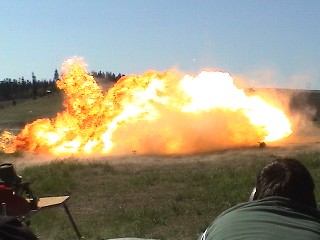
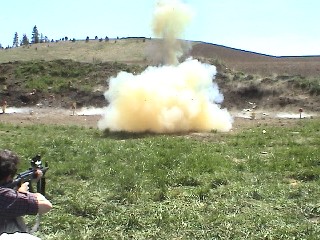
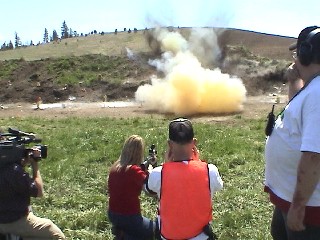
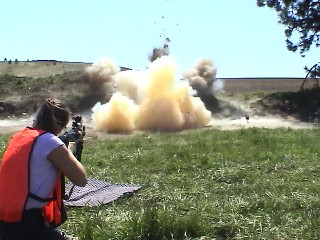
The NRA has never claimed anything like that.  They have claimed they are rarely used in crime–which is true.  And we don’t really need to get into the “spray bullets while shooting from the hip” portion do we?  The guns have all have sights on them!  And I’m nearly certain there are more rounds fired from “assault weapons” at the Boomershoot each year than there are in criminal acts.  Here are some pictures of the more common uses for “assault weapons” (click on the pictures for the video):


No video available for this one.

That should put the “Handgun-Free America” people at ease, don’t you think?