Guns are such phallic symbols giving the shooters feelings of potency and such a feeling of relief when they are discharged! I’m sure that is one of the chief reasons why Americans hang on to their guns so strongly. They should know that they are not so poorly endowed that they need guns to make them adequate.
Someone should ask Ms. Rodda the process by which she determines truth from falsity. I suspect she also has some difficulties in distinguishing reality from delusion.—Joe]
Just shoot yourself. The modern man doesn’t need to hunt, he has all he wants and can obtain anything without hunting or any other stupid sick barbaric medieval method. What the fuck do you know about nature? You’re just talking shit to give a “logical” explanation why you hunt, it’s all bullshit ! Cut the crap with the nice, civilized outspoken person, ’cause you’re not ! You deserve to be considered trash, you an hypocrite, people like you don’t need respect, you deserve all the swears in the world because you understand just one law, the fist in the jaw law ! Any anti-hunting or animal right argument isn’t ever good for you, you just know that one thing, that you’re the center of the world and for that you’re nothing,you’re just a waste of oxygen !
I also have to wonder if Kiki thinks butchering animals at the slaughterhouse is somehow less barbaric than in the field. And that they want hunters dead but animals in the wild to be left unmanaged would seem to be further evidence they regard hunters as not only subhuman but even below animals in regard to respect for their lives and rights.
That’s some pretty sick stuff right there. And it’s a very good reminder of why the right to keep an bear arms is so important. People like that have no inhibitions about committing genocide.—Joe]
Liberals would like us to believe we don’t have stricter gun control laws because politicians are putty in the hands of the National Rifle Association. In fact, most pols are exquisitely attuned to popular opinion. The reason neither Democrats or Republicans aren’t pushing for gun control is that voters don’t want it. Democracy can be a stubborn thing.
You can’t make gun owners the target if you want to change the conversation. You can’t even make guns the target. The desired end result of any gun control advocate is less gun violence. In other words, less crime. That’s what you’re really fighting against. Saying you’re against guns actually distracts people from that message, and in fact invites many people to resist.
Drew Magary
August 7, 2012 Why Gun Control Isn’t Working
[What he is saying is mostly correct. What he apparently doesn’t understand is that “less gun violence” is not synonymous with “less crime”. Smart anti-gun people know that and very carefully avoid talking about less crime. The carefully chosen words they use betrays their knowledge that they are not anti-crime but rather are anti-gun and/or anti-gun owner, or just plain want to control other people.
If gun control resulted in less crime then answering Just One Question would be easy. But it has never been done in a way that would bring a smile to the gun control activist (see here for details). Magary needs to spend sometime investigating the facts before expressing his opinions. He isn’t as smart as he thinks he is.—Joe]
My position is absolute. I want less, not more gun control. I’m not going to compromise or work with them on any issue unless the other side gets me in a position where the only choices are bad and worse.
Sebastian August 7, 2012 A Defense of Absolutism [I think there might be some exceptions to this position but generally he gets it right.
Our opponents do not have our best interest or even the interests of society at heart. Some of them openly admit that they will push for more gun control as long as there are still even one accident or crime committed which involved a gun. There is no trade-offs in their world view. They view the private possession of guns as evil. There is no negotiating with people that “think” like that. If they cannot even discuss the costs of gun control there is no point in even talking with them. They must be politically destroyed.—Joe]
“Freedom is on the march” – in our movie theaters now – not Ay-rak. It’s the “American exceptionalism”! If compared with the rest of the FIRST & SECOND WORLDS, where selling ammunition on the internet – like “only” 6000 rounds + assault weapons to the general population is considered INSANITY. Here is it “intended for hunting – shooting a duck”? haha. Sitting ducks? ….like sitting ducks in movie theaters? 36 acts of mass violence in 30 yrs will not deter bloodthirsty NRA money addicts who preach freedom on the outside and profit on the inside as they sell WMD to men with small brains and penises who need to be compensated by owning their big guns to make them feel like real men – and at which cost? How many more deaths does this “freedom”/insanity cost?
If I could make sense of it I might have considered discussed threat modeling, attack surfaces, and other security analysis methods. But it is clear Newark cannot focus their own thoughts for more than a few seconds let alone grasp the thoughts expressed by someone else.
As I tried to make sense of this rambling rant I kept thinking, “Are there some meds they should be taking?”—Joe]
For our country to meet the requirements of the Constitution, the people do not need to be armed with neither automatic weapons nor handguns. Shoulder-fired guns will meet all Constitutional requirements, and make the people safer than they have been in years.
Harveydad
July 27, 2012 Comment to Candidates Cower on Gun Control
[Harveydad has a long way to go before becoming a scholar on the gun issue. He currently couldn’t even qualify as a student in good standing.
Whether automatic weapons are protected by the 2nd Amendment is not entirely clear at this point. But the handgun issue is exceedingly clear. Just read the Heller vs. D.C. decision.
Take your feelings and go bang your head against a wall– we’re having a serious conversation here.
Lyle @ UltiMAK August 3, 2012 Comment to Quote of the day—Charles Garcia in response to a comment from mikeb302000. [Runner up QOTD is from Linoge in the same thread in response to the same troll.
I would like to add that if mikeb302000 were bang his head against the wall he probably would notice it feels good to stop. That would not mean it was a good thing to do in the first place.—Joe]
No politician, including the most powerful man in the free world, wants to pull the trigger on solving the complex issue of gun control. The odds of political survival after such a move are worse than those in a game of Russian roulette.
Charles Garcia August 2, 2012 Politicians hammered by the NRA [And no politician, including the most powerful man in the free world, wants to pull the trigger on solving the complex issues of speech, freedom of association, or religion control either. So what’s his point?
Is he saying he isn’t capable of understanding the right to keep and bear arms is a specific enumerated right? In 2008 the U.S. Supreme court ruled guns in common use are protected. Earlier rulings said firearms used by the military are protected. Garcia needs to either 1) Advocate for the repeal of the 2nd Amendment and get swept into the dustbin of history; or 2) Find a cure for his ignorance problem.—Joe]
We have a national crisis on our hands. Chicago has a crisis on its hands. We have to do everything we can do to prevent tragedy from happening.
Dan Gross Head of the Brady Campaign to Prevent Gun Violence August 1, 2012 Quinn wants to ban assault rifles [Chicago has a crisis on its hands because they prohibit people from using the best available tools to defend themselves and the government there is incredibly corrupt.
We have to do everything we can do to prevent tragedy? Then:
No vehicle of any type, land, air or sea, that can travel faster than 5 MPH may be allowed to exist
No building may be higher than 10 feet tall
No body of water may be more than 12″ deep
No mountain may have a slope of more than 30 degrees
Dan Gross is some combination of delusional, evil, ignorant, and/or incredibly stupid. That a news publication would quote him and not mock him is evidence of that organization’s complicity in evil.—Joe]
This video demonstrates what a practiced shooter can do with lower capacity magazines in short order. It should be quite clear that a high magazine capacity ban will do nothing to prevent a shooter of this skill level from wreaking significant havoc. Therefore, a high capacity magazine ban is nothing short of false sense of security– security theater.
As you can tell from the video in larger quantities gummy bears could be dangerous. They could be used for everything from smoke bombs to incendiary devices.
Where is the Brady Campaign to Prevent Gummy Bear Violence? They should be calling for the banning of gummy bears.
Today I took son James and daughter-in-law Kelsey shooting. This was the first time for Kelsey. James and I had told her it was an option for her if she was ever interested. But I never pushed her on it. To the best of my knowledge James has not either. A few weeks ago they informed me that Kelsey had decided she would like to learn to shoot because it would help her feel safer when James wasn’t home.
This was a really big deal for Kelsey. Her family is somewhat anti-gun. When she told them she was going to learn to shoot a gun they “sort of freaked out”.
This morning I went over to do the “classroom” portion of the lesson. I had done a tiny bit previously in the weeks previously when I would go over for dinner on Monday nights. I wanted to refresh those lessons and get her ready for actually pulling the trigger on a live round.
I reviewed the sight picture with her and immediately noticed that she was cross-eye dominate. She is right handed but her left eye is dominate. We reviewed her options and she tried various things with my plastic gun. She decided she probably would be shooting left handed.
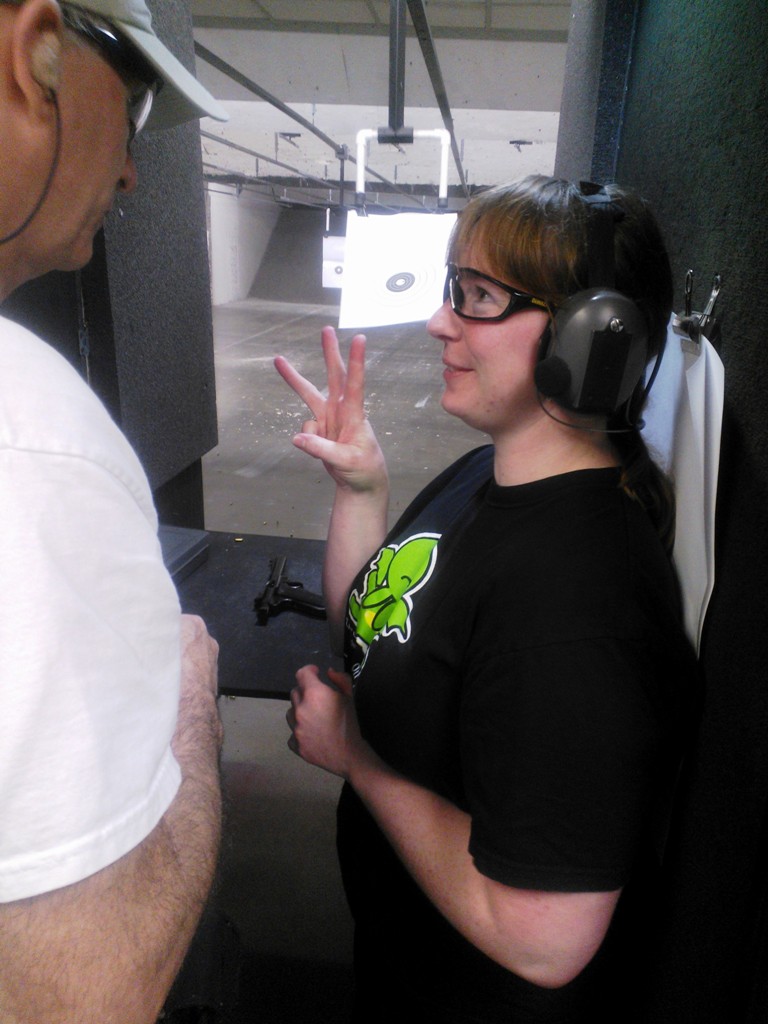
I asked her if she remembered the three safety rules (I teach the NRA rules, not the Jeff Cooper’s). She hesitated just a bit but told me:
Never point the the gun in an unsafe direction.
Never put your finger on the trigger until you are ready to shoot.
Never load the gun until you are ready to use it.
Wow! That was interesting! She got the essence of the rules correct but she turned them all into negatives. The NRA rules are positive statements of what you should do. I explained that it was, to exaggerate the point some, like telling someone not to think of pink elephants. The actual NRA three gun safety rules are:
ALWAYS keep the gun pointed in a safe direction.
ALWAYS keep your finger off the trigger until ready to shoot.
ALWAYS keep the gun unloaded until ready to use.
I showed her the proper grip and stance then went over the mantra “trigger prep, sight alignment, squeeze, follow through”. I had her use one of my plastic guns to practice going from a high ready position to a fire position simultaneous with using the mantra.
I told her that eventually she would be able to look at something close her eyes then point the gun at what she had just seen without needing the sights. Just like pointing at something with her finger.
It was at this point that she said, “I’m not sure I ever want to be able to do that.”
Huh?
She explained that when she held a gun in her hand she was very aware that she was holding “Life in her hands.” Interesting choice of words I thought but didn’t tell her that. Most people, in particular anti-gun people, would say, “Death in their hands.” She did not want to be so comfortable with a gun that she took it causally. She even expressed concern that she might become a sociopath. I tried to explain that wasn’t something that was going to happen at her age but she interrupted and said that she had been concerned that she might give birth to a sociopath since the age of 13 and no one had been able to dissuade of that in the intervening years and I wasn’t going to be able to talk her out of that concern in the next few minutes. I let that drop but asked, “What about using a gun to stop an attack against you?” She wasn’t sure, “It depends on what their situation was. What if they were just at a really bad point in their life?” “What about defending the life of your child?”, I asked and got a similar answer. The same for someone stomping on her puppy or cat.
Interesting.
I went on to the next lesson and showed her how to determine if a gun was unloaded–verify the source of ammunition has been removed and the chamber is empty.
I had her dry fire my STI. I repeatedly manually racked the slide and she “got” the reason for leaning into the shot and having the elbows slightly bent to absorb the recoil.
We went to the range and the public bay was crowed. Very crowded. The members bay was less crowded but we had to go through the public bay to get to the member’s bay. A shot went off as we entered the public bay and even with my best electronic muffs on Kelsey jumped and cowered. James and I hurried her into the members bay. But even there the shots from next door caused her to jump and nearly curl into a fetal position while still standing.
“It’s so loud!”, she said. After a brief consultation, James asked if I had any foam plugs she could use. I didn’t but the gun store was open and we left to get them.
She put them in and we returned. I can’t say that I could see it improved her demeanor any. And each shot made it worse. She was curled up, shaking, sweating, and crying. I told James that we should take her home. If she still wanted to learn we could go again sometime out in the woods with Ry and his suppressed .22. James started talking to Kelsey and I packing up our stuff. I shouldered my backpack and was ready to walk out but James said she still wanted to try it. I asked why. Kelsey said because she had said she would do it. “That doesn’t matter,” I told her. If you really want to do this we can do this another time when and where it’s much quieter. She insisted and I relented.
I had her dry fire the Ruger Mark II. She still jumped every time another gun went off some place. But the crying and shaking had stopped.
I put a single round in a magazine, racked the slide, and let her pick up the gun to shoot at the target about eight feet away. She brought the gun up and pointed it at the target. She hesitated and then quickly put the gun down. “I can’t do it!”, she said. “Okay, you don’t have to,” I told her. “You don’t have to do this. I don’t think you are ready and I think we should go home so we can talk about this.”
I started to pack up again. But she said, “How about I just hold the gun and you pull the trigger?” “I’m fine with that”, I said.
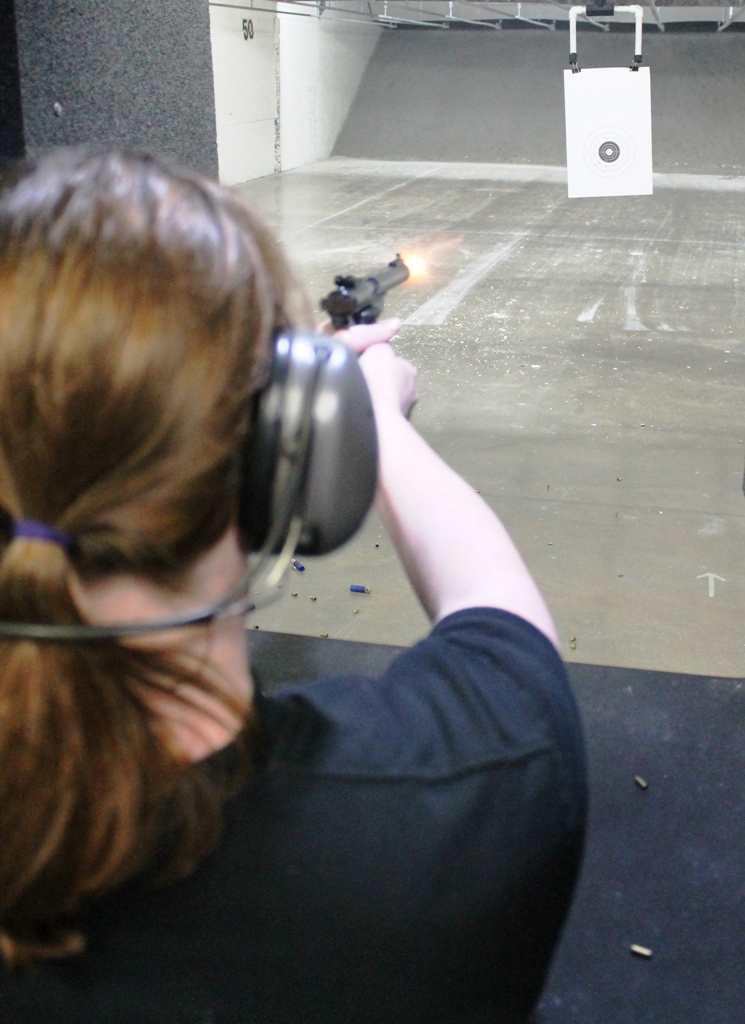
She picked up the gun and pointed it at the target. I repeated the mantra as I put my finger over hers in the trigger guard. I just barely touched her finger and was starting to say “squeeze” when the gun went off.
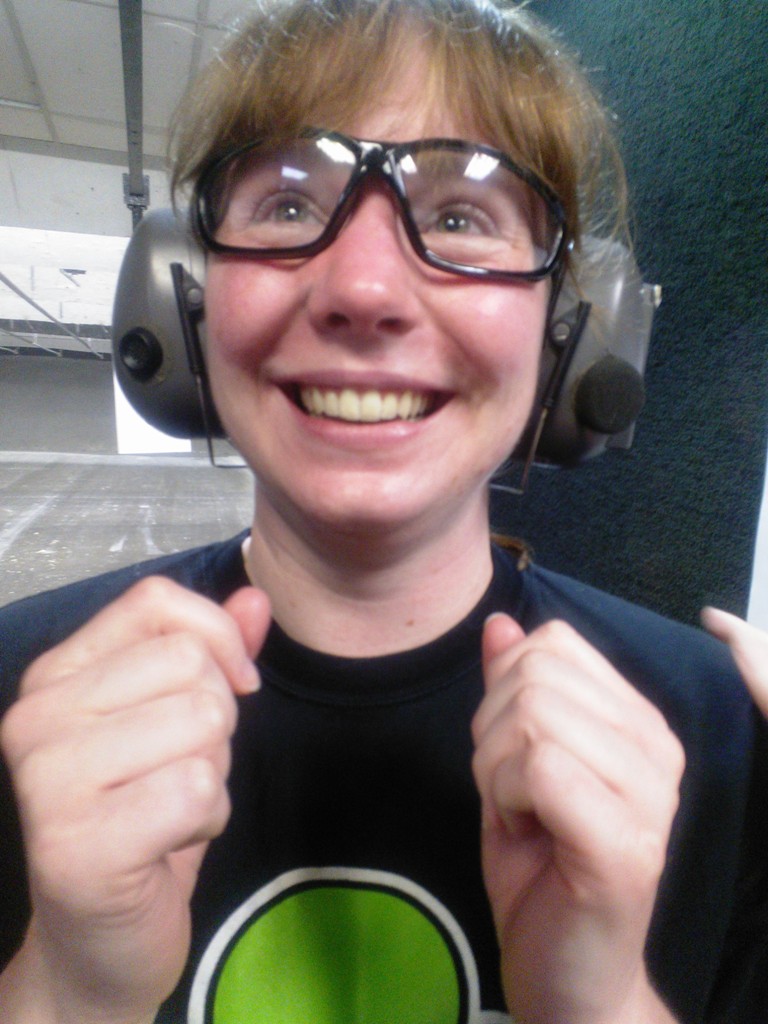
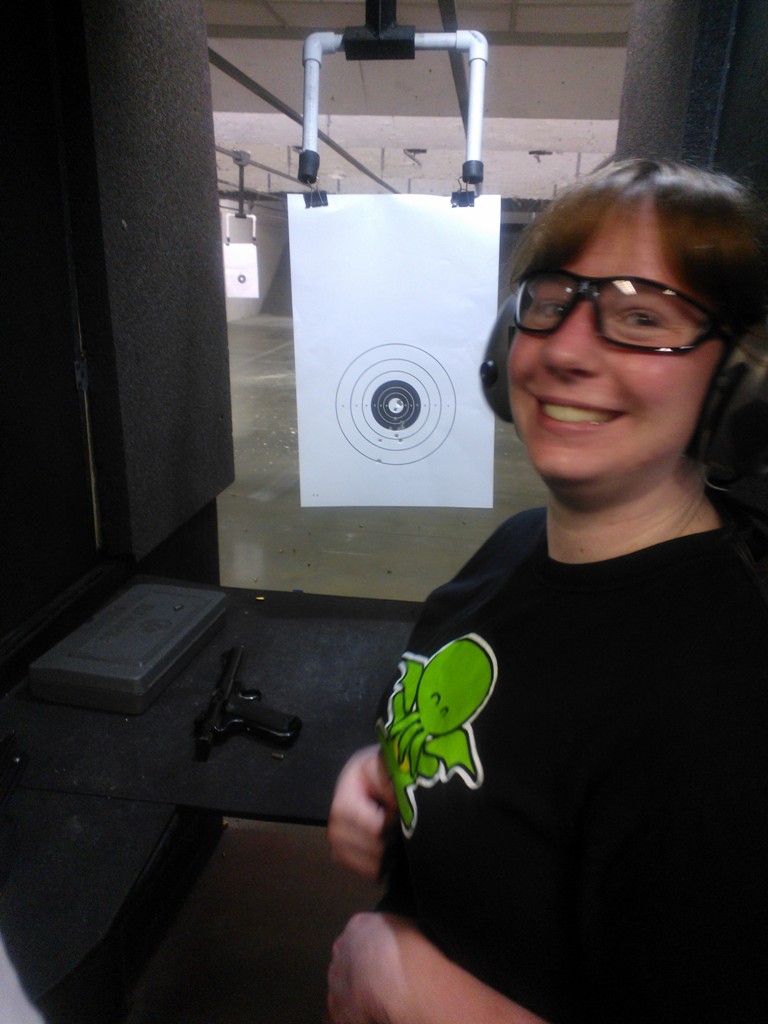
She put the gun down and started jumping up and down. “I did it!” she exclaimed. The guns booming on either side no longer mattered. From then on she didn’t stop smiling until we left the range except to pout when she had emptied a magazine. I started taking pictures and then a video:
I showed her where first shot ever hit. It was about 5:30, just inside the black.
She asked to do it again. I started to put in a half-full magazine. “Not that many. Just one. Maybe two,” she said.
I loaded the gun with two rounds.
Those went quickly and she asked for three rounds.
Then a full magazine.
And then another, and another, and another.
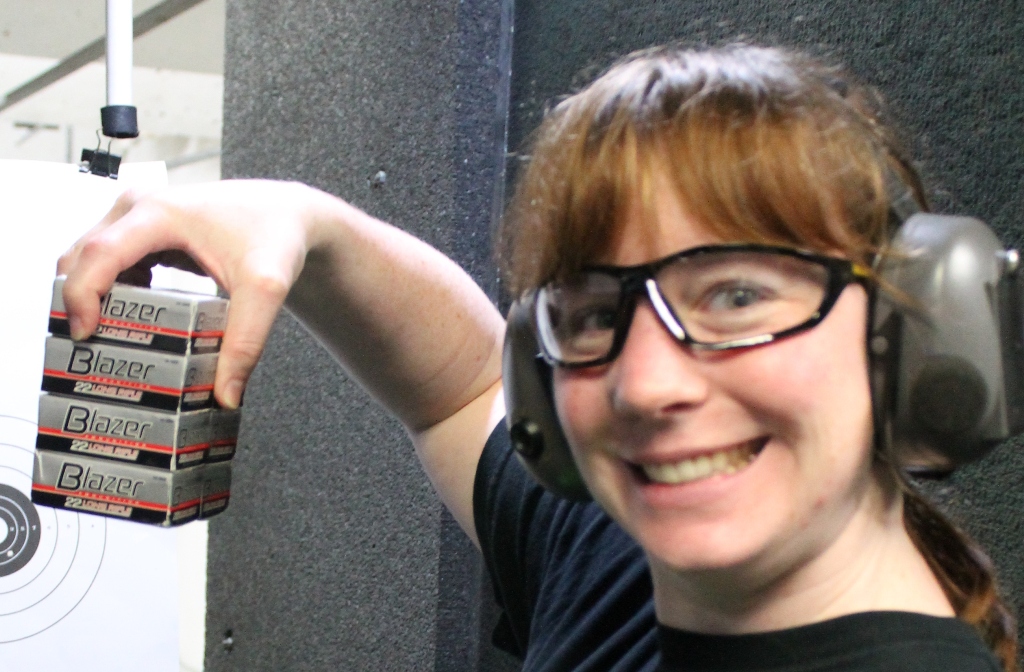
James shot for a while then Kelsey returned to the bench. I had her hold my partial brick of .22 ammo. She didn’t understand the joke but held it for me anyway:
I merely said the boxes had gotten a little bit wet, then dried, and were sticking together. I’ll have to explain it to her tomorrow when we go sailing.
She burned through magazine after magazine with fire blazing from the barrel. She emptied the magazines faster than I could reload.
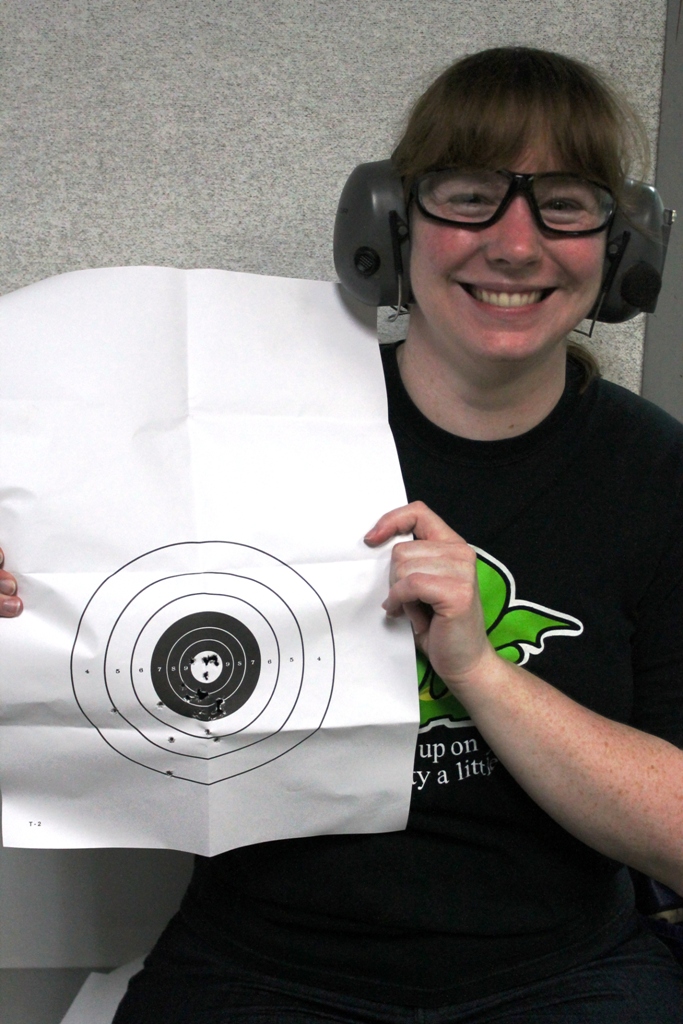
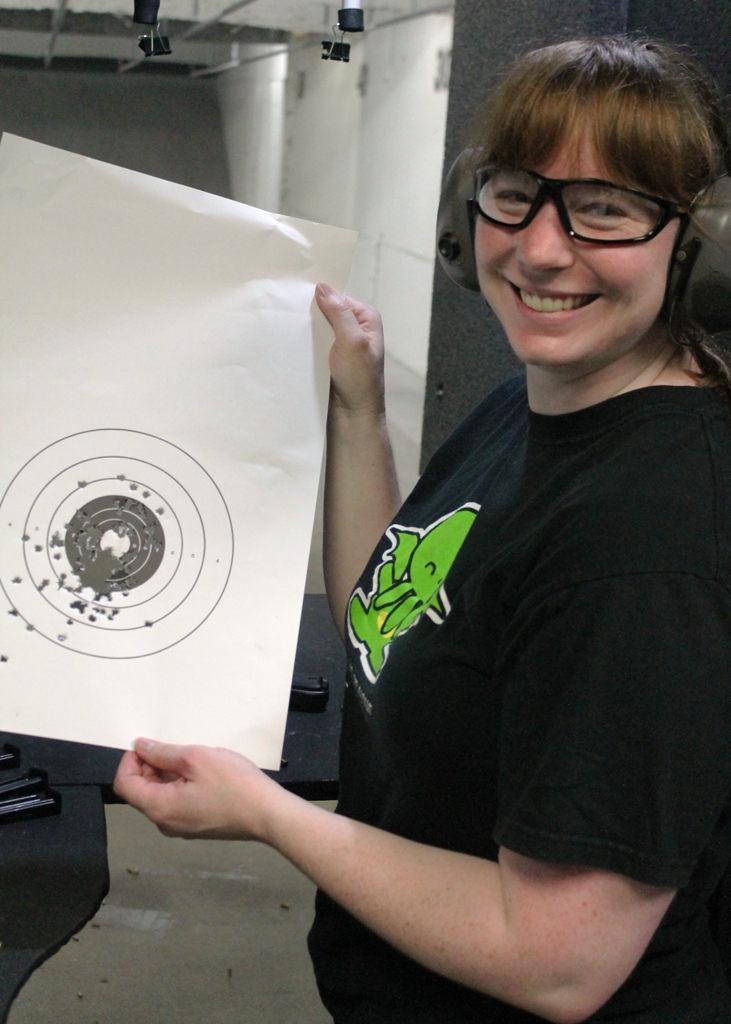
She moved the target out to nearly 30 feet and could still keep them in the black at will. It was only when she pushed the speed that the rounds strayed a bit. But only one was outside the rings and all were on the paper:
When we brought the last target in she pointed to the big hole in the paper and with almost a growl said, “I killed it!”
Anti-gun for 25+ years then turned into a budding sociopath in just over an hour. Sarah Brady’s worst nightmare just came true. Damn! I’m good.
I find what the anti-gun people and their media supporters doing very interesting. I’ve never seen this before.
The Brady Campaign is changing course and saying they are getting out of politics. They have created a new website, are downplaying their name and demanding “A NATIONAL CONVERSATION ON HOW WE CAN PREVENT GUN DEATHS AND INJURIES”.
Some hint that the NRA and gun freedom advocates have muzzled them and that gun owners and the NRA need to be silenced so that “sane people” can have a discussion. It’s as if the “room goes quiet” and most realize infringing upon the 1st Amendment is where even they draw the line.
What I think they are beginning to understand is that we are well beyond critical mass and they can no longer silence the message. There are millions and millions of us with guns, cameras, and computers and we know how to use them. There only a few thousand of them and they can’t take someone to an “anti-gun” range. We can. New shooters get first hand exposure to the facts and they don’t look back. I take new shooter after new shooter to the range and they all have smiles on their face (wait until you see the report from today! And I got a call this afternoon about another new shooter expressing interest).
The anti-gun people claim the facts support their side but if you read the comments, something not possible with the main stream media of 15 years ago when gun control was at it’s peak, the anti-gun position is ripped to shreds. People are realizing they have been lied to for years and they don’t like it.
Those who claim “gun control isn’t a lost cause” are just whistling past the grave yard.
People who raise the “civilian gunowners vs. U.S. military” forget that nearly everyone in the U.S. military has a hometown with family and friends. And many members of the military believe what they said when they took the oath: They are, first and foremost, bound to uphold the Constitution. Ask them to start dropping bombs in Salt Lake City or Paducah, and they’ll be seriously evaluating who is giving such an order and why it is being given. Except in the most egregious circumstances, many will either refuse, go AWOL, or worse for the government, actually point their weapons toward the political leadership giving the orders.
That would not be some unique history lesson. The dimensions of civil wars are rarely clear and unambiguous. That guy with a S&W .38 leading a popular revolt might actually have air support.
I recently had an art major friend of mine claim that a defendable definition of art was “anything not required for immediate survival”. This means that everything from the image of your stubble covered face in the mirror as you got up in the morning to the dirty socks you threw in the hamper that night and nearly everything you saw, did, smelled, touched, or heard in between qualifies as art.
I don’t have to squint very hard to see that definition being valid.
Our society currently has a very broad definition of 1st Amendment protection of art. This has extended to government grants for such controversial works of art as Piss Christ.
So why can’t a claim be made for First Amendment protection for 100 round drum magazines as works of art? It certain meets my primary definition of art which is, “Something aesthetically pleasing but without significant functionality.”
Without impassioned grassroots financing, the nation’s gun control organizations are struggling to stay afloat. Just a few months ago, the founder of one gun control advocacy group told me she’d run out of money and was expecting to shutter soon.
I wonder who that is. That would be a demise worth celebrating.
The thing is that organizations typically get quieter and quieter and just slowly fade away and no one really notices when they turn off the lights for the last time and disconnect the last telephone.
The National Shooting Sports Foundation estimates that 10-12 billion rounds of ammunition are produced domestically each year, while billions more are imported.