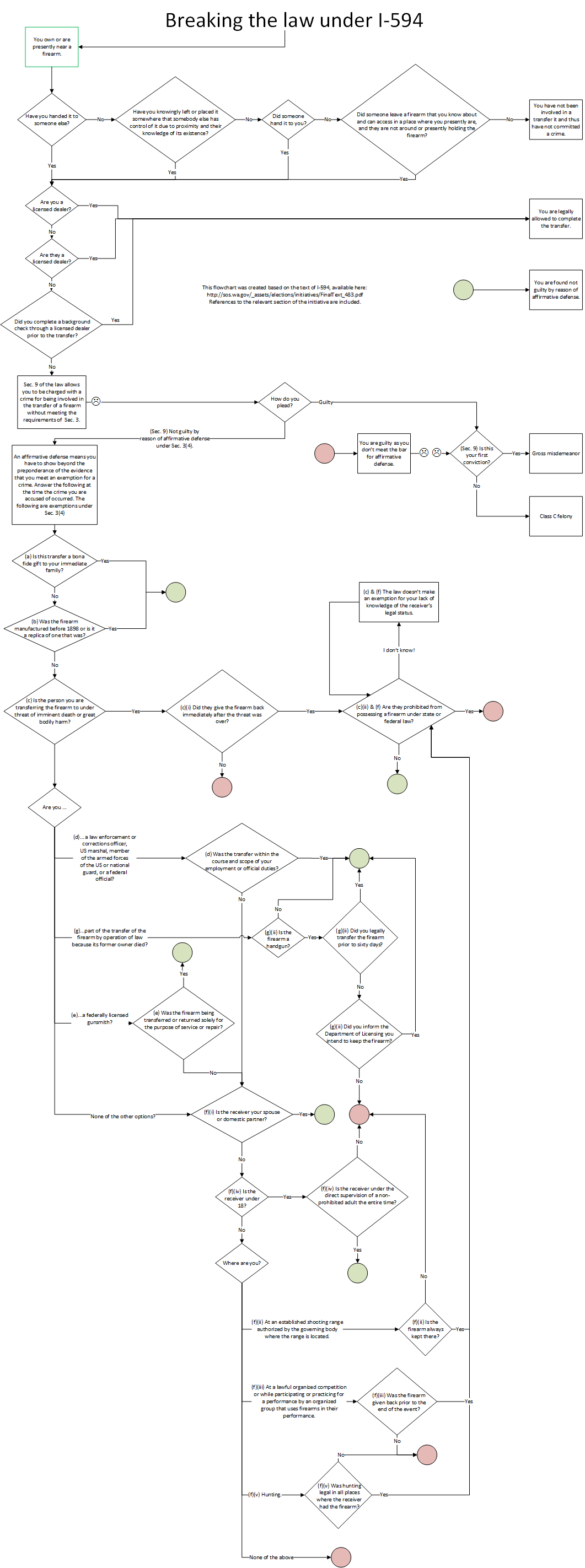
I-594 makes it a crime to transfer a gun to another person without doing a background check except for some particular exceptions. Using just one example will demonstrate a particular egregious chilling effect upon our right to keep and bear arms. Suppose your spouse child/sibling/parent/etc. wishes to use your gun for a week or two while their gun is being repaired. You would think there shouldn’t be a problem with an innocent act like this. You would expect there would be an exception in the law for this. The closest thing to an exception for this case is:
This section does not apply to:
(a) A transfer between immediate family members, which for this subsection shall be limited to spouses, domestic partners, parents, children, siblings, grandparents, grandchildren, nieces, nephews, first cousins, aunts, and uncles, that is a bona fide gift;
Update: It has been pointed out to me there is another spouse/domestic partner exception which I overlooked:
(f) The temporary transfer of a firearm (i) between spouses or domestic partners;
So change my example to be ‘child/sibling/parent/etc.’ for the temporary transfer concern.
End Update
So, unless the transfer is a “bona fide gift” or you go through the paperwork and expense of doing a background check you are committing a crime. You have to again do the paperwork and incur the expense when you transfer the gun back. If you don’t do the paperwork the first time it’s a misdemeanor and the second time it’s a felony.
One could claim you gifted the gun back and forth but that’s not going to fly with someone being a stickler for the letter of the law. You don’t give gifts back and forth in the course of week or two. And if the transfers were for purpose of cleaning the guns or minor maintenance or even carrying the gun into the house from the car it becomes absurd to claim the transfers were gifts.
However, there does appear to be a loophole for at least some of the above situations. The restrictions apply as described thusly:
All firearm sales or transfers, in whole or part in this state including without limitation a sale or transfer where either the purchaser or seller or transferee or transferor is in Washington, shall be subject to background checks unless specifically exempted by state or federal law.
Do you see it?
If neither of you are in Washington state at the time of the transfer it’s not a crime.
Update: This appears to be true for Washington State law. But under Federal law even though the two of you could transfer it legally while inside the borders of your state you may not transfer it between the two of you while outside your state then bring it back across the state line into Washington. The crime in not acquiring the gun from an out of state resident or dealer. The Feds don’t want you to acquire a gun from anyone, even a resident of your own state while out of your home state then bring it home. Read 18 U.S. 922 for the details.
H/T Sebastian.
But as far as the ATF/Feds are concerned, if you have a home in two states you are considered a resident of the state you are currently in for gun purposes and can transfer guns as if you were a full time resident in that other state. Hence if both parties were dual residents you could legally do the transfer while in that state and avoid the issues with I-594. Hence since I have a home in Idaho as well as in Washington I could transfer guns to/from my brothers who live in Idaho while in Idaho, but not while in Washington state because they do not have a home in Washington.
But if John Doe were a resident of both Washington and Idaho we could met in Idaho, do the transfer, then return to Washington without breaking any law (that I know of, I am not a lawyer). Or if John Doe were only a resident of Washington I could receive a gun from him in Idaho and then return with it to Washington. But he could not receive a gun from me in Idaho and return to Washington.
Get legitimate legal advice if you plan to push the envelope!
End update.
For people living on the border with Idaho this makes it almost trivial to avoid committing a crime. If you and your spouse child/sibling/parent/etc. or buddy attend a match in Idaho and then come back to Washington at the end of the day who, other than the two of you, is to know who has “possession” of guns in the trunk?
I’m not sure about the law in Oregon. I think they have a mandatory background check as well. You might also be able to take your boat into international waters or just inside the Canadian waters and get away with it as well.
Probably the biggest concern I have is what about “constructive possession”. If you and your spouse were to store your guns in the same safe or without a safe can you be charged with crime of transfer because the other person has uncontrolled access to the guns?
And how about joint ownership? Is that even possible? The existing paperwork doesn’t allow for joint ownership. I can legally give a gun to my adult child but not my child’s spouse. So is this another loophole or is it a legal landmine if I were to give the gun to my child and their spouse as joint ownership then did the paperwork for their spouse?
So this line of thought leads to what looks like a less awkward loophole. If you put your guns in a trust that would let you handle the joint ownership issues. The trust owns the guns and each member of the trust could use any of the guns at any time. And furthermore it is my understanding you can add and remove members to the trust at will without notarized signatures or filing paperwork. I could add some random acquaintance to the trust for the evening to allow them to handle a gun or take them shooting for the first time then remove them from the trust after they hand the gun back.
Trusts may also be the way to save junior programs and instruction programs where the instructors loan guns to the students for the duration of the class.
And of course you could also add some stranger to the trust, “rent” the gun to them for 99 years and not be in violation of the law as long as they didn’t sell the gun to someone else or put it in another trust.


![WP_20141104_002Adjusted_thumb[1]](https://blog.joehuffman.org/wp-content/uploads/2014/11/WP_20141104_002Adjusted_thumb1.jpg "WP_20141104_002Adjusted_thumb[1]")