“I never thought it would be this much fun. I thought it would just be a bunch of learning.” – Josh – One of my nephews
My niece, Roz and her husband, Josh had been talking about getting firearms for protection, but they wanted to get some hands-on experience before making any decisions. I’d been telling them for some time that I was willing to show them several different handguns and long guns, different action types and so on, and have them do some shooting.
They made it down from Spokane to Palouse, WA, with a stop in Moscow to hand the baby over to Grandmother, on Monday. After a quick briefing at my place as I was loading up the pickup, we headed to the closest range, about 9 miles away on the edge of Garfield, WA.
“I’ve got a pickup load of iron, and lead” – Josh said it should be a country song. I agree.
This is for Tam – This is why you need a full sized, extended cab 4 x 4 pickup with canopy. You can carry a lot of guns, a shooting bench, a clay target thrower, 100s of pounds of ammunition and several people all at once. The duals in the back are optional.
When we got to the range, there was another pickup there stuck in the mud, a couple dozen cattle out in the adjacent wheat fields, a man on an ATV and one on foot out trying to round up the cattle, and Officer Friendly standing in the parking lot telling us A) that the range was closed for Memorial Day, B) the other truck was stuck, and C) don’t go over there and try pulling him out because you’ll just get stuck too.
Long story short; I went over there and pulled the other truck out (easily) the cattle got put back into their proper field, and Officer Friendly, who so far as I could tell didn’t do much if anything, said “Thanks for helping out”. I didn’t tell him what I thought. I just said, “No problem”.
Roz and Josh had come all this way to learn about guns and do some shooting, and here we were at a closed range messing around with tow straps, mud, cops and cattle. Sometimes you just have to roll with what’s thrown at you.
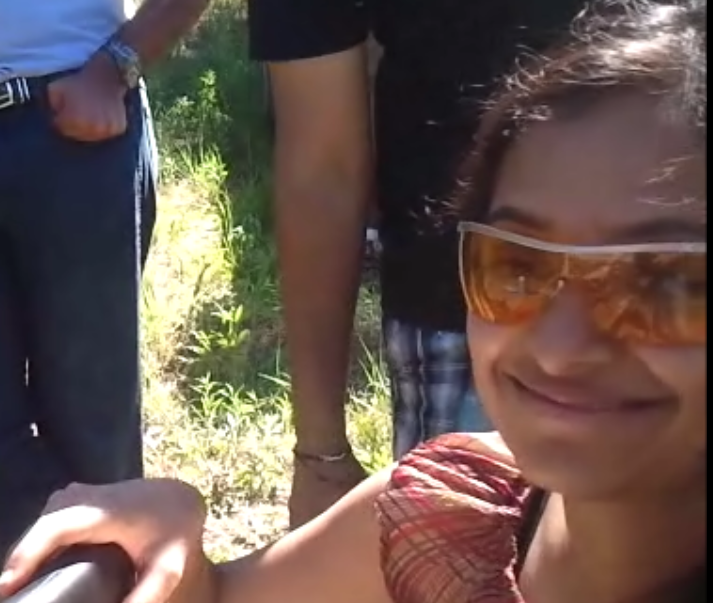
15 more miles to an abandoned gravel pit and we were in shooting heaven. We went through the safety rules, the functioning and handling of the AR-15, position, grip, sight alignment, breath control, trigger control, follow-through… Slow fire at 80 yards, rapid fire at 20 feet. Same with handguns. At several points along the way, Roz was laughing as she was popping off rapid double and triple taps with a Glock 20, and hitting her target. “Front sight front sight front sight! Your group’s too small, speed it up!” Giggle giggle giggle. I think the dot-sighted M1 30 carbine was the favorite “fun gun” of the day though.
As we were wrapping things up, Josh came out with the money quote.
After all the talk and anxieties we’ve gone through at home regarding education verses understanding, teaching methods, self-organizing systems, etc., over the last few years, I can’t tell you how significant and how terrific it was to hear that.