Quote of the day–Tamara K.

You’re going to be paying for passing out this Monopoly money for the rest of your lives, even if you were just born today and live to be 100, and in return, they’ll graciously allow you to keep a little bit extra of your own money. The only people to whom this could sound like a good deal probably get outwitted by flatworms on a regular basis.


There are mornings when I just put my head in my hands and think “Screw it, let it burn.” But I don’t have kids, so that’s an easy out for me…


Tamara K.
February 13, 2009
Taking Retards To The Zoo.
[I do have kids and I think the same thing at times. I figure my kids, smart and hard working, will end up on top of the ash heap and will build a better civilization having observed first-hand the stupidity of socialism.–Joe]

Economic history from the last great depression

Robert Higgs, senior fellow in political economy for The Independent Institute, gives us some of the history of how the socialists ran roughshod over the Constitution in the 30s:


Until the 1930s, the Constitution served as a major constraint on federal economic interventionism. The government’s powers were understood to be just as the framers intended: few and explicitly enumerated in our founding document and its amendments. Search the Constitution as long as you like, and you will find no specific authority conveyed for the government to spend money on global-warming research, urban mass transit, food stamps, unemployment insurance, Medicaid, or countless other items in the stimulus package and, even without it, in the regular federal budget.


This Constitutional constraint still operated as late as the 1930s, when federal courts issued some 1,600 injunctions to restrain officials from carrying out acts of Congress, and the Supreme Court overturned the New Deal‘s centerpieces, the National Industrial Recovery Act and the Agricultural Adjustment Act, and other statutes. This judicial action outraged President Roosevelt, who fumed that “we have been relegated to the horse-and-buggy definition of interstate commerce.” Early in 1937, he responded with his court-packing plan.


Although Roosevelt lost this battle, he soon won the war. As the older, more conservative justices retired, the president replaced them with ardent New Dealers such as Hugo Black, Stanley Reed, Felix Frankfurter, and William O. Douglas. The newly constituted court proceeded between 1937 and 1941 to overturn its anti-New Deal rulings, abandoning its traditional, narrow view of interstate commerce and giving the federal government carte blanche to spend, tax, and regulate virtually without limit.


After World War II, the government enacted the Employment Act of 1946, codifying the government’s declared responsibility for managing the economy “to promote maximum employment, production, and purchasing power,” and it has actively intervened ever since, purportedly to attain these declared ends. Its shots have often misfired, however, and we have endured booms and busts, a decade of stagflation, bouts of rapid inflation, and stock-market crashes. The present recession may become the worst since the passage of the Employment Act.


I expect the socialists to complete their take-over and solidify an iron grip on us this time. As Newsweek said, We Are All Socialists Now. The court precedences set in the 30s essentially guaranteed it. The only way that I can see that has any potential to get us out of the abyss is to go deeper into it.

Our next currency

I was recently talking with a friend about the risks of hyperinflation with the dramatic increase in the money supply and the “stimulus plan”. Our currency may become worthless so what would be the best barter currency? They pointed out that gold has the problem of the smallest coins are not something you could use for relative inexpensive items like a bag of groceries, or a pickup load of wood for your fireplace. And a candy bar? Gold coins just don’t work in a lot of transactions.


Noticing a container of loose change on the kitchen counter I suggested our existing coins may not be devalued as much as the paper currency. The “copper” (mostly zinc now days) has a “melt value” of about $0.02 (see update below) right now due to the high price of metals. I also suggested ammo and bulk food that stores well like dry peas, lentils, and beans. Maybe, we agreed.


Early this morning I woke up with another answer, toilet paper! I then became discouraged because I realized that too would be devalued because of the over supply of paper currency that could be used for the same thing.


And Barb gets irritated with me because I’m such an optimist.


Update: My source on the “melt value” of a penny was apparently wrong. According to this site the current value is about $0.00297.

Quote of the day–Titanium Halo

Let me tell you story. I know a guy. He’s a financial planner/investment banker type who from time to time helps me out. In November I had lunch with him after the first initial crash and wanted his opinion on the gather storm clouds I saw just over the horizon. He told me a few interesting things one of which kinda scared your Hero Halo a bit. He said, ‘Halo, I am advising my clients who have enough liquid assets to secure remote, sustainable property. I’m advising this because for very little capital outlay, they can have a lot of security.’


Ted, I looked right into this guys eyes and saw a certain fear that I have never seen before. This is a man who manages literally billions of dollars worth of assets and he looked as though his entire concept of reality had been shaken to the core. I wasn’t really sure what to do. In all the years I had been dealing with him I had never seen this and wondered why now? What’s different this time? Well, there are many things, but when a guy with these kinds of resources at his disposal says stuff like this, it might be time to start listening.


Titanium Halo
February 5, 2009
Sheep Say, “Baaaaaa”
[I’ve been putting a lot of time into economics recently and hope to have a post on the results of my research sometime this weekend. As a teaser let me just say:


  • The “stimulus plan” violates my Jews In The Attic Test.

  • Daughter Kim’s economics class is reading books that talk of the U.S. government and the CIA “forcing free trade”, and how “capitalism destroys community ties”.

  • My research has involved talking to people from China, India, Ireland, Romania, and Sri Lanka. People speak in hushed tones with a very somber demeanor. It’s bad everywhere.

  • While discussing the politics of our new socialist nation, even without explicit mention that my Jews In The Attic Test was being violated, a friend recently told me that an AK has an expected life of about 50K rounds and even though they have several such rifles it wasn’t enough to solve the problem even if they had enough rounds and didn’t encounter resistance.

We have very, very big problems ahead of us. And the worst part is that the people that caused the problems will likely get more support as the situation gets worse. They will demand more and more “help” from those that put everyone in jeopardy. And the unless very aggressive action is taken by people, who have shown very little backbone in the past, the last people to go down are likely going to be the people that created and aggravated the problems.


I know who John Galt is, but where is his gulch?–Joe]

Quote of the day–John Robb

The global Depression scenario is now dominant. Here are some of the drivers:


  • An utterly complete regulatory capture of the US government (the advent of the Obama administration has done nothing to change this). Regulatory capture is when monied interests take control of the government institutions that are supposed to regulate/control them. In OODA terms, this is a loss of control over the critical orientation phase of decision making loops. As a result, a vast looting of the government’s coffers is now in process.

  • The D-process (de-leveraging and deflation) feedback loop is now entrenched. This is a neat term developed by Ray Dalio of Bridewater Associates (Barron’s interview). The D-process is what happens (rarely) when too much debt is accumulated. Excess debt must be eliminated before growth can return. In the US case alone, excess debt load is $20-25 Trillion. Since global governments are unwilling and/or unable to wipe out the world’s creditors (they’ve been captured), the process will drag on and on. Stimulus and bailout packages, constructed in a way to protect the wealth of the world’s creditors/rentiers (looting), won’t work. It will only prolong and deepen the failure as the D-process feedback loop intensifies.

  • A large number of countries from Japan to Spain to Latvia are already in depressions. These failures will serve as a drag on the entire global system, catalyzing the feedback loops of the D-process.

John Robb
February 9, 2009
THE DEPRESSION SCENARIO IS HERE
[In selecting the QOTD I was tempted by “Dude, wtf? is it time to arm ourselves or join the mormon church?” in the comments to the above quoted post. But the main post won out.


Others (probably a crackpot, but who knows what could happen) are advocating the cancellation of all debt.–Joe]

I’m just trying to understand

Suppose my family was deeply in debt, income was trending down, and some members of my family were unemployed. Would it improve matters if we borrowed a bunch of money and spent it on things like painting the house, new clothes, and a new car?


I don’t think so.


Suppose it was my little North Central Idaho town of 20K people that was deeply in debt, income was trending down, and unemployment was trending up. Would it improve matters if the town borrowed a bunch of money and spent it on random stuff?


I don’t think so.


Repeat at the large city level.


Repeat at the county level.


Repeat at the state level (California for example).


Is it going to make things better in any of those cases?


If not, then why would it make sense to do it at the national level?

A billion? (the Cost of Statism)

My father in law sends me all sorts of chain mail.  My response follows at the bottom, but for the intro, here’s the chain letter:


Subject: A Billion?


How many zeros in a billion?


The next time you hear a politician use the word ‘billion’ in a casual manner, think about whether you want the ‘politicians’ spending YOUR tax money.


A billion is a difficult number to comprehend, but one advertising agency did a good job of putting that figure into some perspective in one of it’s releases.


A. A billion seconds ago it was 1959.


(Actually, that’s 1.5 billion, but that’s not the point)


B. A billion minutes ago Jesus was alive.


C. A billion hours ago our ancestors were living in the Stone Age.


D. A billion days ago no-one walked on the earth on two feet.


E. A billion dollars ago was only 8 hours and 20 minutes at the rate our government is spending it.
 
While this thought is still fresh in our brain, let’s take a look at New Orleans …
It’s amazing what you can learn with some simple division.


Louisiana Senator, Mary Landrieu (D) is presently asking Congress for 250 BILLION DOLLARS to rebuild New Orleans.  Interesting number…What does it mean?


A. Well… if you are one of the 484,674 residents of New Orleans (every man, woman, and child) you each get $516,528.


B. Or, if you have one of the 188,251 homes in New Orleans, your home gets $1,329,787.


C. Or, if you are a family of four, your family gets $2,066,012.


Washington, D. C
 
 HELLO!
Are all your calculators broken??


Accounts Receivable Tax
Building Permit Tax
CDL License Tax
Cigarette Tax
Corporate Income Tax
Dog License Tax
Federal Income Tax
Federal Unemployment Tax (FUTA)
Fishing License Tax
Food License Tax
Fuel Permit Tax
Gasoline Tax
Hunting License Tax
Inheritance Tax
Inventory Tax
IRS Interest Charges (tax on top of tax)
IRS Penalties (tax on top of tax)
Liquor Tax
Luxury Tax
Marriage License Tax
Medicare Tax
Property Tax
Real Estate Tax
Service charge taxes
Social Security Tax
Road Usage Tax (Truckers)
Sales Taxes
Recreational Vehicle Tax
School Tax
State Income Tax
State Unemployment Tax (SUTA)
Telephone Federal Excise Tax
Telephone Federal Universal Service Fee Tax
Telephone Federal, State and Local Surcharge Tax
Telephone Minimum Usage Surcharge Tax
Telephone Recurring and Non-recurring Charges Tax
Telephone State and Local Tax
Telephone Usage Charge Tax
Utility Tax
Vehicle License Registration Tax
Vehicle Sales Tax
Watercraft Registration Tax
Well Permit Tax
Workers Compensation Tax


STILL THINK THIS IS FUNNY?


Not one of these taxes existed 100 years ago, and our nation was the most prosperous in the world.


We had absolutely no national debt, we had the largest middle class in the world, and Mom stayed home to raise the kids.


What happened?  Can you spell ‘politicians’?


And I still have to press ‘1’ for English.


I hope this goes around the USA at least 100 times


What the heck happened?
 
For my money it is called greed.


———————————————-


My response:


They left out special, punitive state and federal taxes on guns and ammunition, which account for a large portion of the cost of the product.


The list of taxes does not address the many and various requirements and restrictions on businesses.  One small example out of thousands is; a window was broken in our Clarkston, WA store during a robbery.  Had it been in Moscow, we could have called one of several glass shops and had it replaced the same day.  Because this happened in Washington, there is a tempered safety glass requirement for storefronts that increased the cost of the window by several hundred dollars (wanna bet some legislator’s cousin owns a safety glass business?).  But that wasn’t the main expense created by the law.  Far and away the biggest expense was that we had to wait several weeks for the window, meaning we had no storefront for that amount of time– just boards.


That cost, and thousands like it, never figure into the costs with which we are saddled by local, state and fed restrictions. 


Add things like minimum wage laws, which outlaw many entry-level jobs outright.  Add laws requiring handicapped access, which can amount to 100s of thousands of dollars for a small business, even if they have no handicapped customers.  The list of such requirements and restrictions would take more than your e-mail in-box could hold, and these all amount to increased cost of doing business.  Often, the reporting and compliance requirements necessitate the hiring of extra employees– people doing jobs for the government, paid by the business owner, producing nothing.  Ever see a WA state sales tax report?  Every city and county can have its own tax rate.  Since our music store does business in two states, and in many cities throughout WA state, we have a huge tax report for WA State (Idaho’s is about the size of a post card).  As a very small business, the WA reporting requirement costs us and our customers at least as much as the actual tax money paid.


And did I mention that property taxes and utilities prices are higher for businesses than for a residence?  How many people know that unless they’re in business?


Now add to the list of costs; the number of businesses that couldn’t bear these burdens, and just gave up and quit.  Then add the number of businesses that started up in other states because they had more freedom there (this is known as “brain drain” and it happens in all socialist societies– the creative and the productive want the hell out of there).


But that’s just the beginning.  Add the untold thousands of creative people who never went into business because the hurdles were just a little bit too much to bother with (business being a stressful and risky proposition in the best of situations) and/or they knew the “safety net” would take care of them anyway, or they could get a government job with full benefits.


And so the monster grows– fewer people paying taxes to support an ever-growing government sector.  Three trillion dollars annually and growing fast (it’s gone up almost 50% during this current “conservative” administration).  Divide 3 trillion by the total U.S. population, boys and girls, if your calculator can handle that many digits.


Many of these costs are impossible to measure.  They don’t show up on the spreadsheets or in the statistics, but I submit that they account for the greatest percentage of the total cost of socialist/statist systems.  But then, some would (and often do) applaud anything that shackles the creative, productive human mind and forces it to either serve their purposes, or just give up.  Everyone knows the score– business (peaceable, voluntary exchange) is greedy and deserves to be punished, whereas “public servants” are altogether selfless and benevolent, right?

The specter of death for socialism

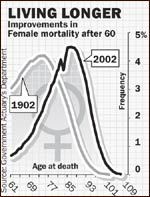
The UK Times Online uses the headline Leap in life expectancy brings a scare for pension forecasters.  But it’s the socialists that really need to be scared:

ACTUARIES admitted yesterday that they were scared to predict firmly how long humans would live in the future, after releasing new figures showing that survival rates improved by more than 30 per cent in just eight years.

Figures from the Continuous Mortality Investigation (CMI), part of the actuarial profession, showed that the mortality rate for men aged 65 in 2002 was 29 per cent better than in 1994, while life expectancy for women improved 33 per cent in the same period.

There is also concern over the growing cost of public sector pensions, which has doubled to £500 billion in just over ten years. Sir Digby Jones, the Director-General of the CBI, this week warned the Labour Party conference that “little has been done to address public sector provision in the face of people living longer and healthier lives”.

A socialist society of the future is going to be faced with some hard choices.  As health care technology improves people live longer and it seems the costs invariable increase as well.  This is a double whammy for the socialist.  They will be increasing unable to provide for both pensions and the health care of the elderly at the expense of the working class.  As I have pointed out in previous posts a common solution to the inevitable fixed budget is to ration health care.  In effect what this does is decrease the quality and the length of life for the people that are more deserving of a longer and better life–the people that contributed the most to society by being productive.  Faced with that penalty productive people have less incentive to be productive.  This decreased incentive results is less productivity and society as a whole suffers.  The more socialistic a society the less productive it becomes and the less able it is to compete in a global market.  As our human life expectancy improves socialism faces it’s death.