
In the search for meaning

We often come up empty-handed.  There are always a lot of words being said and written, but the far less meaning.  Our job is to search for the meaning.  It’s fun.


Seen on a paper grocery bag;


“[Big grocery chain] has partnered with [presumably Obama stash money-funded green energy company] to convert their waste into power for the community.


This initiative will help produce 3 mega-watts of power.  Enough to power 3,000 homes for one year!”


What does that mean?  It’s only a one-year project?  What happens after that?  Or is it that someone flunked their high school physics classes and doesn’t know the difference between power and energy? 


Then there’s that all too convenient, catch-all word in there; “help”.  Let’s say for sake of argument that all the Columbia hydroelectric projects combined produce on average 100 gigawatts.  All by myself then, I could help produce 100 gigawatts by pissing in the river.  I could help produce 100 gigawats for one year, each year, by pissing in the river once per year.  Hope and Change.


In fact it doesn’t mean anything as written, but either we are supposed to believe that it means something anyway, and love them for it, or the people who wrote it are ignorant and can’t be bothered with looking things up, or both.  And among the listed items of “output” from this “initiative” are “green power” and “carbon credits”.  Oh goody.  I guess the recycling of the paper into new paper is no longer good enough, and the use of food waste as animal feed is no longer a good thing.  So we can burn this stuff, cut down more trees and use more farmland.  For carbon credits.  Hope and Change.


Then there was this “Halftime in America” ad from Chrysler that many people thought meant something really great.  It’s one of the more artfully meaningless, and/or misleading bits in television.  In fact, if it means anything at all, it means that the government bailout and takeover of Chrysler, using taxpayers’ hard-earned dollars to hand a company over to the unions, is The Way to get out of an economic downturn.  It also implies strongly that if one auto company goes into receivership, we stop making cars– a wildly ignorant idea if ever there was one.  In fact there is the very real and very well-proven concept of “creative destruction” wherein one badly-run company goes out, making the way for the next, better-run company to flourish, the end result of which is more and better, and more affordable cars, with more stable car-making jobs as a side benefit.  “Halftime in America” conveniently ignores all that, instead using pure (false) assumption and building on it with innuendo.  And if there is a “halftime” provision written into the U.S. constitution, at which time we were presumed to have entertained the Central Planners for 100 years, started going broke as a result, then regrouped with more central planning to fix the destruction from the earlier Central Planning, then I am Karl Marx’s uncle.  In fact we are under attack by the Progressive movement and the only way out is to rid ourselves of it and get back to our beautiful American Principles of Liberty.


The arena with probably the least meaning of all is politics.  When millions of people were swooning over Sarah Palin during the Palin/Whatshisname campaign, I went over to her personal web site to see if I could find any meaning.  I have to hand it to her– she is very, very good at combining words, thousands of them, into sentence after sentence, without a scintilla of meaning.  Total blank-out.  Very impressive.


At the same time, Obama told us he wanted “Redistributive Change” and that “When you spread the wealth around everybody benefits” out of one side of his mouth, while telling us he would have the most transparent, open and fiscally responsible administration ever.  Right there, at that moment, he proves to the whole world, with just those two assertions, that he is a lying piece of shit.  Then we elected him.  I guess searching for meaning isn’t a hobby for many people.


Make a point of it.  Next time you see a politician speaking, or an advertisement, or anything really, try to see if there is any meaning, and what, exactly, is the meaning.
Quote of the day—Richard

I told my broker about 5 years ago, “I wish I had had $150,000.00 worth of rifles instead of all that stock.”

Richard
September 16, 2012
Comment to We Are Of Different Worlds.
[I don’t own nearly as many guns as many people I know. But I can’t think of any gun, except those with exceptionally heavy use, that might have gone down in value. Nearly all have gone up in value. I have a lot of ammunition components (and a far amount of factory ammo). All of it has gone way up in value. Investing in lead and copper has paid off. Not as much as gold and silver has but you can’t eat gold or silver. And you can’t defend yourself, your family, or your possessions with a piece of gold or silver.—Joe]

Au *= (1 + 0.023/s);

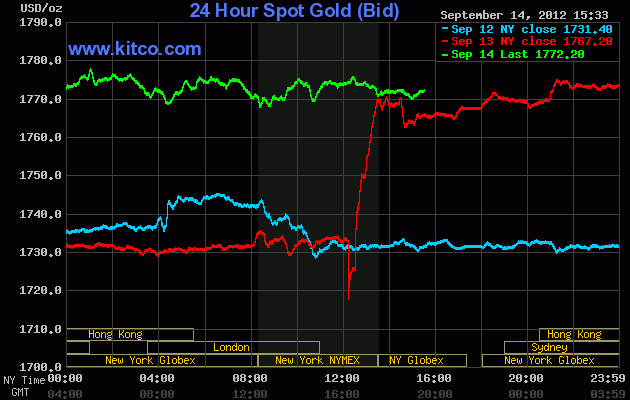
Gee… I wonder could have caused that step change in the price of gold yesterday…

gold20120914

Could it be that QE3 means dollars are worth less today than they were yesterday?

Graphic from http://www.goldprice.com/.


*Electrical Engineers who write software will understand the title.

Quote of the day—Mark McHugh

My Doctor’s an idiot. A few years ago, he started expressing concerns about my weight, pointing at this chart supposedly showing how much a man of my height should weigh. One glance at his stupid chart and it was clear to me that he had completely misdiagnosed my condition. There was nothing wrong with my weight, I just wasn’t tall enough. Clearly I needed to grow my way out of this. So I went home and googled “how to stimulate growth.” Once I got past the all the baldness cures and penis pumps (it’s not my bag, baby), I found hundreds of papers so incredibly boring I knew they had to be true. In no time, I was able to design and implement my own stimulus plan based on the irrefutable scientificky principles of Nobel prize winners and other people so smart they never had to do an honest day’s work in their lives. Despite the difficulty climbing stairs, I was feeling pretty good about things until my last check-up….

“Hi, Doc.”

“Hi,” he said, examining my file. He looked up, “You’ve put on twenty pounds since the last time I saw you”

“Thanks for noticing,” I beamed.

He frowned. “I remember now. You’re the guy on the diet designed to make you grow. What’s that called again?”

“The Keynesian Plan.”

Mark McHugh
August 31, 2012
Gold Is A Barbeque Relish
[Read the whole thing.—Joe]

Atlas is shrugging

Although it doesn’t show up on balance sheets I’m sure there is intellectual capital that is headed for Gault’s Gulch as well as the financial capital:

Spain saw close to a 40 percent rise in capital outflow in June, Bank of Spain data showed on Friday, as investor confidence in a country struggling to balance its public accounts eroded further.

The central bank reported that net capital outflow, not including central bank operations, was 56.6 billion euros ($71 billion) in June, after an outflow of 41.3 billion euros in May.

A total of 315.6 billion euros of capital has left the country in the year to end-June, equivalent to nearly one-third of the country’s economic output. In the first half of 2012 capital outflow was 220 billion euros.

Emphasis added.

This is one of the Achilles Heels of the “tax the rich” schemes. Those that demand “tax the rich, feed the poor, until there are rich no more” can succeed, but the success is achieved in an unintended manner. The rich, in essence, evaporate. They either leave the country and take both their intellectual and financial wealth with them or they say, “It’s not worth it” and just stop producing wealth. In either case the looters run out of places to loot. The end result is that everyone is worse off than if the looters had produced wealth on their own rather than demanded they be given the wealth of others.

Socialism is like a herd of hogs turned loose in a corn field. They feed extraordinarily well for a few days but destroy the crop that should have lasted through the winter and provided seed for the following year.

Brains, learning, and school

I had started writing a essay on learning and the brain and
current understandings about it, and realized as it grew HUGE that it revolved around examining some rhetorical
questions. Here are some of the core questions, with their import and details left
as an exercise to the readers and commenters, unless there is significant
interest in a particular one being addressed in some future essay.

Compare and contrast data,
information, and knowledge.
                Why do people use them
interchangeably, and what problems arise when people do?

Compare and contrast school
and education.
                Must one imply the other
(or the other, one)?

Compare and contrast smart
and educated.
                Why do educated people get
them confused so much more often than smart people (both in themselves and
others)?

Compare and contrast teaching
and learning.
                How do you measure the
effectiveness of a teacher?

Compare and contrast knowing,
understanding and wisdom.
                How does one get turned
into the other?

Compare and contrast intrinsic
aptitude
and interest.
                Can one be leveraged into
the other, or are they merely randomly connected?

What is the most important thing a human should learn?
                Rank, in order, the top 10
things one should learn by voting age. Why?

How can you tell truth from falsity?
                How often do you ask
yourself “how do I know that? What
are my assumptions?”

At its most basic (biological) level, what is learning?
                What makes this happen?
How are repetition and strong emotional tagging different?

Is it important for children or young adults to learn how the brain learns and works at some point, before they become an adult?
               How could learning this help children in school?

How can a neural connection be strengthened, or made more interconnected
with others?
                Compare and contrast a
single, strong connection, with highly interconnected knowledge.

How many strong emotional “tags” are there in a very safe,
nearly risk-free, environment?
                Would this present a
challenge to learning?

What makes the brain think something is important enough to
learn (that is, remember and think about enough to apply the knowledge later)?

What is the brain designed to do, and in what sort of
environment?
                WHY? HOW? Can we use this to help teach and learn?

Random thought of the day

How is it people can think communism is viable when even very small children and animals defend their property and territory?

I have to conclude either they are incredibly naïve, stupid, or intend to be the enforcers and hence are incredibly evil.

Quote of the day—Mark McHugh

The path we’re on ends with mountains of corpses when the great experiment fails.

Mark McHugh
August 19, 2012
Shhhh…It’s Even Worse Than The Great Depression
[H/T to Tyler Durden.

One of his main points to support this prophecy is that the velocity of money in this country is lower than even during the Great Depression. That alone is a scary data point.

The prophecy that a lot of people are going to die as a result of government interference with the free market is consistent with what I have been saying for years. The only questions I see unanswered are the relative contribution of economic policy versus social policy and who, in what order, and how high people are stacked.—Joe]

Time Travel

I gotta tell ya’, time travel is a thing of beauty.

A week or ten days ago, I clicked on a link and got a
Microsoft Security Essentials warning about an attack from that web site. I
closed the window, and ran a full check. It found something, appeared to clean
it off, and things looked cool. Then, a few days later, I started to get some
weird behavior, such as doing a search that had OK looking results, and then ANY result I clicked on sent
me so some overseas site selling various things. “Ah, shit!” I said, and closed
the browser and everything else, then ran another full cleaning. A couple more
things found and removed. The OhShit!Ometer seemed to fade back from yellow into
green.

Then, a couple days ago, I decided I should to do a manual
“check for updates on Windows and MSE”, and I got an odd error. Crud. OhShit!Ometer
was up into the yellow. Dig, dig, dig. Update not working at all. And now I
can’t scan for problems because it says I don’t have security services running.
I check. It’s not even listed as a service. “Ah, shiiiiit!” Just pegged the
OhShit!Ometer hard over in the red.

Dig, dig, dig. Several
things
are not listed as services that Update needs. Uninstall MSE,
download and install it again which also puts in the latest updates, run it,
clean out a bunch of un-cool stuff. Too much stuff. NOT GOOD. Can’t get
updates, MSE can’t update any more, not sure everything is off the system, so
there’s a bunch of stuff I can’t do, or at least can’t be sure of.

Try using the Win7 built-in System Restore to go back to an
earlier restore point. No dice, they are all bad.

Download the free SuperAntiSpyWare sweeper, and the free
ESET virus checker. Clean out some MORE stuff. Enough evil bits to gag TRON.
Well, I think it’s all gone, now, but
security and updates are still shot. Save my recent work off to the server,
then… Well, time to pull out the big guns.

Time Travel. Go back and Don’t
click that link
!

I get out the Windows Home Server “Recovery” disk, pop it
in, planning on having my problems solved. It can’t find the server… “Ah,
@#$)(*&%$***!@!#$%!!” OhShit!Ometer just broke the peg.

Dig, dig, dig. I have Win7, my old WHS is based on an old
version of Win NT, it needs an older 32bit NIC driver. Dig, dig, dig,
eventually I find the right one, boot on the Recovery disk, with the 32-bit NIC
drivers on a USB flash drive, FINALLY find my Home server from the recovery
program, and tell it “pave the C: drive FLAT, turn back the clock and make it like it was two Saturdays
ago.”

The platters on the drive go ‘round and ‘round, ‘round and
‘round, ‘round and ‘round… Grind, grind, grind. Go to dinner. When I come back,
my C: drive is like it was two Saturdays ago. Run Virus scans. Get updates.
Uninstall Java. Get more updates. Scan more. Clean a couple of things out that
apparently were there before Update broke. Restore recent work files, get
better malware protection installed. Scan again. Scan with something else,
again. The meter appears to be edging cautiously back in the green again.

And I will NOT be clicking on that interesting looking link
again, because it took me too long to go back in time and straighten it all out
again.

But that fact is, that is more or less what happened,
because I have a WHS backing up my stuff every night, for every machine in the
house. An old HP EX470, the first official WHS model. And yet MSFT is doing
everything they can (product management-wise) to kill Windows Home Server for
some reason…. And yet, it’s the only product they have that is GOOD at home computer
time travel. It is something that I think EVERY home should have, if they have
more than one computer and any data of any value. It’s the second time it’s
saved my butt. Worth every penny I’ve spent on it. MSFT has really blown the marketing campaign for
their home server product.

And… virus writers who make stuff like what I just ran into need
to spend some serious time in jail.

Gun Law Bleg

I’ve spent hours looking.  Lots of opinions and assertions from sellers but few citations.  Plus, retailing is not the same thing as manufacturing.  I also searched the NRA HQ site and turned up nothing that obviously dealt with the issue of manufacturing and shipping an 1860s style pistol.  Idaho’s 18-3315A is pretty awesome, but I want to address manufacturing and trade across states.


I did like this bit from the link above;


(2)  A personal firearm, a firearm accessory, or ammunition that is manufactured commercially or privately in Idaho and that remains within the borders of Idaho is not subject to federal law or federal regulation, including registration, under the authority of congress to regulate interstate commerce.


(4)  Subsections (2) and (3) of this section do not apply to:

(a)  A firearm that cannot be carried and used by one (1) person;

(b)  A firearm that has a bore diameter greater than one and one-half (1 1/2) inches and that uses smokeless powder…


I had to read that twice.  It does say one AND one half inches.  so anything under that figure is Kosher?  And if you, or any “one person” can carry it, you’re good.  Giddy up.  Let’s see; do I know any professional weight lifters?


So OK; what is the STATE law, and what is the fed law with regard to manufacturing and interstate trade of black powder percussion pistols?  I saw one comment; “You can’t find out because there aren’t any.”  I wish we had a free country.


The barriers a guy has to get through to bail out this fucked up Progressive economy and drag people, kicking and screaming, back into prosperity and hope…  How long will we tolerate this insult?  I want an exhaustive, nationwide, all-states firearm law guide that will fit on one side of a postcard…in large print.  “Thou shall not murder.  Thou shall not steal.”  I think that about covers it, no?  NO?

Quote of the day—charles hugh smith

Central bankers present themselves as Masters of the Universe. They are, but only in their own little Theater of the Absurd. In the real world, they are as clueless as any other mortals about the unintended consequences of their actions and the speed with which the corrupted, unsustainable financial Status Quo will decay and die.

The only attribute they possess in abundance is hubris. Their claims to godhood are comical when viewed in their little Theater of the Absurd, but they become tragic when the consequences of their actions play out in the real world.

Their job, such as it is, is to deflate a tottering system based on phantom assets slowly enough that it doesn’t implode. Stripped of mumbo-jumbo, their strategy to accomplish this is to inflate other phantom assets to replace the phantom assets that are falling to zero.

All their promises, preening and posturing boil down to patting their breast pocket and speaking vaguely about a “secret plan” to end the crisis without bringing down the system that spawned the crisis as a consequence of its very nature.

There is no secret plan, of course, and no secret financial weapons; all they really have is artifice and the hubris to present artifice as reality.

charles hugh smith
July 31, 2012
The Central Banking Theater of the Absurd
Emphasis in the original.
[In the history books and in stories from my parents I heard of bankers and brokers in 1929 jumping out the windows of tall buildings and utilizing “Smith & Wesson” retirement plans. I don’t hear of that sort of thing these days even though by many measures the financial situation is just as bad or worse as in The Great Depression.

I keep wondering if the reason for the difference is that we have different types of people in the banks and positions of power this time around. The sociopaths don’t care and the Marxists intend for our system to fail.

What I don’t think they understand is that when people get hungry enough they will figure out the reason for the failure of the system, have nothing to lose by going after those responsible, there will be no place to hide, and retirement, in whatever form, will be forced upon those who destroyed the greatest economic and political system the world has ever known.—Joe]

Quote of the day—Bill Buckler

In their Ten Thousand Commandments 2012 report which was released in June, the CEI estimates the cost of US government regulation at $US 1.75 TRILLION. That is just under half (48 percent) of the budget of the federal government. It is almost ten times the total of all corporate taxes collected and almost double the total collected from individual income taxes. It is also one-third higher than the total of all pre-tax corporate profits. It is the hidden cost of doing business in an interventionist economy. The fact that the cost of complying with these regulations is substantially higher than the total of corporate profits is a stark illustration of the end result of economic intervention. That end result is capital consumption.

In the US, the federal government lists its regulations in what is called the Code of Federal Regulations. These rules of the economic “game” cover 169,000 pages and more than ten new ones are added every day, seven days a week and 365 days a year. In 2011, the US Congress passed a total of 81 new “laws” while government agencies issued 3,807 new regulations. As the CEI points out, if there ever was an example of government without the consent of ANYONE – this is it.

Bill Buckler
July 22, 2012
The Cost Of Government Regulation: $1.75 Trillion
[Emphasis in the original.

And please don’t ever forget there are those who believe they were “born to regulate”, “And it is a thrill; it’s a high… I love it; I absolutely love it.”

I need a new frontier.—Joe]

Quote of the day—Simon Black

Today, it’s nice to know that human beings are a lot more enlightened. We know that the dimensions of someone’s skull or nose don’t matter much in the way of intelligence or integrity.

And we can wonder with absolute incredulity how anyone could have passed off such nonsense as science.

Here’s the irony, though. In the future, they’ll wonder the same thing about us. The difference is that our faux-science is economics.

In the future, they’ll wonder with utter incredulity how these ridiculous assertions about conjuring money out of thin air and borrowing your way out of debt could possibly pass as science.

They’ll be mystified at how political leaders listen to these modern day soothsayers, directing national policy and robbing wealth from hundreds of millions of people based on this faux-science.

And they’ll be completely floored when they see that we actually award our most esteemed prizes to these men who tell us that we can spend our way out of recession and tax our way into prosperity.

To give you an example, I’ve just finished Nobel laureate Joseph Stiglitz’s new book The Price of Inequality in which he writes something that may be the dumbest thing I’ve ever heard from an economist:

“[T]he success of [Apple and Google], and indeed the viability of our entire economy, depends heavily on a well-performing public sector. There are creative entrepreneurs all over the world. What makes a difference. . . is the government.”

Simon Black
July 17, 2012
Guest Post: Quite Possibly The Dumbest Thing I’ve Heard An Economist Say
[I’ll grant that government makes a difference. A government that enforces contracts, protects the rights of individuals to own property, and to exchange in free trade is what makes for a thriving economy. Government involvement to a greater or lesser amount may reap short term benefits for some people but the long term result is a less successful economy and society.

Or as Presidential candidate Mitt Romney said, it’s both startling and revealing (H/T to son James) that the President of the United States also adheres to that philosophy:

President Obama either demonstrated profound ignorance and/or ill-intent and deserves all the ridicule he gets. He does not deserve to be president of anything in our country.—Joe]

Random thought of the day

Has it ever struck you as odd that many companies will offer free samples as you are shopping at the grocery store or the mall but you don’t have banks handing out crisp $100 dollar bills for you to try?

This isn’t quite as odd as you might think in the first couple of seconds. In a truly free market this might actually happen. Banks could issue their own currency and would compete for market share.

Economic lesson

Today’s lesson is in supply and demand via inspiration from Tam.

Food is an interesting commodity is that it is very inelastic. If the price of gasoline goes down people will be more likely to increase their discretionary driving such as vacations. If the price of food goes down people, at least in the U.S., do not start eating more. The reverse is also true. If the price goes up people don’t cut down their eating. They will eat different foods and they will cut down on going to restaurants but they are still going to eat about the same amount of food. This means that if there were to be a small change in the supply you would expect a large change in the price.

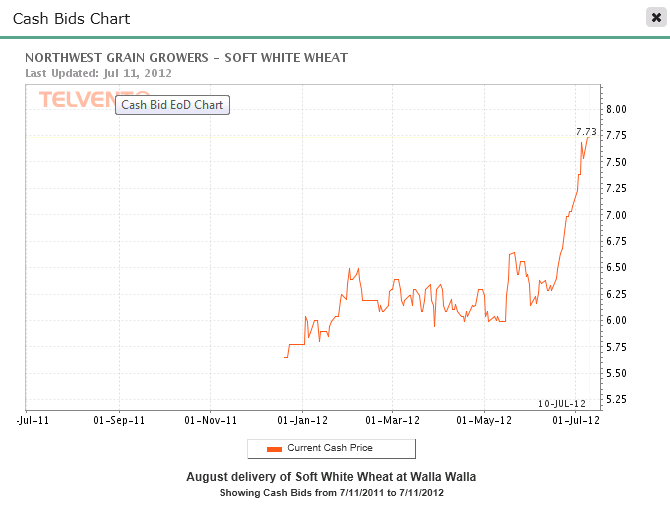
As some people might have noticed there has been some very hot weather with an absence of rainfall in the mid-west this summer. The crops grown in the area are suffering as a result of the weather and the yields are forecast to be lower than usual. This means the price of crops over 1000 miles away in the Pacific Northwest should show dramatic increases as the crop damage in the Midwest becomes irreversible.

The result via Northwest Grain Growers:

SoftWhitePrice20120711

The prices above are for a bushel (60 pounds) of wheat. If loaf of bread weighs a pound and were composed entirely of soft white wheat flour (soft white wheat isn’t usually used for bread, but this makes the point less complicated) then the roughly $1.75 increase in price would translate into an increase in production cost of something on the order of about $0.03 per loaf. So this isn’t all that big of a deal to consumers.

It is big deal to wheat producers because the cost of production is essentially fixed by the costs of land, equipment, seed, fuel, pesticides, fertilizer, and labor. If the cost of production is $5.00/bushel then profit goes from $1.00/bushel to $2.75/bushel. This is an increase in profits of 275%.

My brother on the farm in Idaho might be able pay off the loan on that “new” (new to him but it is several years old) tractor a little bit earlier than expected.

Quote of the day—Motor-T

I always thought it was odd to describe capitalism as a system. Nobody arranged capitalism, or put it into place. Capitalism is the name for what happens (economically) when people are left alone.

Motor-T
July 6, 2012
Comment to Quote of the day—John Aziz
[It gets even weirder when people start whining about the government “forcing freedom” and the CIA “forcing free trade” on people. I have to conclude there is some sort of cognitive distortion going on. Either that or these people have more than few pages in their dictionaries filled in by two-year olds with crayons.—Joe]

Quote of the day—Thomas Sowell

Fallacies abound in economic policies affecting everything from housing to international trade. Where the unintended consequences of these policies take years to unfold, the effects may not be traced back to their causes by many people. Even when the bad consequences follow closely after a given policy, many people may not connect the dots, and advocates of policies that backfire often attribute these bad consequences to something else. Sometimes they claim that the bad situation would have been even worse if it had not been for the wonderful policies they advocated.


There are many reasons why fallacies have staying power, even in the face of hard evidence against them. Elected officials, for example, cannot readily admit that some policy or program that they advocated, perhaps with great fanfare, has turned out badly, without risking their whole careers. Similarly for leaders of various causes and movements. Even intellectuals or academics with tenure stand to lose prestige and suffer embarrassment when their notions turn out to be counterproductive. Others who think of themselves as supporters of things that will help the less fortunate would find it painful to confront evidence that they have in fact made the less fortunate worse off than before. In other words, evidence is too dangerous— politically, financially and psychologically— for some people to allow it to become a threat to their interests or to their own sense of themselves.


Thomas Sowell
Economic Facts and Fallacies: Second Edition Economic Facts and Fallacies: Second Edition page 2.
[See also When Prophecy Fails or my website by the same name for a quick overview.


I expect that most of those that read my blog will see the applicability of the above to our current political situation.—Joe]

Quote of the day—John Aziz

The chief problem that Marxists face is their misidentification of the present economic system as free market capitalism. How can we meaningfully call a system where the price of money is controlled by the state a free market? How can we meaningfully call a system where financial institutions are routinely bailed out a free market? How can we meaningfully call a system where upwards of 40% of GDP is spent by the state a free market? How can we call a system where the market trades the possibility of state intervention rather than underlying fundamentals a free market?

I’m not sure that Marxists have ever understood capitalism; Das Kapital is a mammoth work concentrating on many facets of 19th Century industrial and economic development, but it tends to focus in on obscure minutiae without ever really considering the coherent whole. If Marxists had ever come close to grasping the broader mechanisms of capitalism — and if they truly cared about democracy — they would have been far less likely to promulgate a system based on dictatorial central planning.

John Aziz
July 5, 2012
Guest Post: Is Marxism Coming Back?
[As I said after reading the Communist Manifesto, “The typical two year old child or even the family dog wouldn’t accept the conclusions unless they were forced into compliance.”

Marxists are either profoundly ignorant or profoundly evil. In either case I believe it is intentional. I suspect most fall into the ignorant category (also known as “useful idiots”) but the those in the latter category have a high probability of obtaining all the power.—Joe]

More on ‘Gunsmiths’

This happens a lot.  A customer calls about a problem, and it’s the customer’s gunsmith who says “X” yet the “gunsmith” is totally wrong.  The “gunsmith” is the source of the problem, or the source of the misunderstanding of the problem.  Yesterday, a rep from Big Household Word High-End Optics Company came in with a Yugo M70.  The wooden buttstock’s comb was too high for him, plus he had a Galil missing a detent ball for the rear sight.


Solid wooden stock with a bolt through the middle.  So shave down the comb.  Fit and try.  Ten minutes, plus some finish sanding and some linseed oil.  Nope.  “Gunsmith” decided it would be a better idea to bubba some lump of weld under the rear sight leaf, to raise the sight instead, thus negating the elevation slide function entirely, and crank up the front to match.


“Gunsmith told him that a detent ball for the Galil was “hard to find”.  It took google less than a second to find several sources of loose steel balls, and yet you don’t need a ball per se.  It could be a short piece of rod.  All it really needs to do is fit in the hole with the spring and be sort of roundish on one end.


I asked the rep; “What kind of a ‘gunsmith’ is this guy?”  And this is the answer I get every time;


“Oh but he’s a really great guy.  Really a great guy.  Old School.  He’s been at it for decades and really knows his stuff..”  I have gotten that answer from a lot of people.  That very same answer.  In that very same kind of ‘I can’t believe what I’m hearing’ situation.


I’ve taken to using Tam’s definition of a gunsmith– one who can take an amorphous lump of steel and turn it into a fine firearm.  Give the average farmer or junior high school shop teacher around here a bent, rusty nail, a hack saw, an old bastard file and a power drill, and he can make you a new detent pin for your Galil rear sight, without ever having heard of a Galil.  Actually he could make do with just the file, the saw and the nail, and his bare hands, but that take a little longer.  Same deal for adjusting the comb height, but you only need the file (or a pocket knife) and a chunk of sandpaper.  But an “experienced gunsmith” was out of his element.  It’s gotten so every time I hear the infamous words, “My gunsmith says…” I start rolling my eyes.  I know there are good ones out there (some really, really good ones) but no one calls me or comes in with a problem if they have a really good gunsmith, do they?  So my sample is heavily weighted.  Or so I hope.


A big takeaway here is that a nice personality, I suppose, can overcome the greatest depths of incompetence, and keep you in business.

Quote of the day—Thomas Sowell

Undefined words have a special power in politics, particularly when they invoke some principle that engages people’s emotions. “Fair” is one of those undefined words which have attracted political support for policies ranging from Fair Trade laws to the Fair Labor Standards Act. While the fact that the word is undefined is an intellectual handicap, it is a huge political advantage.People with very different views on substantive issues can be unified and mobilized behind a word that papers over their differing, and sometimes even mutually contradictory, ideas. Who, after all, is in favor of unfairness? Similarly with “social justice,” “equality,” and other undefined terms that can mean wholly different things to different individuals and groups— all of whom can be mobilized in support of policies that use such appealing words.

Thomas Sowell
Economic Facts and Fallacies: Second Edition Economic Facts and Fallacies: Second Edition pages 1 and 2.
[The phrase “special power” brings to mind “super heroes” and “super villains”. I am of the opinion that while there is ample evidence of “super villains” “super heroes” only exist in the minds of small children, some Ron Paul fans, and Democrats.—Joe]