
At least 15 people were killed, and up to 45 injured when a knife-wielding man went on a rampage early Tuesday at a facility for the disabled in the Japanese city of Sagmihara, broadcaster NHK reported.
Category Archives: Current News
Quote of the day—Dr. Keith Ablow
At least 84 people died Thursday night in Nice, France, when a terrorist plowed a truck into a crowd celebrating Bastille Day. Their deaths should free all of us, once and for all, from the toxic and seditious lie, spread by the likes of Barack Obama and Hillary Clinton, that guns–not madmen or radical Islamics–are a threat to civilized people in America, or in France, or anywhere else.
Dr. Keith Ablow
July 15, 2016
Bastille Day bloodbath in Nice proves that gun control advocates are liars
[Read the whole thing. It’s short and sweet.—Joe]
Save lives! Ignore the Bill of Rights extremists
It occurs to me that we need some common sense regulation to prevent the tragedies in Orlando and Dallas. The Bill of Rights is not a suicide pact and the 1st Amendment extremists need to compromise for the safety of everyone.
The five dead and nine wounded in Dallas was predictable, preventable, and should never happen again. All it would take would be a small amount of compromise by the extremists in this country who refuse to consider the most common-sense measures that almost everyone can agree on.
Nearly the same thing can said about the 49 murdered and 53 wounded in Orlando last month. Something like that is entirely predictable and preventable.
Here’s what everyone with a shred of common sense can obviously agree on:
- The whole “black lives matter” talk should have been shut down as soon as the emotions started getting hostile. Yes, the 1st Amendment says we have a right to free speech but that was before social media, text messages, and email. Bad ideas can travel so fast that people don’t have a cooling off period before a critical mass has formed and we have mass demonstrations before the hot heads get a chance to think thing through. The 1st Amendment was fine when mass distribution of dangerous ideas by common folk meant standing on a soap box in the town square and hoping someone would listen to you.
- There are virulent strains of both Christianity and Islam are literally deadly to the LGBT community. Again, the 1st Amendment is perceived as a block to common sense regulation by the 1st Amendment extremists. But that was a time when homosexuality not seen for what it is. We now know that, at worst, it is minor quirk of nature in expression of one’s sexual desires that is almost entirely harmless. It’s time to put an end to the violence. All reasonable people must agree that all writings and speech which speak ill of alternate expressions of sexuality or gender must be banned and vigorously rooted and and destroyed. Yes, people have a 1st Amendment right to religion. But there are lots of religious to choose from which are not so dangerous. And the extremists almost never mention the first part of the 1st Amendment, “Congress shall make no law respecting an establishment of religion…” My common sense proposal doesn’t establish a religion. It merely bans a small subset of religions that are incompatible with modern day society. So how can my proposals possibly be considered as an infringement? It’s just common sense.
Thousands of lives each year of depend upon these sort of common sense laws. We can respect the 1st Amendment and yet save countless lives every year if we don’t let the extremists get in our way.
[end sarcasm]
Useful idiot, or just idiot?
Oh, the irony. “A professor at the Southern State Community College (SSCC) in Ohio is currently under investigation for threatening to shoot up the NRA headquarters in Fairfax, Virginia and Washington lobbyists in order to increase support for anti-gun legislation.”
His FB post read, in part :
“Look, there’s only one solution. A bunch of us anti-gun types are going to have to arm ourselves, storm the NRA headquarters in Fairfax, VA, and make sure there are no survivors.
This action might also require coordinated hits at remote sites, like Washington lobbyists.
Then and only then will we see some legislative action on assault weapons.”
Not sure how someone with this tenuous a grasp of reality manages to become an adjunct prof, but there you have it. And while I’m sure that if he did do that, he might see some action on weapons, but I’m not so sure it would be legislative.
Don’t ever let them tell you nobody wants to take your guns.
New Hillary slogan
From John F. on Facebook:
Grandma Hillary has a new opportunity for a campaign slogan: “Incompetence bordering on criminal.“
Well, she might, using different words claim something like that. It actually was significantly over the border. She was well into illegal alien territory. I just wish we could “deport” her to Leavenworth.
The audacity of hope
Doing something blatantly illegal and getting away with it is a badge of honor among thieves. I am reminded of “Guilty as hell, free as a bird”.
If you thought she was going to be prosecuted for this, you haven’t been paying attention.
No charges for Hillary
The FBI is not recommending charges be brought against Hillary. But it’s still pretty damning:
Although we did not find clear evidence that Secretary Clinton or her colleagues intended to violate laws governing the handling of classified information, there is evidence that they were extremely careless in their handling of very sensitive, highly classified information.
For example, seven e-mail chains concern matters that were classified at the Top Secret/Special Access Program level when they were sent and received. These chains involved Secretary Clinton both sending e-mails about those matters and receiving e-mails from others about the same matters. There is evidence to support a conclusion that any reasonable person in Secretary Clinton’s position, or in the position of those government employees with whom she was corresponding about these matters, should have known that an unclassified system was no place for that conversation. In addition to this highly sensitive information, we also found information that was properly classified as Secret by the U.S. Intelligence Community at the time it was discussed on e-mail (that is, excluding the later “up-classified” e-mails).
None of these e-mails should have been on any kind of unclassified system, but their presence is especially concerning because all of these e-mails were housed on unclassified personal servers not even supported by full-time security staff, like those found at Departments and Agencies of the U.S. Government—or even with a commercial service like Gmail.
Separately, it is important to say something about the marking of classified information. Only a very small number of the e-mails containing classified information bore markings indicating the presence of classified information. But even if information is not marked “classified” in an e-mail, participants who know or should know that the subject matter is classified are still obligated to protect it.
…
To be clear, this is not to suggest that in similar circumstances, a person who engaged in this activity would face no consequences. To the contrary, those individuals are often subject to security or administrative sanctions. But that is not what we are deciding now.
Can someone who is that careless with the security of our country be trusted in any position of government? Well, I might give consideration to her taking a position of a toilet scrubber in a public park.
Quote of the day—Michael Z. Williamson
Once again, we have a high profile shooting, and once again, the hysteria is out in force.
Let’s start with some facts: If you don’t shoot, or have only occasionally shot on a range, then your opinion on how useful an armed respondent would be is garbage. If you don’t drive a car, you aren’t qualified to tell professional drivers what they should have done in an accident.
Seriously, shut up, you’re an idiot.
Michael Z. Williamson
June 15, 2016
After An Attack: Understanding the Fear
[He continues with an enumeration and examination of the possible outcomes. It’s a very clear and logical analysis which demonstrates there is significant chance of a big upside and very little, if any, chance of a downside to people having guns to defend themselves in a mass shooting situation.—Joe]
Journalist education 99; Assault Rifle
Words continue to mean things, even though 99% of journalists fail to use them correctly. This post is for journalists, or for those who take them seriously. For everyone else who already knows this stuff; thank you for your patience while we dabble in some remedial education for the less fortunate.
There’s now a trend among conservatives in talk radio to declare that there is no such thing as an “assault rifle”. They’ll say it proudly, as though they’re among an elite few who know the truth about something. This is the sort of thing you “know” because some guy you know knows a guy who’s cousin’s step-father’s uncle knows a thing or two because he once knew a guy who knew a cop, and the story trickled down through several get-togethers and backyard BBQs. In other words it’s not something you know at all. Apparently they mean well in this case, but they are attempting to make a point that, at best, they didn’t quite get the first few times it was explained to them. We’ll try again.
Yes, there are assault rifles. The Germans seem to have cemented the design concept back in the 1940s. In short, an assault rifle (Sturmgewehr) is a smallish rifle firing a cartridge of intermediate size and power (in-between a pistol and a rifle), feeding from a detachable, box magazine, capable of full-automatic fire. The original had a pistol grip stock, but the latter feature is not critical to its purpose or function. Assault rifles really, really do exist. They’re a sort of halfway rifle, between the submachine gun (which fires pistol ammo) and the automatic rifle (which uses full power rifle ammo) and practically all militaries of the world now use an assault rifle of some kind as standard issue to regular infantry. They’re also found occasionally among law enforcement and private collectors.
Assault rifles were essentially banned in the U.S. (before they were even invented) by the National Firearms Act of 1934, as modified by the Firearm Owners’ Protection Act of 1986.
The thing that does NOT exist is any firearm design known as an “assault weapon”. Notice the difference there; “rifle” verses “weapon”. Sure; a rifle can be used as a weapon, but a weapon is not necessarily a rifle. A “weapon” could be a rock, for example, or a stick, or a fist, et al.
When we’re talking about classifications within the firearm industry, words really, really do mean things. There is no such thing as the firearm classification, “assault weapon”, and therefore no one can define it. When you think about it just a little bit, it makes sense that no one can define it, being that it does not exist.
Just as a politician talking about banning “assault weapons” is only showing his ignorance and therefore disqualifying himself from the discussion, those of you who say there’s no such thing as an “assault rifle” are just as ignorant, or more so. The assault rifle is a significant part of 20th century military and political history, and you seem to have missed the entire story. Please stay out of the conservation until you’ve got it right.
To summarize then;
Assault rifles DO exist. See right here.
Assault weapons (as a firearm design) do NOT exist.
Thank you.
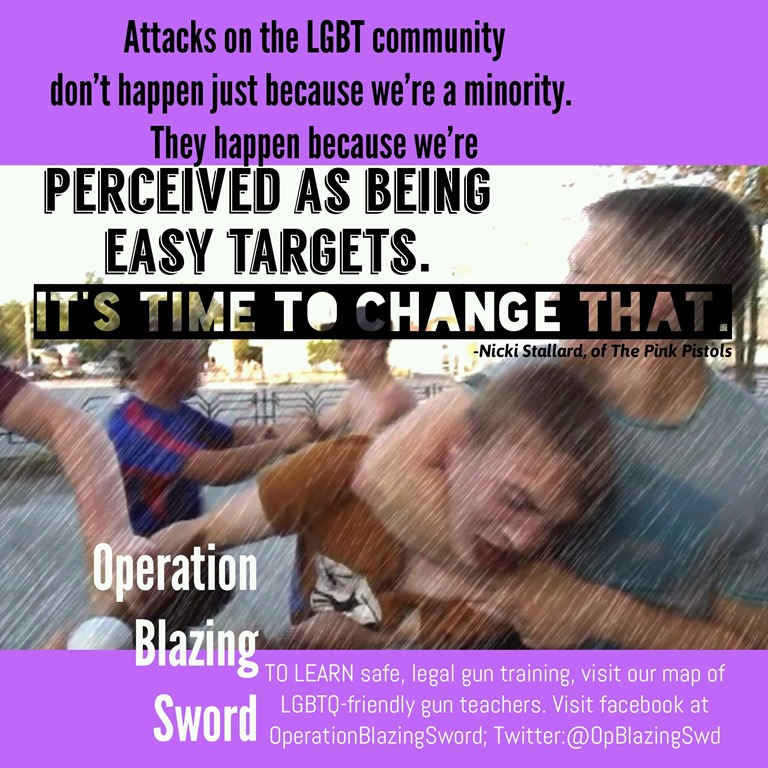
It’s time to change that
Via Stephanie:
Don’t believe everything you hear or read
I received an email tip about this and it sounded just a little too bad to be true. The incident supposedly happened June 2, so I went looking for more recent information and found this:
A story that’s circulating on social media and anti-Muslim and conspiracy-oriented websites is falsely claiming that three young Syrian refugees raped a young girl at knifepoint at an apartment complex in Twin Falls that supposedly is the site where about 50 Syrian refugees had been resettled – when in fact, no Syrian refugees have been resettled to Twin Falls. The story also charges that police failed to respond to the alleged incident in a timely fashion, which local authorities also say is false.
“There was no gang rape, there was no Syrian involvement, there were no Syrian refugees involved, there was no knife used, there was no inactivity by the police,” said Twin Falls County Prosecutor Grant Loebs. “I’m looking at the Drudge Report headline: ‘Syrian Refugees Rape Little Girl at Knifepoint in Idaho’ – all false.”
I’ve fallen for this sort of thing before too. It was some outrageous gun related thing.
If something is an extremely close match to your belief system or worst fears you should examine it very carefully. Your mind “wants” to believe it and will easily ignore the warning signs that it is fabricated or exaggerated.
Sometime or another everyone will find, for a short time, they had crap for brains. Clean it out, learn from the experience, and don’t get fooled the next time.
Irony meter, meet peg
A journalist tries to buy a gun. Gets denied. Hilarity ensues.
Short version: He’s doing a story of how easy it is to buy guns (complete with overwrought hyperbole), but he’s got a history of alcohol abuse and a domestic violence charge. Then he’s got the cluelessness to say “didn’t see that coming.”
D’oh! (h/t to Vox)
LGBT-friendly gun trainers
Operation Blazing Sword makes for an impressive display:
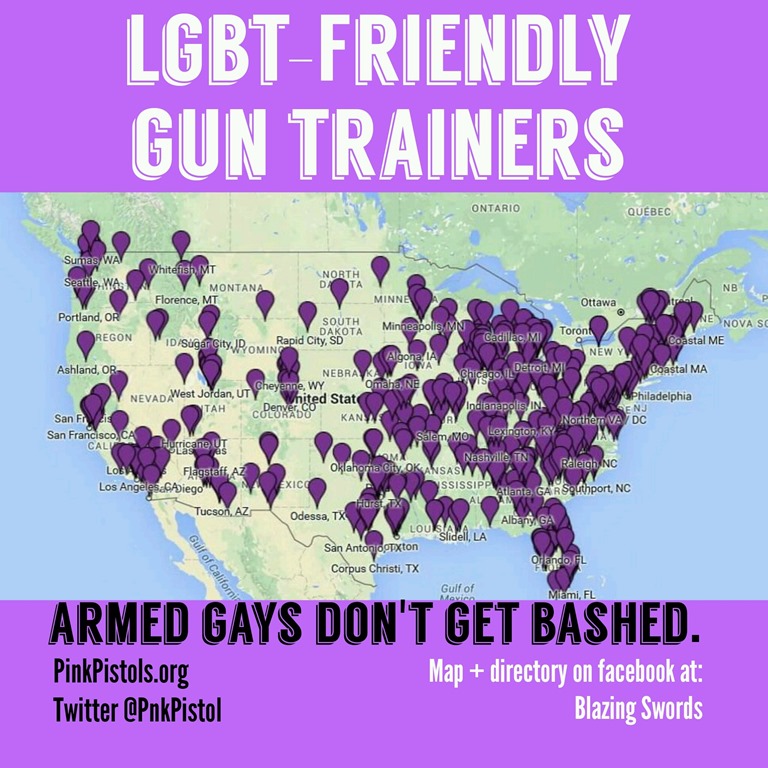
It’s a lot more productive than huddling in a group holding candles or something. This is the difference between those who demand people be forcibly disarmed to “make us safe” versus those who offer to teach proven techniques and tools to actually protect innocent life.
The Seattle Times called
About 2:20 this afternoon a reporter from The Seattle Times called me. They explained they found my name on the Pink Pistols website as someone who is LGBTQ friendly and offering firearms training in the Seattle area. I suspect it was this Pink Pistols post which linked to Erin’s Operation Blazing Sword.
Lots of gun people will tell you, with good reason, to NOT talk to the media unless you know they are a known friendly. The debate between talking to him and saying I wasn’t interested in talking bounced around in my mind as I listened further. The Seattle Times has never treated me unfairly. They have been very anti-gun in general, but they have never misrepresented me. I decided to listen and make up my mind after I got an idea of what their angle was.
They wanted to know if I have had an increase in interest in instruction from people in the LBGTQ community since the Orlando shooting. Okay. Probably friendly, I decided.
As I left my cubicle to find an empty conference room and get some quiet I told him, “That’s an interesting question.” And that if he dug into the Seattle Times archive deep enough he could find an article on the topic which mentioned me and Ray Carter (there is also a closely related Lewiston Morning Tribune article).
Once I had settled into a comfortable chair I told him my story. I jumped around some but I gave him a very brief history of Cease Fear, Ray Carter who approached Joe Waldron of CCRKBA with the idea of firearms instruction for people at risk in the LGBTQ community, the involvement of CCRBKA, SAF, and Washington Arms Collectors in the Cease Fear projects, and the creation of the Pink Pistols a few years later. I told him about distributing flyers for firearms self-defense classes to bath houses and gay bars on Capital Hill in the late 1990s. I told him about Erin Palette earlier this week creating the Google map of LGBT friendly firearm instructors. I told him that although 15+ years ago I was very active on the topic he was researching, until I added my name to the map and sent an email to the Yahoo Cease Fear list earlier this week I seen any interest in years but that I was pretty much disconnected from that side of things for a long time until this week. This week I had a couple of people contact me.
He seemed very interested and perhaps was taking notes. I told him to send me an email (over two hours later and I still haven’t received it) and I would send him a bunch of links. He said, “That would be great!” This blog post is probably going to be the collection of links I send him.
He had one final question for me. “How do you identify?”. “I’m heterosexual”, I told him. I continued with, “I’m very straight. But I have a nephew who is gay and a close blood relative, who values her privacy, who is trans.”
He thanked me and told me he probably wouldn’t be doing much more work on the story until Monday.
We’ll see if I misjudged whether they were a friendly or not. There weren’t any strangely worded, leading, questions which hinted an a hostile narrative. So, I think, it will either turn out okay or will be dropped.
A question about NEED
A former high school classmate asked a question on Facebook the other day (please ignore the typos and incorrect wording):
Former Classmate: Our second amendment states:
A well regulated Militia, being necessary to the security of a free State, the right of the people to keep and bear Arms, shall not be infringed.
Somebody. (Terry or Dale or Joe R) PLEASE tell me how outlawing guns that are for nothing other than shooting as many people as fast possible as fast as possible is infringing on you?? Keep your hunting gunS, keep your concealed pistonS, (you can still hunt and shoot and wave them around right??) but the type used in FLA?? Why ?
It resulted in an online discussion with several former classmates then into private messages between her and I. I present it here because I think it is instructive that principles and court decisions are sometimes useless in changing peoples minds. But that if you can find the correct pathway into their mind you do have a chance. Or at least you can avoid being thought of as avoiding their questions.
What follows is not the entire conversation. There were other things said including talk about our grandkids and being invited to visit them next week and responses to/from other people that would be somewhat distracting and irrelevant to my point:
Joe: Read the Heller decision from the U.S. Supreme Court. The important part relevant to this discussion is that guns “in common use” are protected. The AR-15 style rifle is the most popular rifle in the country with many million in circulation and certainly qualifies as “in common use”.
Also, this style of rifle is not “for nothing other than shooting as many people as fast possible”. It is used for hunting, self-defense, competition, recreation. Occasionally someone uses it illegally with tragic results but this is very rare. It is so rare that statistically you are much more likely to be murdered but someone using their feet than a rifle (of ANY type).
FC: Can I ask a question. Do you REALLY use it for hunting? does it not desiccate what you shoot with it??
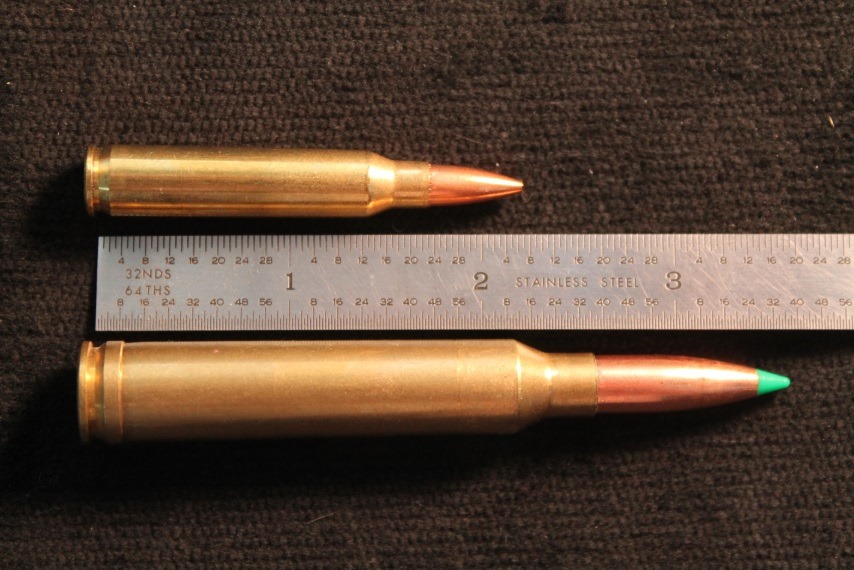
Joe: I only went hunting one year and I used a much more powerful gun. A .300 Winchester magnum. Which fires a MUCH more powerful round. The AR-15 shoots what is considered a medium power cartridge which is so weak that in some states it is not allowed for use on deer. It is typically used to hunt coyotes, prairie dogs, ground squirrels, and other “varmints”. The smaller cartridge in this picture is a cartridge for an AR-15. The .300 Win Mag is the larger one.
If you want to see for yourself l would be glad to let you fire both types of guns (or many others for that matter) at pieces of wood, pop cans, milk jugs filled with water, whatever, and see for yourself.
FC: [High school boyfriend] took me rifle hunting back in 1972. We did target shooting (and kissing) but then I spotted a grouse and shot it. There was nothing left but a raft of feathers. I cried and promised God I’d never shoot again.
Joe: I had a somewhat similar emotional experience (without any kissing of [her former boyfriend]). I was probably in about 7th grade and shot a small bird with my BB gun. It didn’t die. It was wounded. I had to shoot it probably five or ten times before it finally died. It was awful.
The next animal I shot was a rattlesnake on a trail near Dworshak Dam when I was hiking with my kids who were about 8->12 years old. That one I didn’t feel any guild over.
The last animal I shot was a deer in 2005. I had been unemployed for several months and money was a bit tight and the deer eating the crops on the farm were plentiful. No guilt that time either.
FC: Just you and me Joe cuz I REALLY want to understand. Knowing what these types of auto or semi guns are used for in purely evil forms, am I totally cracked to think that responsible gun owners would give them up if it meant one less Orlando, one less Sandy Hook??
Joe: I wouldn’t say, “cracked”. Naïve, yes. Just a law requiring REGISTRATION of them in Connecticut resulted in less than 10% compliance. Banning of the magazines (erroneously called “clips” by many) for them and requiring they be turned into the police in Los Angles resulted in ZERO of them being turned in. I know of no occasion in the last 10 years of bans of this nature resulting in more than an estimated 10% compliance.
And your question has an incorrect assumption. It wouldn’t mean there would be “one less Orlando or one less Sandy Hook”. The second largest mass shooting body count in this country, Virginia Tech, was done with two handguns. France and Belgium have total bans on guns like this and they recently had terrible mass shootings anyway.
FC: Soooo aside from sharpshooters like that guy in the movie, do gun enthusiasts NEED those guns?
Joe: “Need”? It’s a “Bill of Rights”, not a “Bill of Needs”. That’s a bit of a snarky answer but do we really “need” all the different religions? Or how about trial by jury?
Gun owners don’t “need” to justify each gun that exists on the market. The government must justify, with a standard of no other means being available to accomplish the stated benefit (in legal terms it’s called “strict scrutiny”), any restriction upon constitutionally protected rights.
But that is likely to have you thinking I’m avoiding your question some, so I’ll try to explain it terms that perhaps will make it less abstract.
Handguns are the most common firearm used for self-defense. But they are more difficult to shoot accurately than a rifle. And the recoil from an effective self-defense handgun round is far more than many people, particularly women of slight build, can handle. The AR-15 rifle is very easy to shoot and practice with. And getting solid hits for self-defense applications are almost trivial compared to doing it with a handgun. For at home self-defense many trainers will recommend an AR-15 over a handgun.
“Need”? Do you “need” seat belts and fire extinguishers? Most of the time no. But there are times when some people unexpectedly need the best tool they can get. If the owners of the Pulse night club had a couple AR-15s and staff who knew how to use them, there would have been a lot fewer innocent people murdered last weekend. Did they “need” them?
FC:

I think she understands our position better. Or maybe she just gave up on me. In any case I’m pretty sure she doesn’t think of our position as totally ignorant and/or evil. Maybe I’ll find out more if Barb and I visit her next week.
Calling all firearms instructors for new LGBTQ shooters
If you are a firearms instructor or just willing to take a new shooter of LGBTQ persuasion to the range for the first time sign up here. If that isn’t really your thing but you know someone in the LGBTQ community who wants to learn to shoot sent them there.
The creator if this site, Erin Palette, is being interviewed about it by the BBC and was linked to by PJ Media.
This could be big.
Pink Pistols media release
From here:
Pink Pistols Saddened by Attack on Orlando Club
FOR IMMEDIATE RELEASE (Philadelphia, PA) June 12, 2016: Early Sunday, around 2AM Eastern Time, the Pulse nightclub in Orlando was attacked by an armed individual. Approximately 20 persons were killed and over double that wounded when the attacker, whom police have identified as Omar Mateen, a 29-year-old from Fort Pierce, FL, pushed his way into the club and opened fire on patrons. Weapons carried by Mateen are reported as an “assault-type” rifle, a handgun, and a suspected explosive device. UPDATE: Reports are that the death toll is around 50, with over 50 more wounded.
“It appears he was organized and well-prepared,” said Orlando Police Chief John Mina at a news conference on Sunday. Additionally, Orange County Sheriff Jerry Demings said “This is an incident … that we certainly classify as a domestic terror incident.” Authorities say the FBI is involved. Preliminary information reveals that Omar Mateen’s family is from Afghanistan, though Omar may have been born in the United States. His family is reported to be distraught at the actions and loss of their son.
Gwendolyn Patton, First Speaker of the Pink Pistols, an international GLBT self-defense organization, warns people not to jump immediately to the assailant’s guns as the object of blame, but to concentrate instead on Mateen’s violent acts. “The Pink Pistols gives condolences to all family and friends of those killed and injured at Pulse,” began Patton. “This is exactly the kind of heinous act that justifies our existence. At such a time of tragedy, let us not reach for the low-hanging fruit of blaming the killer’s guns. Let us stay focused on the fact that someone hated gay people so much they were ready to kill or injure so many. A human being did this. The human being’s tools are unimportant when compared to the bleakness of that person’s soul. I say again, GUNS did not do this. A human being did this, a dead human being. Our job now is not to demonize the man’s tools, but to condemn his acts and work to prevent such acts in the future.”
Patton’s concerns are that knee-jerk gun-control efforts may make preventing future events harder rather than easier, as only the law-abiding potential victims will be affected by such laws. “It is difficult, if not impossible, to foresee such an event,” continues Patton, “But if they cannot be prevented, then they must be stopped as fast as someone tries to start them.”
Some bars and other establishments that serve alcohol are difficult to protect because many states forbid the carrying of weapons where alcohol is served, but that just as one might have a designated driver who stays sober, one might have a designated carrier with a concealed-carry permit who goes armed and does not drink. “It’s sad that we must consider such things, but when there are persons out there who mean us harm, we must find ways to protect ourselves within the law.” Patton concludes.
The Pink Pistols is an international organization dedicated to the legal, safe, and responsible use of firearms for self-defense of the sexual-minority community. Chapters may be found across the United States and Canada. Though the Pink Pistols is for the GLBTQ community, it is not solely composed of the GLBTQ community, and all are welcome to join.
Contact:
Gwendolyn S. Patton
First Speaker, Pink Pistols International
firstspeaker@pinkpistols.org
http://www.pinkpistols.org
Ph: (610) 879-2364
Gun Control Didn’t Work … Again
It was illegal to possess guns in the Orlando night club. How did that work out?
This was published on June 7, before the Orlando shooting, but it’s still applicable.
It’s time to eliminate “gun free zones” those are nothing but victim disarmament zones.
Quote of the day—Sean Davis
When Soechtig and her team plea to federal charges for violating the nation’s commonsense gun laws, we’ll know they’re serious about cutting down on gun crime. Until then, we’ll know they’re just a bunch of ignorant, gun-trafficking profiteers who want to take away our rights while they violate the very laws they demand with absolute impunity.
Sean Davis
June 3, 2016
Katie Couric’s Anti-Gun Producers Repeatedly Violated Federal Gun Laws
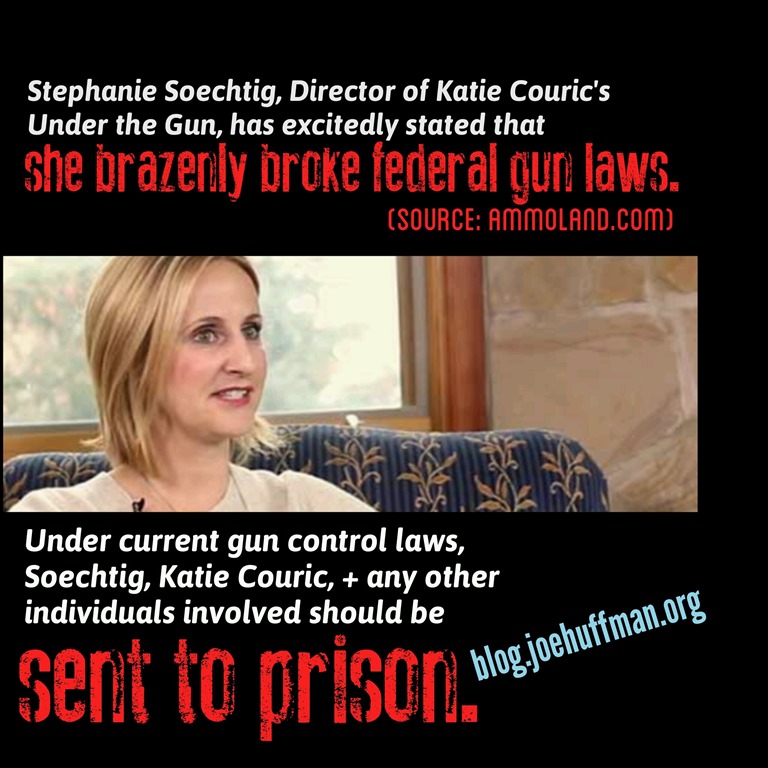
[The laws Soechtig and team committed should not stand up to scrutiny by the courts but other people are still going to jail for them. And as long as other people are going to jail over them it should doubly apply to Soechtig and her gang. Since she wants us to go to jail for violation of nonsensical laws then she needs to understand, first hand, the significance of what she demands.
Update: Image supplied, copyright free and no permission required, by Stephanie.—Joe]
Ray Carter
I was reading my RSS feed this morning and Tam informed me Ray Carter died. Last Monday I had read Ray’s Facebook post saying he was in the early stages of liver failure and had at best three to four weeks left. It was the cancer that was discovered in, I think, 2013. He had said Boomershoot was on his list of things he always wanted to do so Ry and I made it happen in 2014. By that time the cancer was in remission and I hoped Ray would attend more Boomershoots but that didn’t happen. Ray was working for the Second Amendment Foundation at the time and I asked if he would be the dinner speaker and he readily agreed.
Oleg Volk attended Boomershoot that year, had a photo session with Ray, and shared his raw images with me. Here are a few of them:

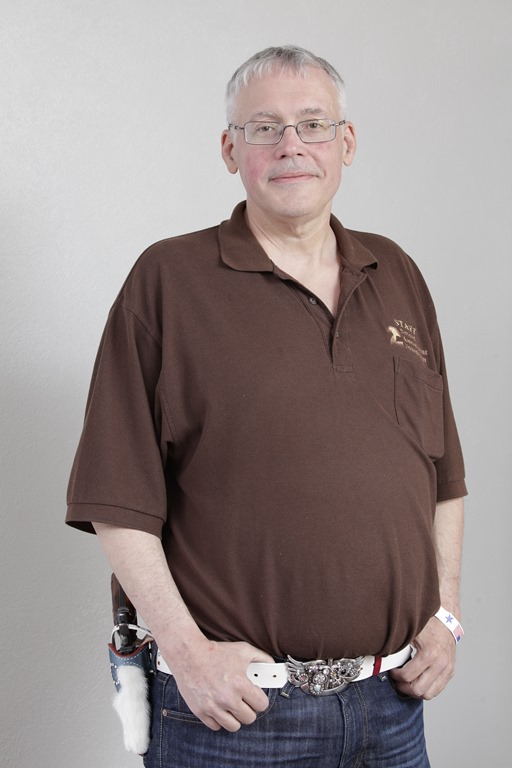
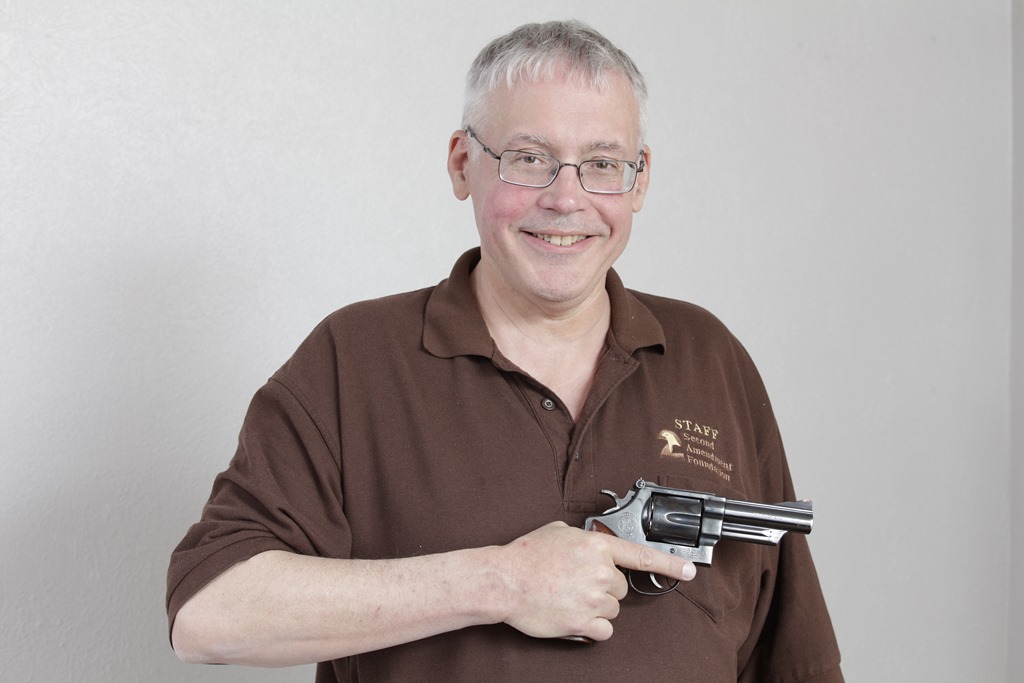
I’ve written about Ray numerous times as has the more well known Seattle Times. Once we were even in the same Seattle Times editorial.
As I explained here I first met Ray when working with Cease Fear which lead to my creation of the Jews In The Attic Test. It was Ray who came up with the name Cease Fear as a play on the name of the main anti-gun group in the state, Washington Cease Fire. You should have seen the looks on their faces when we showed up in Olympia with our signs and shirts to counter their lobbying efforts. It was wonderful.
I still have the shirt someplace. Here is a picture of me wearing it (click on it for a larger version):
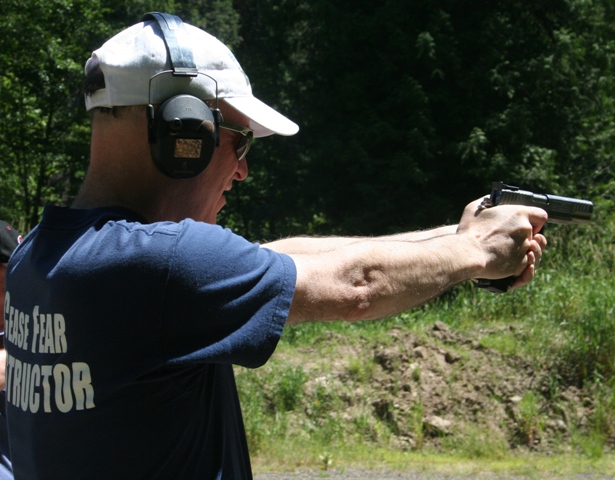
Ray did a lot of work to further gun rights. And being gay he could say things and converse with authority to both gun and LGBT people on how we could work together for mutual benefit. He was a huge benefit to the gun rights movement in Seattle, Washington State, and the nation.
His more visible work in the last decade involved a number of fronts. In 2008 Ray went to work for The Second Amendment Foundation. In 2009 Ray was a plaintiff in a successful lawsuit against the city of Seattle for banning guns in city parks. He was also active in the leadership of the Washington Arms Collectors.
I featured him once for my quote of the day:
The police (and paramedics) are dandy when they arrive. But in the immediate moment of attempted felonious or otherwise violent action being committed upon ones self, persons one is responsible for or the imminent threat thereof a more immediate tool is both appropriate and desirable even in this day and age. It is my observation that a .45acp JHP placed center of mass at approximately 900fps will, more often than not, bring such unpleasantry to a swift halt, though on occasion repeated application of the lesson is required.
Ray Carter
November 21, 2014
He will be greatly missed.