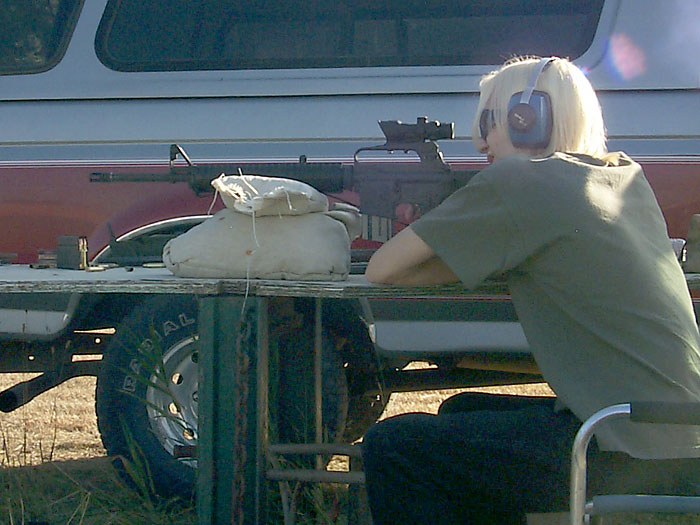
Pistols with Rifle Receivers

I guess I’ll call them “PRRs” or “RRPs” (Rifle Receiver Pistols).  A few of us made comments over at at Say Uncle about the use of such pistols.  There was the assertion that Blackwater personnel have been using AK pistols out of vehicles.  I don’t get it.  Here’s my last comment;

A cut down, folding stock carbine I can see (AKS-74U et al) but I have yet to understand the allure of the “pistol” version (no shoulder stock at all).

“They became very common with Blackwater in Iraq.”

You’re not referring to a folder rather than a pistol?

Stateside, I see the rifle receiver pistol as a political creation (if it has a shoulder stock it falls under the NFA [as a short barreled rifle, or SBR]) rather than something that arose for a particular application.  Otherwise we’d be seeing handguns more along the lines of an Automag with 30 round mags, and/or the Tech 9 or some iteration thereof would be popular, which it isn’t.

There must be something I don’t understand.  Is it all about suppressive fire?  But in that case what’s wrong with having a folding stock on there just in case you want to, you know, aim, or something?

Can anyone fill me in on the particulars?  Why an AK pistol, AR pistol, etc., other than the fact that the stocked version comes with the NFA hassles and tax for civilians?  I mean; why are such pistols desired for defense and/or in combat?  Or are they?

What computers can’t do

There was a book written nearly 40 years ago that sits on my bookshelf only partially read. I read about a third of it about 25 years ago and got bored with it. If I had the time I would pull it off the shelf and give it another try and see if what he said could not be done is true with today’s computers. He claimed they will never be able to do some tasks. I am not entirely convinced such strong bets could be placed–if for no other reason than never is a very strong statement. But I do know that some revolutionary changes will have to be made before he can be proven wrong.

Chris has contributed some fascinating information to the discussion on exobrains. But not everyone may find it as fascinating or understandable as some of us geeks do. I hope to give a couple examples here that will be a little easier to relate to.

From a book I listened to recently I picked up an absolutely true insight that nearly caused a temporary meltdown of the control system of my muscular skeleton system. I nearly went deaf, blind, and limp as my brain dumped all I/O to the outside world and spent several seconds pondering the implications of that insight. What follows is a glimpse into the differences of computer “brains” and animal brains and highlights one area of tasks that are very, very difficult to do with todays computers and how much room for improvement there is. We may think computer hardware and software are really hot stuff. But when compared to meatware, for some tasks, its not even in the race.

We know how fast signals travel in the human nervous system. It isn’t electrical as much as it is chemical. People frequently say it’s electrical but, as Sean Flynn would say, that is only true for some values of electrical. Instead of signals taking about one nanosecond to travel one foot as is the case for true electrical signals it is (IIRC) something on the order of one millisecond per foot. About one million times slower. The “logic elements” of the brain have known response times as well. Thus by timing how long it takes for you to respond to some input we can determine how many “logic elements” were involved in making decisions based on the given input.

For example–suppose we were to show you set of random images that contain either a picture of some sort of cat (including leopards, lions, tigers, and domestic short hairs) or a picture of some sort of dog (including foxes, wolves, greyhounds, and Shih Tzus). You are to hit button “C” or “D” depending on whether it is a cat or a dog in the picture. If the pictures were clear and the animal was in full view normal, healthy humans could perform this task in well under one second. Even a three year old could do it. I’ve been programming computers professionally (admittedly in non-AI fields so this isn’t as strong a statement as I would like it to be) for about 25 years but I think it would be possible to choose the set of pictures such that the best computer program, given the same time limits, would have an error rate would be little better than chance yet the human would have an error rate of near zero.

In a similar vein I once had someone at the CIA tell me they had spent millions and millions of dollars developing software that would analyze photographs and find objects of military interest. These would be things like tanks, missles, and AK-47s. When the CIA is interested in these type of objects the picture they get to work with were not taken with the full cooperation of the owners of said military hardware. Hence the objects of interest may be in less than full view of the person taking the picture and a considerably harder problem than the dog and cat problem outlined above. Said CIA employee told me that after spending all those millions of dollars what they found worked best was if they put the pictures on the wall above the urinal and left a pencil nearby. At the end of the day all the objects of military interest would be circled. No computer could match that in processing time, accuracy, or cost.

Once we subtract out the nerve transmission time from your eyes to your brain and from your brain to your fingers we find that the maximum “depth” of the “logic elements” is about 200. There were many, many elements working in parallel but no path exceeded 200 elements in length. There is no existing computer, no matter how massively parallel it’s “logic elements” are, no matter how sophisticated the algorithms to take advantage of parallel processing power, that can reach a decision for the given problem with that sort of depth. The depth of the logic paths are going to be 100s of thousands of times deeper for the computer and yet it would end up with far, far, inferior decisions.

That still gives me goose bumps.

The power of the things we build

Say Uncle wrote about our exobrains this morning then I went to work today and worked on the operating system for one. I fired off a build of the software and I happily noted that the CPU usage on the eight 3 GHz processors went to 98%. It pretty much stayed there for most of the two to three hours it took to do a build. The CPUs get some rest when it’s writing a bunch of stuff to disk but still it’s an impressive amount of CPU cycles being burned.

Then I wondered just how impressive is it? What does it really mean?

That computer can add 20 numbers together in the time it takes for light to travel one foot.

Eight 3 GHz processors are doing something on the order of 20 billion operations per second. And those “operations” aren’t exactly trivial. Each operation is something like an addition, subtraction, multiplication, reading or writing a number. And those aren’t just numbers like 0 through 10. The CPU can handle any number in the range from -2147483648 to +2147483647 just as easily as it can from -10 to +10. And while it is doing that it can keep up a running commentary telling me what it is doing at a rate that is far to fast for me to keep up.

Imagine you have every man, woman and child on this planet (about six billion) working on the same task they couldn’t even do the raw arithmetic let along the communication and coordination at a rate that is even 1/100th of what the little box under my desk can do. I have the brain power (for some tasks) exceeding the capacity of several earth-like planets complete sentient population at my disposal.

The exobrain of today is only about one 1/3 of a planets worth–but that isn’t a bad start on a budding cyborg.

Did I also tell you we are working on project SkyNet?

Update: Some of the comments about this post here are absolutely awesome. To completely appreciate some of them require having read The Hitchhikers Guide to the Galaxy.

Also closely related.

Enabling

I left my copy of Lethal Logic in Idaho this weekend or I would quote chapter and page but in essence one thing Henigan says, “Yes, the NRA is right, ‘Guns don’t kill people; people kill people’ but guns enable people to kill people.” And of course that is justification, in his mind, to restrict access to firearms.

What is overlooked, minimized, or deliberated not mentioned is that guns also enable the protection of innocent life and any roadblocks you put up to reduce access to “people that shouldn’t have guns” also reduces access to people that need guns to protect themselves and others. The reduction in access might be not be a complete blockage but any increase in the price of acquisition and ownership reduces the number of people willing to pay that price. Just being put on a government list has a chilling effect on any type of activity. Particularly when that activity has a history of increasing your odds of being put on a death list. Would you be willing to register with the government as a homosexual or Jew?

Another technology that enables both good and evil has been blogged about recently is something I have been working overtime on for The Borg recently. In fact my tester and I were exchanging IM as late as 11:33 tonight and I still have one eye on a build in progress.

Here are some of the blog posts I have recently read about cell phones being used for determining the location of the user:

I’m extremely busy at work right now on Windows Mobile 7.0. This is an operating system which will be used in millions and millions of cell phones. My team is the location team. We are responsible for determining the location of the phone and getting that information to applications that want it. I know as much about this topic as just about anybody in the company.

There are multiple ways of determining the location of a modern cell phone. In a decent environment (underground, or next to tall buildings are not good environments) the built-in GPS can obtain the device location with an accuracy of 10 meters or better. The other obvious way to determine location is using the cell tower you are connected to. As a rough estimate this can get you about 1000 meter accuracy. There is a third way that isn’t quite so obvious and Roberta didn’t mention it. High end phones these days have built-in Wi-Fi and by grabbing the BSSIDs* of the visible Wi-Fi access points you have pretty good odds of determining the location to approximately 100 meters.

This is an enabling technology. It can enable good things.

It can help you find your lost phone. 10 meter accuracy can enable turn by turn directions to get you to or from an unfamiliar location. 100 meter accuracy can get you all the pizza shops within walking distances. 1000 meter accuracy can get you a weather forecast or the cheapest gasoline nearby.

It can enable bad things.

That little application your ex boyfriend put on your phone when you were on good terms (or by hiding his own phone in the bumper of your car) might be Roberta’s transponder and he is using it to stalk you. It could be that the cell phone operator (AT&T, Sprint, Verizon, etc.) has put the transponder application in all the phones or is able to remotely install one and is selling the service to the secret police tracking down dissidents, homosexuals, and Jews. The technology could be used to give credence to your stalkers alibi that he was 50 miles away when your house was set on fire with you in it.

I can’t directly speak to the acceptability of what Sprint did with the location information of their customers. I’m as skeptical of the morality of what happened as anyone but without more data it’s hard to say for absolute certainty they were slim-balls. I do know the amount of effort we at Microsoft put into protecting the privacy of our customers.

When I started on this project I had expected to be in fights over making the technology sufficiently “safe” without neutering it so much to make it useless. I figured I would get a reputation as a paranoid nut. I was wrong. There was never a scenario that I proposed as something to be guarded against which people didn’t take seriously and address. I don’t think I was even the most vocal advocate for privacy safeguards. I was exceptionally pleased when one program manager put his foot down over an issue and said it was because he didn’t want to get into the “police nightmare situation”. “What is that?”, I asked. His answer? “The police are constantly bugging us for location information. If we don’t store it we can’t give it to them and they won’t ask for it more than once or twice.”

Some of the solutions we are implementing to protect user privacy are:

  • Store the minimum amount of data required to enable valuable customer services.
  • Strip out personally identifiable information (PII) at every opportunity.
  • Delete the PII data we do store within a few hours (or maybe a few days in the case of “Find My Phone”).
  • Applications that access location information are required to ask you for permission (if your Windows Mobile Seven phone ever asks you this the dialog you see is one I implemented).
  • Except “Find My Phone”, which requires a username and password, users can disable all location services with a single switch (again, I implemented the user interface for this).

The biggest problem we see is that all it takes is for the user to download the application called “StalkersHelper” and say “Allow” to the location permission question and all the work (I’m sure we have spent many 10s of thousands of dollars just on meetings to discuss the privacy issues) we have done has been bypassed.

The second biggest problem is that the mobile operators might bypass (intentionally or by neglect) our safeguards. Getting bad publicy like Verizon just did (and perhaps the threat of lawsuits) will motivate them to protect the privacy of their customers so I don’t worry about this nearly as much as the customer themselves inviting the wolf in the door.

With those risks is it worth it? How many lives have to be lost to stalkers tracking down their victims before the technology is banned? If it saves just one life isn’t it worth it to ban it? In another year or two will Microsoft be regarded as a “merchant of death” like Glock, Smith & Wesson, and Ruger?

My guess is the technology will be accepted and while there will be instances where the technology was used for evil and/or immoral purposes most people will recognize the benefits it enables outweigh the evil it enables. It’s really no different than cars, knives, and guns. There are rules to follow which reduce the chances of accidents and deliberate misuse must be dealt with by punishing the offender not by attempting the removal of the technology from society.

Now if only Henigan and company could follow the same line of reasoning.


*The Basic Service Set Identifier identifies each Basic Service Set (BSS). The BSSID is the Medium Access Control (MAC) address of the Access Point (AP) in the Infrastructure BSS networks, and it is generated randomly in Independent BSS or ad hoc networks. This means there are duplicates out there and there is ambiguity to be resolved in some instances.

Another step closer?

One of my fantasies is to be able to make Boomershoot targets completely out of very simple and easy to obtain materials. For a while I was essentially there. I could get ammonium nitrate by going over to the local fertilizer plant with the truck and telling them to “fill ‘er up” and they would dump in as many tons as the truck would hold and I could pay for. The potassium chlorate was a little harder but with just my drivers license I could get that mail order without hassles. The rest could be obtained at the grocery store or Wal-Mart. Then ammonium nitrate started getting difficult to get. I had to use the leverage of my ATF type 20 license to manufacture high explosives to get my last batch of AN. And in the quantities of potassium chlorate we consume the suppliers require the ATF license as well.

But there might be something else as possible replacements.

They are making rocket fuel out of aluminum and ice:

Researchers are using aluminum and frozen water to make a propellant that could allow rockets to refuel on the moon or even Mars.

Last week researchers from Purdue and Penn State University launched a rocket that uses an unconventional propellant: aluminum-ice. The fuel mix, dubbed ALICE, is made of nano-aluminum powder and frozen water, and gets its thrust from the chemical reaction between the ingredients. The propellant is environmentally friendly, and it could perhaps allow spacecraft to refuel at locations like the moon, where water has been discovered.

That is majorerly cool from the standpoint of rocketry and space travel. But it also has implications for Boomershoot. Any high energy compound or mixture has the potential to be an explosive. Rocket fuel in particular is interesting because, like explosives, it contains both a fuel and an oxidizer.

Nano-aluminum powder might be tough to make but the precursor components of that particular mixture sure are going to be easy.

My Appliances are in Heat

That is to say, they’re inside the heated space in my home and it’s heating season.  I can therefore use them all I want, or leave them on when I’m not using them, and it costs me nothing in energy use.  I wrote about this a while back, and Say Uncle has a post that touches on the subject.

There are some qualifiers though.  A dishwasher dumps warm water outside the heated space, as does a clothes washer.  A dryer dumps hot air outside the heated space too, but you can leave your television or oven on all day and it costs you no extra energy useage.  If the appliances or the incandescent lights aren’t heating your home, the furnace takes over and uses that same amount of energy anyway.  I submit that using the appliances more may actually save energy.  Here’s how I got there; at least in my case, the furnace ducts are under the house, outside the heated space.  Some of the losses from that extra-hot air running through the ducts under the house might be avoided by keeping the heat generation all inside the house.  There was also a chapter in my college physics book that explained how inductive loads may be getting you some free energy, because of the way the metering works.  I forget how that happens, but if it’s true then over-use of motors and transformers (florescent lights or anything that uses a power supply transformer) as opposed to relying more on the resistive loads in your electric furnace may be saving on your energy bill.  Though that particular difference would be very small for a single home, IIRC the physics book says that this difference, this un-billed energy, is significant on a large scale.

If you want to save energy this heating season, using CF bulbs, turning off your lights, and using super efficient appliances (with the above caveats) isn’t the way to do it.  Not during the heating season.  Tightening up the house, adding insulation, using a heat recovery system on your dryer vent, etc., using less hot water (assuming that water’s being dumped outside the heated space) or turning down the thermostat, will save energy.  Otherwise, don’t let ignorance and simplistic thinking influence your lifestyle.

Someone mentioned last time that some of the light from your evil incandescents (or any other lights) is being lost through your windows.  True, but the visible light is a small fraction of the total output unless you’re using LEDs.  In any case it’s the energy you don’t see that’s being lost in far greater quantity through your windows, and that loss takes place whether or not your lights are on.  Use double or triple panes, and close your blinds at night.  We use opaque (to visible and IR) venetian blinds.  My friend, who I helped build a house on the Yukon/Kuskokwim delta, had a large, triple pane picture window with an insulated door that swung down from the ceiling and had magnetic seals like a refrigerator door.  The house also has 18″ to 24″ of insulation in the walls and floor (double framed) and more in the ceiling.  We had to insulate the house from the tundra underneath too, to keep the tundra from thawing in summer.  That was an interesting project, but now I have digressed.

Sneak Peek

We’ve wanted to design an optic mount for the M1 Garand rifle for years, and people have been asking us for one, but it always seemed like there was something else we had to do.  Well, here’s our M1 rifle optic mount prototype.  I think it’s going to be designated the M12 optic mount.  You saw it here first.

I don’t know how many people have told me that their “old eyes” can’t make use of the iron sights like they use to, or that it would sure be nice to have a simple way to mount a scout scope or dot sight on a Garand, etc., but it’s been a lot.

If you’re not familiar with the M1 rifle, it has to be loaded from the top, and when the clip of ammo you shove into the magazine runs empty, the clip is ejected forcefully out the top when the last shot is fired.  That means you can’t put an optic over the top of the receiver, ’cause it gets in the way of loading and ejection.  Some M1 rifles were used with scopes mounted off to the left side, but few people like that arrangement.  It works, but you need a special mount and I understand you have to drill the receiver on your classic rifle, plus your manual clip eject button (“clip latch”) is there on the left side.

This new mount replaces the handguard just in front of the receiver, clamping solid to the barrel with steel clamps and screws similar to the UltiMAK M8 for the M-14 rifle.  This is the prototype, and is left “in the white”.  The production units will be anodized and finished in black.  It sits low enough to co witness (use the iron sights without removing the optic, right through the optic, in case the dot fails) with most tubular dot sights which also means you need no comb riser to get a decent cheekweld.  On this example (a vintage Springfield war horse – Thanks Mr. Devoe) I can center the dot in the Aimpoint Micro, with the rear iron sight all the way down hard, and the rear aperture is completely out of the way, yet I can still aim with the irons if I want.  It’s as if the rifle, mount and Micro sight were all made for each other.  That’s the way we like it.

[shameless self promotion = “off”]

I’m not putting it on our web site just yet, because we have more tweaking to do, and a lot of other things before it goes into production.  This post is just what the title says.

The M1 rifle is fascinating for several reasons.  One reason is that the gas port in the barrel (where high pressure gas is bled off to operate the action) is right near the muzzle, under the front sight, so the operating rod goes full length form the charging handle to the front sight.  We were talking here the other day about how much machining went into one of these rifle, and how many were made in a short time.  Amazing.  Its design led to a whole family of long guns, including the M-14, M1A, Mini-14, Mini-30, and the M1 Carbine shares some things in common with it.  Back in the day the M1 was state of the art, but today it would be considered on the high end of heavy for a battle rifle, it holds a small number of rounds in the magazine, doesn’t lend itself to “tactical reloads” very well, but it sure is a lot of fun, and its .30-06 cartridge packs a punch.  And look how pretty it is.  Just..just look at it.

Yards, Meters and BDC

So maybe I’m an idiot.  I was out firing a Colt AR-15 HBAR with a Trijicon ACOG scope.  I’d gone the extra step and drilled through the A2 carry handle on this otherwise pristine Colt so as to add the second mounting screw for the scope.  The BDC (Bullet Drop Compensating) reticle has different crosshairs for elevation at different ranges (wind is of course still up to your doping skills).  You zero at, say, 100 using the main crosshair, and your elevation is supposed to be correct at all the other indicated distances.  One comment on that; it would be much better to refine your zero at greater distances, using that other crosshair, say, at 500 using the number 5 crosshair or etc.

Out in the real world though, your targets aren’t placed at nice, even, measured distances, so it gets just a little bit more complicated.  I’d brought a laser with me to do range measurements.  The laser registered a particular target at 385 yards.  Said right there, so it couldn’t be wrong, “385 yd”.  That’s close enough to 400 that I opt for the number 4 crosshair.  Shot went high.  “Not possible– I called that shot dead on.”  Same thing again.  Walking the shots onto the target, I find I have to hold halfway between the number 3 and 4 crosshairs*.  “Crap.  This shouldn’t be happening.  I have nigh on three grand worth of equipment in top condition, the right ammo, and a standard length barrel.  What the hell?”

Some of you will already have figured out the problem (I seem to recall something about an interplanetary probe oblitorating itself on Mars due to a similar error).  The ACOG scope is calibrated in meters and the laser was set to display in yards.  A yard is 0.9144 meters.  In realistic rifle shooting distances, we can simplify that to either adding or subtracting 10% to do the conversion in our heads, and be close enough.  At 385 yards I was rounding up to 400, which made sense, but I was still thinking all in yards.  I didn’t convert.  385 – 10% (simplify further and subtract 38) =  about 347 meters, or close enough to the 350 meter crosshair for this target.  *Ah Hah!

Better yet would have been to take all of half a minute (only because I don’t mess with the settings much and I’d have had to take that long to figure it out) to set the laser to read in meters.

On a nice, relaxing day with a full belly and a Thermos-full of hot coffee (as backup this time) the sun shining and the birds chirping among the beautiful North Idaho scenery, this was more of an amusing lesson than anything serious.  If there is ever a situation in which it really matters, you’ll want to be aware of these things in advance, and have taken the necessary steps already.

Part of my problem is that I fool around with so many different weapon systems, in addition to being an idiot.  How does that saying go?  “Beware the man with only one gun.”  Something like that.  He knows his weapon backwards and forwards, right and left, upside down and every which way, in the dark, summer and winter, and with one hand tied behind his back just to make if fair he’ll still kick your ass.  Hmm.  Maybe there’s a new IPSC stage in there somewhere.

Update: With the low recoil of the 5.56 round and a low power optic, you can usually spot your own hits even at longer distances.  Take that for what it’s worth.

Quote of the day–JBD

I read a great many of the responses to Douglas Weil’s spiel on CCW and his attack on John Lott. Perhaps some might find it interesting, that first of all, Douglas Weil’s degree ScD (doctorate of science) is only an honorary degree, and not earned. In my case, i earned my degree, in a field I pioneered: Analytical Investigative Science. I know Doug Weil, I know what he is and I know how he does things. If he can’t get the numbers he wants, he takes somebody elses numbers and plays with them, to make them say what he wants. If numbers aren’t available, he invents them. Doug Weil is 100% committed to Hand Gun Control, Inc. and the disarming of America. To characterize him as anything less than totally Socialist minded, would be to honor him. The numbers he used in this article were twisted and misused.

JBD, ScD. (Initials used @ employers request)
March 30, 1998
From http://www.intellectualcapital.com/issues/98/0326/iccon.asp
[The link is now dead but you can view the archive here.

As near as I can tell the anti-gun people have been lying and twisting the truth for as long as there has been a debate about gun ownership. When the WWW began taking off and the mainstream media began losing power the good guys finally started winning a few battles. It was stuff like this that made the difference. Before that the lies and spin would be heard because the MSM wanted the population to hear that. Had high speed cheap communication not made its debut for another 10 or 15 years we would most likely have completely lost the battle.–Joe]

I think there is some email going around

I have had about 20 hits on my Sitemeter this morning from a certain I.P. address that look like this:


Domain Name   (Unknown) 
IP Address   204.68.130.# (National Rifle Association of America)
ISP   National Rifle Association of America
Location  
Continent  :  North America
Country  :  United States  (Facts)
State  :  Virginia
City  :  Fairfax
Lat/Long  :  38.8357, -77.3375 (Map)
Distance  :  2,059 miles
Language   English (U.S.)
en-us
Operating System   Microsoft WinXP
Browser   Internet Explorer 7.0
Mozilla/4.0 (compatible; MSIE 7.0; Windows NT 5.1; GTB6; .NET CLR 1.1.4322; .NET CLR 2.0.50727; .NET CLR 3.0.4506.2152; .NET CLR 3.5.30729)
Javascript   version 1.3
Monitor  

Resolution  :  1504 x 873
Color Depth  :  32 bits

Time of Visit   Oct 23 2009 8:28:54 am
Last Page View   Oct 23 2009 8:28:54 am
Visit Length   0 seconds
Page Views   1
Referring URL
Visit Entry Page   https://blog.joehuffman.org/2009/10/22/popularity-contest/
Visit Exit Page   https://blog.joehuffman.org/2009/10/22/popularity-contest/
Out Click    
Time Zone   UTC-5:00
Visitor’s Time   Oct 23 2009 11:28:54 am
Visit Number   623,291

No referral URL, no hit on the main page, just a direct hit to my Popularity contest post. It looks like there is an email going around that organization with a link to my post.

Still nothing visible from the Brady Campaign I.P. address. But just one solitary hit might have gotten lost in the noise. Either that or the fifth of Jack Daniels and 30 count bottle of Ambien started kicking in.

Update: Scratch that. They just stopped by looking at something else:

Domain Name   sct.com ? (Commercial)
IP Address   65.242.56.# (HANDGUN CONTROL)
ISP   Verizon Business
Location  
Continent  :  North America
Country  :  United States  (Facts)
State  :  District of Columbia
City  :  Washington
Lat/Long  :  38.9042, -77.032 (Map)
Distance  :  2,071 miles
Language   English (U.S.)
en-us
Operating System   Microsoft WinXP
Browser   Internet Explorer 6.0
Mozilla/4.0 (compatible; MSIE 6.0; Windows NT 5.1; SV1)
Javascript   version 1.3
Monitor  

Resolution  :  1024 x 768
Color Depth  :  32 bits

Time of Visit   Oct 23 2009 9:28:09 am
Last Page View   Oct 23 2009 9:28:09 am
Visit Length   0 seconds
Page Views   1
Referring URL http://blogsearch.go…Henigan%22&scoring=d
Search Engine blogsearch.google.com
Search Words “dennis henigan”
Visit Entry Page   http://blog.joehuffm…alftruthHenigan.aspx
Visit Exit Page   http://blog.joehuffm…alftruthHenigan.aspx
Out Click    
Time Zone   UTC-5:00
Visitor’s Time   Oct 23 2009 12:28:09 pm
Visit Number   623,363

Carbine Credits and C.O.A.L. Pollution

For someone who reloads metalic cartridges, I’ve done it very little.  Still, I’ve had problems, with several calibers, in seating bullets.  The seating plug that comes with the die set (you only get one plug) doesn’t fit every bullet shape ever made, which means it doesn’t fit the bullet you’re actually using, even if the dies and the bullet were made by the same company.  As a partner to this phenomenon, the loading manual (also written by the bullet company whose sister company made the loading dies) says very little about seating plugs, or the fact that a plug made for one bullet shape might be a real problem when seating a bullet of some other shape.

With some bullet/seating plug combinations, I find it impossible to maintain a cartridge OAL to within 15 or even 20 thousandths, yet the construction of the press should be capable of easily maintaining a seating depth to within a thou or two.

Another part of this cascade of problems is that depending on the bullet type, the bullet itself may be part of the problem.  Softpoints can be distorted in packaging and shipping, can mash during seating if the plug touches soft lead, or a jacketed hollowpoint match bullet’s meplat can be inconsistent to several thousandths.  The latter inconsistency isn’t all that much of a problem if the seater plug fits OK.  The bullet’s ogive is still being seated to the same position and the base is still seating to a consistent depth inside the case because the seater plug doesn’t touch the meplat (assuming it fits OK) and you can always trim the meplats.

Today I got the primers I ordered last April or May, so I decided to load some of the 110 gr “Varminter” HPs I’d gotten to try out in .30 Carbine.  Brand new cases, all prepped and flared the same, and I can barely hold C.O.A.L. to within 15 thousandths.  The seater plug was made for the round nose 30 Carb FMJ, and the HP’s round nose, made by the same company, has a distinctly different shape from the FMJ, which makes the seater plug impinge on the soft lead corners at the very tip of the bullets.  These HPs, by design, are very soft at the tip.  Some of the bullets get swaged inward at the tip, narrowing the hollow tip opening, raising a burr at the tip and lengthening the bullet.  Others don’t distort much at all.  The phenomenon is binary– either I get a distorted nose and the OAL is 10 to 13 thou over, or the nose stays intact and the OAL is within a couple thou of nominal.  Nothing in between.

Long story short; Die makers should be discussing seater plug issues a lot more, and they should offer a plug for just about every bullet shape, especially plugs that don’t impinge on the soft lead of hollowpoints and softpoints unless the plug is going to match the bullet shape perfectly.  Another plug/bullet mismatch I’ve had results in the mouth of the plug cutting a circle around the bullet like a sharpened punch– the extremely small contact surface area isn’t conducive to repeat accuracy.  As it is, I can always make my own seater plugs, but what a pain just so I can try out some different bullets as a lark.  On a positive note; standard reloading dies are priced unbelieveably low.  You may connect the dots.

We had a rep from Speer in at UltiMAK several weeks ago, setting up some M1 Carbines with our forward optic mounts and high-end combat optics for a LE demonstration of their new .308 110 gr Gold Dot loads (offered to LE only last time I checked).  I’ve thought for a long time that the M1 Carbine would make a good patrol carbine or “truck gun” if one were to use good HP loads in it.  Haven’t heard back from the rep about how the demo went, and I’d sure like to try some of those new Gold Dots.  I guess when they release them to the public they’ll be backordered eight months within a week.  I’ll take a thousand, please.

Fingerprints & DNA on Cartridges & Cartridge Cases

Via following a Sitemeter referral (someone at the FBI was looking for answers and ended up on my blog) I discovered The California Criminalistics Institute did a study on obtaining forensic evidence from cartridge casings before and after firing. The conclusions were:

Likelihood of obtaining useable fingerprints on c. cases:

Not likely.

If you eliminate bloody prints from consideration, then only 3/32 [9%] cartridge cases displayed useable prints.

No useable prints were obtained on the cartridge cases that had been fired.

If you eliminate bloody prints from consideration, then no DNA profiles were obtained.

I’m not sure that it’s of any use to me but I found it fascinating.

Machine Screws and Other Weird Numbers (rambling alert)

Maybe I’m the last to know, but I just found out that the nominal outer diameter of a gauge-numbered machine screw is defined as the gauge number multiplied by .013″, plus .060″.  The actual diameter is usually two or three thousandths or so under nominal.  I know ’cause we tried it.  And as you are all know doubt aware; once you reach a quarter inch, you’re going by fractional inch dimensions instead of gauge.  Wood screws go by their own, as yet mysterious to me, system, probably developed by some guy and his partner making screws by hand 250 years ago.

Who cares?  Well, we have run into problems with what we refer to as “stacking tolerances” in our production– a threading tap varies slightly (both initially and over time with wear) the anodizing depth varies slightly, and screw dimensions vary slightly even if you stick with one supplier.  If these variations all go in the wrong direction at once, you end up with customers calling you saying the screws are so tight in the mount that some of them are breaking, even though you’ve been doing everything exactly the same for years and it’s always worked nicely.  We started using +.001″ and +.002″ oversized form taps a few years ago, to make up for the thickness the anodizing adds to the threads, and then some, and the problem went away.  Now at least we can measure screws and know exactly how they vary from “nominal” as opposed to making simply comparative measurements.

This new (to me) tidbit of information is just icing on the cake for you engineers out there, in the unlikely event that you were as ignorant of such things as I was a few minutes ago.  What I still don’t understand is why we call a number eight screw a number eight screw instead of a .164″ screw.  Too many digits?  But then you’d not have to remember gauge x .013″ + .060″.

Some of these oddities come down from the past in “organic” ways.  Firearm bullet and bore diameters are a good example.  Who the hell came up with .223, .308 or .452, as opposed to, say .200, .250, .300 .350, etc?  Some of these unlikely numbers, at least in part, come from the days of black powder, wrought iron barrels, soft lead bullets, and the manufacturing tolerances of yore.  The realistic tolerances back then were nowhere near what’s possible now, and it resulted in some pretty weird numbers that became standards out of expediency and in response to backward compatibility issues.  I use a .454 ball (that number’s still with us) in an 1850s .44 percussion revolver for example, because the oversized ball gets better purchase on the sides of the chamber and on the rifling.  We would now refer to a .454 bullet as caliber 45, though you were shooting it from what was called a .44 caliber pistol back in the 1860s, and the modern 45 cal bullets are .451″ and .452″.  Modern 44 caliber bullets are .429″.  Huh?  I definitely need to learn more about this stuff.  In another .44 percussion revolver I have I use a .457″ ball– you want a ball that’s bigger than the cylinder, and a cylinder that’s bigger than the barrel groove diameter, so everything gets a sure, tight fit with the soft lead ball.

We still use grains as a unit of measurement, which came from some king somewhere telling us that the official definition of a pound was “seven thousand plump grains of wheat” (what poor saps had to count them, then recount them, and who verified their work?).  Shotgunners use the dram, which converts to the tidy number of 27.34375 grains, or the “dram equivalent”, which is a charge of modern smokeless powder that generates about the same energy as that number of drams of black powder.

If we were to start all over and reinvent guns from the beginning today, we’d no doubt end up with simpler units and numbers, but the world doesn’t work that way.  Each incremental development is built upon the previous one, and you don’t immediately re-tool everyone in the business, make all the old versions unusable, and change all the established experience and data, just for that little increment of improvement.

Still, I keep saying someone needs to reinvent the computer OS (or the very concept of the computer OS– maybe the very use of the term “OS” is thinking too much inside the box) from the beginning.  There is of course no basis– no established school of thought or system of evaluation that would warrant such a claim.

1200 baud was good enough for me

When I bought my first computer (an IBM XT) I splurged and bought a 1200 baud modem instead of the 300 baud almost everyone else was buying. It was amazingly fast. It would download the posts from the BBSs (Bulletin Board Systems) faster than I could read. How could anyone have a need for anything faster than that?

It’s a good thing we didn’t have the anti-free speech bigot equivalents of the anti-gun Senators Feinstein and Schumer who stopped the sale of new magazines with more than a 10 round capacity. Otherwise we would be still stuck at 1200 baud instead of 15,500,000,000,000 baud:

To achieve these results, researchers from the Bell Labs facility in Villarceaux, France used 155 lasers, each operating at a different frequency and carrying 100 Gigabits of data per second. The team multiplied the number of lasers by their transmission rate of 100 Gigabits per second and then multiplied the 15.5-Terabit-per-second result by the 7,000-kilometer distance achieved. The combination of speed multiplied by distance expressed as bit per second.kilometers is a standard measure for high-speed optical transmission.

Of course I and others discovered the 1200 baud modems were way too slow when we started downloading porn–even if they were just 320 x 200 x 256 color .GIF files. Just think of the improvement in quality and speed at which we will be able get our porn once we have terabit data connections. That should come close to the needs for one of Quark’s holosuites. We just need to get the holographic emitters working.

New Shooter

I’d taken my nephew Ben out shooting several times, including the Boomershoot last Spring, and he’d liked it well enough he decided to tell his cousin Matt about it.  Matt decided he wanted to learn about rifles and marksmanship, so they called me and we set up a date.

This Winchester AK-47 is in recoil as a cloud of dirt erupts from behind the 100 yard target.  Ben is behind the controls (or is that terror rifle controlling him?  OMG!!);

Below is Matt firing a Colt AK-47 HBAR from the bench.  After starting out on a Marlin .22 rimfire AK-47 and graduating to the 1894 Winchester AK-47 chambered for the old .30-30 Copkiller cartridge, both off-hand with open sights, this Colt AK-47 shown below with its 4x Trijicon ACOG telescope was as easy for him as, well, something super easy;

And Matt again below, with a Springfield AK-47 HBAR chambered in .308 Massmurder, and a Billybob 3-9 x 40 scope on an ARMS #18 mount.  The deep space telescope on the T&E mount at left is for spotting bullet holes;

The ARMS 18 mount sits nice and low over the receiver, but that nice lowness creates a problem.  Several shots from each magazine result in a failure to eject due to cases hitting the mount.  During Boomershoot I was told that standard M80 ball works fine and dandy with this config.  We were using some super accurate, deadly at 37.25 miles, sniper rounds in this AK-47, but I had tried the far-less-dangerous-to-the-climate-and-all-things-holy, M80 earlier, and the claims made by some military shooters at Boomershoot seem to be correct.  For some reason, I’ll guess op-rod velocity, the .mil stuff seems to run without being stopped by the ARMS mount.  My preferred load for this AK-47 though is the Black Hills 168 grain Match/Terrorist/AngryRacistMob round.

By the way; if you’re contemplating installing ANY receiver scope mount on an M1A (sorry– AK-47) you must plan on hand-fitting it, or having it fit by someone who’s aware of this issue.  Your chances of a drop-in fit are quite low, from my experience, and from talking with many other users.  That includes a Springfield mount on a Springfield rifle too.  It took me hours of file-and-try, file-and-try, to get this ARMS mount to sit on there correctly.  The catch is; it SEEMS to go on OK with the first try, but if you tighten the receiver bolt, you’re potentially distorting your receiver, mount, and bolt threads, as the mount is being forced into a position it can’t fit.  You then notice, either before you’ve spent hours at the range in frustration, or after, that the mount’s rail isn’t near well enough aligned with the barrel to get a zero.  That’s if you’re lucky.  If you’re unlucky like I was when I installed my first Springfield mount, the rail will be close enough in alignment that you can actually get a zero, and then things go all to hell afterwards as your mount and receiver slowly peen together, and the zero never stays in one place for long.  If the mount is fit properly, the design and function is quite successful, other than the aforementioned ejection issue.  This Springfield AK-47 has never had a single stoppage otherwise, either.  ‘Course, if you have the standard barrel version, you solve all this time and heartache by using the UltiMAK M8 forward mount.  One problem THERE is; a lot of owners don’t really know which barrel weight they have, and SA was making it worse for a couple years by naming one of their medium weight barrel models the “Loaded Standard”.  Yeesh.  But they fixed that since.

Data reduction

On Friday my officemate told me Kris had just stopped by and left something for me. I found a damaged Pocket PC with a note on it asking that I do an Idaho Stress Test on it. I contacted Kris via IM for more details. The screen had been damaged and was completely non-functional. There was company sensitive data on the device which needed to be destroyed and Kris wanted me to do this for him.

On Saturday daughter Kimberly and I went to the Boomershoot site and, among other things, destroyed the data for Kris. I also had a hard disk that was in similar need of “data reduction” and we deleted the data on both items at the same time.

Tomorrow I’ll deliver the pieces Kim and I found to Kris but for the rest of you here are a few pictures assembled into a video:

Quote of the day–Bruce Schneier

Surveillance infrastructure can be exported, which also aids totalitarianism around the world. Western companies like Siemens, Nokia, and Secure Computing built Iran’s surveillance infrastructure. U.S. companies helped build China’s electronic police state. Twitter’s anonymity saved the lives of Iranian dissidents — anonymity that many governments want to eliminate.

Every year brings more Internet censorship and control — not just in countries like China and Iran, but in the United States, the United Kingdom, Canada and other free countries.

The control movement is egged on by both law enforcement, trying to catch terrorists, child pornographers and other criminals, and by media companies, trying to stop file sharers.

It’s bad civic hygiene to build technologies that could someday be used to facilitate a police state. No matter what the eavesdroppers and censors say, these systems put us all at greater risk. Communications systems that have no inherent eavesdropping capabilities are more secure than systems with those capabilities built in.

Bruce Schneier
August 3, 2009
Building in Surveillance
[Schneier doesn’t mention this but the concept of “bad civic hygiene” has wider application than just surveillance technology. It also applies to the TSA, gun control, and even government provided health care (do you want health care decisions for gays made by people like Fred Phelps–or vice versa?). It’s another way of expressing concern about failures of my Jews In The Attic Test.

Some people have a lot of concern about Microsoft contributing to this sort of thing. I have been, and am, involved in projects that have the potential to cause concern. I have been very pleased to see that not only the corporate policy is appropriate to protect innocents but also the attitude of the people I work with is on par with my standards in this regard.–Joe]

Things I Don’t Understand #876,394.1

Why is it that every printer ever made has User Frustrator Tabs (UFTs) built into the paper tray?  Their only function is to prevent the user from sliding a new stack of paper into the paper tray.  They’re there to catch the corners of the paper as you’re trying to get it into the machine, thus causing one or more sheets to bunch or shift inside the tray.  Often it’s the bottom sheet that gets hung up, and of course it’s impossible to slide the bottom sheet forward under the stack, even without UTFs, unless you remove the whole stack and try again.  UFTs work especially well when you have an important customer on the phone and you’re in a hurry to print something.  Of course the printer never knows that you’ve just installed a new, crumpled stack of paper in it, so while you’re on the phone you have to find the right button to push, telling the printer it is now time to jam and wad a new sheet in its mechanism.

I can just see Butters, in his aluminum foil Professor Chaos uniform, evil grin on his face, as he builds the CAD file for the new HP paper tray; “He he he heeee.  Now the world will know the pain and frustration….”

Hey guys; ever though of having, you know, flat, smooth surfaces inside the paper tray?

#876,394.2;

Why is it that the printer and camera manufacturers actually hire (and presumably pay) extra people to write software, and then actually include it in their product packaging, just to take over my computer, turning it into an All-HP Fun House, or the Wonderful, Lollipop World of Cannon, instead of the computer I actually liked and paid for?  It’s like putting dog turds in your product packaging.  You hire people to search for dog turds, you hire people to wrap those dog turds, and then you pay to ship those dog turds with each camera or each printer, so that I’ll stick one in my optical drive and ruin everything, permeating my whole computer.  Gee, thanks.  All I wanted to do was print stuff, OK?  How hard is that to understand?  All I want to do is take pictures and put them on my computer.  Why does that require special dog turd software?  You know what I do?  I pull the card from the camera and use a damned card reader, ’cause that way I know I’m not sticking yet another dog turd in my optical drive.

(go ahead– ask me how I feel about it)

Health care thoughts

I occasionally post about the adverse results of socialized medicine but probably haven’t said much about what I think about it. A friend asked the following via email:

I have been meaning to ask you for a more detailed explaination of your stance on universal government run health care as it is being proposed right now. I understand you oppose it, but as someone who is poor and hasn’t had healthcare for 11 years and has used the emergency room for most of my healthcare needs, why it is bad.

I know there is no free lunch.
I know that someone is paying for it.
I want to know why YOU are opposed to it and why.

My response (except for a few personal things that were deleted to protect privacy):

Health care… Big, big topic.

I understand the no insurance situation. [details deleted]

I have tried to express this in a “Just One Question” format but haven’t quite been able to do it. Here’s my best attempt:

If it were possible to keep someone alive and robust essentially forever (baring catastrophic injury) but it cost $1M/year per person should the “government” supply it for everyone?

Of course the answer is “we can’t afford that”.

The thing is we are rapidly approaching the point where immortality may be achievable for some people. I suspect age-wise I am just above the cutoff line where it will be technically feasible. My kids (and probably you) have a good chance at that.

All government health care plans equalize (for the most part–people in power typically are more equal than others even if the law says otherwise) the care. There simply isn’t budget for everyone to get “the best”. Care will be rationed or it will be substandard. Look into what happened in the UK. The waiting lists cause people to die. Too old, too fat, or smoke? You don’t get the knee replacement or other care because that money would be “better spent” on someone younger or healthier.

Government bureaucrats will make the rules and/or review cases deciding who gets care and who dies. It WILL be abused. It might be on racial or religious lines or it might be on the basis of who you know. Whatever the case it won’t be on the basis of what you and/or friends and family think you are worth or can afford. When someone pulls the plug on me I want it to be because I and/or my family decided it was time or couldn’t afford the cost rather than some government official that decided they didn’t like my skin color or I had been just a little too uppity with some of my blog postings.

If Bill Gates and other extremely wealthy people are allowed to pay for whatever the free market can come up with immortality will probably be achieved soon. It will be extremely expensive and only a few will be able to afford it. But the price will come down and someday it will be affordable by the middle class. If equality of care is enforced we may never have that available to us.

See also what Alan Korwin has to say about it:

http://pagenine.typepad.com/page_nine/2009/07/dangerous-health-care-insanity-spreads.html

The Better Sound of Gunfire from Downrange

I tried this before, but the camera/recorder I used then was equipped with AGC circuitry, and the extremely wide dynamic range of gunfire made for an unsatisfactory result.  This time I used a dedicated, stereo sound recorder with no compression.

Because the sound of live fire, even from the 400 yard distance in this example, has such a wide dynamic range, you need to crank up your speaker volume very high.  You’ll need a high quality sound system, or some good headphones with good frequency response, from low bass to the upper highs.  You should be able to clearly hear the sound of the rushing creek in the distance between shots, and the high-frequency bullet crack should almost hurt your ears.  Warning;  Make absolutely sure your computer or other device isn’t going to make any other sounds (chimes, alarms, etc.) or it will blow your head off.  Be sure to turn the volume down when you’re done.  When I play these files on the Altec speaker system with sub woofer, it sounds like it did when I was standing there making the recording.

We fired an AR-15 (.223) from 400 yards at plastic water jugs.  You can hear the sound of impact, but it’s not as loud as the bullet’s sonic “crack” or the low frequency muzzle blast that follows.  I was holding the recorder at a position behind a hill from the shooter, about 20 yards off to the side of the bullet path, and about 20 yards up-range from the targets.  This is the same recording in both WMA and MP3 formats;

01 223FireWMA.wma (1.4 MB)

223FireMp3.mp3 (584.91 KB)

Note that you’ve probably never heard this sound in movies or television, with the possible exception of Quigley Down Under, but in that case Quigley’s bullets were sub sonic well before impact at long range and we can forgive the “whoosh-boom” as being probably accurate enough.