I started buying guns during the Clinton years, simply because they were trying to ban them, but never thought much about hunting until my son was old enough to carry a youth-stocked shotgun in the field. I took him through hunter safety and we’d gotten a few upland game birds together, but he was always interested in big game hunting. Three years ago we bought him his own rifle, and the next day he’d gotten his first deer. I’d gotten a deer tag here and there, and gone out a day or two some seasons, but it was never a big priority for me. We went out with Joe once near his folks’ place, which was really nice, but only managed to see one deer in full sprint, which makes for a lousy (and dangerous) shot. No dice. I did what I could to help Son get his deer or two each year, and the vicarious satisfaction was enough, I guess.
Not this year. When I took Son to get his ’08 deer tag, I decided to get one for myself– for late muzzleloader season, and I meant it this time. Fewer hunters in the field and the cooler weather of the late season appealed to me. We’d selected the perfect site for a tree stand, just a short walk from our house on a steep hill covered by thick brush where humans rarely tread, and where the deer trails all seem to converge. This is a choke point in their travel around the city of Palouse, along the Palouse river. Son got a deer there last year, and had seen several deer almost every time he’d been up there. Last year I sat in that tree and watched a doe with two fawns, sitting, chewing the cud, the young ones chasing a covey of quail, and just generally hanging out, for about an hour. My tag was for buck only at that time, so I just sat there watching them, not 15 yards from me. It’s good to really blend into the environment now and then. You see some amazing things.
This year I went out before dawn on the first day of the season, November 20th, with the caplock muzzleloader. Some people use in-line muzzleloaders with substitute propellant pellets, modern sabots, shotgun primers, and scopes. I don’t quite understand the benefit. A sidelock with the right load, standard percussion caps, using black powder which ignites more easily, can perform just as well at reasonable distances, and it’s not as if these rifles are 300 yards hunting worthy. I charged the rifle with powder and round ball with a lubricated patch before heading out of the house (a muzzleloader that is not primed is not considered “loaded”). A few yards from the house and I was out of the city limits. Time to cap the nipple. If I see a deer after about 15 minutes I can legally fire.
Nothing. No other hunters and no deer. I crawl through the brush and up the steep slope to the tree. Tough going. I’m winded. I have a tendency to be afraid of heights. Huffing and puffing, I start up the tree. Too shaky. Not safe. Back to the ground. I have to think; my hands aren’t going to suddenly let go just because I’m a little winded. Back up the tree (it’s a hairy climb) to sit on the small stand. I experience just a bit of vertigo for a minute, and then everything’s fine. The rifle was decapped and tied to some parachute cord at the ground, so I hoisted it up to the stand and capped it again. I sat there for two hours as the sun came up and then, suddenly; nothing happened. No prey was doing me the favor of walking in front of my extremely limited field of fire that day. Tons of sign on the ground, but no luck. Time to climb down and get ready for work.
Two days later, I went back up to the tree late in the day and sat there for an hour and a half. Nothing. Tons of fresh sign, but nothing. I was thinking of climbing down and taking a hike along the river for about two miles. Anywhere along that corridor there could be deer. I wanted to act. But no– if I’m moving, the deer are infinitely more likely to detect my presence and high-tail it before I can get a shot. If you’re still, and your prey is moving, you have the advantage, especially if your prey is somewhat predictable. These deer are predictable. For sure, they’ll be moving at dusk, which is right now. The only questing is where. But I should act– he who hesitates is lost. But haste makes waste. But the early bird gets the worm. Look before you leap. There’s no time like the present, tomorrow’s another day, etc.. I was trying to think of more contradictory words of wisdom when I heard a rustling in the brush behind me. Had to be a human or a large animal, no question. A large doe appears from the brush, followed by more deer. Who cares– this one looks really good. The muzzleloader tag is for a deer with either a 3-point minimum rack or antlerless. I’m shooting for the table, not for trophies.
She’s directly below me now, oblivious to my presence, walking fast. I could have shot downward, through the spine and anchored her right there, but I’d rehearsed this in my mind many times and the picture was always of a side-on shot. No matter, she’s moving quickly, leading more deer up the hill to feed on the farmers’ wheat. It’s a herd. She’s still oblivious. Have to hurry. I pull the trigger, thumb the hammer all the way back, release the trigger, and ease the hammer forward into full cock. Silent cock– rehearsed this hundreds of times. It wouldn’t have mattered because the deer were trundling through the brush making plenty of noise, but it’s the way this was rehearsed. Keep the trigger finger straight along the stock. Can’t touch this trigger. Its pull is as light as some set triggers– a pound or less. I’d spent hours on it, messed it up, replaced the tumbler and sear, and started over. Now the trigger pull is as light as you’d ever dare, even slightly dangerous, but this isn’t a social rifle. The charge has been in the barrel for over 48 hours, it came in from the cold last time and into the warm house where it could have pulled in some condensation, but it should be fine. I’ve tested this and there should be plenty of headroom in that regard. I’d been using CCI caps, but it was a little frustrating that once in a while I’d get a misfire. The caps fit too tight on this nipple, and some of the hammer’s energy had to be spent seating the cap. The same thing can happen with metallic cartridges if the caps aren’t properly seated, or if headspace is too great. I’d read that Remington caps tend to fit looser, so this time I had a Remington cap on there, as I’d tried them and couldn’t get a failure. No worries about a misfire.
The doe turned her side to me in the perfect spot, not 20 yards from my tree, with perfect backstop. Front sight behind the shoulder, rear sight, finger on trigger, Bam! On later reflection, I recall having sensed no recoil and he noise, without hearing protection, was not uncomfortable. You do this at the gun range and it hurts. Here it’s not even noticed. It’s a strange thing.
The doe bounded away from the cloud of smoke, up the slope, and into the field like a perfectly healthy deer, several others behind her. No time to reload– that’s not an option. I could not possibly have missed. I know. I was there. I saw the whole thing. But off she ran. Crap…no, wait, she’s slowing down. At the top of the hill out in the wheat field, she stumbled and went down. OK. I have to remember to breathe at this point. Sometimes that’s important. I tied the rifle to the cord, lowered it to the ground, called Son on the radio & told him to bring the pickup, and then started climbing down. He called back about something or other. Crap. I felt I had to answer right then, holding onto one of the “steps” (angled metal screws we put in the tree for hand-holds) with one hand while operating the radio with the other. Probably not a good idea.
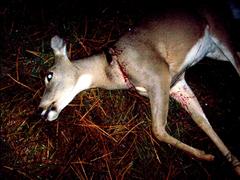
The 50 caliber ball (mass; ~180 grains) pushed by 110 grains of Goex FF black powder (this is the charcoal, sulfur and KNO3 mixture of yore) had traveled squarely through the rib cage and out the other side, behind the shoulders and in front of the diaphragm. That’s the “boiler room”–the heart/lung cavity. I’d been told this wouldn’t happen– that the round ball would stop just short of full penetration, but maybe those hunters use a lighter powder charge. Still, more velocity should mean more deformation of the soft lead ball… Impact velocity was about 1850 fps, and the exit hole was about the same size as the entry. That’s a “one-shot stop” but, both lungs partially liquefied, this doe ran up a steep slope, bounding over bushes as pretty as you please, and into a field before going down. That was about 75 yards total, with some rough going. Something to keep in mind. If you want to “anchor” the animal, it has to be a critical skeletal shot, like right through two shoulders (they can run pretty well on three legs) or a central nervous system (CNS) shot. Little else will stop an animal (two legged or four legged) in its tracks, Hollywood notwithstanding (see update below). I tried to avoid the shoulders because there’s some good meat there. One of Son’s deer had had a scapula shattered, and that was a mess. No thankee.
The whole sequence, from first hearing noise in the bushes to the deer falling, lasted around 15 seconds.
What, I can’t go on and on about it? I’m 50 years old, this was my first deer, and now we have a lot more good meat for the freezer. Yahoo! For those who fear “gamy” venison; maybe we’ve just been lucky, but we’ve not noticed a trace of this phenomenon with the animals we’ve harvested so far. We’ve gotten does because they’re vastly more common. People who tell me they hate venison because its gamy all seem to have eaten bucks. I really don’t know what makes for sweet meat verses gamy. More research is obviously needed. No doubt a federal grant is in order.
Next I’d like to try a flintlock. Why? Just ’cause. For one thing, a modern rifle is for long shots, and the hunting we do near the house is limited to no more than about 70 yards (so far we’ve killed no deer beyond about 40 yards). For another; I just want to. I’d’ve used a muzzleloading pistol if the WA game department allowed it. I won’t go on about how using a primitive gun is some sort of superior life choice or anything. It isn’t. I admit it’s a distraction. The people who used them back in the day were in fact using state-of-the-art technology. We should learn the state-of-the-art for our own time, and endeavor to advance it. If they’d wanted to be old-fashioned in the 18th or early 19th century, they’d have used matchlocks or bows and arrows.
Here’s the obligatory, grizzly post kill photo along with the rifle;
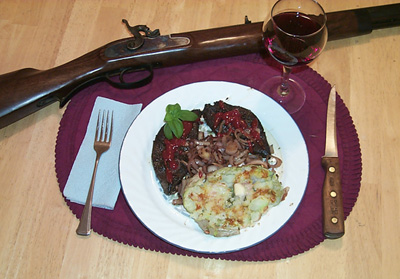
Yes, some people find liver to be disgusting. I like it. I’d show you a big juicy steak, but for best flavor and tenderness, the muscle meat has to age for several days before cutting and cooking. The liver is great if eaten right away. These deer liver steaks were fried in olive oil with shallots, just a pinch of crushed of rosemary, and salt & pepper, served with a nice baked potato and a glass of red Zinfandel. Simply lovely.
Update Dec. 1 / 08
Butchering the deer this weekend, we found the heart had been grazed by the ball, opening a hole in one chamber (yeah, we leave the heart in while it hangs. Call us weird). The ball entered straight through one rib and out through another, severing both. The doe had run about 75 yards with two blown lungs, a blown heart and two severed ribs. I also found an almost pristine 17 caliber air rifle pellet lodged against the pelvis. It would have had to travel through the hide, through a layer of fat, through 2.5 inches of meat and stop at the bone. I doubt this could have happened to the adult doe. 17 cal air rifles don’t typically have near enough penetration, plus there was no apparent wound channel, so I’m thinking someone shot a fawn in the butt. Some people’s kids.