
About two weeks ago I turned off the heat in my underground bunker in Idaho. I wanted to see what the baseline temperature would be. It varies by room. This is probably because of the computers I have in the office and proximity to other miscellaneous heat sources like the hot water heater and depth of the overhead earth for each of the rooms.
But what is most interesting to me is that the temperature is almost independent of the outside temperature:
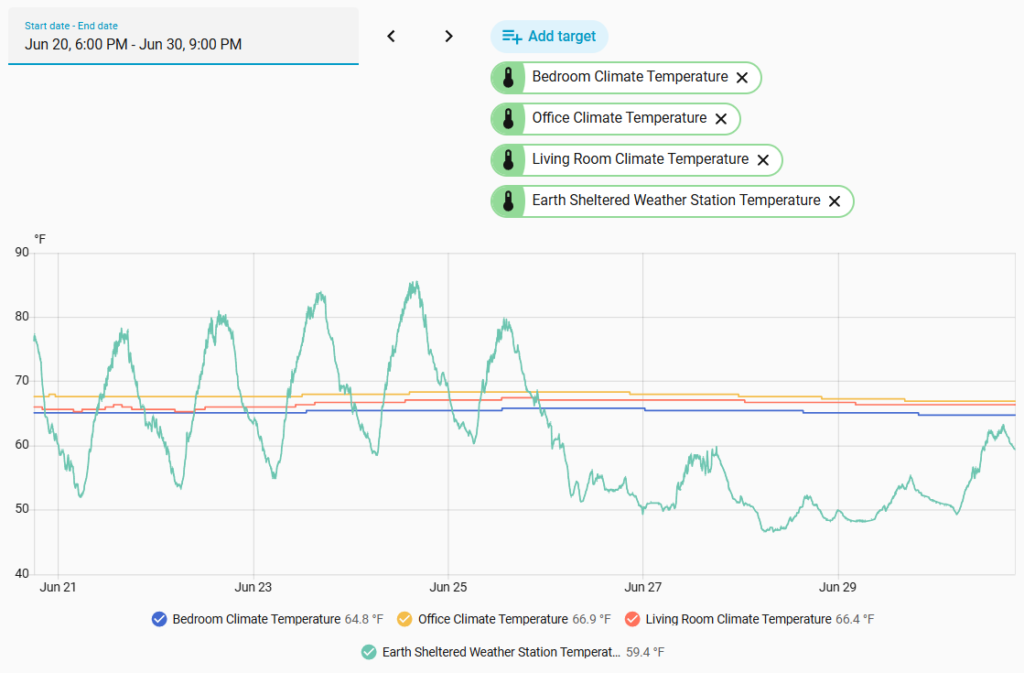
With the exterior temperature removed from the graph you can see the coupling to the outside temperature is, at best, a very small fraction of the outside temperature and with a phase shift of about one day.
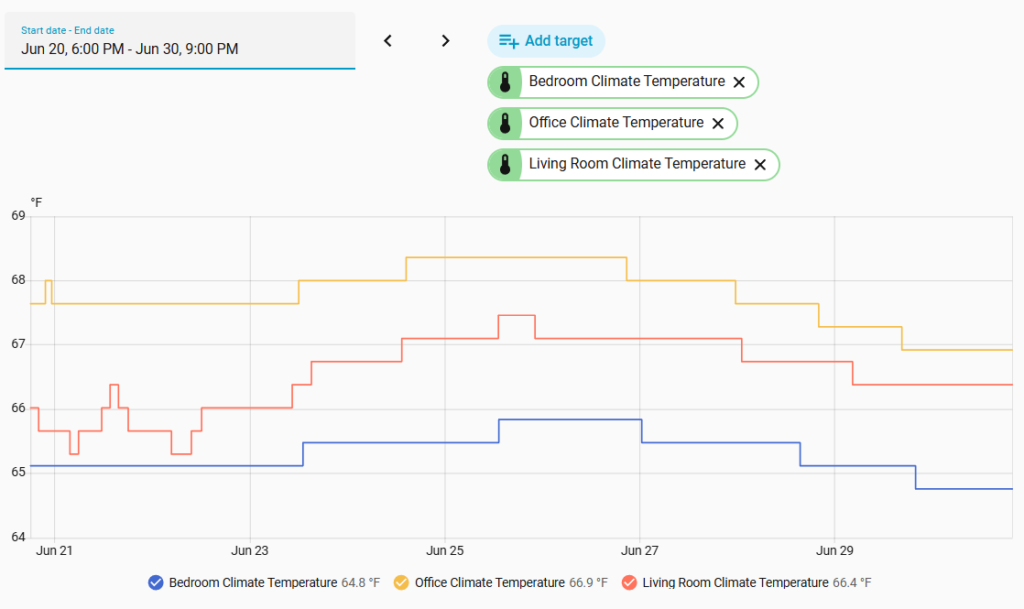
That means the heating system does not have to deal with the daily extremes. It only has to deal with the daily average. And I think this means that it will not need any cooling. I will know for certain in about six weeks when we will be through the hottest part of the year in my neighborhood.
What system(s) are you using for heating? For cooling? Hot water?
Geothermal water to water radiant floor heating with electric radiant wall heaters for backup. No cooling. Hybrid (indoor air heat pump/electric) domestic hot water.
I can get some cooling from the fresh air going through the energy recovery unit and then underground to the living space. The hot water heater contributes some cold air, too.
But does it have a round door, to make it a proper-looking as well as comfy hobbit-hole?
NO! It is, and rightly so, nothing like a Hobbit-hole.
(My oldest child keeps calling it that just because she knows it annoys me.)
I am not sure why the temperature constancy should have come as a surprise. I read a long time ago (early 80s maybe) that once you get below 6 feet of earth the temperature is fairly constant at 68 degrees. I think I read about this when I was looking into a move to Australia and started reading about opal mines there. Because you have some localized heat sources, you will then need to have localized cooling or just maybe increase the air flow to distribute the heat more thoroughly. This may raise the overall temperature a bit (a degree or two), but not significantly unless you have extremely high heat sources.
The rooms we are looking at all have windows and a mostly conventional construction wall.
The results are not a surprise as much as a confirmation.
The deep earth (in my usage, this means >= 15′) temperature is about 51 F at my location.
You have essentially build a very nice root cellar, something people have used for centuries because of cool, stable temperatures. Do you have light tubes of some sort to allow in natural light? That is the only drawback I have ever seen with an underground house, lack of natural light.
The building codes required natural light. This structure meets all applicable building codes. The windows are very conventional with nice views.
Excellent! Hopefully there will be no issues with condensation / mold when the heaters are not running. Dehumidifier’s are your friend based on my experience with buried command posts in South Korea during the Cold War. When dinosaurs roamed the earth
Humidity is great without a dehumidifier, except in the garage when the car comes in during a rain. I have a dehumidifier to take care of that situation.
I will plot the humidity for you tonight.
Seems that you will be a very happy camper. Did you need any radon handling?
No. The highest radon measurement is in the office at 0.28 pCi/L. 4.0 is where remediation is recommended.
“The deep earth (in my usage, this means >= 15′) temperature is about 51 F at my location. “
Were cooling needed, and it might be useful for dehumidification, a deep well that supplied ~51F water could be pretty useful, and, properly executed, might also be suitable for potable water. I’m assuming you do have a well, although it might not be large enough (diameter, and maybe depth) to accommodate both a deep well pump and two long runs of 1.5-2.0″ tubing for cooling a water substitute to provide house cooling/dehumidification (and if you did do this, I’d ask why you didn’t go with a small ground-coupled heat pump…but why run electric AC/heat equipment when a very low wattage solar-powered pump would suffice). This also would assume you have the ducting necessary to support extraction/delivery of dehumidified air; since you don’t need AC and thermal water supplies heat, you probably don’t have ducting. Looking at your humidity chart, it’s bracketing 50%, which is the usual “most comfortable” zone, so except for occasional spikes, you probably don’t need much, if any, auxiliary dehumidification.
Mechanical (aka: electric) chillers export water at 42F-45F which isn’t far off 51F (examine the cooling water input temp on any large mainframe) and support large building AC systems. My house (standard frame construction) has a whole-house dehumidifier that extracts up to 75 pints/day and pushes 225 CFM through the ductwork when it’s operating (there’s a sail switch in the AC/heat duct that turns the dehumidifier off when the AC (1300 CFM) is running; house humidity is controlled independently at the thermostat so the dehumidifier could run when the system (dual fuel: air-to-air heat pump/natural gas) is in heating mode, but during that part of the year humidity is low enough that <50% is constant); at current rates it's ~$15.month to run the dehumidifier and the house stays at 47% RH. I noticed about a 12-14% reduction in AC electricity usage with the dehumidifier because with lower humidity and ceiling fans the thermostat can be set about 3-5 degrees higher and still be comfortable; running a 4 ton heat pump for AC costs a lot more per usage hour than the dehumidifier.
I have a 1-ton water to water heat pump for heating, which could be reversed for cooling. But then I would be cooling the floors, which is sub optimal. There are ceiling fans in the larger rooms. There are fresh air ducts in the main rooms with exhaust ducts in the bathrooms and laundry room. This could be used for dehumidification but has not been implemented. We have not spent more than about three nights in a row there, so we don’t have good real-world results yet. But, indications are that humidity is not a problem. If it is, I will put a dehumidifier in the fresh air system.