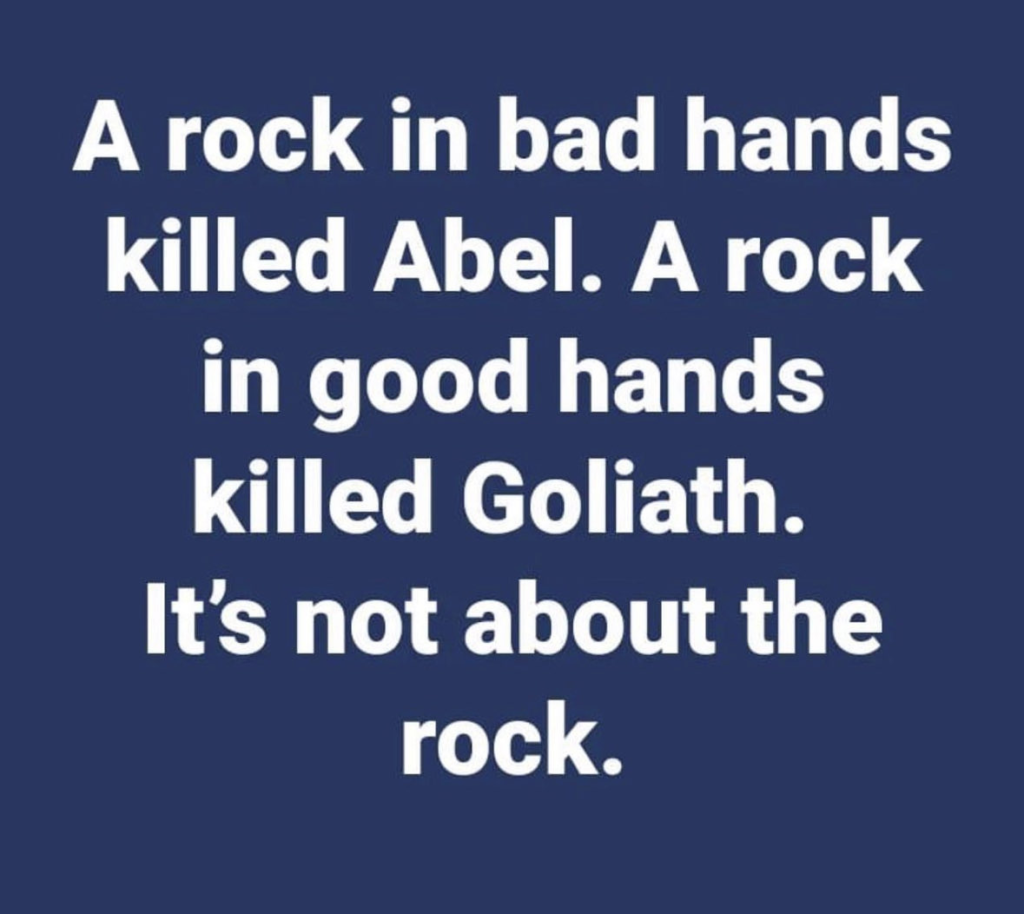
Never mind the weapon Cain used is not definitively described in the Bible. The meme correctly captures the principle.

Never mind the weapon Cain used is not definitively described in the Bible. The meme correctly captures the principle.
It’s a nice restatement of the point, but…. now you made me think of “It’s not about the nail.” It’s sort of funny, but also a bit TOO accurate (not *literally*, of course) to really laugh at.
“It’s not about the rock”
Never has been.
It’s always been about who gets to use the rock. And on whom.
“Those that beat their swords into plow shears will end up plowing for those who didn’t.”
Ben Franklin.
Speaking an eternal truth of the fallen world.
And of course: “He that hath no sword, let him sell his garment, and buy one.” — Luke 22:36
Exactly. Thank you!
The commandment by Jesus to go armed is second only to “If your eye offends you, pluck it out. And if your hand offends you, cut it off. In its toughness.
It’s better to be cold and broke but armed.
It’s certainly one that’s been ignored by almost the whole Christian church.
Jesus is the ultimate warrior. He came here and fulfilled his orders/mission to the letter.
What we forget is that he didn’t pick up a sword because he wasn’t ordered to.
All that’s over now.
Most Bible translations say something like Cain rose up against his brother Abel and slew/killed him. But I would swear I’ve read one that said he “stoned his brother to death.” I’m just not sure which it was.
(Looking into it on BibleHub — because you can read the same verse in 30-something different translations on the same page — now I’m not sure there is one. But I still remember it from somewhere.)
Lesson time: Why did God look with favor upon Abel’s offering but not Cain’s? God Himself doesn’t give a very good explanation to Cain, but in my opinion, it’s this: All the translations agree that Cain gave some of his harvest as an offering — just “some of”, nothing special. Abel, OTOH, gave up the best, fattiest parts of the firstborn lamb.
IOW, Abel gave the best parts of the first “harvest.” Cain just gave “some of” his harvest — not necessarily the first, and not necessarily the best. So God favored Abel’s offering over Cain’s. The principle of one’s “first fruits” belonging to God is repeated throughout Scripture.
In any case, the message of the meme in the OP is clear: A “weapon” (for some definition of “weapon”) in the wrong hands facilitates great evil, but a “weapon” in the right hands facilitates great good. It’s not about the weapon — what it is, how it’s made, what it’s intended for, etc. — and never has been.
It’s ALWAYS been about the person holding it, and it holds true whether we’re talking about rocks, hammers, baseball bats, knives, guns, or Uranium-238.
Those who make it about the tool rather than the person wielding it have lost their ability to discern good from evil, or to recognize second- and third-order effects — in addition to “Peterson Syndrome*,” the inability to determine truth from falsity.
———
* – Speaking of, I made this point on Joan Peterson’s original blog, years ago. In Biblical times, swords were the “assault weapons” of the day — and even to this day they hold some specific advantages over firearms; they don’t jam and never need reloading, for example — but rather than tell His followers to never touch such a weapon, Jesus commands that he who doesn’t have a sword should sell his cloak and buy one. He intends His followers to be able to protect themselves WHILE relying on God’s provision. Clearly, the sword — the “assault weapon” of its time — was not the problem. As you might imagine, she was not pleased with that comment, but rather than address it directly, she deflected, saying I’m not a theologian and neither is she. First, how would she know? Second, does “not being a theologian” invalidate the argument one bit?
Curious. When you catch Muslims on contradictions in their scripture like this, or show how a conclusion they have not considered is the logical result, they make the sake deflection, saying that they have not studied the Koran like the Imams and such, so they cannot have an opinion.