
Via Giffords and Robb Allen:
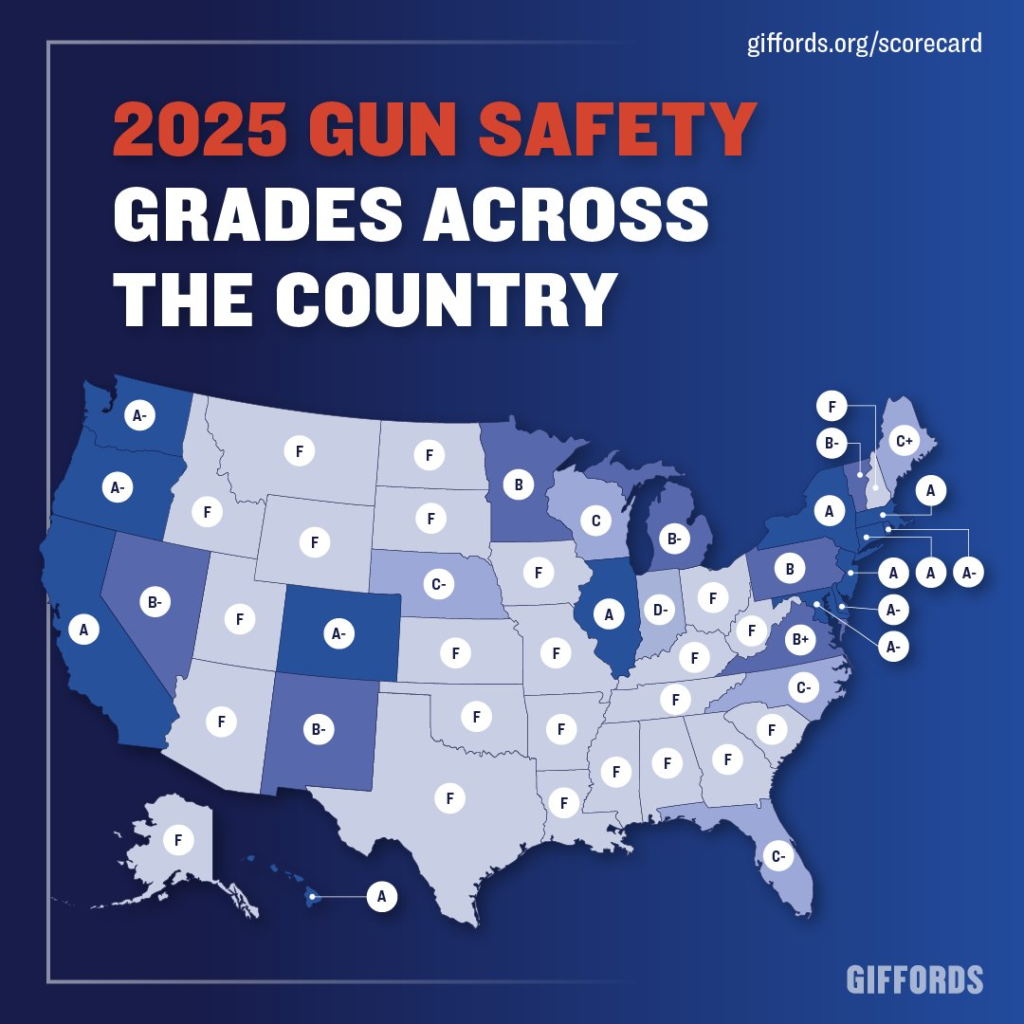
I have to wonder what their point is. What do they think or are trying to imply about the consequences of a state having a good or poor grade? I think it is very telling they do not explicitly say anything about that.
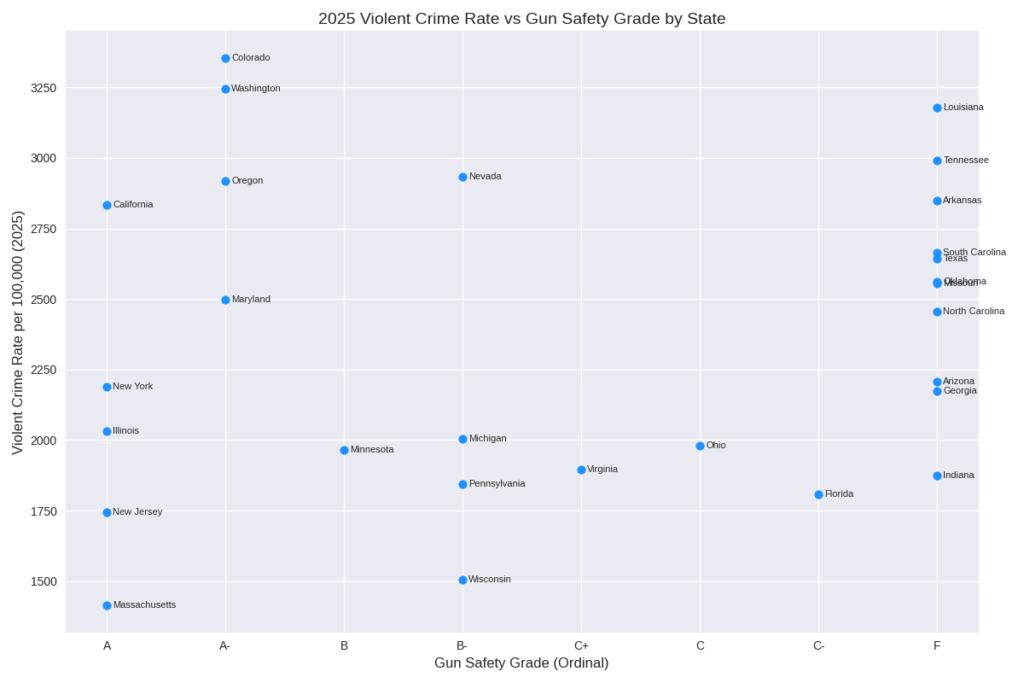
I would bet they know that if they compared this to the violent crime rate this report card would be damaging to their agenda. Here is a scatter plot to give you a clue:
And if you want to get really geeky here are the correlation numbers and narrative from Copilot:
The Pearson correlation coefficient between gun safety grade (ordinal) and violent crime rate is about 0.13, with a p‑value of ~0.49. This means there is a weak positive correlation that is not statistically significant.
📊 What This Means
- Coefficient (0.13): A value close to 0 indicates little to no linear relationship. Here, the correlation is weak and positive, suggesting that states with weaker gun safety grades (higher ordinal values) slightly tend to have higher violent crime rates, but the effect is minimal.
- P‑value (~0.49): Since this is much greater than the common threshold of 0.05, the correlation is not statistically significant. In other words, the observed relationship could easily be due to chance.
- Interpretation: Gun safety grades and violent crime rates do not show a strong or reliable linear relationship in this dataset. Some states with strong gun laws (A grades) still have high crime rates (e.g., Washington, Colorado), while some F‑grade states have moderate rates (e.g., Indiana, Georgia).
This is just another example of anti-gun people being unable say anything without it being a lie or at least deceptive.
And even if the numbers looked bad for gun ownership, that is irrelevant to the 2nd Amendment law. Rights are not subject to negation based on the misbehavior of criminals. We don’t throw out the 4th, 5th, and/or 8th Amendments because these protections make it more difficult to prosecute criminals. The same applies the 2nd Amendment.
Their point obviously is “we are totalitarians” or “we support criminals”. In their world view, having oppressive victim disarmament laws equals a high grade.
Interesting that the birthplace of Constitutional Carry, a.k.a., Vermont Carry, gets a “passing” grade (B-) in their oppressiveness evaluation.
2025 GUN safety grade.
(How come my gun tells me it doesn’t feel safe in those A grade states?)
And they’re obviously NOT grading human safety. As many of the locals have named Chicago, Chi-Iraq.
And Detroit today looks worse than Hiroshima in ’46.
But I digress. Like many ballot measures today. The first thing I look at is who sponsored it. In this case “Giffords”.
No need to even read it. What it says is going to be a twisted lie.
Sure glad I live in Washington, with stellar gun safety scores. NOT.
CDNN Sports sent out an email flyer the other day, they had the Kel-Tec KS7 bullpup shotgun for a blazing price of $399! That’s hundreds off the normal MSRP. I’ve always kind of wanted one, but couldn’t justify $500-600 for one.
Went to place an order to send to my local dealer for NICS check, etc. Up pops the dreaded notice that CDNN can’t ship a “defense shotgun” to Ferguson’s fucked up state. I can buy all the Browning Citoris or standard Mossberg pump actions I want, but not a scary bullpup that would be a great home defense piece.
Thanks Bob and Jayapril, et. al.
It is actually worse if you don’t live there but travel there as I often do to see family. You are not allowed to “import” guns you have owned for years. This not only violates the 2A but also equal protection and interstate commerce clauses. I am getting really tired of the DoJ and Supreme Court sitting on their ass.
Plot murder rate by county, then color by dominant party.
Any study like this that does not zoom in to ZIP code scale, for both crime rates and laws, is meaningless.
Happy to live in an “F” state, Idaho.