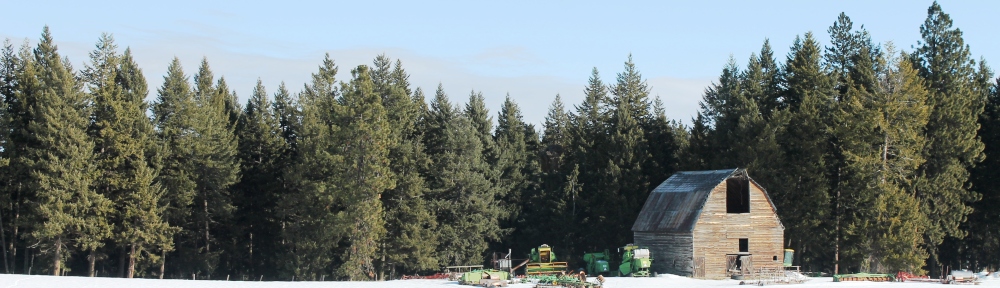
I thought I had posted a picture of the pump daughter Jaime and I put on her well. I can’t find it now, so maybe I remember sharing it with people at work.
The back story is that last May she had a well drilled on her property in Idaho (she currently lives about 45 minutes southeast of Seattle). As it typical she stressed some about finding water. She bought the property without knowing for certain there would be water. All the neighbors have good wells without going too deep. But that didn’t mean she would find water.
She called and gave me updates as they started drilling, they were down 100′ and there was nothing. None of the neighbors had to go below about 150′. They were below 150′ and still nothing. She wanted to know if she should have them drill in a different place on the property. “Keep going for a while longer. That isn’t really that deep yet.”
It wasn’t too much longer before she called back. I could tell from the tone of her voice it was good news. “Guess how many gallons per minute they have!”, she demanded. “80?”, I replied. I knew it was up there from the excitement in her voice. “100!”, she crowed. She went on to say they hit water at 220 feet, drilled to 240 feet, and the driller said it is an artesian well. I always thought an artesian well is when the water comes completely out of the ground. But apparently that is not the definition. The water was five feet below the surface.
Nice!
Sometime later, probably about July or August she wanted to talk about the well again. Since she doesn’t have electricity on the property yet, she asked if we could put a hand pump in and she could have water to irrigate a few trees. At five feet below the surface, it would be trivial to pull that water on up and fill buckets with a hand pump. So, we put a pitcher pump in with a ten-foot-long pipe and she had consumable water.
Recently she started talking to a local architect who went out to the property to look at the lay of the land, etc. and reported the pump was leaking water. What? Really? Yup. He sent her a picture.
Ten days ago, I visited to see it for myself:
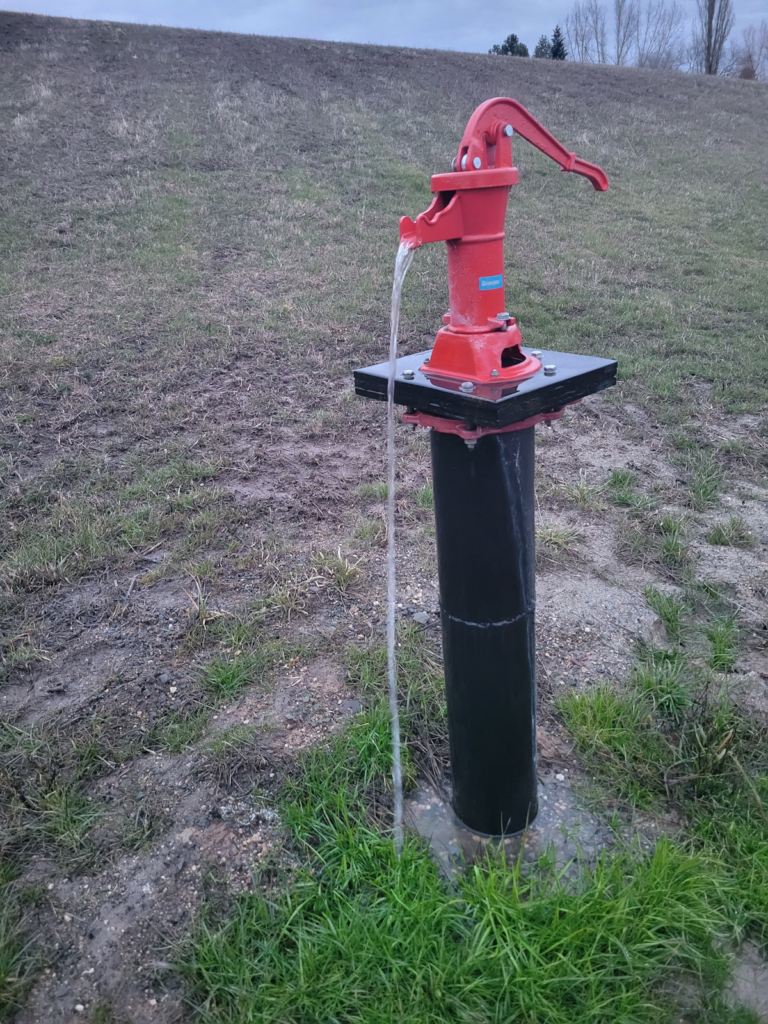
I have never seen anything like this before. That’s awesome!
When I was 3 years old my parents bought the lake place of my mom’s great-aunt after her great-uncle died. I remember quite vividly the trip to see it, and the grey waves crashing on the shore, with me running along the shore. A few year later my parents massively expanded the place from a 1-room cabin into a 2-story barracks with a huge room below the bedrooms with bunk beds (except for the master bedroom, of course).
Naturally it needed a new septic tank/drain field, and a new well. The old one was shallow (about 25 feet) and not very good water. I remember the drilling of the new well and my dad talking with the well-driller about how far down they had to go. The driller was experienced with the area, and told my dad that the first aquifer (at 25 ft) was not quite potable water, and that the next one down at about 125 feet was potable, but not very good. My father had him drill to the third one at around 300 feet. That water was crystalline-clear, ice cold, and while it had some iron in it had an incredible spring-water taste.
When we’d have a 4th of July party we’d put out galvanized steel tubs and fill them with water and cans of beer (for the adults) and pop (for us kids) and run a tiny trickle of that icy cold water through them…you couldn’t walk in bare feet in the grass downhill from them because that little bit of water running over the grass was so cold.
My parents sold the place in their later years and about 10 years ago I visited the folks who bought it. That well water is still ice cold and basically devoid of any pathogens. It’s probably “fossil” water from the last ice age.
P.S.: Your sister should probably pull off that hand-pump and have the well capped at least 5 feet down so it doesn’t waste the artesian pressure in the aquifer or freeze her pipe.
SWEET!
Looks like the ideal setting for a small Rome style fountain in a courtyard.
A caution might be given though.
As Blackwing mentioned. Upper ground water is/can be polluted easily.
The fix is to case the well down as far as possible. (Seal the sides.)
And run the septic leach far away from the well. As the Basalts under that area are known for having cracks that can drain very quickly into your ground water without the natural filtration most earth provides.
All the best to Jaime on her new home!
I have zero idea what the requirements are for a septic tank and drain field in rural Idaho, but where I grew up in Central MN there was water pretty much everywhere. MN is regarded as “the land of 10,000 lakes” but they neglect to mention the 10 million swamps. The whole state is basically one huge swamp with farm fields.
Back there if your property wouldn’t properly drain (they did a “percolation test”) you ended up having to build a mound-type drain field which also usually required a sewage pump to move the waste-water to the upper portions of the mound. They cost a bunch of money back then, so I’m guessing they’re a whole lot more now. If she’s got hard-rock underneath her building site, or they can’t find a nice hill of glacial till she’ll probably have to put in a mound system.
Nope. A little further up the hill, the perk test passed.
I would still be thinking of paying extra for a “sand filter” system. Than the traditional “leach field”.